Leading with Calm and Clarity in Change

Generated from prompt:

Presentation title: 'Your Role as Leaders — and How to Relay This to Your Teams' Slide 1: Title Slide - Title: Your Role as Leaders — and How to Relay This to Your Teams - Subtitle: Communicating Calm, Clarity, and Confidence - Visual: Calm, steady leadership image Slide 2: Leadership During Change - Key message: Teams look to leaders for reassurance - Quote: “Your steady tone, your clarity, and your consistency will determine how safe they feel.” - Visual: Lighthouse or calm sea Slide 3: What to Say to Your Teams - Script summary for managers to use - Highlight main points: transparency, reassurance, value of each team member - Visual: Manager speaking confidently to group Slide 4: Employee Questions You Can Expect - Common concerns: layoffs, workload, stability - Visual: Q&A icons or dialogue bubbles Slide 5: Approved Responses - Examples of how to respond: - “No additional layoffs planned.” - “This was about structure, not performance.” - “Every role that remains was intentionally kept.” - Visual: Calm, steady tone imagery Slide 6: If You Don’t Know the Answer - Use approved response: “That’s a great question, let me check with HR…” - Benefits: professionalism, accuracy, alignment - Visual: Manager consulting HR Slide 7: What You Need to Do as Branch Managers - Action List: - Be visible and available - Forward concerns to HR - Stick to approved messaging - Maintain calm tone - Document employee feedback - Visual: Checklist Slide 8: Additional Guidance - Key reminders: - Be calm and confident - Don’t speculate - Reinforce consistency - Bring concerns to HR - Show empathy - Visual: Leadership teamwork imagery Slide 9: Closing - Title: Lead with Stability and Empathy - Message: “Your calm leadership helps your teams feel secure and supported.” - Visual: Team together in unity

This presentation guides leaders on communicating organizational changes to teams, emphasizing transparency, reassurance, and approved responses to common concerns like layoffs and workload, while mai

November 26, 20259 slides
Slide 1 of 9

Slide 1 - Your Role as Leaders — and How to Relay This to Your Teams

The slide's title emphasizes leaders' roles and strategies for communicating these to their teams. Its subtitle highlights the importance of conveying calm, clarity, and confidence in that process.

Your Role as Leaders — and How to Relay This to Your Teams

Communicating Calm, Clarity, and Confidence

Slide 1 - Your Role as Leaders — and How to Relay This to Your Teams
Slide 2 of 9

Slide 2 - Leadership During Change

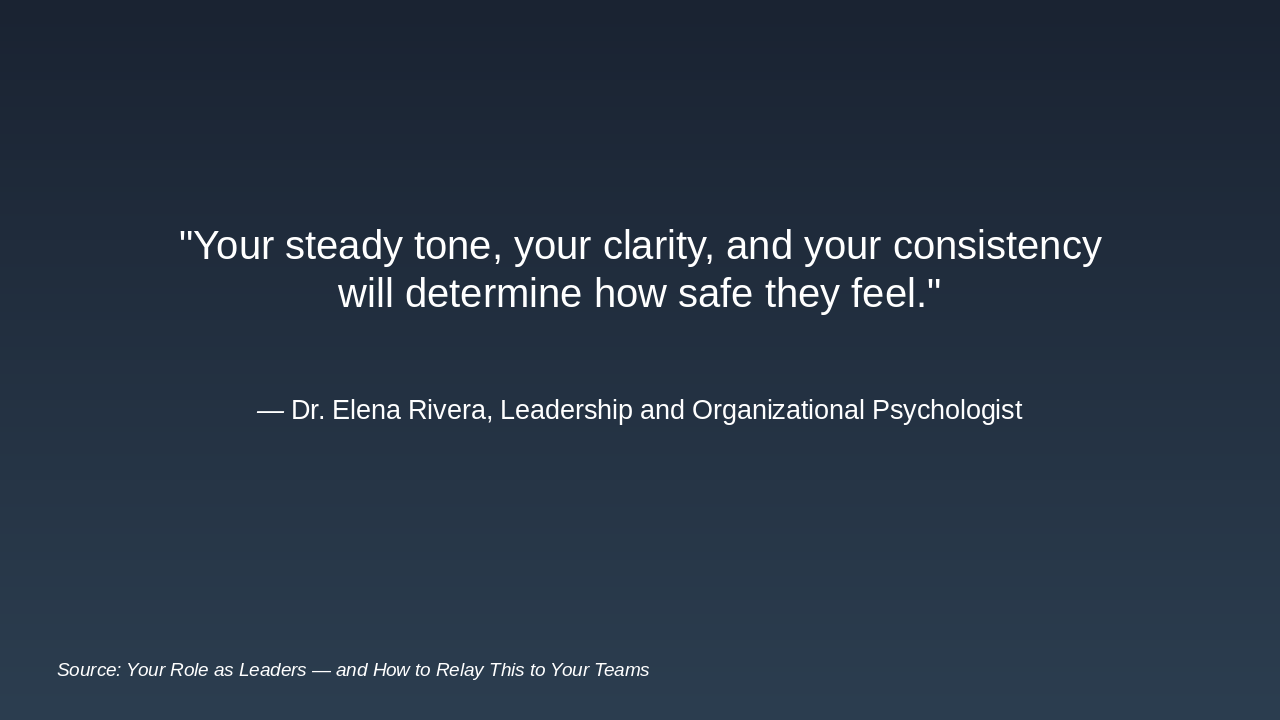
The slide, titled "Leadership During Change," features a quote from Dr. Elena Rivera, a Leadership and Organizational Psychologist. The quote emphasizes that a leader's steady tone, clarity, and consistency are key to making team members feel safe amid transitions.

Leadership During Change

> Your steady tone, your clarity, and your consistency will determine how safe they feel.

— Dr. Elena Rivera, Leadership and Organizational Psychologist

Source: Your Role as Leaders — and How to Relay This to Your Teams

Speaker Notes
Key message: Teams look to leaders for reassurance. Visual: Lighthouse or calm sea.
Slide 2 - Leadership During Change
Slide 3 of 9

Slide 3 - What to Say to Your Teams

When communicating changes to your teams, share updates transparently to foster trust, reassure them about job security and stability, and highlight each member's unique contributions. Deliver messages with calm confidence to inspire reassurance, while inviting questions to promote open dialogue.

What to Say to Your Teams

  • Share changes transparently to build trust and understanding.
  • Reassure teams of their security and ongoing stability.
  • Emphasize the unique value each team member contributes.
  • Communicate with calm confidence to inspire reassurance.
  • Invite questions to encourage open and supportive dialogue.

Source: Your Role as Leaders — and How to Relay This to Your Teams

Slide 3 - What to Say to Your Teams
Slide 4 of 9

Slide 4 - Employee Questions You Can Expect

This slide outlines common employee questions to anticipate during uncertain times. It highlights concerns about potential future layoffs, increased workloads, and job stability and security.

Employee Questions You Can Expect

  • Expect questions about potential future layoffs.
  • Anticipate concerns regarding increased workload.
  • Prepare for inquiries on job stability and security.
Speaker Notes
Common concerns: layoffs, workload, stability. Visual: Q&A icons or dialogue bubbles.
Slide 4 - Employee Questions You Can Expect
Slide 5 of 9

Slide 5 - Approved Responses

The slide titled "Approved Responses" lists three key talking points for addressing concerns about recent organizational changes. These include assuring no further layoffs are planned, clarifying that the changes focused on structure rather than performance, and emphasizing that all remaining roles were deliberately retained.

Approved Responses

  • “No additional layoffs planned.”
  • “This was about structure, not performance.”
  • “Every role that remains was intentionally kept.”
Slide 5 - Approved Responses
Slide 6 of 9

Slide 6 - If You Don’t Know the Answer

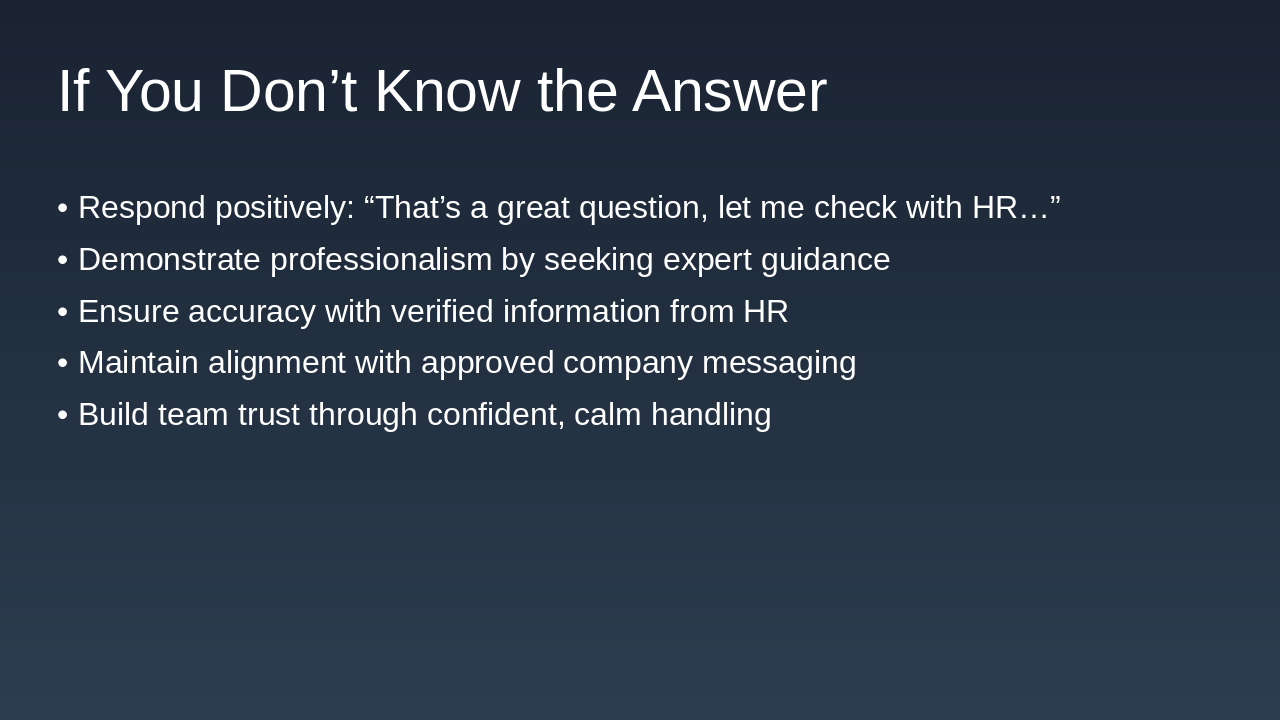
When unsure of an answer, respond positively by acknowledging the question and seeking HR's input, such as saying, “That’s a great question, let me check with HR…” This approach demonstrates professionalism and ensures responses are accurate, aligned with company messaging, and handled calmly to build team trust.

If You Don’t Know the Answer

  • Respond positively: “That’s a great question, let me check with HR…”
  • Demonstrate professionalism by seeking expert guidance
  • Ensure accuracy with verified information from HR
  • Maintain alignment with approved company messaging
  • Build team trust through confident, calm handling
Slide 6 - If You Don’t Know the Answer
Slide 7 of 9

Slide 7 - What You Need to Do as Branch Managers

This agenda slide outlines essential responsibilities for branch managers during organizational change, starting with an introduction to leadership focused on providing reassurance. It covers communicating key messages and handling employee questions, using approved responses for unknowns, specific actions like maintaining visibility and forwarding concerns, and closing with empathy to foster team stability.

What You Need to Do as Branch Managers

  1. Introduction to Leadership
  2. Overview of role in providing reassurance during change.

  3. Communicating with Teams
  4. Key messages, scripts, and expected employee questions.

  5. Approved Responses and Guidance
  6. Handling unknowns, maintaining tone, and documentation.

  7. Actions for Branch Managers
  8. Visibility, forwarding concerns, and calm messaging checklist.

  9. Closing and Empathy

Lead with stability to support team security. Source: Your Role as Leaders — and How to Relay This to Your Teams

Speaker Notes
Action list: Be visible and available; Forward concerns to HR; Stick to approved messaging; Maintain calm tone; Document employee feedback. Visual: Checklist.
Slide 7 - What You Need to Do as Branch Managers
Slide 8 of 9

Slide 8 - Additional Guidance

The "Additional Guidance" slide provides key tips for handling interactions professionally, including staying calm and confident, avoiding speculation by sticking to approved messaging, and ensuring team-wide consistency in communications. It also advises escalating concerns to HR, while demonstrating empathy to support the team.

Additional Guidance

  • Remain calm and confident in all interactions.
  • Avoid speculation; stick to approved messaging.
  • Reinforce message consistency across the team.
  • Escalate concerns directly to HR for guidance.
  • Demonstrate empathy to support your team.
Slide 8 - Additional Guidance
Slide 9 of 9

Slide 9 - Lead with Stability and Empathy

The slide emphasizes that calm leadership fosters a sense of security and support for teams. It calls for a commitment to incorporating empathy and stability into every interaction.

Lead with Stability and Empathy

Your calm leadership helps your teams feel secure and supported.

Commit to leading with empathy and stability in every interaction.

Source: Your Role as Leaders — and How to Relay This to Your Teams

Slide 9 - Lead with Stability and Empathy

Discover More Presentations

Explore thousands of AI-generated presentations for inspiration

Browse Presentations
Powered by AI

Create Your Own Presentation

Generate professional presentations in seconds with Karaf's AI. Customize this presentation or start from scratch.

Create New Presentation

Powered by Karaf.ai — AI-Powered Presentation Generator