Titration: Principles, Types & Indicators

Generated from prompt:

Principal and Theory of titration and types of titration and chemistry about indicators

Explore titration's core principles, theory based on stoichiometric reactions, types (acid-base, redox, etc.), equivalence points, and indicator chemistry for precise chemical analysis. (148 character

February 11, 202610 slides
Slide 1 of 10

Slide 1 - Principle, Theory, and Types of Titration

Principle, Theory, and Types of Titration

Fundamentals of titration in analytical chemistry and role of indicators
Slide 1 - Principle, Theory, and Types of Titration
Slide 2 of 10

Slide 2 - Agenda

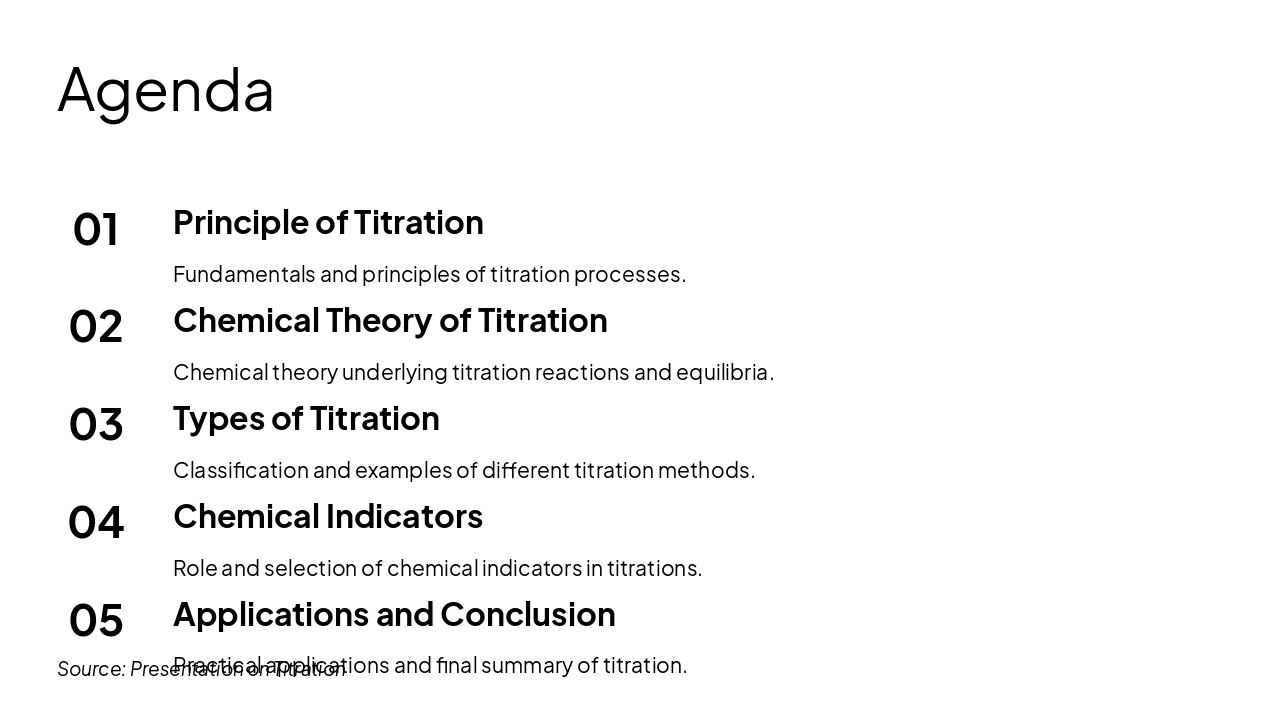
  1. Principle of Titration
  2. Fundamentals and principles of titration processes.

  3. Chemical Theory of Titration
  4. Chemical theory underlying titration reactions and equilibria.

  5. Types of Titration
  6. Classification and examples of different titration methods.

  7. Chemical Indicators
  8. Role and selection of chemical indicators in titrations.

  9. Applications and Conclusion
  10. Practical applications and final summary of titration.
Slide 2 - Agenda
Slide 3 of 10

Slide 3 - Principle of Titration

01

Principle of Titration

Determination of concentration through stoichiometric reaction with known solution
Slide 3 - Principle of Titration
Slide 4 of 10

Slide 4 - Titration Theory

  • Based on acid-base, redox, precipitation or complexation reactions
  • Equivalence point: reactants in stoichiometric proportion
  • Titration curve shows pH or potential changes
Slide 4 - Titration Theory
Slide 5 of 10

Slide 5 - Principal and Theory of titration and types of titration and chemistry about indicators

  • Titration determines unknown concentration using known solution.
  • Theory based on stoichiometric reaction equivalence point.
  • Types: acid-base, redox, complexometric, precipitation.
  • Indicators change color at endpoint, e.g., phenolphthalein pink in base.
Slide 5 - Principal and Theory of titration and types of titration and chemistry about indicators
Slide 6 of 10

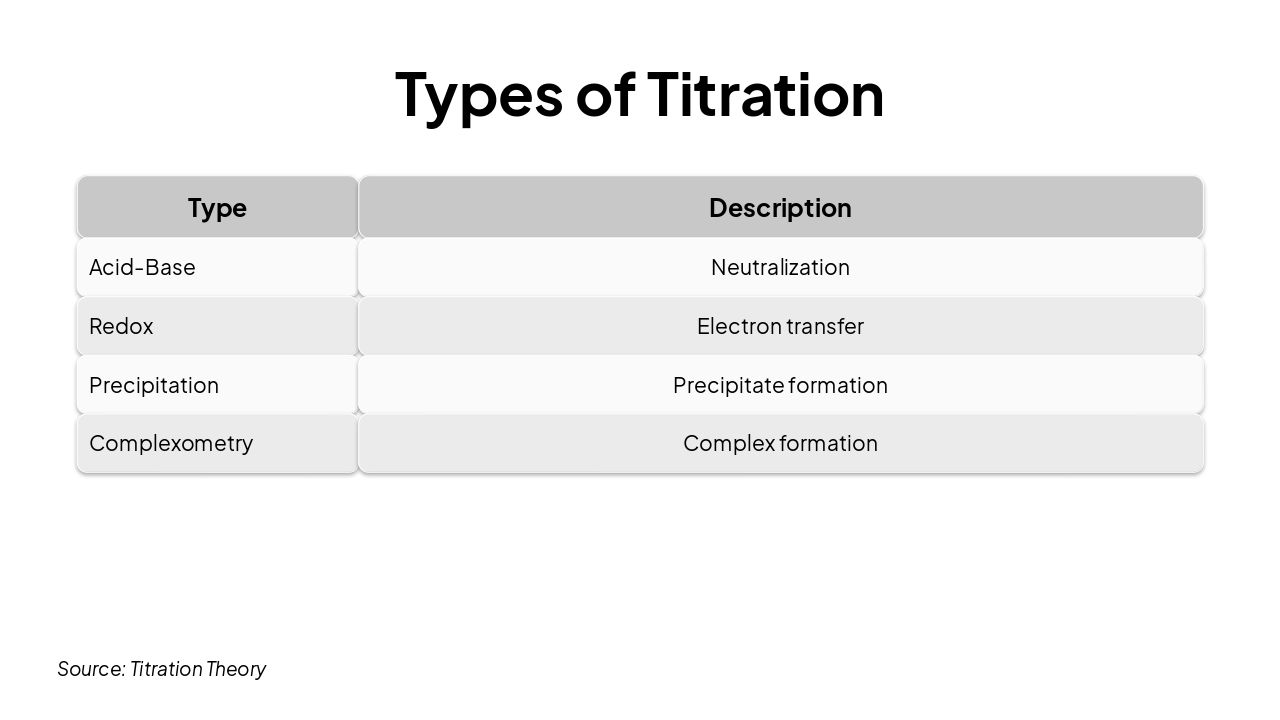
Slide 6 - Types of Titration

TypeDescription
Acid-BaseNeutralization
RedoxElectron transfer
PrecipitationPrecipitate formation
ComplexometryComplex formation
Slide 6 - Types of Titration
Slide 7 of 10

Slide 7 - Visual of titration curve showing equivalence point with pH changes and indicator transition

  • Equivalence point where moles of acid equal base.
  • pH changes sharply around equivalence point.
  • Indicator transitions color at endpoint.
Slide 7 - Visual of titration curve showing equivalence point with pH changes and indicator transition
Slide 8 of 10

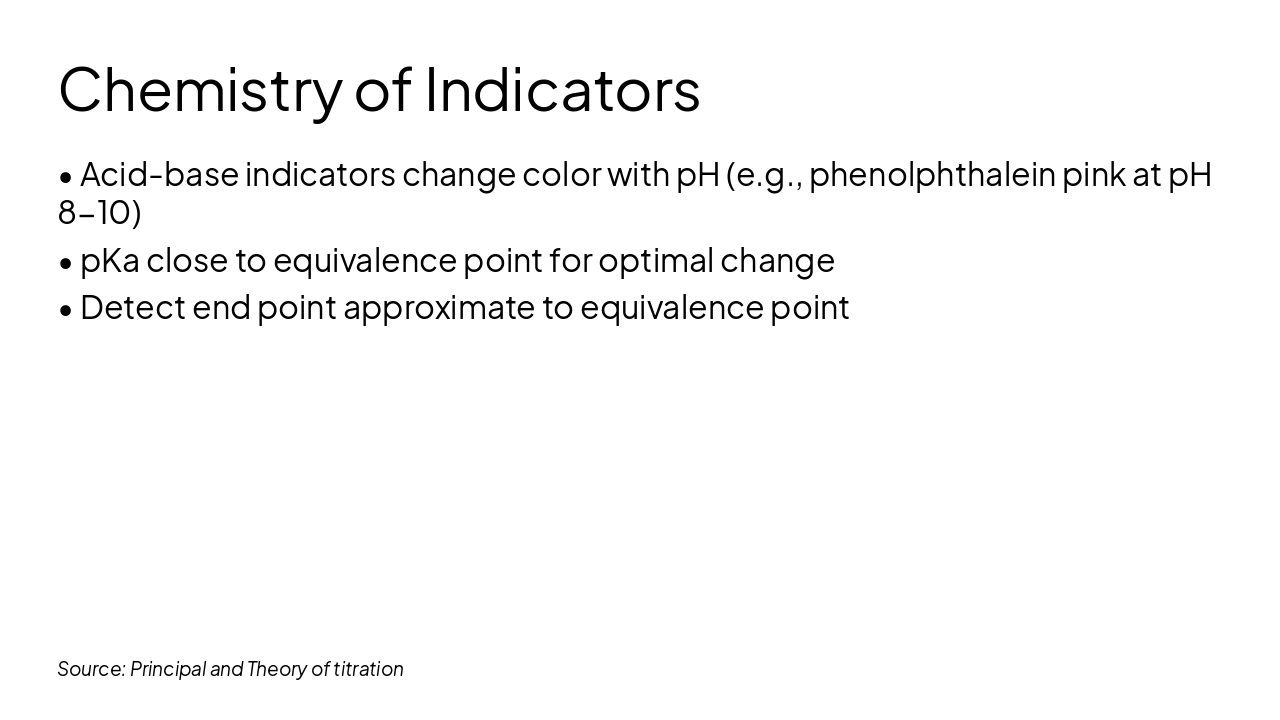
Slide 8 - Chemistry of Indicators

  • Acid-base indicators change color with pH (e.g., phenolphthalein pink at pH 8-10)
  • pKa close to equivalence point for optimal change
  • Detect end point approximate to equivalence point
Slide 8 - Chemistry of Indicators
Slide 9 of 10

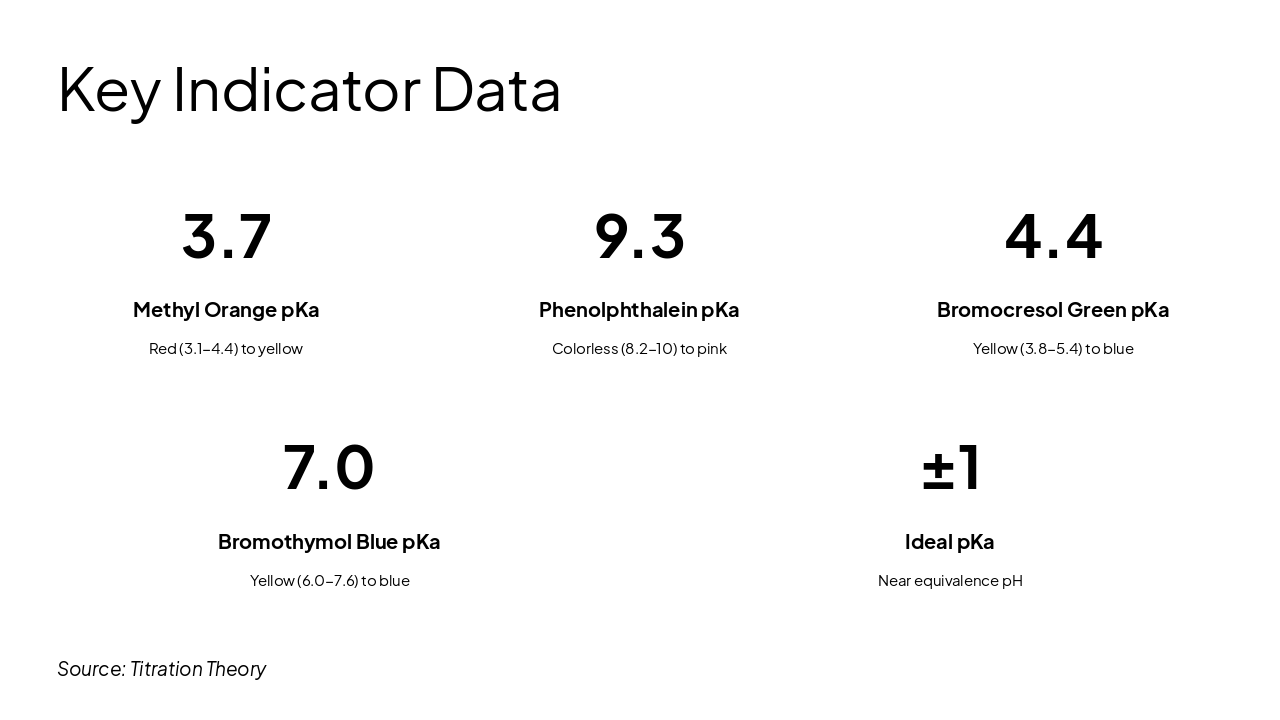
Slide 9 - Key Indicator Data

  • 3.7: Methyl Orange pKa
  • Red (3.1-4.4) to yellow

  • 9.3: Phenolphthalein pKa
  • Colorless (8.2-10) to pink

  • 4.4: Bromocresol Green pKa
  • Yellow (3.8-5.4) to blue

  • 7.0: Bromothymol Blue pKa
  • Yellow (6.0-7.6) to blue

  • ±1: Ideal pKa
  • Near equivalence pH

Slide 9 - Key Indicator Data
Slide 10 of 10

Slide 10 - Conclusion

Precise titration: key in chemical analysis.

Thanks! Contact: help@karaf.ai
Slide 10 - Conclusion

Discover More Presentations

Explore thousands of AI-generated presentations for inspiration

Browse Presentations
Powered by AI

Create Your Own Presentation

Generate professional presentations in seconds with Karaf's AI. Customize this presentation or start from scratch.

Create New Presentation

Powered by Karaf.ai — AI-Powered Presentation Generator