Mitigating SSR in Wind Energy with PI Control

Generated from prompt:

Create a PowerPoint presentation slide titled 'Flow of Motivation' in Technical Engineering Dark Mode style. The content should include: Problem Background (impact of wind energy penetration, SSR issues with series capacitive compensation), Challenges Identified (SSR damage, costly mitigation methods), Motivation for the Study (cost-effective RSC and GSC with PI controllers), and Goal (damping sub-synchronous oscillations using PI control).

This presentation outlines the rising wind energy penetration causing SSR issues with series capacitors, leading to equipment damage and costly mitigations. It motivates a study using cost-effective R

December 3, 20253 slides
Slide 1 of 3

Slide 1 - Flow of Motivation

The slide, titled "Flow of Motivation," serves as an introductory title page. Its subtitle outlines the focus on motivating the mitigation of sub-synchronous resonance (SSR) in wind energy systems through the use of PI controllers.

Flow of Motivation

Motivating SSR Mitigation in Wind Energy via PI Controllers

Source: Introduction to SSR Mitigation in Wind Energy Systems

Speaker Notes
Problem Background: Impact of wind energy penetration and SSR issues with series capacitive compensation. Challenges Identified: SSR damage and costly mitigation methods. Motivation for the Study: Cost-effective use of RSC and GSC with PI controllers. Goal: Damping sub-synchronous oscillations using PI control.
Slide 1 - Flow of Motivation
Slide 2 of 3

Slide 2 - Flow of Motivation

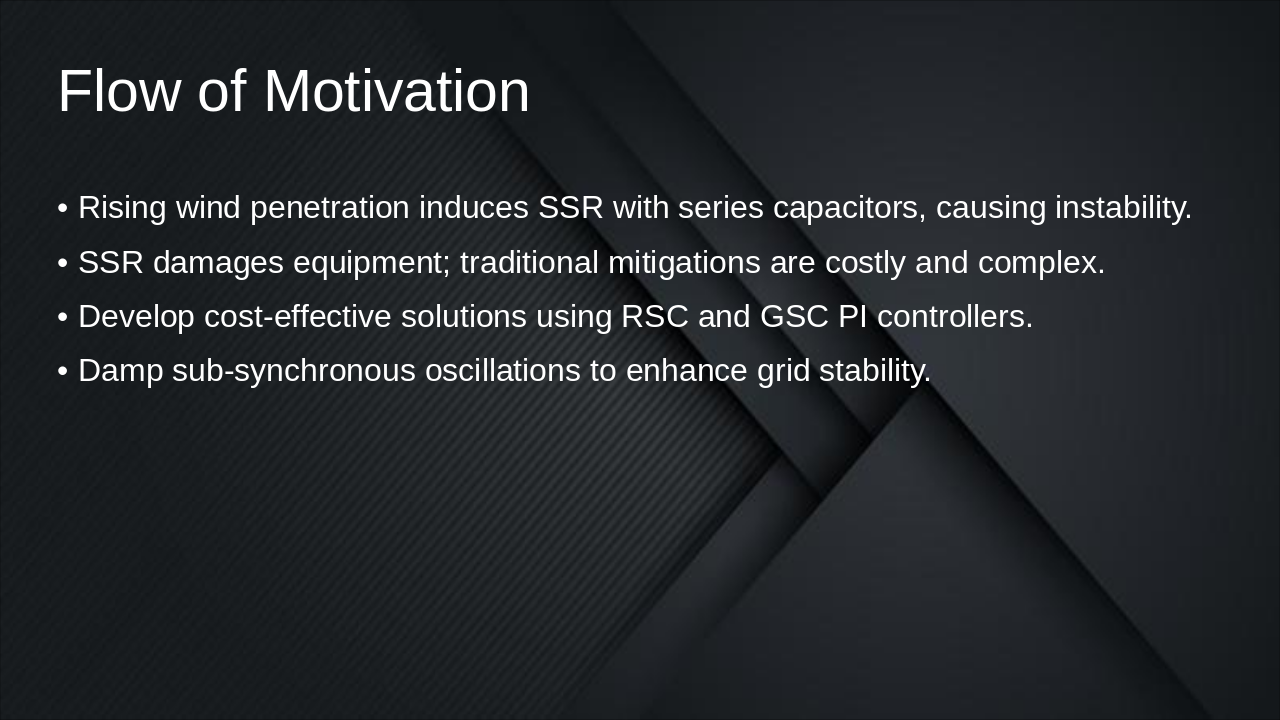
Increasing wind penetration triggers subsynchronous resonance (SSR) with series capacitors, leading to grid instability and costly equipment damage from traditional mitigation methods. The slide proposes developing affordable solutions using PI controllers in rotor-side and grid-side converters to dampen these oscillations and improve overall stability.

Flow of Motivation

  • Rising wind penetration induces SSR with series capacitors, causing instability.
  • SSR damages equipment; traditional mitigations are costly and complex.
  • Develop cost-effective solutions using RSC and GSC PI controllers.
  • Damp sub-synchronous oscillations to enhance grid stability.
Slide 2 - Flow of Motivation
Slide 3 of 3

Slide 3 - Summary

This conclusion slide summarizes a study focused on developing an efficient proportional-integral (PI) control strategy to damp subsynchronous resonance (SSR) in wind energy systems. It emphasizes enhancing the reliability of wind energy integration for more stable power grid operations.

Summary

This study aims to provide an efficient PI control strategy for SSR damping, promoting reliable wind energy integration.

Enhancing Reliability in Wind Energy Systems

Speaker Notes
Call-to-action: Implement PI control strategies to enhance SSR damping and ensure reliable wind energy integration in power systems.
Slide 3 - Summary

Discover More Presentations

Explore thousands of AI-generated presentations for inspiration

Browse Presentations
Powered by AI

Create Your Own Presentation

Generate professional presentations in seconds with Karaf's AI. Customize this presentation or start from scratch.

Create New Presentation

Powered by Karaf.ai — AI-Powered Presentation Generator