Probability Theory and Random Variables: Fundamentals andKey

Generated from prompt:

Create a PowerPoint presentation titled 'Probability Theory and Random Variables'. Use the provided slide structure exactly and do not remove any content. Slides: 1 Introduction to Probability Theory with definition, probability scale (0 impossible,1 certain), rule sum=1. 2 Real World Applications: weather forecasting, insurance risk, networks/systems reliability, poll management. 3 Random Experiment definition, conditions (multiple outcomes, unpredictable), examples coin/die, defective bolts, bulb lifetime 0<t<4000. 4 Sample Space and Events with examples coin S={H,T}, die S={1..6}, sample point, event subset example two coins only one head. 5 Types of Events: sure event S, impossible event empty set example rolling 7, simple event example exactly 3 on die, compound event at least one head in three tosses. 6 Bayes Theorem (heading only). 7 Random Variable definition, purpose, representation X,Y,Z; example two coin toss mapping HH->2 HT->1 TH->1 TT->0 range {0,1,2}. 8 Mapping S to R with X:S→R; examples die mapping and two coins mapping to number of heads. 9 Examples of Random Variables: heads in 3 tosses, customers per hour, bulb lifespan, defective items among 10. 10 Discrete Random Variable definition, countable values, examples students in class, telephone calls, number of heads; mention binomial and poisson. 11 Continuous Random Variable definition, examples height, weight, temperature, race time; mention uniform and normal distributions. 12 Range of Random Variable with examples two coins {0,1,2} and sum of two dice {2..12}. 13 Probability Distribution Function for continuous variable with properties non‑negative, total area 1, probability as area; formula P(a≤X≤b)=∫ab f(x)dx. 14 Cumulative Distribution Function F(x)=P(X≤x) properties 0–1, non‑decreasing, limit→1; relation to PDF via integration. 15 Binomial Distribution criteria n trials, success p failure q=1-p independence; formula P(X=k)=C(n,k)p^k q^{n-k}. 16 Binomial example defective bolts n=4 p=0.10 find P(X=1)=4*(0.1)*(0.9)^3=0.2916 conclusion 29.16%. 17 Poisson (heading only). 18 Uniform Distribution definition f(x)=1/(b-a) for a≤x≤b and probability formula integral equals (x2-x1)/(b-a); examples bus waiting time 0–10 min and random point on 1m ruler. 19 Mean and Variance of Uniform μ=(a+b)/2 variance (b-a)^2/12 explanation midpoint and interval length. 20 Problems Uniform: X uniform -2 to 6 mean=2 variance=64/12; P(X<4)=6/8; P(X>0)=6/8=3/4. Problem2 uniform 8–20 mean14 variance12; P(|X−6|≤15)=1; P(15≤X≤17)=1/6. 21 Normal/Gaussian Distribution definition with pdf (1/(σ√(2π)))e^{-(x-μ)^2/(2σ^2)}, bell shaped symmetric; examples heights IQ measurement errors. 22 Standard Normal Distribution Z=(X-μ)/σ Z~N(0,1) pdf φ(z)=(1/√(2π))e^{-z^2/2} purpose universal table. 23 Area Under Normal Curve properties total area1; P(μ−σ<X<μ+σ)=0.6826 explanation using Z. 24 Standard Normal Table how to use steps and examples Z=1.00 area0.3413 Z=1.96 area≈0.4750. 25 Comparison Uniform vs Normal example uniform(8,20) P(15≤X≤17)=1/6≈0.1667 vs normal μ=14 σ²=12 giving ≈0.1937 conclusion different shapes different probabilities. Design: academic clean theme, clear headings, math formatted, include simple diagrams where relevant (bell curve, uniform line).

Comprehensive introduction to probability theory, covering random experiments, sample spaces, events, discrete and continuous random variables, key distributions (Binomial, Poisson, Uniform, Normal), Bayes' Theorem, and real-world applications like天气

March 14, 202626 slides
Slide 1 of 26

Slide 1 - Probability Theory and Random Variables

Probability Theory and Random Variables

Fundamentals, Distributions, and Applications

---

Photo by Deng Xiang on Unsplash

Slide 1 - Probability Theory and Random Variables
Slide 2 of 26

Slide 2 - Introduction to Probability Theory

  • Definition: A branch of mathematics concerned with probability, providing a rigorous formalization of uncertainty.
  • Probability Scale: Ranges from 0 (impossible event) to 1 (certain event).
  • Fundamental Rule: The sum of probabilities for all possible outcomes in a sample space must equal 1.
Slide 2 - Introduction to Probability Theory
Slide 3 of 26

Slide 3 - Real World Applications

  • Weather forecasting (predicting precipitation likelihood).
  • Insurance risk assessment (calculating premiums and claims).
  • Networks and systems reliability (uptime and failure analysis).
  • Poll management (statistical sampling and opinion prediction).
Slide 3 - Real World Applications
Slide 4 of 26

Slide 4 - Random Experiment

  • Definition: A process with multiple possible outcomes where the specific outcome is unpredictable.
  • Conditions: Must be repeatable under identical conditions.
  • Examples: Flipping a coin, rolling a die, counting defective bolts in a batch, measuring bulb lifetime (0 < t < 4000).
Slide 4 - Random Experiment
Slide 5 of 26

Slide 5 - Sample Space and Events

  • Sample Space (S): The set of all possible outcomes. Examples: Coin S={H,T}, Die S={1, 2, 3, 4, 5, 6}.
  • Sample Point: A single element within the sample space.
  • Event: A subset of the sample space. Example: Two coin tosses resulting in only one head, S={HT, TH}.
Slide 5 - Sample Space and Events
Slide 6 of 26

Slide 6 - Types of Events

  • Sure Event: The entire sample space S.
  • Impossible Event: The empty set (e.g., rolling a 7 on a standard 6-sided die).
  • Simple Event: An event with only one outcome (e.g., rolling exactly 3).
  • Compound Event: An event with multiple outcomes (e.g., getting at least one head in three tosses).
Slide 6 - Types of Events
Slide 7 of 26

Slide 7 - Bayes Theorem

Bayes Theorem

Advanced Conditional Probability

---

Photo by Shubham Dhage on Unsplash

Slide 7 - Bayes Theorem
Slide 8 of 26

Slide 8 - Random Variable Definition

  • Definition: A mathematical mapping from outcomes of a random experiment to real numbers.
  • Purpose: To quantify outcomes for numerical analysis. Representation: X, Y, Z.
  • Example: Two coin toss outcomes (HH, HT, TH, TT) mapped to number of heads: HH->2, HT->1, TH->1, TT->0. Range = {0, 1, 2}.
Slide 8 - Random Variable Definition
Slide 9 of 26

Slide 9 - Mapping Sample Space to Real Numbers

  • Formalism: A random variable X is a function X:S → R.
  • Examples: Mapping die outcomes to faces, mapping two-coin outcomes to the number of heads.
Slide 9 - Mapping Sample Space to Real Numbers
Slide 10 of 26

Slide 10 - Examples of Random Variables

  • Number of heads in 3 coin tosses.
  • Number of customer arrivals per hour.
  • Lifespan of an electronic bulb.
  • Number of defective items in a batch of 10.
Slide 10 - Examples of Random Variables
Slide 11 of 26

Slide 11 - Discrete Random Variable

  • Definition: A variable that takes countable values (finite or countably infinite).
  • Examples: Students in a class, telephone calls received, number of heads.
  • Key Distributions: Binomial and Poisson.
Slide 11 - Discrete Random Variable
Slide 12 of 26

Slide 12 - Continuous Random Variable

  • Definition: A variable that takes any value within an interval of real numbers.
  • Examples: Height, weight, temperature, race completion time.
  • Key Distributions: Uniform and Normal (Gaussian).
Slide 12 - Continuous Random Variable
Slide 13 of 26

Slide 13 - Range of Random Variable

  • The set of possible values a random variable can take.
  • Two coin toss: Range = {0, 1, 2}.
  • Sum of two dice: Range = {2, 3, 4, 5, 6, 7, 8, 9, 10, 11, 12}.
Slide 13 - Range of Random Variable
Slide 14 of 26

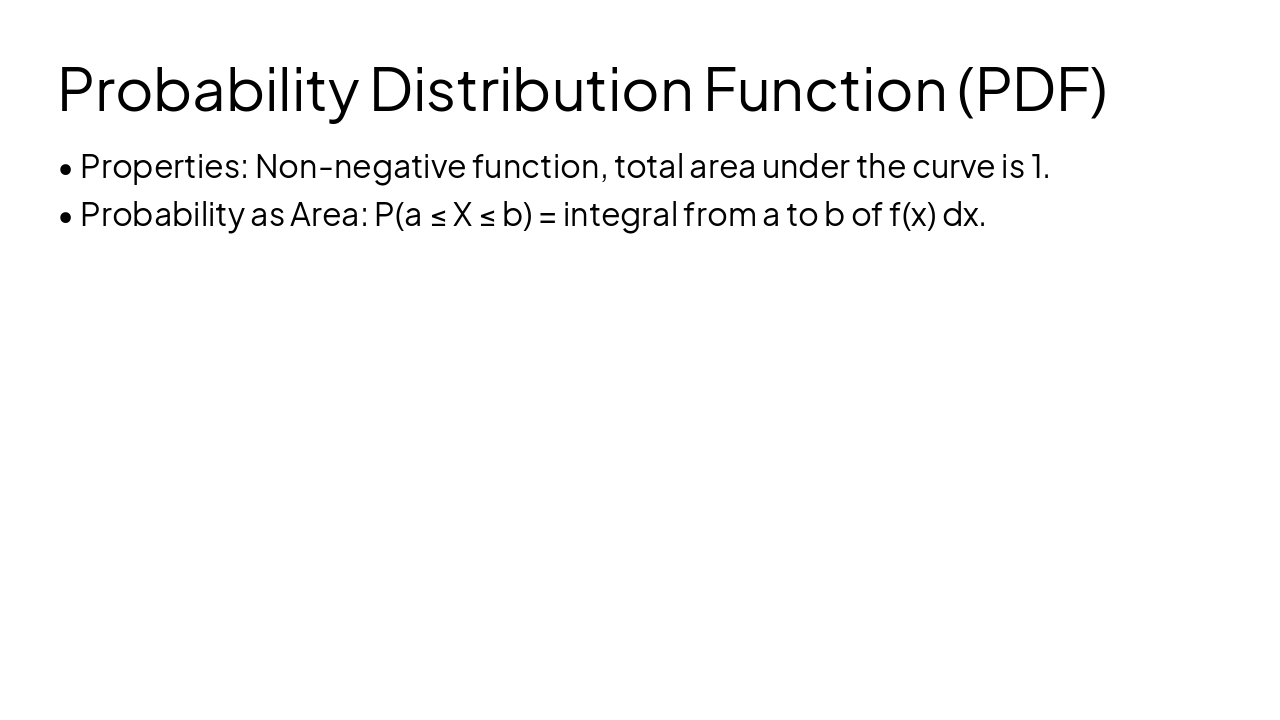
Slide 14 - Probability Distribution Function (PDF)

  • Properties: Non-negative function, total area under the curve is 1.
  • Probability as Area: P(a ≤ X ≤ b) = integral from a to b of f(x) dx.
Slide 14 - Probability Distribution Function (PDF)
Slide 15 of 26

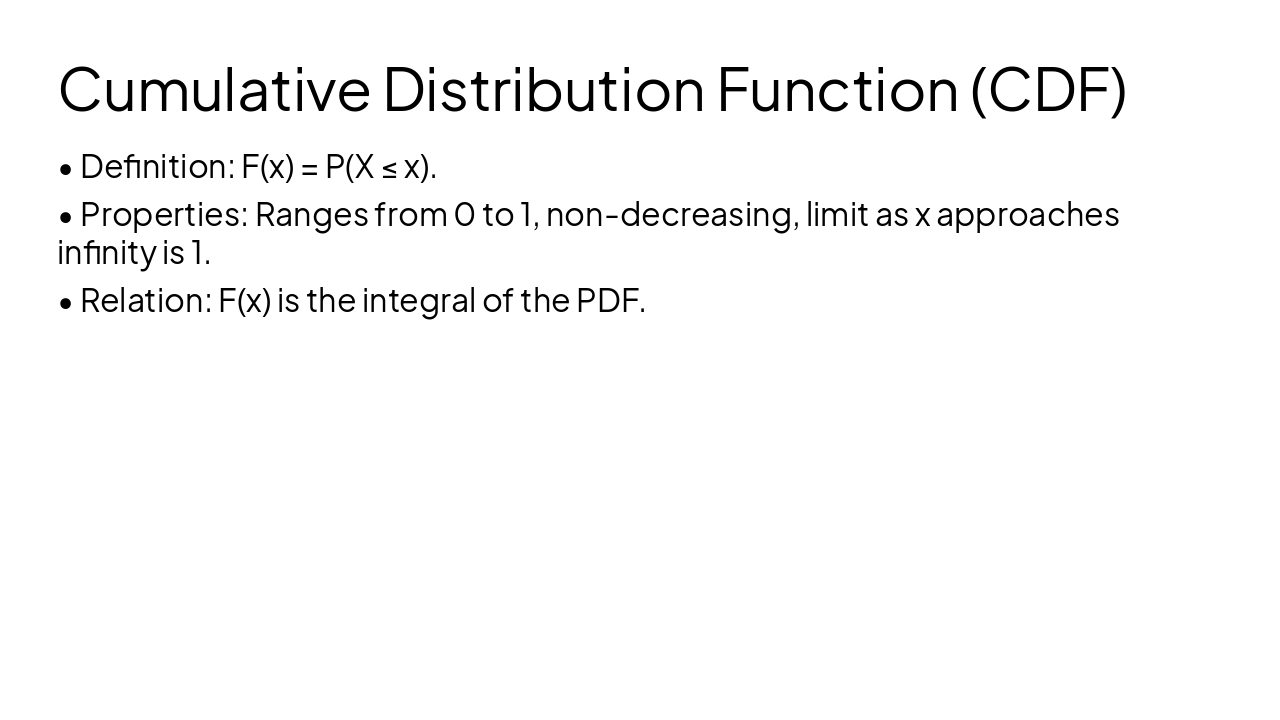
Slide 15 - Cumulative Distribution Function (CDF)

  • Definition: F(x) = P(X ≤ x).
  • Properties: Ranges from 0 to 1, non-decreasing, limit as x approaches infinity is 1.
  • Relation: F(x) is the integral of the PDF.
Slide 15 - Cumulative Distribution Function (CDF)
Slide 16 of 26

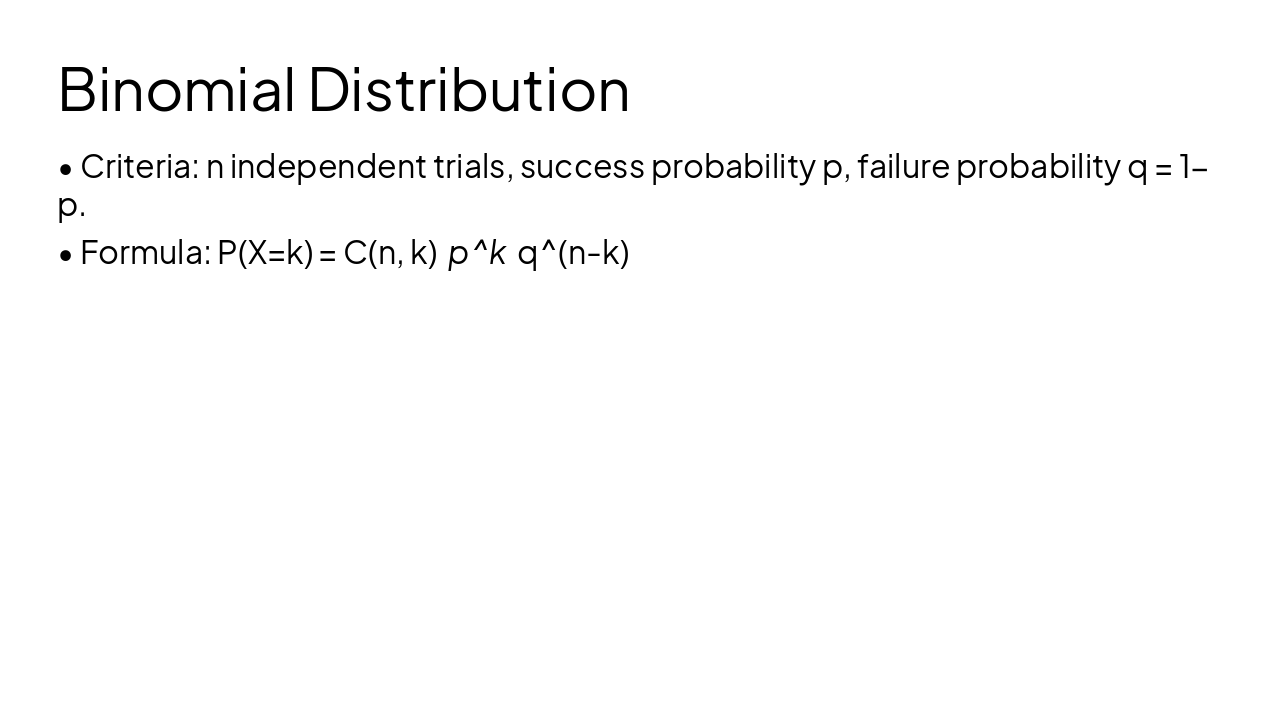
Slide 16 - Binomial Distribution

  • Criteria: n independent trials, success probability p, failure probability q = 1-p.
  • Formula: P(X=k) = C(n, k) p^k q^(n-k)
Slide 16 - Binomial Distribution
Slide 17 of 26

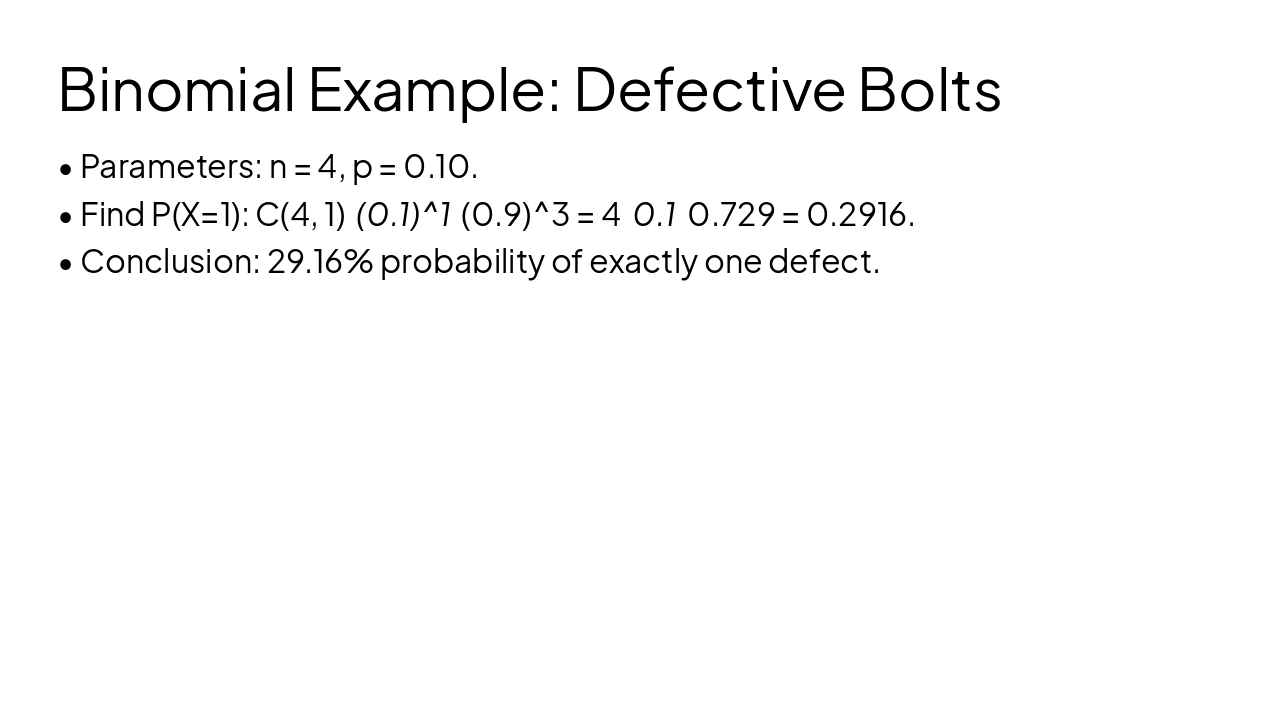
Slide 17 - Binomial Example: Defective Bolts

  • Parameters: n = 4, p = 0.10.
  • Find P(X=1): C(4, 1) (0.1)^1 (0.9)^3 = 4 0.1 0.729 = 0.2916.
  • Conclusion: 29.16% probability of exactly one defect.
Slide 17 - Binomial Example: Defective Bolts
Slide 18 of 26

Slide 18 - Poisson

Poisson Distribution

Modeling rare events in fixed intervals

---

Photo by Deng Xiang (https://unsplash.com/@dengxiangs?utmsource=karaf&amp;utmmedium=referral) on Unsplash (https://unsplash.com/?utmsource=karaf&amp;utmmedium=referral)

Slide 18 - Poisson
Slide 19 of 26

Slide 19 - Uniform Distribution

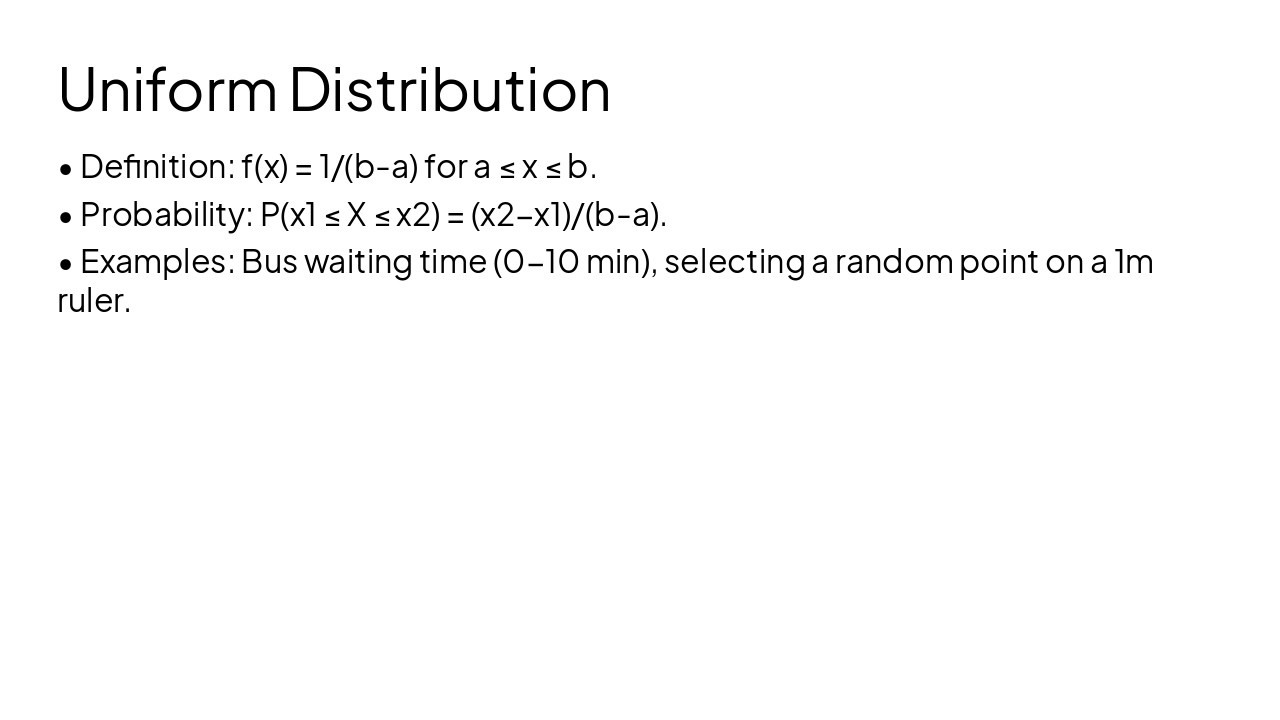
  • Definition: f(x) = 1/(b-a) for a ≤ x ≤ b.
  • Probability: P(x1 ≤ X ≤ x2) = (x2-x1)/(b-a).
  • Examples: Bus waiting time (0-10 min), selecting a random point on a 1m ruler.
Slide 19 - Uniform Distribution
Slide 20 of 26

Slide 20 - Mean and Variance of Uniform Distribution

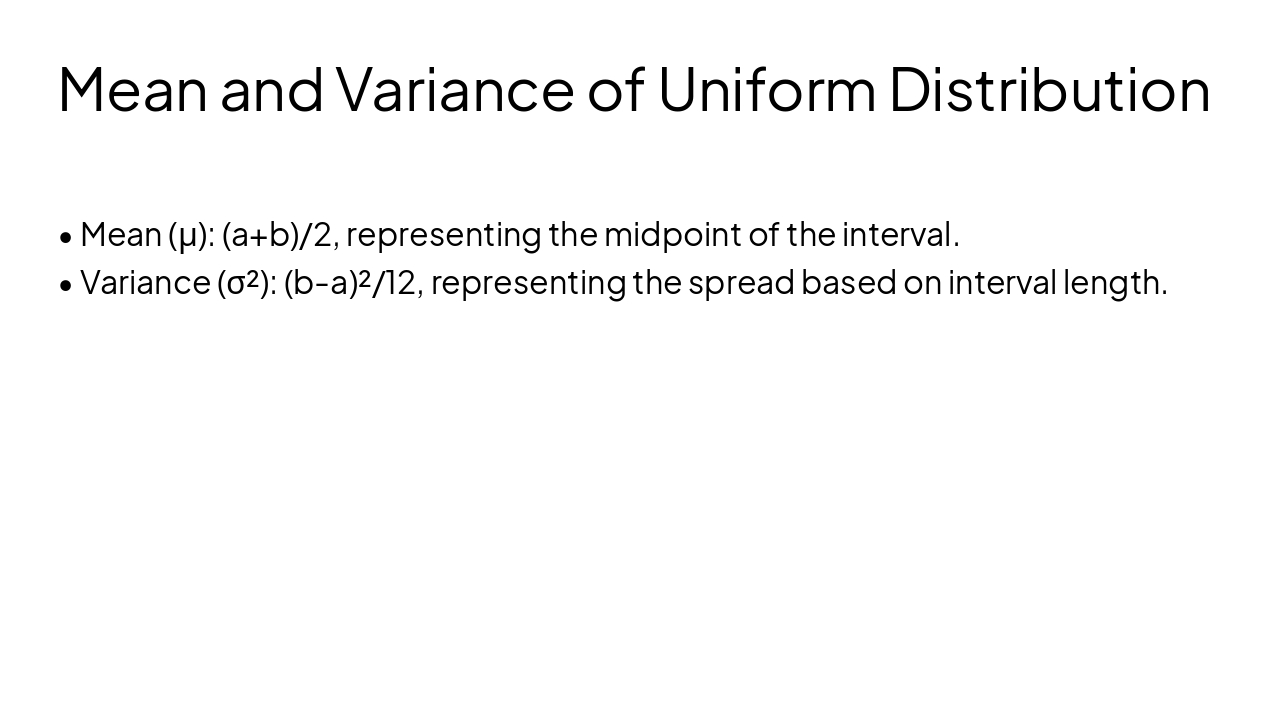
  • Mean (μ): (a+b)/2, representing the midpoint of the interval.
  • Variance (σ²): (b-a)²/12, representing the spread based on interval length.
Slide 20 - Mean and Variance of Uniform Distribution
Slide 21 of 26

Slide 21 - Problems: Uniform Distribution

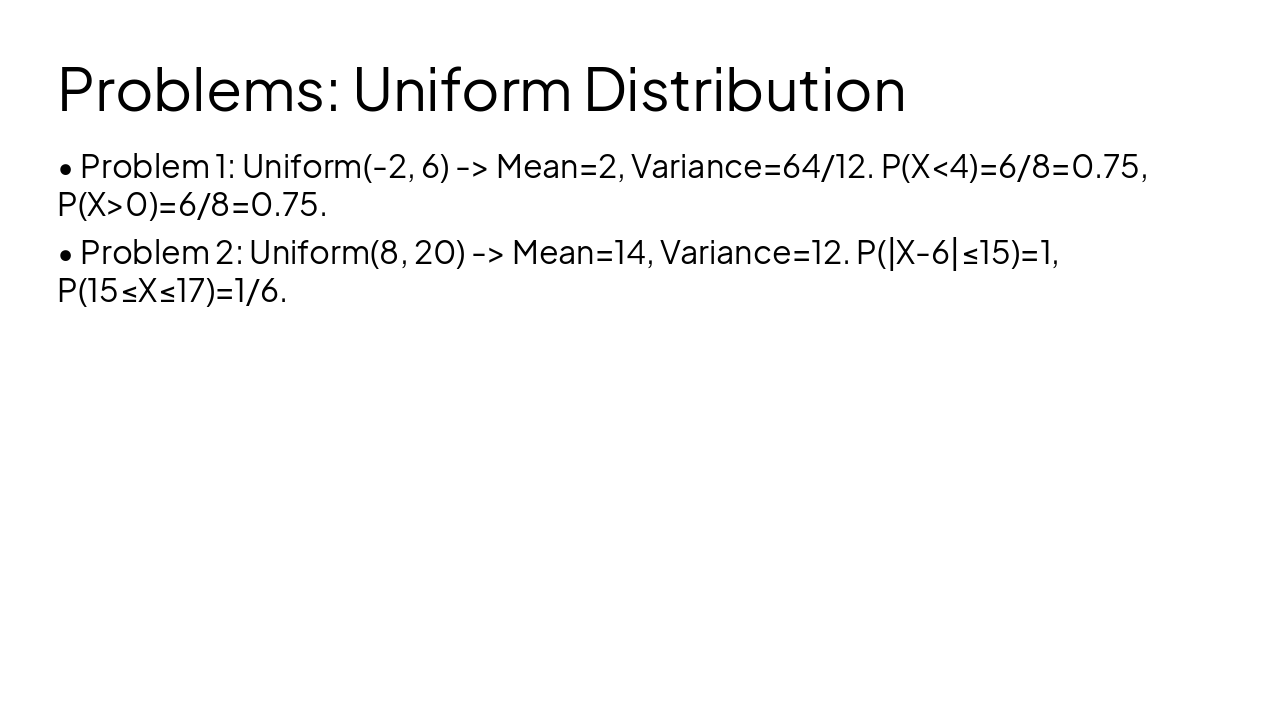
  • Problem 1: Uniform(-2, 6) -> Mean=2, Variance=64/12. P(X<4)=6/8=0.75, P(X>0)=6/8=0.75.
  • Problem 2: Uniform(8, 20) -> Mean=14, Variance=12. P(|X-6|≤15)=1, P(15≤X≤17)=1/6.
Slide 21 - Problems: Uniform Distribution
Slide 22 of 26

Slide 22 - Normal/Gaussian Distribution

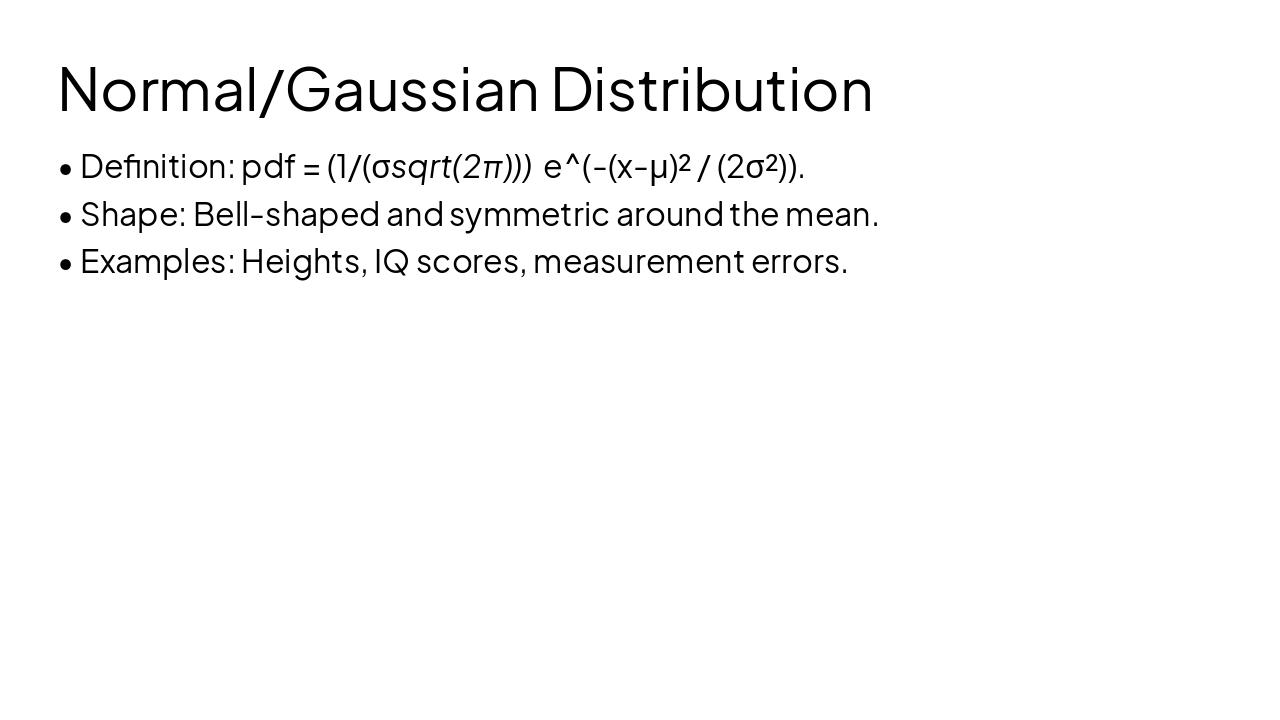
  • Definition: pdf = (1/(σsqrt(2π))) e^(-(x-μ)² / (2σ²)).
  • Shape: Bell-shaped and symmetric around the mean.
  • Examples: Heights, IQ scores, measurement errors.
Slide 22 - Normal/Gaussian Distribution
Slide 23 of 26

Slide 23 - Standard Normal Distribution

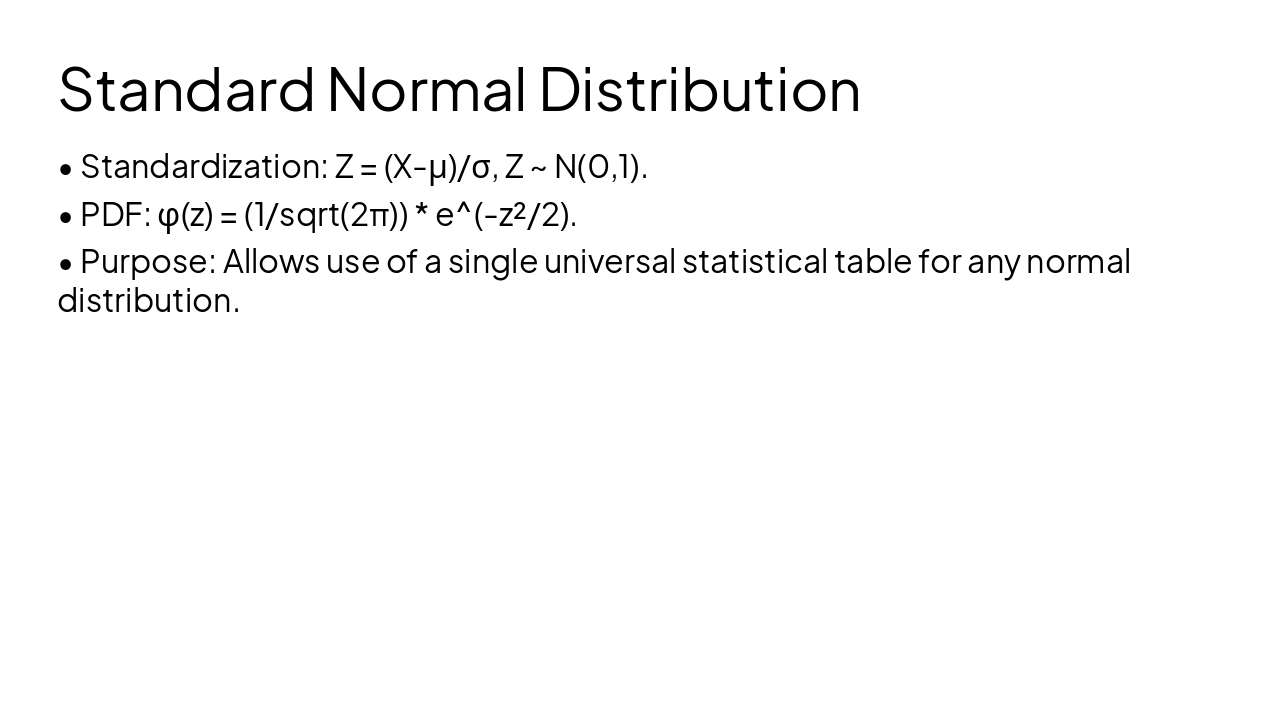
  • Standardization: Z = (X-μ)/σ, Z ~ N(0,1).
  • PDF: φ(z) = (1/sqrt(2π)) * e^(-z²/2).
  • Purpose: Allows use of a single universal statistical table for any normal distribution.
Slide 23 - Standard Normal Distribution
Slide 24 of 26

Slide 24 - Area Under Normal Curve

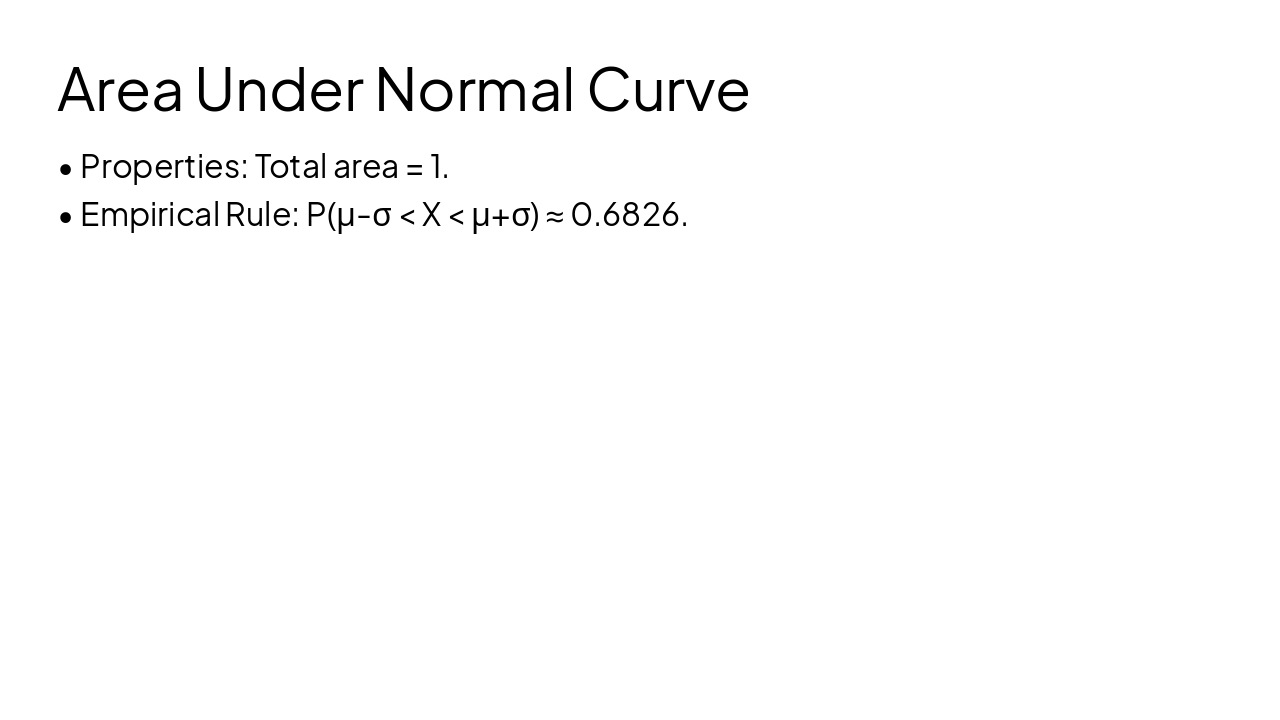
  • Properties: Total area = 1.
  • Empirical Rule: P(μ-σ < X < μ+σ) ≈ 0.6826.
Slide 24 - Area Under Normal Curve
Slide 25 of 26

Slide 25 - Standard Normal Table

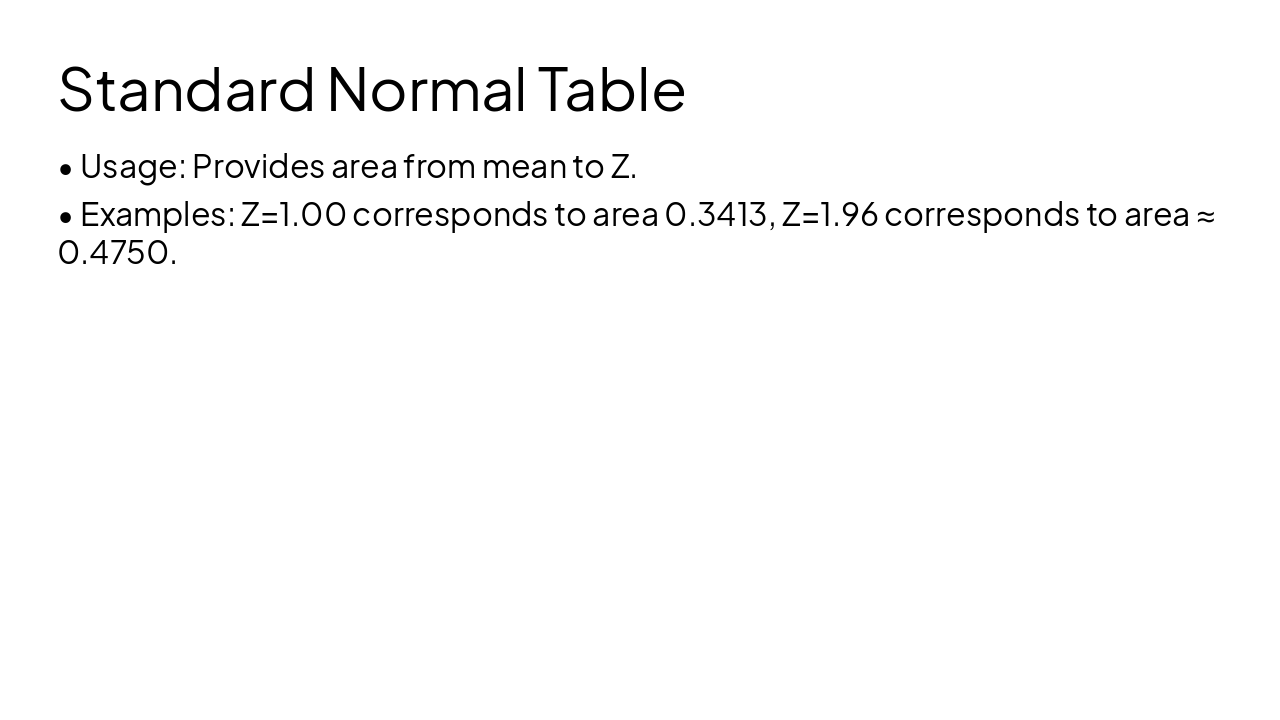
  • Usage: Provides area from mean to Z.
  • Examples: Z=1.00 corresponds to area 0.3413, Z=1.96 corresponds to area ≈ 0.4750.
Slide 25 - Standard Normal Table
Slide 26 of 26

Slide 26 - Comparison: Uniform vs. Normal

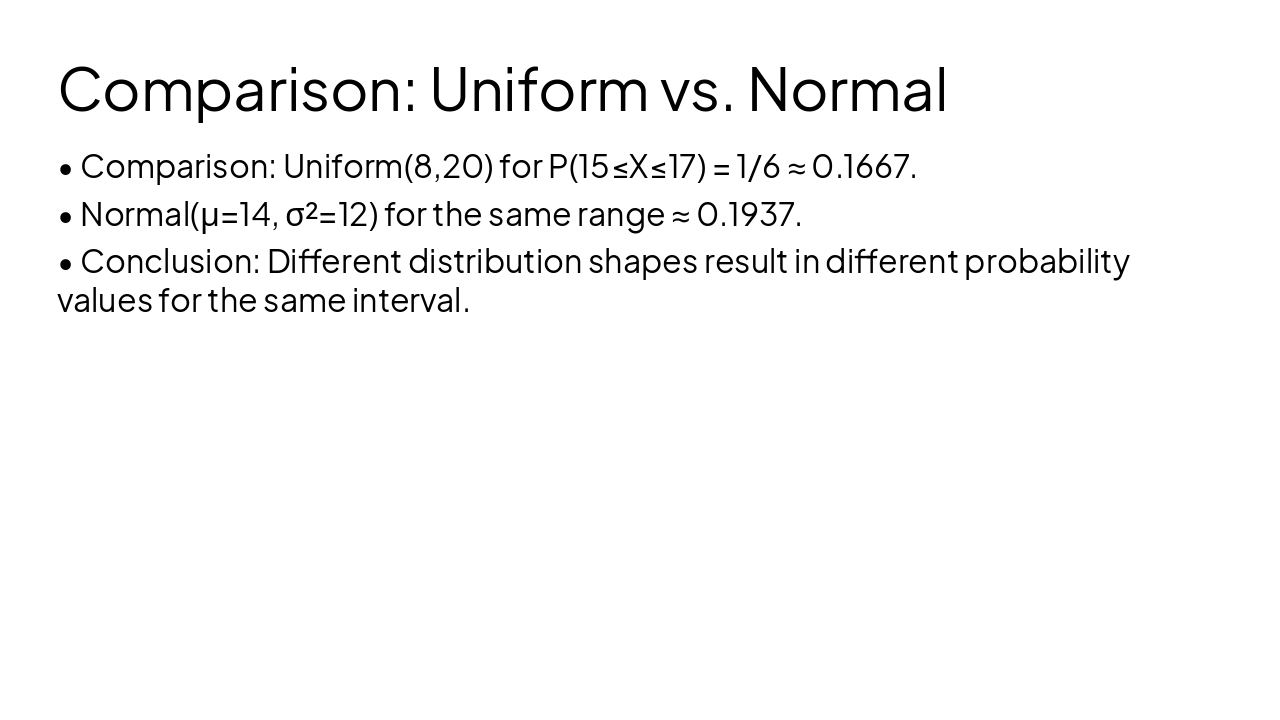
  • Comparison: Uniform(8,20) for P(15≤X≤17) = 1/6 ≈ 0.1667.
  • Normal(μ=14, σ²=12) for the same range ≈ 0.1937.
  • Conclusion: Different distribution shapes result in different probability values for the same interval.
Slide 26 - Comparison: Uniform vs. Normal

Discover More Presentations

Explore thousands of AI-generated presentations for inspiration

Browse Presentations
Powered by AI

Create Your Own Presentation

Generate professional presentations in seconds with Karaf's AI. Customize this presentation or start from scratch.

Create New Presentation

Powered by Karaf.ai — AI-Powered Presentation Generator