Mastering DPIAs: GDPR Essentials

Generated from prompt:

Create a professional PowerPoint presentation on 'Data Protection Impact Assessments (DPIA)' with the following structure: 1. What is a DPIA? a. Definition and legal basis (Art. 35 GDPR) b. What a DPIA looks like in practice (written assessment, risk analysis) 2. Why do we conduct DPIAs? - Responding to evolving technologies - Ensuring compliance and protecting fundamental rights & freedoms 3. Who is involved? - Roles and responsibilities: Controller, Processor, Joint Controllers - Involvement of the DPO (Art. 35(2) GDPR) 4. When is a DPIA required? - Timing: carried out before starting the processing - High-risk processing: what “high risk” means - Legal framework: 3 situations triggering a DPIA - WP29 / EDPB high-risk criteria + practical examples 5. Core DPIA elements - Mandatory components under Art. 35(3) GDPR: • Description of processing • Purpose and necessity/proportionality assessment • Risk assessment • Mitigating measures 6. How to conduct a DPIA (step-by-step) - Method under Art. 35(7) GDPR - Basic flowchart overview - Practical 7-step process 7. Sanctions - Infringement on the obligation of conducting a DPIA Style: Clean, professional, GDPR/compliance themed with subtle blue and grey tones.

Professional guide to Data Protection Impact Assessments (DPIA) under GDPR Art. 35. Covers definition, purpose, roles, triggers, elements, step-by-step process, and sanctions for compliance. (148 char

January 16, 20269 slides
Slide 1 of 9

Slide 1 - Data Protection Impact Assessments (DPIA)

This title slide introduces "Data Protection Impact Assessments (DPIA)" as its main topic. It describes DPIA as an essential GDPR tool for ensuring compliance in high-risk data processing.

Data Protection Impact Assessments

(DPIA)

Essential GDPR Tool for High-Risk Processing Compliance

Source: GDPR Compliance Presentation

Speaker Notes
Introduce the topic of DPIA under GDPR, emphasizing its importance for high-risk processing.
Slide 1 - Data Protection Impact Assessments (DPIA)
Slide 2 of 9

Slide 2 - 1. What is a DPIA?

This section header slide, titled "1. What is a DPIA?", introduces the definition and practical application of DPIA. It is numbered as section 01 with the subtitle "Introduction to Definition and Practical Application."

1. What is a DPIA?

01

What is a DPIA?

Introduction to Definition and Practical Application

Source: Data Protection Impact Assessments (DPIA) Presentation

Speaker Notes
Introduce the definition of DPIA and its practical application, setting the foundation for the presentation.
Slide 2 - 1. What is a DPIA?
Slide 3 of 9

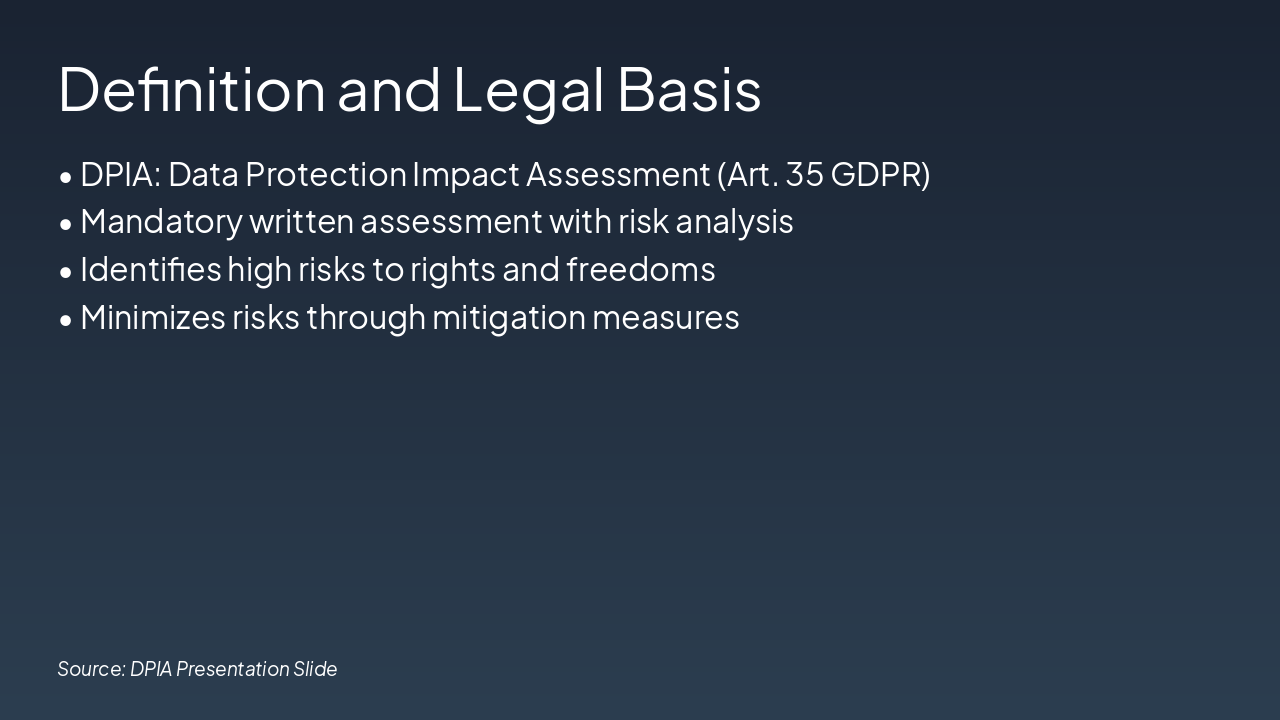
Slide 3 - Definition and Legal Basis

The slide defines DPIA (Data Protection Impact Assessment) under Article 35 of the GDPR as a mandatory written assessment involving risk analysis. It identifies high risks to rights and freedoms and minimizes them through mitigation measures.

Definition and Legal Basis

  • DPIA: Data Protection Impact Assessment (Art. 35 GDPR)
  • Mandatory written assessment with risk analysis
  • Identifies high risks to rights and freedoms
  • Minimizes risks through mitigation measures

Source: DPIA Presentation Slide

Speaker Notes
Introduce DPIA as a mandatory written assessment under Art. 35 GDPR, focusing on risk analysis to identify and minimize high risks to individuals' rights and freedoms.
Slide 3 - Definition and Legal Basis
Slide 4 of 9

Slide 4 - Why Conduct DPIAs?

This section header slide, titled "Why Conduct DPIAs?" (section 02), explains the purpose and benefits of conducting Data Protection Impact Assessments. It highlights key advantages including regulatory compliance, risk mitigation, and protection of individuals' rights.

Why Conduct DPIAs?

02

Why Conduct DPIAs?

Purpose and Benefits: Compliance, Risk Mitigation, and Rights Protection

Source: Data Protection Impact Assessments (DPIA)

Speaker Notes
Highlight the purpose and benefits of DPIAs, focusing on responding to evolving technologies, ensuring GDPR compliance, and protecting fundamental rights and freedoms.
Slide 4 - Why Conduct DPIAs?
Slide 5 of 9

Slide 5 - Reasons for DPIAs

DPIAs are conducted to respond to evolving technologies, ensure GDPR compliance, and protect fundamental rights and freedoms. They also enable proactive risk management.

Reasons for DPIAs

  • Respond to evolving technologies
  • Ensure GDPR compliance
  • Protect fundamental rights and freedoms
  • Enable proactive risk management

Source: Data Protection Impact Assessments (DPIA) Presentation

Speaker Notes
Highlight the strategic importance of DPIAs in adapting to tech changes, meeting GDPR requirements, safeguarding rights, and managing risks proactively. Ties into section 2 on 'Why conduct DPIAs?'
Slide 5 - Reasons for DPIAs
Slide 6 of 9

Slide 6 - 3. Who is Involved?

This section header slide, titled "3. Who is Involved?", introduces the roles and responsibilities in the DPIA process. It is numbered as section 03 and focuses on key participants.

3. Who is Involved?

03

Who is Involved?

Roles and Responsibilities in the DPIA Process

Source: Data Protection Impact Assessments (DPIA)

Speaker Notes
Introduce roles and responsibilities in the DPIA process, including Controller, Processor, Joint Controllers, and DPO involvement per Art. 35(2) GDPR.
Slide 6 - 3. Who is Involved?
Slide 7 of 9

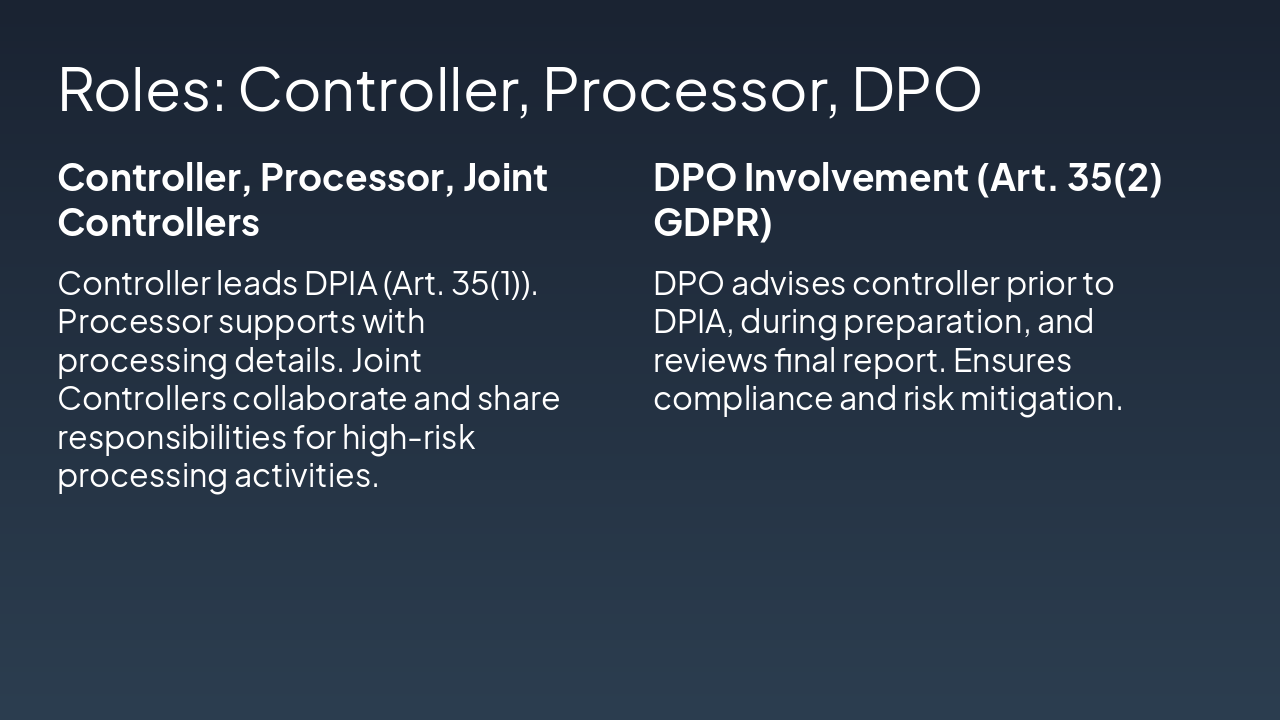
Slide 7 - Roles: Controller, Processor, DPO

The slide outlines roles in GDPR: the Controller leads DPIA (Art. 35(1)), the Processor provides processing details, and Joint Controllers share responsibilities for high-risk activities. The DPO advises the controller before and during DPIA preparation (Art. 35(2)), reviews the final report, and ensures compliance and risk mitigation.

Roles: Controller, Processor, DPO

Controller, Processor, Joint ControllersDPO Involvement (Art. 35(2) GDPR)
Controller leads DPIA (Art. 35(1)). Processor supports with processing details. Joint Controllers collaborate and share responsibilities for high-risk processing activities.DPO advises controller prior to DPIA, during preparation, and reviews final report. Ensures compliance and risk mitigation.
Speaker Notes
Slide covers key roles in DPIA process per section 3. Emphasize controller's leadership and DPO's advisory role under Art. 35(2) GDPR.
Slide 7 - Roles: Controller, Processor, DPO
Slide 8 of 9

Slide 8 - 4-7. When, Elements, Process & Sanctions

This section header slide, titled "4-7. When, Elements, Process & Sanctions," outlines key aspects including triggers, core elements, a 7-step process, flowchart, and penalties for infringements. It serves as an introduction to these procedural and enforcement components.

4-7. When, Elements, Process & Sanctions

4-7

When, Elements, Process & Sanctions

Triggers, core elements, 7-step process, flowchart, and infringement penalties

Source: Data Protection Impact Assessments (DPIA)

Speaker Notes
Summary slide covering DPIA triggers, core elements, 7-step process flowchart, and infringement penalties.
Slide 8 - 4-7. When, Elements, Process & Sanctions
Slide 9 of 9

Slide 9 - Key Takeaways & Next Steps

The slide's key takeaways emphasize conducting a DPIA before high-risk processing, following Article 35 of the GDPR, and consulting the DPO. Next steps include assessing processing activities and implementing the DPIA process immediately to ensure compliance and avoid fines.

Key Takeaways & Next Steps

**Key Takeaways:

  • Conduct DPIA prior to high-risk processing
  • Follow Art. 35 GDPR
  • Consult DPO

Next Steps:

  • Assess your processing activities
  • Implement DPIA process today

Secure compliance. Protect rights.***

Start with DPIA – Avoid Fines

Source: Data Protection Impact Assessments (DPIA)*

Speaker Notes
Summarize the critical actions: always conduct DPIA for high-risk processing per Art. 35 GDPR, involve DPO, and avoid fines. Encourage immediate implementation.
Slide 9 - Key Takeaways & Next Steps

Discover More Presentations

Explore thousands of AI-generated presentations for inspiration

Browse Presentations
Powered by AI

Create Your Own Presentation

Generate professional presentations in seconds with Karaf's AI. Customize this presentation or start from scratch.

Create New Presentation

Powered by Karaf.ai — AI-Powered Presentation Generator