Mastering Critical Thinking in Leadership

Generated from prompt:

Generate a pitch deck for critical thinking and leadership

This pitch deck explores critical thinking fundamentals, its key elements and impacts, leadership essentials, comparisons to traditional thinking, development timelines, and a call to action for trans

November 15, 202512 slides
Slide 1 of 12

Slide 1 - Mastering Critical Thinking and Leadership

The slide's title is "Mastering Critical Thinking and Leadership," focusing on developing essential skills for effective decision-making and team management. Its subtitle, "Empowering Teams Through Sharp Thinking and Strong Guidance," highlights how these abilities enable leaders to inspire and direct groups successfully.

Mastering Critical Thinking and Leadership

Empowering Teams Through Sharp Thinking and Strong Guidance

Source: Pitch deck for critical thinking and leadership

Speaker Notes
Presenter: [Your Name] Date: [Current Date]
Slide 1 - Mastering Critical Thinking and Leadership
Slide 2 of 12

Slide 2 - Presentation Agenda

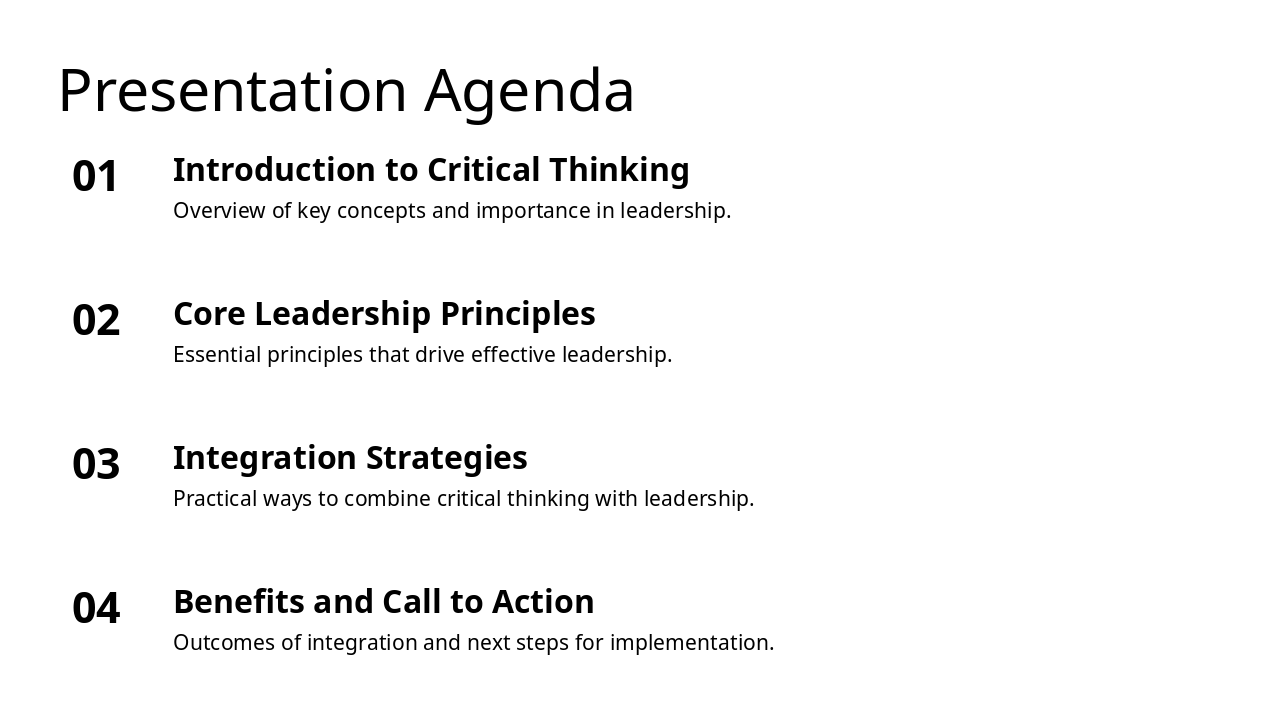
The agenda slide outlines a presentation on critical thinking in leadership, starting with an introduction to its key concepts and importance. It then covers core leadership principles, strategies for integrating critical thinking, and the benefits along with a call to action for implementation.

Presentation Agenda

  1. Introduction to Critical Thinking
  2. Overview of key concepts and importance in leadership.

  3. Core Leadership Principles
  4. Essential principles that drive effective leadership.

  5. Integration Strategies
  6. Practical ways to combine critical thinking with leadership.

  7. Benefits and Call to Action
  8. Outcomes of integration and next steps for implementation.

Slide 2 - Presentation Agenda
Slide 3 of 12

Slide 3 - What is Critical Thinking?

This section header slide, titled "What is Critical Thinking?" and numbered as 02, introduces the topic by focusing on its core definition. It features a subtitle that highlights foundational skills for analyzing information, evaluating evidence, and making informed decisions in dynamic environments.

What is Critical Thinking?

02

What is Critical Thinking?

Explore foundational skills for analyzing information, evaluating evidence, and making informed decisions in dynamic environments.

Slide 3 - What is Critical Thinking?
Slide 4 of 12

Slide 4 - Key Elements of Critical Thinking

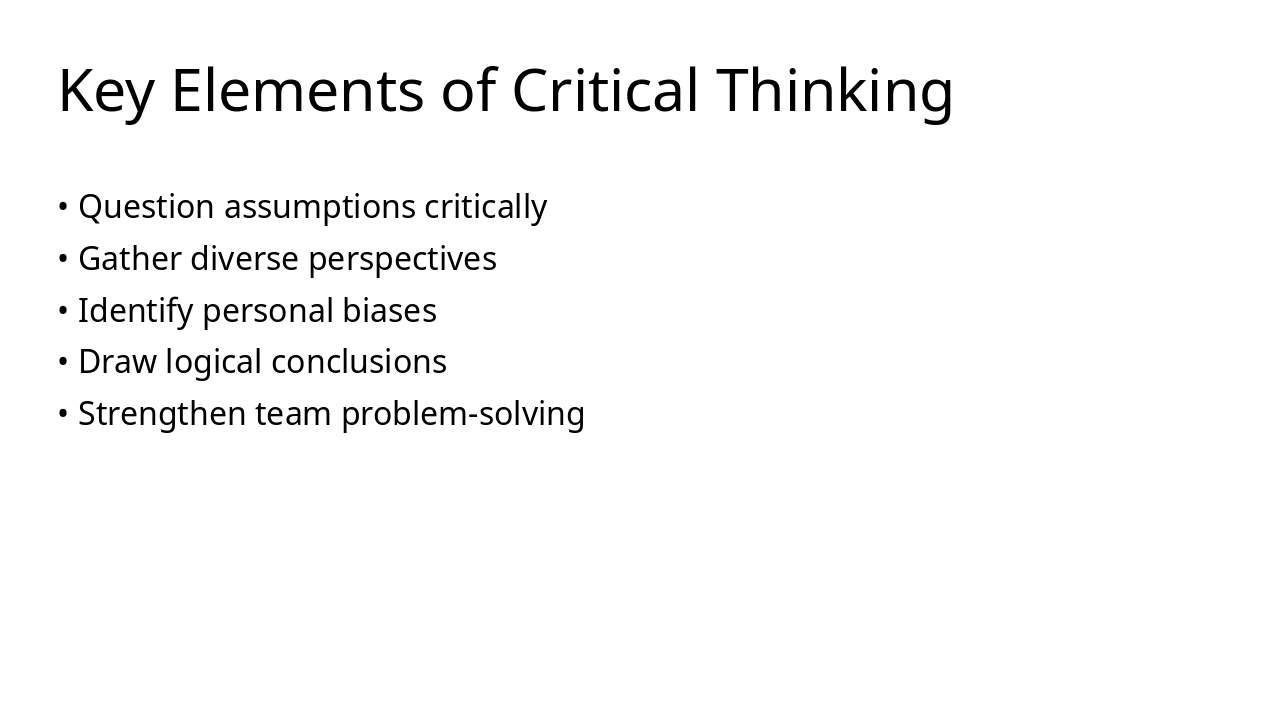
Critical thinking involves questioning assumptions, gathering diverse perspectives, and identifying personal biases to draw logical conclusions effectively. These elements ultimately strengthen team problem-solving capabilities.

Key Elements of Critical Thinking

  • Question assumptions critically
  • Gather diverse perspectives
  • Identify personal biases
  • Draw logical conclusions
  • Strengthen team problem-solving
Speaker Notes
Enhance problem-solving in teams.
Slide 4 - Key Elements of Critical Thinking
Slide 5 of 12

Slide 5 - Impact of Critical Thinking

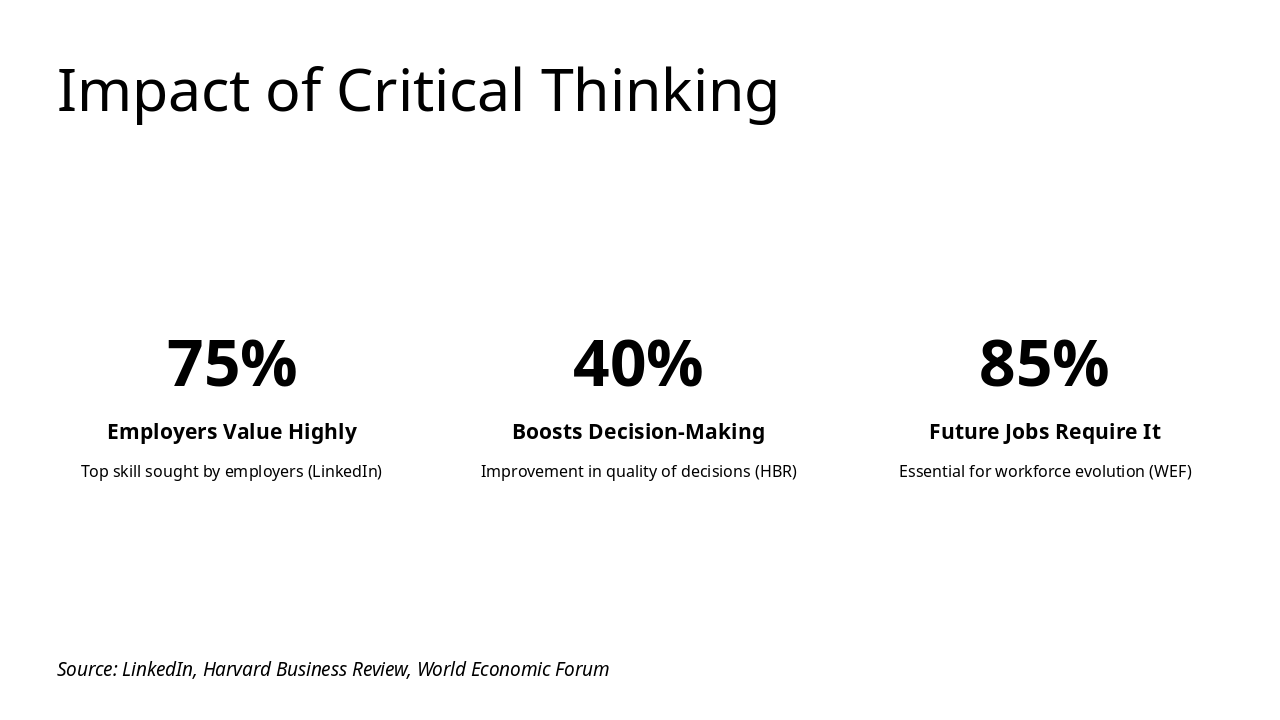
Employers highly value critical thinking as the top skill sought, with 75% prioritizing it according to LinkedIn data. It boosts decision-making quality by 40% per HBR insights and is essential for 85% of future jobs as outlined by the World Economic Forum.

Impact of Critical Thinking

  • 75%: Employers Value Highly
  • Top skill sought by employers (LinkedIn)

  • 40%: Boosts Decision-Making
  • Improvement in quality of decisions (HBR)

  • 85%: Future Jobs Require It

Essential for workforce evolution (WEF) Source: LinkedIn, Harvard Business Review, World Economic Forum

Speaker Notes
Highlight the value of critical thinking in leadership and decision-making for the pitch.
Slide 5 - Impact of Critical Thinking
Slide 6 of 12

Slide 6 - Critical Thinking in Action

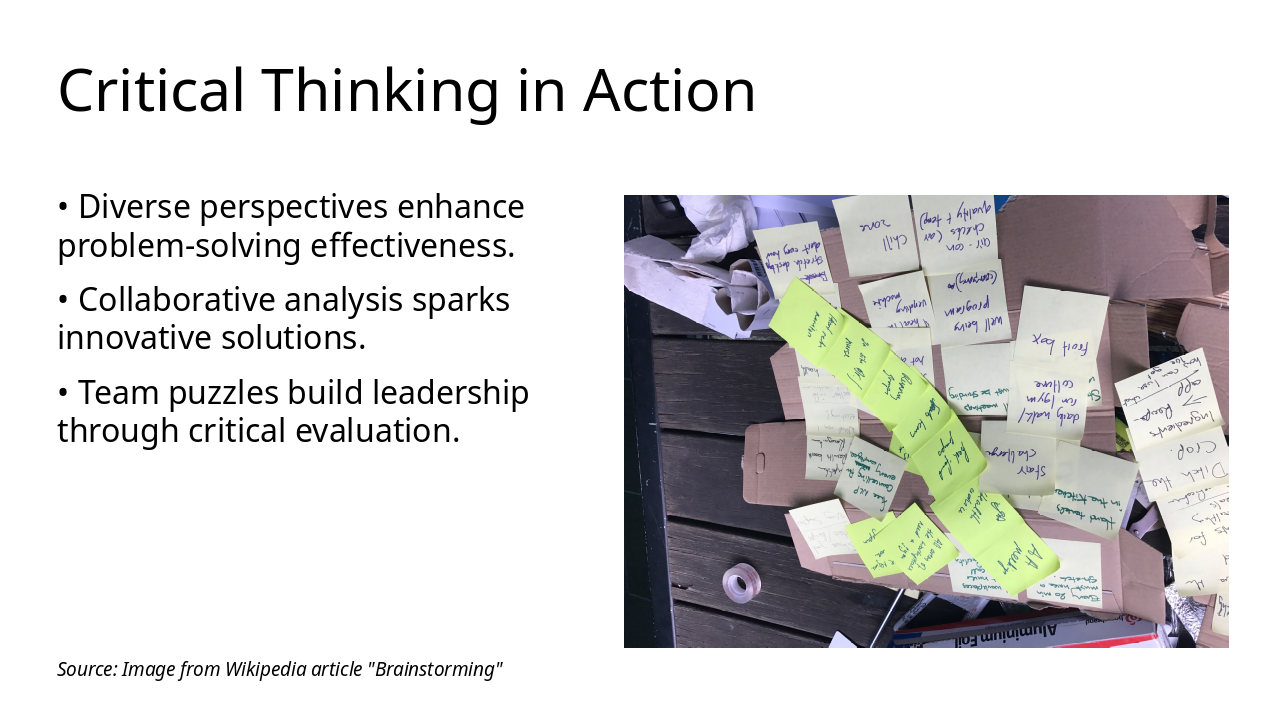
The slide titled "Critical Thinking in Action" features an image illustrating how diverse perspectives improve problem-solving and foster innovative solutions through collaborative analysis. It also highlights team-based puzzles that develop leadership skills via critical evaluation.

Critical Thinking in Action

!Image

  • Diverse perspectives enhance problem-solving effectiveness.
  • Collaborative analysis sparks innovative solutions.
  • Team puzzles build leadership through critical evaluation.

Source: Image from Wikipedia article "Brainstorming"

Slide 6 - Critical Thinking in Action
Slide 7 of 12

Slide 7 - Essentials of Leadership

This section header slide, titled "Essentials of Leadership" and numbered 06, introduces key principles for effective leadership. It highlights visionary guidance, empathy, and resilience as core elements that drive organizational success and motivate teams.

Essentials of Leadership

06

Essentials of Leadership

Delve into visionary guidance, empathy, and resilience driving organizational success and team motivation.

Source: Pitch Deck for Critical Thinking and Leadership

Speaker Notes
Delve into visionary guidance, empathy, and resilience that drive organizational success and team motivation.
Slide 7 - Essentials of Leadership
Slide 8 of 12

Slide 8 - Core Leadership Skills

Core leadership skills outlined on the slide include inspiring a compelling vision, fostering an inclusive environment, and delegating tasks effectively. Additionally, they emphasize adapting to changing circumstances while building trust to drive results.

Core Leadership Skills

  • Inspire a compelling vision
  • Foster an inclusive environment
  • Delegate tasks effectively
  • Adapt to changing circumstances
  • Build trust and drive results
Slide 8 - Core Leadership Skills
Slide 9 of 12

Slide 9 - Critical Thinking vs. Traditional Thinking

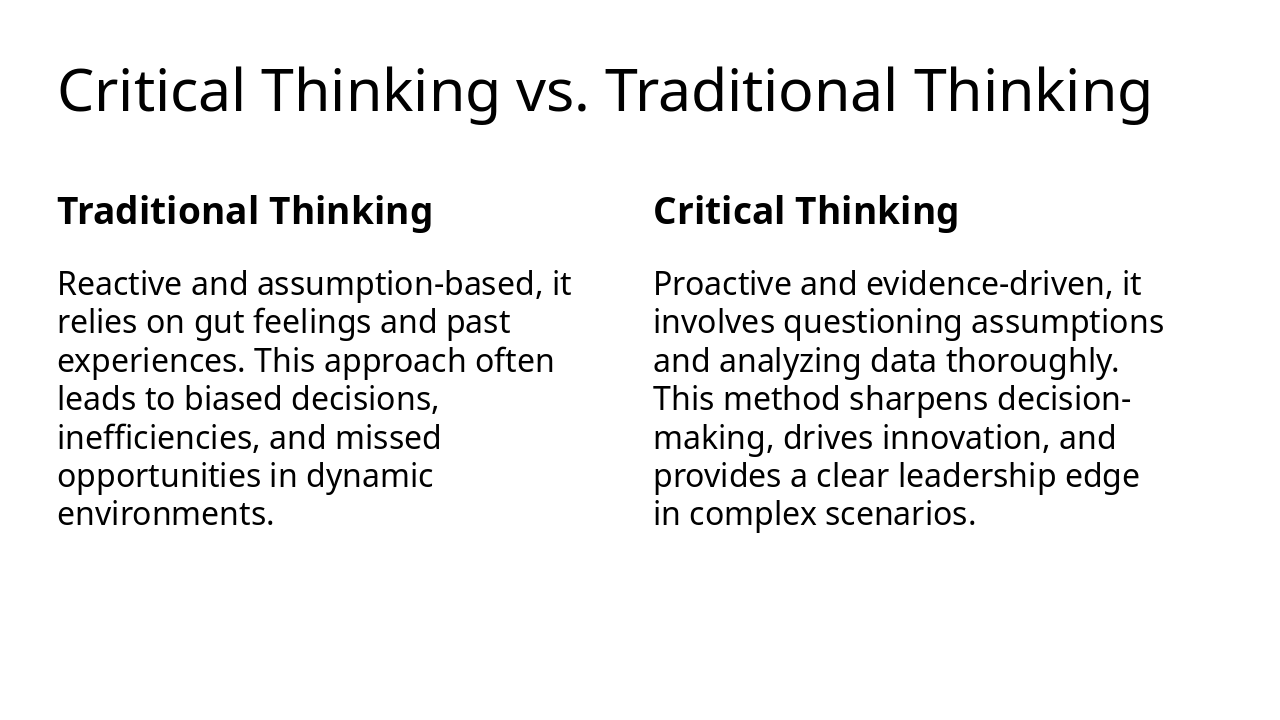
Traditional thinking is reactive and assumption-based, relying on gut feelings and past experiences, which often results in biased decisions, inefficiencies, and missed opportunities in dynamic settings. In contrast, critical thinking is proactive and evidence-driven, involving thorough questioning of assumptions and data analysis to enhance decision-making, foster innovation, and deliver a leadership advantage in complex scenarios.

Critical Thinking vs. Traditional Thinking

Traditional ThinkingCritical Thinking
Reactive and assumption-based, it relies on gut feelings and past experiences. This approach often leads to biased decisions, inefficiencies, and missed opportunities in dynamic environments.Proactive and evidence-driven, it involves questioning assumptions and analyzing data thoroughly. This method sharpens decision-making, drives innovation, and provides a clear leadership edge in complex scenarios.
Slide 9 - Critical Thinking vs. Traditional Thinking
Slide 10 of 12

Slide 10 - Developing Critical Leadership

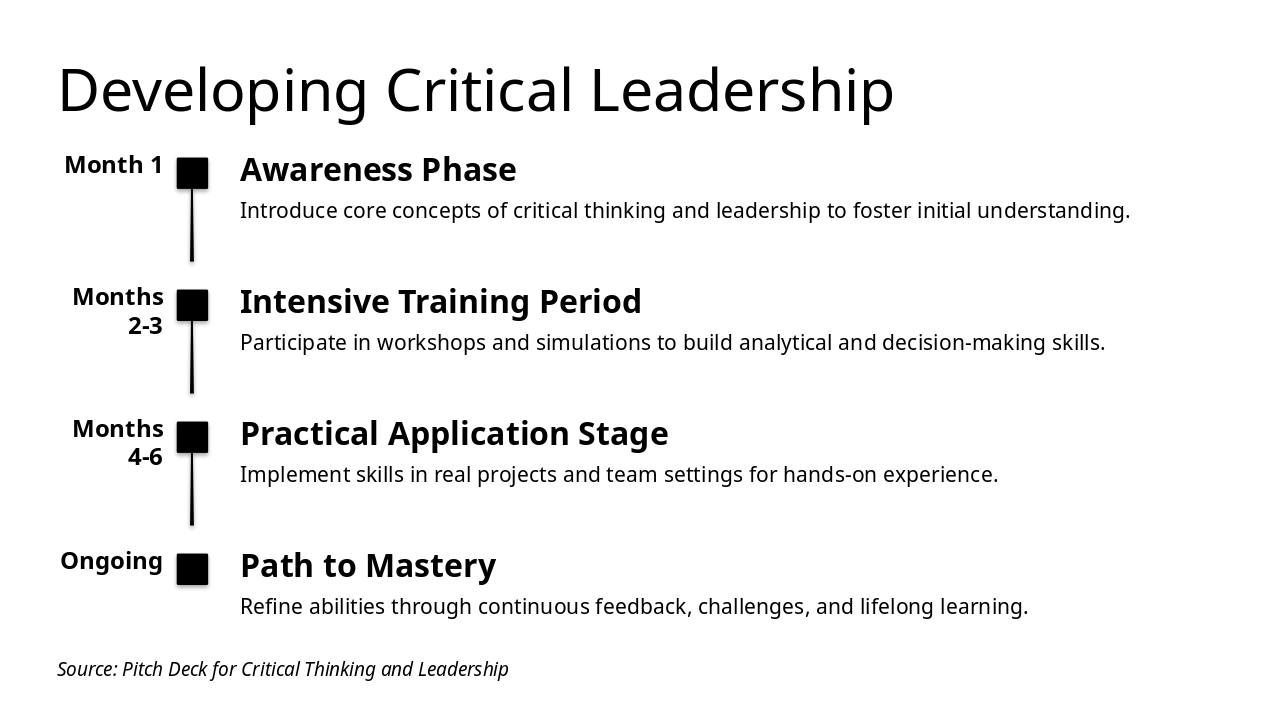
The "Developing Critical Leadership" timeline outlines a structured progression starting with the Awareness Phase in Month 1, where core concepts of critical thinking and leadership are introduced to build initial understanding. It advances through an Intensive Training Period in Months 2-3 with workshops and simulations for analytical skills, a Practical Application Stage in Months 4-6 applying those skills in real projects, and an Ongoing Path to Mastery via continuous feedback and lifelong learning.

Developing Critical Leadership

Month 1: Awareness Phase Introduce core concepts of critical thinking and leadership to foster initial understanding. Months 2-3: Intensive Training Period Participate in workshops and simulations to build analytical and decision-making skills. Months 4-6: Practical Application Stage Implement skills in real projects and team settings for hands-on experience. Ongoing: Path to Mastery Refine abilities through continuous feedback, challenges, and lifelong learning.

Source: Pitch Deck for Critical Thinking and Leadership

Slide 10 - Developing Critical Leadership
Slide 11 of 12

Slide 11 - A Leader's Insight

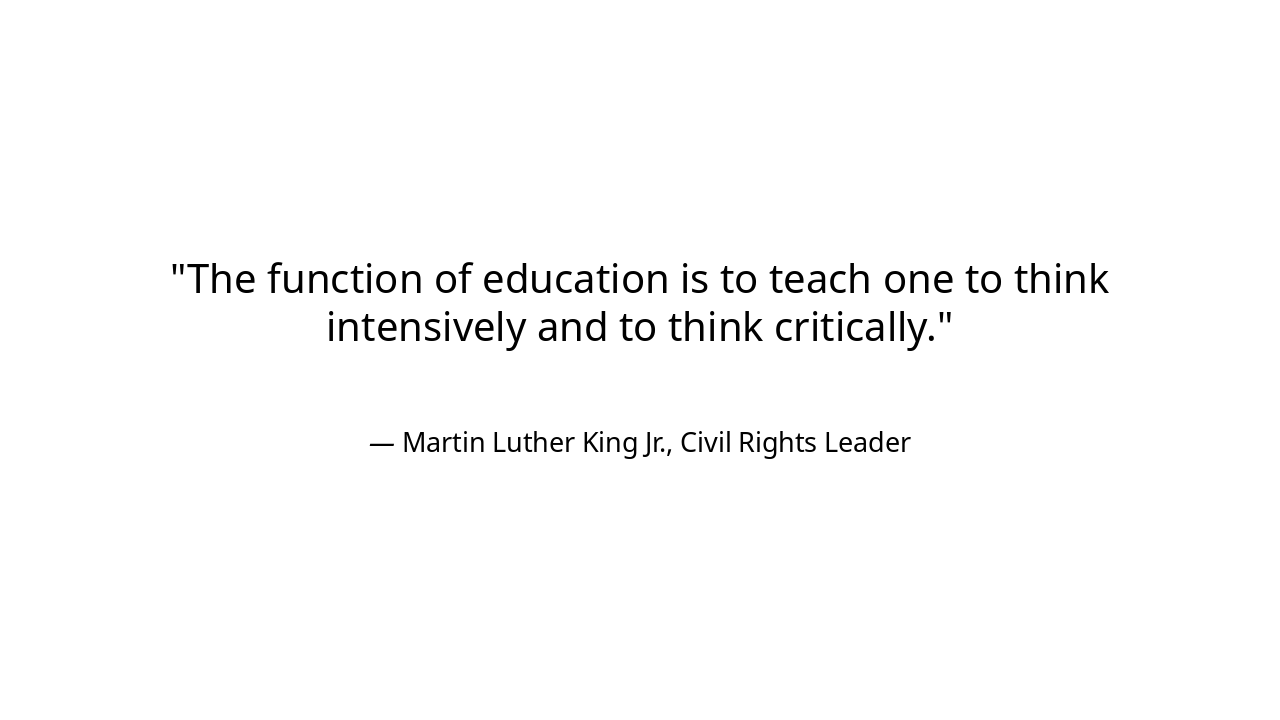
The slide, titled "A Leader's Insight," features a quote slide highlighting Martin Luther King Jr.'s view on education. It states: "The function of education is to teach one to think intensively and to think critically," attributing the words to the renowned civil rights leader.

A Leader's Insight

> The function of education is to teach one to think intensively and to think critically.

— Martin Luther King Jr., Civil Rights Leader

Speaker Notes
Inspire reflection.
Slide 11 - A Leader's Insight
Slide 12 of 12

Slide 12 - Call to Action

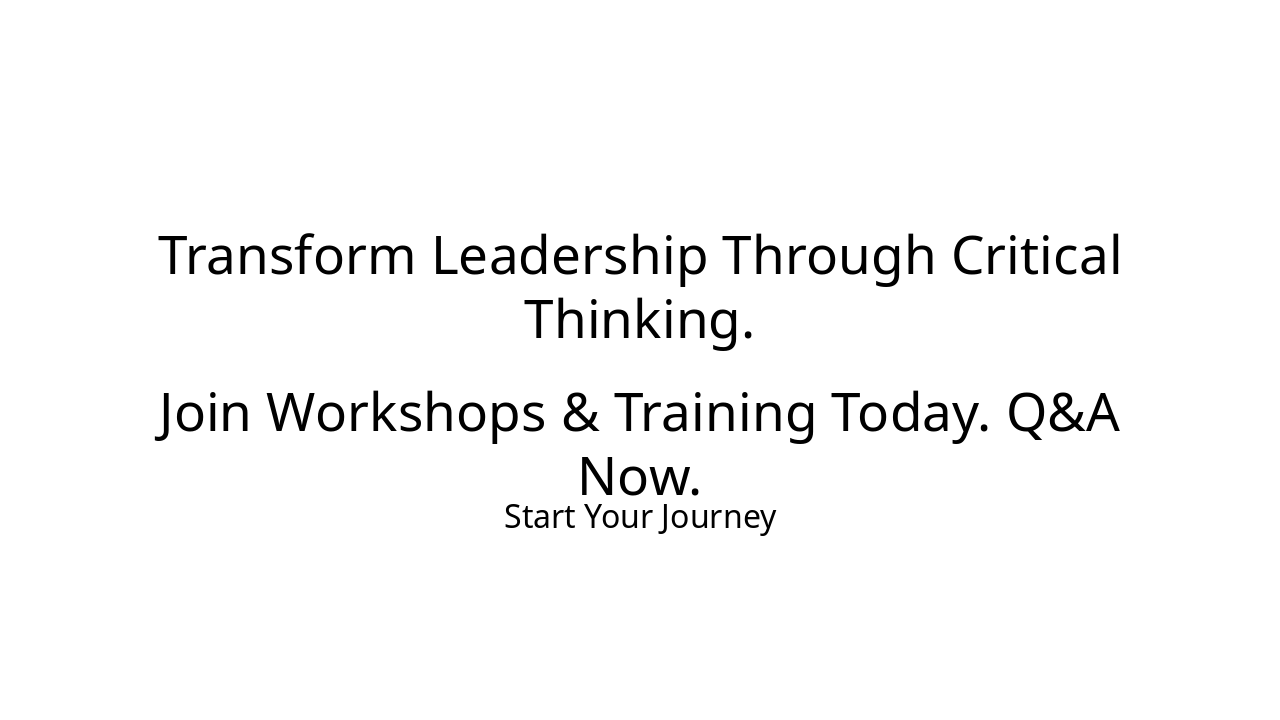
The slide, titled "Call to Action" with the subtitle "Start Your Journey," urges viewers to transform their leadership by embracing critical thinking. It invites participation in workshops and training today, followed by an immediate Q&A session.

Call to Action

Transform Leadership Through Critical Thinking.

Join Workshops & Training Today. Q&A Now.

Start Your Journey

Speaker Notes
Integrate critical thinking into leadership for transformative results. Start today: Workshops, training programs. Q&A.
Slide 12 - Call to Action

Discover More Presentations

Explore thousands of AI-generated presentations for inspiration

Browse Presentations
Powered by AI

Create Your Own Presentation

Generate professional presentations in seconds with Karaf's AI. Customize this presentation or start from scratch.

Create New Presentation

Powered by Karaf.ai — AI-Powered Presentation Generator