Scientific Perspectives on Art and Design History

Generated from prompt:

Create a visually enhanced, professional scientific poster PowerPoint (PPTX) using EXACT text from the uploaded file without any modifications. Preserve all wording, structure, and content exactly as-is. Focus only on: - Modern academic poster layout - Strong visual hierarchy - Clean typography - Color-coded sections - Improved spacing and alignment - Visual grouping of methods (quantitative vs qualitative) - Highlight key numbers (e.g., 73%) - Add icons and subtle design elements Do NOT edit, summarize, or rewrite any text. Use uploaded file as full content source. Output must be PPTX.

This professional scientific poster presentation explores the nature of art, traces the history of graphic design from early printing technologies, and analyzes the iconic WWI recruitment poster 'Daddy, What Did You Do in the Great War?' as a case of

March 21, 20268 slides
Slide 1 of 8

Slide 1 - Professional Scientific Poster

Scientific Perspectives on Art and Design History

A Comprehensive Analysis of Art, Graphic Design, and Cultural Artifacts

---

Photo by Minh Pham on Unsplash
Slide 1 - Professional Scientific Poster
Slide 2 of 8

Slide 2 - Section 1: The Nature of Art

1

The Nature of Art

Conceptual foundations and historical interpretations of visual arts

---

Photo by Fons Heijnsbroek on Unsplash
Slide 2 - Section 1: The Nature of Art
Slide 3 of 8

Slide 3 - Definition and Scope of Art

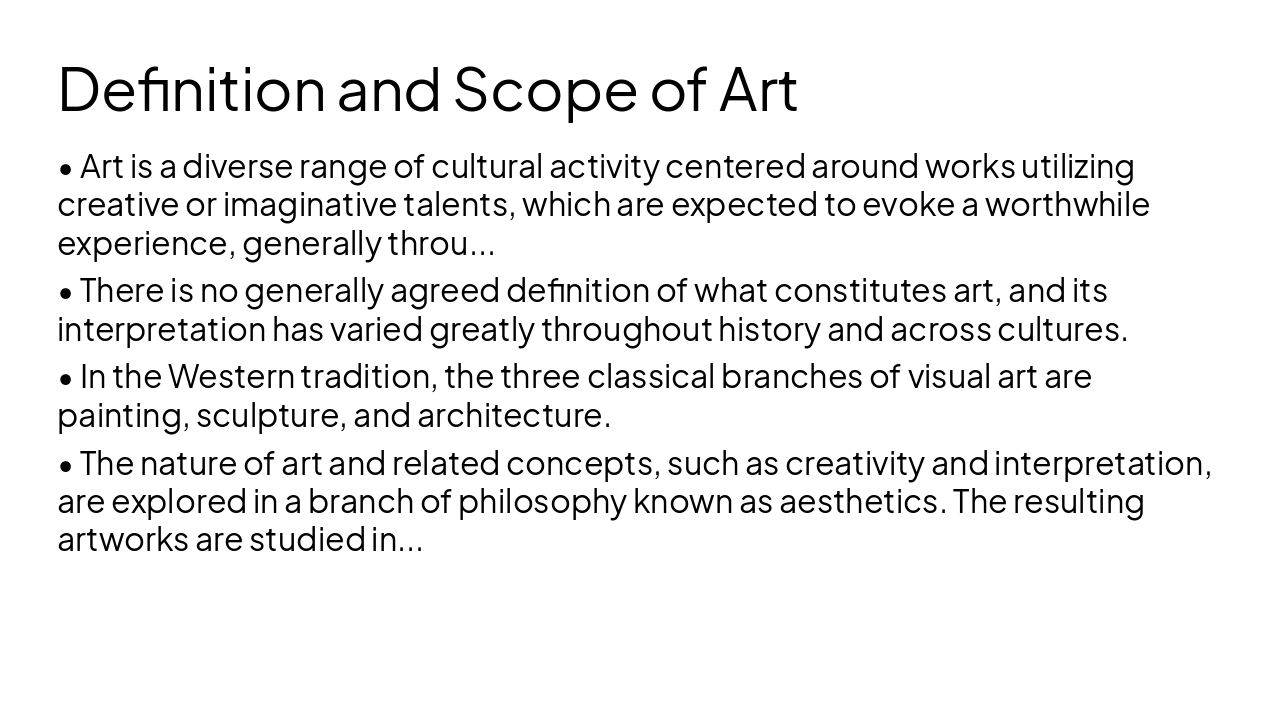
  • Art is a diverse range of cultural activity centered around works utilizing creative or imaginative talents, which are expected to evoke a worthwhile experience, generally through an expression of emotional power, conceptual ideas, technical proficiency, or beauty.
  • There is no generally agreed definition of what constitutes art, and its interpretation has varied greatly throughout history and across cultures.
  • In the Western tradition, the three classical branches of visual art are painting, sculpture, and architecture.
  • The nature of art and related concepts, such as creativity and interpretation, are explored in a branch of philosophy known as aesthetics. The resulting artworks are studied in the professional fields of art criticism and the history of art.
Slide 3 - Definition and Scope of Art
Slide 4 of 8

Slide 4 - Section 2: Graphic Design History

2

History of Graphic Design

Tracing the evolution of visual communication technologies

---

Photo by Marina Gorskaya on Unsplash
Slide 4 - Section 2: Graphic Design History
Slide 5 of 8

Slide 5 - Graphic Design Practice and History

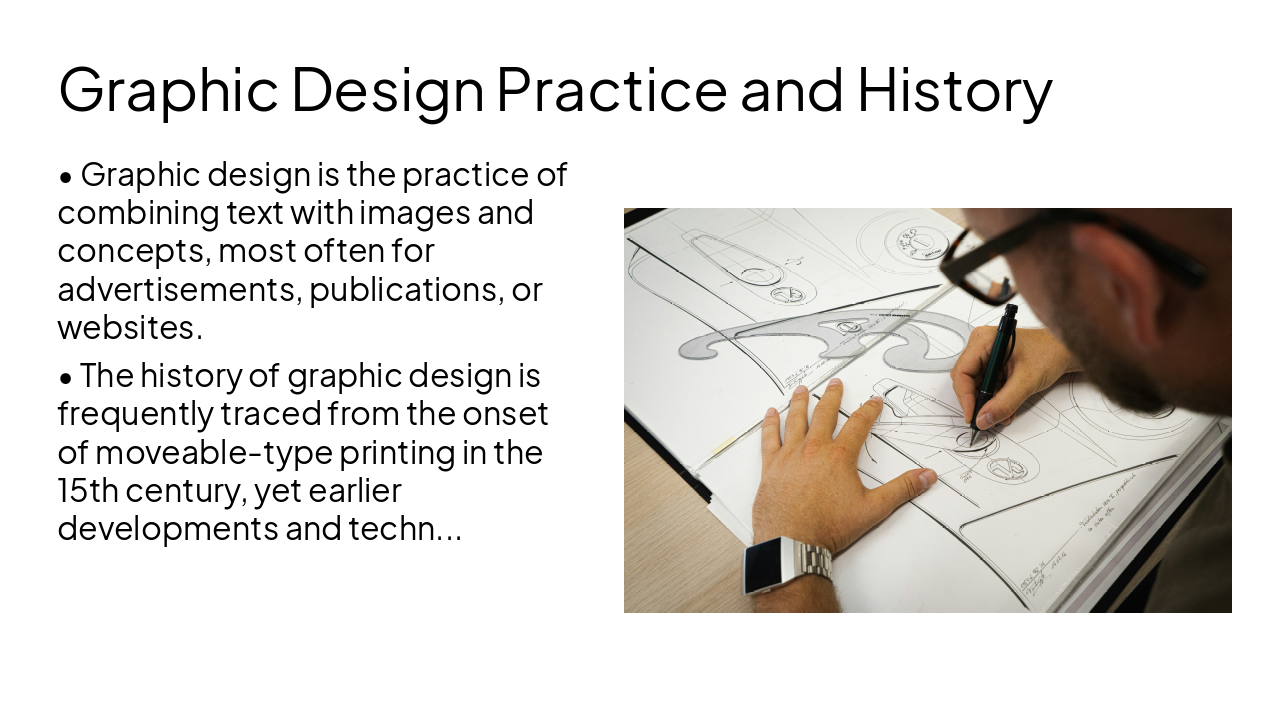
  • Graphic design is the practice of combining text with images and concepts, most often for advertisements, publications, or websites.
  • The history of graphic design is frequently traced from the onset of moveable-type printing in the 15th century, yet earlier developments and technologies related to writing and printing can be considered as parts of the longer history of communication.

---

Photo by Kumpan Electric on Unsplash
Slide 5 - Graphic Design Practice and History
Slide 6 of 8

Slide 6 - Section 3: Case Study

3

Iconic Recruitment Messaging

Case study of 'Daddy, What Did You Do in the Great War?'

---

Photo by Community Archives of Belleville and Hastings County on Unsplash

Slide 6 - Section 3: Case Study
Slide 7 of 8

Slide 7 - Case Study: Iconic Recruitment Poster

  • 'Daddy, What Did You Do in the Great War?' was a British First World War recruitment poster by Savile Lumley, and first published in March 1915 by the Parliamentary Recruiting Committee.
  • The poster shows a daughter posing a question to her father, depicting a future from the perspective of viewers in 1915.
  • It implies the viewer will be seen as a coward by following generations if they do not contribute to the war, a message inspired by Gunn's own feelings of guilt.
  • Unlike other recruitment posters of the time which focused on more direct calls to action, the poster used indirect messaging.
  • Although the poster is now considered an icon of British history during the First World War, it was not one of the most circulated recruitment posters.
Slide 7 - Case Study: Iconic Recruitment Poster
Slide 8 of 8

Slide 8 - Concluding Remarks

Conclusion: Art and Design as Historical Documents

The intersection of art, history, and graphic design communication.

---

Photo by Robert Bye on Unsplash
Slide 8 - Concluding Remarks

Discover More Presentations

Explore thousands of AI-generated presentations for inspiration

Browse Presentations
Powered by AI

Create Your Own Presentation

Generate professional presentations in seconds with Karaf's AI. Customize this presentation or start from scratch.

Create New Presentation

Powered by Karaf.ai — AI-Powered Presentation Generator