AI in CS Student Assessment: Practical Insights

Generated from prompt:

Create an 8-minute academic and research-focused presentation titled 'The Role of AI in Computer Science Student Assessment: A Practical Approach'. The presentation should include 8–10 slides and cover: introduction, context of AI in education, challenges in traditional CS assessment, AI-driven assessment approaches, case studies or evidence from research, ethical considerations (bias, fairness, transparency), future implications, and a concise conclusion. Include scholarly tone, professional visual style, and logical flow suitable for an interview or academic defense.

This presentation explores AI's integration in computer science education, addressing traditional assessment challenges, AI-driven methods, research evidence from MIT and Stanford, ethical issues like

November 29, 202510 slides
Slide 1 of 10

Slide 1 - The Role of AI in CS Student Assessment

The slide's title, "The Role of AI in CS Student Assessment: A Practical Approach," introduces a focus on integrating artificial intelligence into evaluating computer science students. Its subtitle, "Exploring AI-Driven Methods for Effective Evaluation in Computer Science Education," highlights practical AI techniques to enhance assessment in CS learning environments.

The Role of AI in CS Student Assessment: A Practical Approach

Exploring AI-Driven Methods for Effective Evaluation in Computer Science Education

Speaker Notes
Welcome to the presentation on the role of AI in assessing computer science students. Presenter name and date. Scholarly introduction to the practical approach.
Slide 1 - The Role of AI in CS Student Assessment
Slide 2 of 10

Slide 2 - Presentation Agenda

The presentation agenda outlines a structured overview starting with an introduction to the topic and objectives, followed by the role of AI in enhancing educational practices and the challenges of traditional computer science assessments. It then covers innovative AI-driven assessment techniques, concluding with case studies, ethical considerations, and a future outlook.

Presentation Agenda

  1. Introduction
  2. Overview of the presentation and objectives.

  3. AI in Education Context
  4. Role of AI in enhancing educational practices.

  5. Traditional CS Assessment Challenges
  6. Key limitations in conventional evaluation methods.

  7. AI-Driven Assessment Approaches
  8. Innovative AI techniques for student assessment.

  9. Case Studies, Ethics, and Future Outlook

Evidence, considerations, implications, and conclusion. Source: The Role of AI in Computer Science Student Assessment: A Practical Approach

Slide 2 - Presentation Agenda
Slide 3 of 10

Slide 3 - Introduction to AI in Student Assessment

This slide introduces the growing integration of AI in higher education assessments, with a particular focus on computer science curricula and evaluation methods. It highlights how AI enables personalized learning experiences, boosts the efficiency and scalability of assessments, and delivers practical benefits for academic and research environments.

Introduction to AI in Student Assessment

  • AI's rising integration in higher education assessments
  • Focus on computer science curricula and evaluation
  • Enables personalized learning experiences for students
  • Enhances efficiency and scalability of assessments
  • Practical benefits for academic and research contexts
Slide 3 - Introduction to AI in Student Assessment
Slide 4 of 10

Slide 4 - The Role of AI in Computer Science Student Assessment: A Practical Approach

This section header slide introduces the "Context of AI in Education" as the third part of the presentation on AI's role in assessing computer science students. It highlights the historical evolution of AI in education, from adaptive learning systems to automated grading tools and their integration into global curricula.

The Role of AI in Computer Science Student Assessment: A Practical Approach

03

Context of AI in Education

Historical evolution from adaptive learning to automated grading and global curriculum integration.

Speaker Notes
Description: Historical evolution of AI from adaptive learning to automated grading. Highlight integration in curricula worldwide, supported by recent educational tech trends.
Slide 4 - The Role of AI in Computer Science Student Assessment: A Practical Approach
Slide 5 of 10

Slide 5 - Challenges in Traditional CS Assessment

Traditional computer science assessments face challenges like subjectivity in grading code, which causes inconsistent evaluations, and scalability issues that hinder handling large classes. Additionally, time-consuming manual reviews burden instructors, limited plagiarism detection undermines integrity, and inadequate feedback slows student learning.

Challenges in Traditional CS Assessment

  • Subjectivity in grading code leads to inconsistent evaluations
  • Scalability issues limit assessment in large classes
  • Time-intensive manual reviews burden instructors
  • Limitations in detecting plagiarism compromise integrity
  • Inadequate feedback delays student learning
Slide 5 - Challenges in Traditional CS Assessment
Slide 6 of 10

Slide 6 - AI-Driven Assessment Approaches

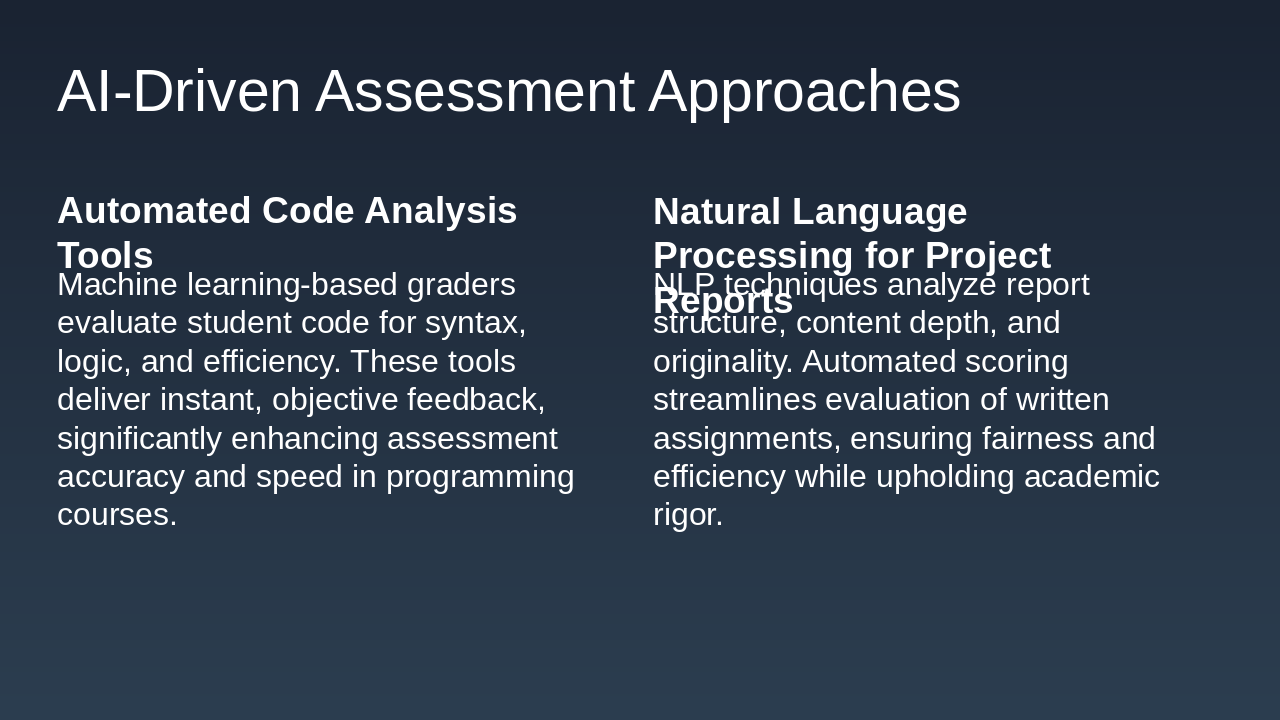
AI-Driven Assessment Approaches highlight automated code analysis tools that use machine learning to evaluate student programming submissions for syntax, logic, and efficiency, providing instant and objective feedback to boost accuracy and speed. On the other side, natural language processing techniques assess project reports by analyzing structure, content depth, and originality, enabling fair, efficient scoring that maintains academic standards.

AI-Driven Assessment Approaches

Automated Code Analysis ToolsNatural Language Processing for Project Reports
Machine learning-based graders evaluate student code for syntax, logic, and efficiency. These tools deliver instant, objective feedback, significantly enhancing assessment accuracy and speed in programming courses.NLP techniques analyze report structure, content depth, and originality. Automated scoring streamlines evaluation of written assignments, ensuring fairness and efficiency while upholding academic rigor.
Slide 6 - AI-Driven Assessment Approaches
Slide 7 of 10

Slide 7 - Case Studies and Research Evidence

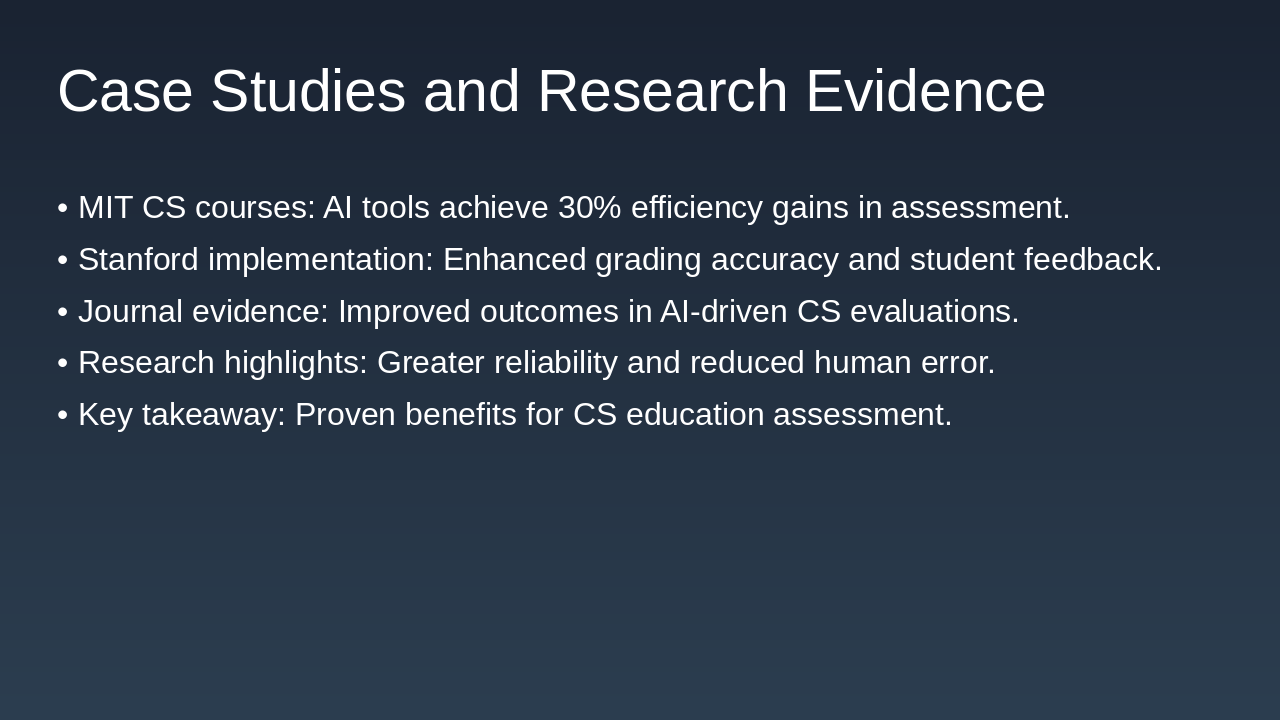
Case studies from MIT CS courses and Stanford implementations demonstrate that AI tools deliver 30% efficiency gains in assessments, enhanced grading accuracy, and improved student feedback. Research evidence from journals highlights greater reliability, reduced human error, and proven benefits for AI-driven CS education evaluations.

Case Studies and Research Evidence

  • MIT CS courses: AI tools achieve 30% efficiency gains in assessment.
  • Stanford implementation: Enhanced grading accuracy and student feedback.
  • Journal evidence: Improved outcomes in AI-driven CS evaluations.
  • Research highlights: Greater reliability and reduced human error.
  • Key takeaway: Proven benefits for CS education assessment.
Slide 7 - Case Studies and Research Evidence
Slide 8 of 10

Slide 8 - Ethical Considerations: Bias, Fairness, Transparency

The slide addresses ethical challenges in AI for education, emphasizing the need to tackle biases that affect diverse student groups in assessments and to perform regular fairness audits for detecting and reducing inequities. It also advocates for transparent AI models to build accountability and trust, alongside creating guidelines for responsible deployment in educational settings.

Ethical Considerations: Bias, Fairness, Transparency

  • Address AI biases impacting diverse student demographics in assessments
  • Conduct regular fairness audits to detect and mitigate inequities
  • Promote transparent models for accountability and trust in AI systems
  • Establish ethical guidelines for responsible AI deployment in education
Slide 8 - Ethical Considerations: Bias, Fairness, Transparency
Slide 9 of 10

Slide 9 - Future Implications

AI is transforming computer science education by delivering real-time, personalized feedback, while upskilling educators helps overcome adoption challenges and fosters hybrid human-AI systems for more effective and scalable assessments. The slide emphasizes the need for continued research to ensure ethical and transparent integration of AI in these areas.

Future Implications

  • AI revolutionizes CS education through real-time, personalized feedback.
  • Upskilling educators addresses key challenges in AI adoption.
  • Hybrid human-AI systems enhance assessment effectiveness and scalability.
  • Ongoing research needed for ethical, transparent AI integration.
Slide 9 - Future Implications
Slide 10 of 10

Slide 10 - Conclusion

AI transforms computer science student assessment by providing practical efficiencies, but it requires ethical oversight to address bias, fairness, and transparency. To enhance educational outcomes, the slide urges embracing AI's potential ethically and advancing research along with its implementation in academia today.

Conclusion

AI plays a transformative role in CS student assessment, offering practical efficiencies while demanding ethical guidance on bias, fairness, and transparency. As we advance, integrating AI thoughtfully will enhance educational outcomes.

Closing Message: Embrace AI's potential ethically.

Call to Action: Advance research and implement AI in academia today.

Slide 10 - Conclusion

Discover More Presentations

Explore thousands of AI-generated presentations for inspiration

Browse Presentations
Powered by AI

Create Your Own Presentation

Generate professional presentations in seconds with Karaf's AI. Customize this presentation or start from scratch.

Create New Presentation

Powered by Karaf.ai — AI-Powered Presentation Generator