Dinosauria: Exploring the Dino World

Generated from prompt:

Make a presentation about dinosuria die fragen kannst du nehmen

This presentation introduces Dinosauria, covering their definition, key traits like bipedal/quadrupedal locomotion and hollow bones, evolutionary timeline, iconic species such as late Cretaceous apex

November 18, 202510 slides
Slide 1 of 10

Slide 1 - Dinosauria

The slide, titled "Dinosauria," serves as a title slide introducing the topic. It features the main text "Welcome to the World of Dinosaurs" and a subtitle "Explore the Fascinating Clade Dinosauria and Their Impact on Earth."

Welcome to the World of Dinosaurs

Explore the Fascinating Clade Dinosauria and Their Impact on Earth

Slide 1
Slide 2 of 10

Slide 2 - Presentation Agenda

The presentation agenda outlines a structured exploration of dinosaurs, starting with an introduction to what Dinosauria is. It then covers the evolutionary timeline, types of dinosaurs, fun facts along with their extinction, and ends with a conclusion.

Presentation Agenda

  1. What is Dinosauria?
  1. Evolutionary Timeline
  1. Types of Dinosaurs
  1. Fun Facts and Extinction
  1. Conclusion
Slide 2
Slide 3 of 10

Slide 3 - What is Dinosauria?

The slide titled "What is Dinosauria?" serves as a section header introducing the topic. It defines Dinosauria as a diverse group of reptiles that dominated terrestrial ecosystems for over 165 million years.

What is Dinosauria?

What is Dinosauria?

A diverse group of reptiles that dominated terrestrial ecosystems for over 165 million years.

--- Speaker Notes: Dinosauria is a diverse group of reptiles that dominated terrestrial ecosystems for over 165 million years.

Slide 3
Slide 4 of 10

Slide 4 - Key Characteristics

Dinosaurs exhibited diverse locomotion, walking on either two or four legs, and possessed hollow bones that contributed to their lightness. They laid eggs with hard shells and varied greatly in size, ranging from small to massive.

Key Characteristics

  • Walked on two or four legs
  • Featured hollow bones for lightness
  • Laid eggs with hard shells
  • Varied in size from small to massive
Slide 4
Slide 5 of 10

Slide 5 - Evolutionary Timeline

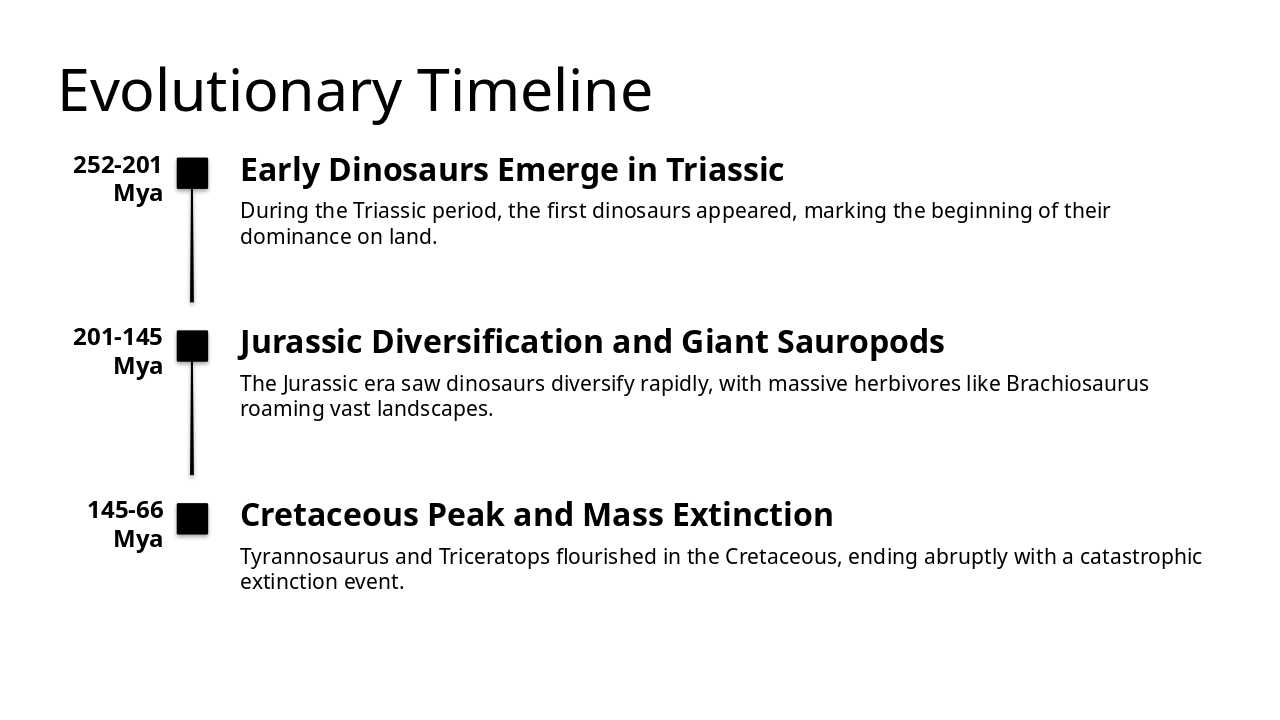
The Evolutionary Timeline slide outlines the rise and fall of dinosaurs across three Mesozoic periods. It begins with their emergence in the Triassic (252-201 Mya), followed by rapid diversification and giant sauropods in the Jurassic (201-145 Mya), and peaks with iconic species like Tyrannosaurus in the Cretaceous (145-66 Mya) before a mass extinction.

Evolutionary Timeline

252-201 Mya: Early Dinosaurs Emerge in Triassic During the Triassic period, the first dinosaurs appeared, marking the beginning of their dominance on land. 201-145 Mya: Jurassic Diversification and Giant Sauropods The Jurassic era saw dinosaurs diversify rapidly, with massive herbivores like Brachiosaurus roaming vast landscapes. 145-66 Mya: Cretaceous Peak and Mass Extinction Tyrannosaurus and Triceratops flourished in the Cretaceous, ending abruptly with a catastrophic extinction event.

Slide 5
Slide 6 of 10

Slide 6 - Iconic Dinosaurs

This slide, titled "Iconic Dinosaurs," features an image of Tyrannosaurus rex, a famous apex predator from the late Cretaceous period known for its massive jaws and tiny forelimbs. It highlights key facts, including that fossils of this dinosaur have been discovered in North America.

Iconic Dinosaurs

!Image

  • Lived during late Cretaceous period
  • Apex predator with massive jaws
  • Famous for tiny forelimbs
  • Fossils discovered in North America

Source: Wikipedia

--- Speaker Notes: The mighty Tyrannosaurus rex, apex predator of the late Cretaceous.

Slide 6
Slide 7 of 10

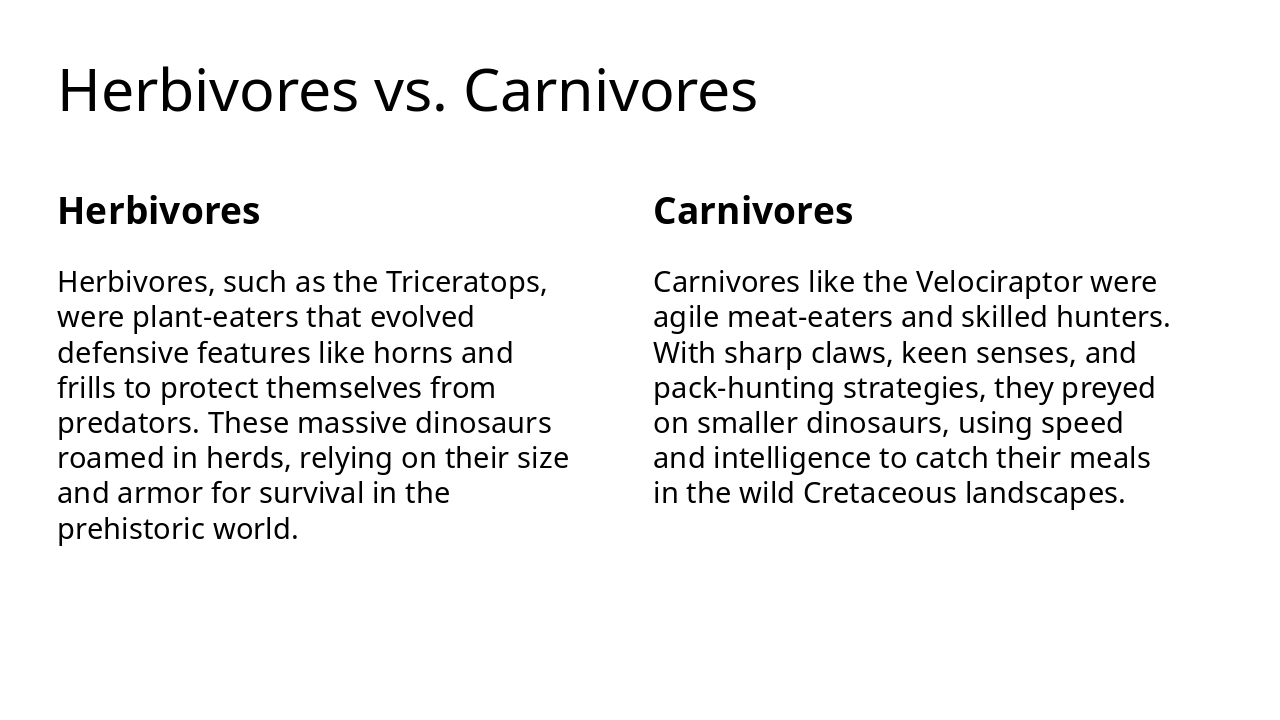
Slide 7 - Herbivores vs. Carnivores

Herbivores like the Triceratops were plant-eating dinosaurs that developed defensive traits such as horns and frills, roaming in herds and relying on their size and armor for protection against predators. In contrast, carnivores such as the Velociraptor were agile meat-eaters equipped with sharp claws, keen senses, and pack-hunting tactics, using speed and intelligence to hunt smaller dinosaurs in Cretaceous environments.

Herbivores vs. Carnivores

HerbivoresCarnivores
Herbivores, such as the Triceratops, were plant-eaters that evolved defensive features like horns and frills to protect themselves from predators. These massive dinosaurs roamed in herds, relying on their size and armor for survival in the prehistoric world.Carnivores like the Velociraptor were agile meat-eaters and skilled hunters. With sharp claws, keen senses, and pack-hunting strategies, they preyed on smaller dinosaurs, using speed and intelligence to catch their meals in the wild Cretaceous landscapes.
Slide 7
Slide 8 of 10

Slide 8 - Dinosaur Stats

Over 1,000 dinosaur species have been discovered, with the largest being Argentinosaurus at 35 meters long and the smallest, Microraptor, at just 0.6 meters. Dinosaurs dominated Earth for 165 million years.

Dinosaur Stats

  • 1,000+: Species Discovered

Over 1,000 dinosaur species identified

  • 35m: Largest Dinosaur

Argentinosaurus reached 35 meters long

  • 0.6m: Smallest Dinosaur

Microraptor measured just 0.6 meters

  • 165M: Years Ruled

Dominated Earth for 165 million years

Slide 8
Slide 9 of 10

Slide 9 - A Paleontologist's View

The slide, titled "A Paleontologist's View," features a quote from renowned paleontologist Jack Horner. In it, he describes dinosaurs as an evolutionary pinnacle that achieved remarkable adaptive success, dominating Earth for over 165 million years.

A Paleontologist's View

> Dinosaurs represent a pinnacle of evolution, demonstrating remarkable adaptive success that dominated the Earth for over 165 million years.

— Jack Horner, Renowned Paleontologist

--- Speaker Notes: Reflecting on their adaptive success in a presentation about dinosaurs.

Slide 9
Slide 10 of 10

Slide 10 - Conclusion: Legacy of Dinosauria

The conclusion slide, titled "Legacy of Dinosauria," emphasizes that dinosaurs profoundly shaped Earth's history and continue to inspire science and culture despite their extinction. Its subtitle, "The legacy endures," reinforces this lasting impact, ending with a thank-you to the audience.

Conclusion: Legacy of Dinosauria

Dinosaurs shaped our planet's history. Though extinct, they inspire science and culture today. Thanks for watching!

The legacy endures.

Slide 10
Powered by AI

Create Your Own Presentation

Generate professional presentations in seconds with Karaf's AI. Customize this presentation or start from scratch.

Create New Presentation

Powered by Karaf.ai — AI-Powered Presentation Generator