Int8 Quantization & Training Optimization Practices (48 char

Generated from prompt:

生成一份主题为《Int8量化与训练优化实践》的技术分享PPT,面向深度学习工程师,内容包括:1. 量化的背景与意义 2. Int8 量化原理 3. 训练后量化(PTQ)与量化感知训练(QAT)对比 4. 主流框架支持(PyTorch、TensorFlow、ONNX Runtime) 5. 精度与性能权衡 6. 实践案例:MobileNet量化实验 7. 总结与未来展望。整体风格为技术风,简洁、蓝色调,含图表示意与代码片段,约12页。

Technical PPT for DL engineers on Int8 quantization: background, principles, PTQ/QAT comparison, framework support (PyTorch/TF/ONNX), precision-performance trade-offs, MobileNet case study, and future

December 16, 202515 slides
Slide 1 of 15

Slide 1 - Int8量化与训练优化实践

This title slide presents "Int8 Quantization and Training Optimization Practices" as the main topic. The subtitle describes it as "Deep Learning Model Optimization: Sharing from Principles to Practices."

Int8量化与训练优化实践

深度学习模型优化:从原理到实践分享

Source: 技术分享PPT,面向深度学习工程师

Speaker Notes
页1/12:标题页,简洁蓝色调,突出主题。
Slide 1 - Int8量化与训练优化实践
Slide 2 of 15

Slide 2 - 分享大纲

This agenda slide outlines a presentation on quantization in deep learning, starting with its background and significance. It then covers Int8 principles, PTQ vs. QAT comparison, framework support with trade-offs, and MobileNet experiments with summary and outlook.

分享大纲

  1. 1. 量化的背景与意义
  2. 介绍量化技术的背景、必要性及其在深度学习中的意义。

  3. 2. Int8量化原理
  4. 详解Int8量化的核心原理和数学基础。

  5. 3. PTQ与QAT对比
  6. 对比训练后量化(PTQ)与量化感知训练(QAT)的差异。

  7. 4. 框架支持与权衡
  8. 主流框架支持及精度、性能的权衡分析。

  9. 5. 实验、总结与展望

MobileNet量化实践案例、总结及未来展望。 Source: Int8量化与训练优化实践

Slide 2 - 分享大纲
Slide 3 of 15

Slide 3 - Int8量化与训练优化实践

This section header slide, titled "Int8 Quantization and Training Optimization Practices," introduces Section 1: "Background and Significance of Quantization." The subtitle outlines model deployment pain points, edge computing demands, and quantization benefits like reduced memory/computation and faster inference speed.

Int8量化与训练优化实践

1

量化的背景与意义

模型部署痛点、边缘计算需求与量化益处:降低内存计算,提升推理速度

Speaker Notes
介绍量化技术兴起背景:模型部署痛点、边缘计算需求。意义:降低内存/计算量,提升推理速度。(配趋势图)
Slide 3 - Int8量化与训练优化实践
Slide 4 of 15

Slide 4 - 量化背景详解

The slide outlines challenges of deploying floating-point models, including high memory and power consumption, especially on resource-limited mobile and edge devices. It explains quantization's goal of 8-bit integer representation for 2-4x acceleration, with INT8 as the emerging industry mainstream.

量化背景详解

  • 浮点模型部署挑战:高内存、高功耗
  • 移动/边缘设备:资源严格限制
  • 量化目标:8bit整数表示,加速2-4x
  • 行业趋势:INT8量化成主流
Slide 4 - 量化背景详解
Slide 5 of 15

Slide 5 - 量化意义示意图

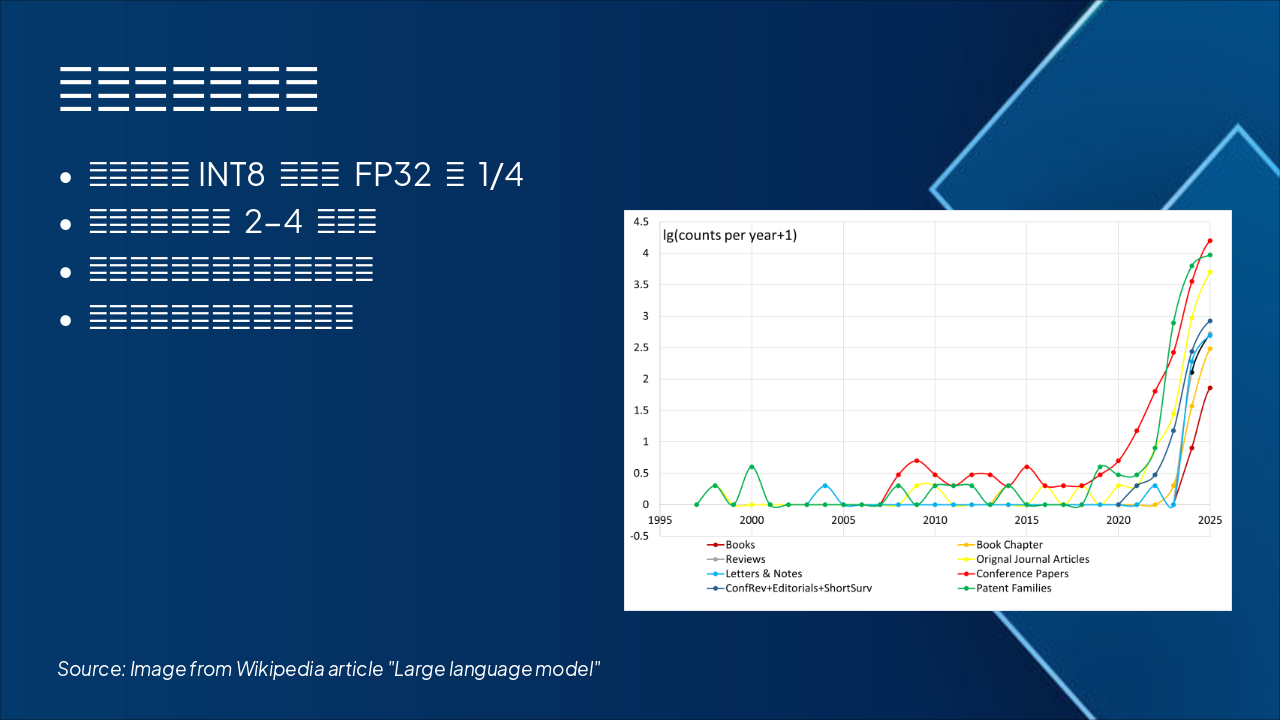
This slide diagram illustrates the benefits of INT8 quantization compared to FP32. It shows model size reduced to 1/4, 2-4x faster inference speed, significantly lower memory usage, and efficient deployment on edge devices.

量化意义示意图

!Image

  • 模型大小:INT8 缩小至 FP32 的 1/4
  • 推理速度:提升 2-4 倍性能
  • 内存占用:显著降低,节省资源
  • 部署优势:边缘设备高效运行

Source: Image from Wikipedia article "Large language model"

Speaker Notes
展示FP32 vs INT8模型大小/速度对比图表。突出性能提升与部署优势。(插入柱状图)
Slide 5 - 量化意义示意图
Slide 6 of 15

Slide 6 - 2. Int8 量化原理

This slide is a section header for Section 2: Int8 Quantization Principles. It subtitles the mapping of weights and activations from FP32 to INT8 via dynamic/static range calibration and zero point/scale calculations.

2. Int8 量化原理

2

Int8 量化原理

权重/激活值从 FP32 映射到 INT8:动态/静态范围校准与零点/尺度计算

Source: Int8量化与训练优化实践 PPT

Speaker Notes
核心:权重/激活值从FP32映射到INT8。动态/静态范围校准,零点/尺度计算。
Slide 6 - 2. Int8 量化原理
Slide 7 of 15

Slide 7 - INT8量化流程

The slide details the INT8 quantization workflow in four steps: collecting activation statistics via model forward propagation, computing min/max values, calculating scale as (max - min)/255, and applying the quantization formula q = round(x / scale + zp). This process converts floating-point activations to INT8 format using per-tensor scaling and zero-point.

INT8量化流程

{ "headers": [ "步骤", "描述", "公式/细节" ], "rows": [ [ "1. 收集激活统计", "通过模型前向传播收集激活值的统计信息", "统计激活分布" ], [ "2. 计算min/max", "从收集的统计中提取激活的最小值和最大值", "min = min(activations) max = max(activations)" ], [ "3. 计算尺度", "基于范围计算量化尺度", "scale = (max - min) / 255" ], [ "4. 量化公式", "将浮点值转换为INT8量化值", "q = round(x / scale + zp)" ] ] }

Slide 7 - INT8量化流程
Slide 8 of 15

Slide 8 - 量化公式与代码

The slide outlines the PyTorch code and formula for asymmetric quantization, mapping dynamic input ranges to [0,255]. It calculates scale as (max - min)/255, applies quant = torch.round(x / scale + zeropoint).clamp(0, 255), and implements the non-symmetric mapping.

量化公式与代码

  • scale = (max - min) / 255 // 缩放因子
  • quant = torch.round(x / scale + zeropoint) // 量化计算
  • .clamp(0, 255) // 范围裁剪
  • 实现动态范围到[0,255]的非对称映射

Source: scale = (max - min) / 255 quant = torch.round(x / scale + zero_point).clamp(0, 255)

Speaker Notes
PyTorch风格伪代码,展示Int8非对称量化核心公式与实现步骤。
Slide 8 - 量化公式与代码
Slide 9 of 15

Slide 9 - 3. PTQ vs QAT对比

This section header slide marks Section 3, titled "PTQ vs QAT Comparison." The subtitle contrasts Post-Training Quantization (PTQ) with Quantization-Aware Training (QAT).

3

PTQ vs QAT对比

训练后量化(PTQ) vs 量化感知训练(QAT)

Slide 9 - 3. PTQ vs QAT对比
Slide 10 of 15

Slide 10 - PTQ 与 QAT 对比

The slide compares PTQ (Post-Training Quantization) and QAT (Quantization-Aware Training) in a two-column format. PTQ offers simple, fast quantization without retraining but with significant accuracy loss, while QAT simulates quantization during training for higher precision at the cost of increased training effort.

PTQ 与 QAT 对比

PTQ (训练后量化)QAT (量化感知训练)
后处理方式,简单快速,无需重新训练。直接量化预训练模型权重和激活。优点:实现便捷。缺点:精度损失较大,尤其低比特下。(约20字)训练中插入量化节点,模拟推理量化误差。通过反向传播优化。优点:精度更高,接近FP32。缺点:训练成本高,需修改训练流程。(配精度曲线图)(约28字)
Slide 10 - PTQ 与 QAT 对比
Slide 11 of 15

Slide 11 - 主流框架支持

The slide "Mainstream Framework Support" compares quantization capabilities across PyTorch, TensorFlow, and ONNX Runtime. It lists PTQ (e.g., ✓ for PyTorch, tf.lite for TensorFlow), QAT (e.g., torch.ao.quantization, Model Optimization), and optimizers (e.g., FXGraph, TPU, CUDA/CPU).

主流框架支持

{ "headers": [ "框架", "PTQ", "QAT", "优化器" ], "rows": [ [ "PyTorch", "✓", "torch.ao.quantization", "FXGraph" ], [ "TensorFlow", "tf.lite", "Model Optimization", "TPU" ], [ "ONNX Runtime", "ORTQuant", "QOperator", "CUDA/CPU" ] ] }

Slide 11 - 主流框架支持
Slide 12 of 15

Slide 12 - 5. 精度与性能权衡

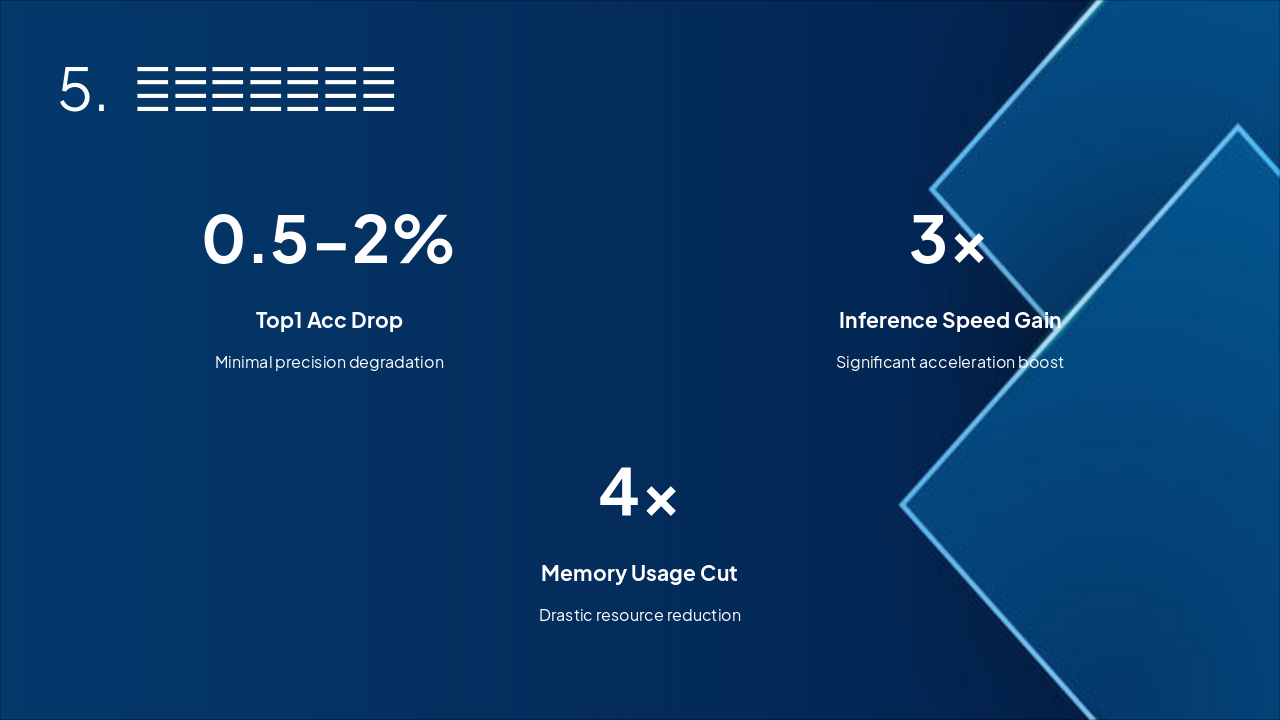
The slide on precision-performance trade-off reports a minimal Top1 accuracy drop of 0.5-2%. It delivers a 3x inference speed gain and 4x memory usage reduction.

5. 精度与性能权衡

  • 0.5-2%: Top1 Acc Drop
  • Minimal precision degradation

  • 3x: Inference Speed Gain
  • Significant acceleration boost

  • 4x: Memory Usage Cut
  • Drastic resource reduction

Slide 12 - 5. 精度与性能权衡
Slide 13 of 15

Slide 13 - MobileNet量化实验

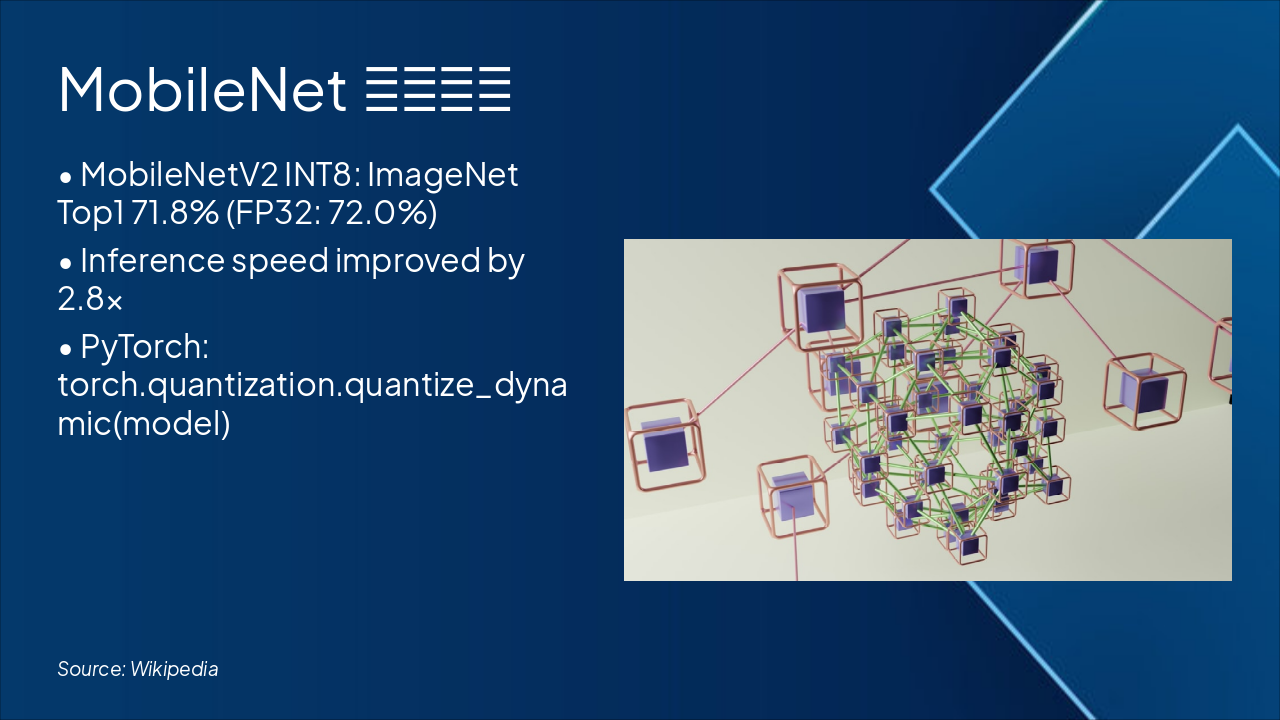
The slide on MobileNet quantization experiments shows MobileNetV2 INT8 achieving 71.8% ImageNet Top-1 accuracy (vs. 72.0% for FP32). It highlights a 2.8x inference speed improvement using PyTorch's torch.quantization.quantizedynamic(model).

MobileNet量化实验

!Image

  • MobileNetV2 INT8: ImageNet Top1 71.8% (FP32: 72.0%)
  • Inference speed improved by 2.8x
  • PyTorch: torch.quantization.quantize_dynamic(model)

Source: Wikipedia

Speaker Notes
MobileNetV2 INT8实验结果图:ImageNet Top1 71.8% (FP32:72.0%),速度2.8x。含代码片段:torch.quantization.quantize_dynamic。
Slide 13 - MobileNet量化实验
Slide 14 of 15

Slide 14 - 实践要点

This slide's practical key points recommend using COCO/ImageNet datasets for model calibration and torch.quantization tools for implementation. It addresses accuracy drops from abnormal activation distributions via fusion operators and KMeans clustering optimizations.

实践要点

  • 选择COCO/ImageNet数据集进行模型校准
  • 使用torch.quantization工具实现量化
  • 应对激活分布异常精度下降挑战
  • 采用融合算子和KMeans聚类优化方案
Slide 14 - 实践要点
Slide 15 of 15

Slide 15 - 总结与未来展望

INT8 quantization significantly boosts deployment efficiency, with QAT ensuring accuracy preservation. Future work includes INT4/mixed quantization and NAS automation, ending with thanks and Q&A.

总结与未来展望

INT8量化显著提升部署效率,QAT为精度保障。 未来:INT4/混合量化、NAS自动化。

感谢聆听!Q&A?

Slide 15 - 总结与未来展望

Discover More Presentations

Explore thousands of AI-generated presentations for inspiration

Browse Presentations
Powered by AI

Create Your Own Presentation

Generate professional presentations in seconds with Karaf's AI. Customize this presentation or start from scratch.

Create New Presentation

Powered by Karaf.ai — AI-Powered Presentation Generator