AI-Driven Bug Triage for Agile Teams (32 chars)

Generated from prompt:

Create a 15–18 slide presentation for the DRC research proposal titled 'Intelligent Bug Triage using Machine Learning for Agile Teams'. Use the exact content from the provided document (MS Research Synopsis). Include these sections: 1. Title Slide – Project title, student name (Muhammad Zohaib Anwar), supervisor (Dr. Mustafa Hameed), department, university. 2. Contents Slide – Overview of presentation sections. 3. Introduction (1) – Agile issue tracking and bug triage background. 4. Introduction (2) – Importance of automation in bug triage. 5. Problem Statement – Manual triage challenges: time, inconsistency, scalability, knowledge gaps. 6. Research Questions – RQ1 (Accuracy), RQ2 (Feature Importance), RQ3 (Explainability). 7. Research Objectives – Goals: model development, explainability, integration. 8. Research Significance – Academic and industrial impact. 9. Literature Review (1) – Evolution from classical ML to transformers. 10. Literature Review (2) – Table/summary of key works and research gaps. 11. Identified Research Gaps – Data size, explainability, integration issues. 12. Proposed Methodology Framework (1) – Dataset collection and preprocessing. 13. Proposed Methodology Framework (2) – Model development (TF-IDF, XGBoost, DistilBERT). 14. Proposed Methodology Framework (3) – Evaluation metrics and explainability (SHAP). 15. Expected Results – Accuracy comparison and practical outcomes. 16. Research Timeline – 6-month plan (collection, training, evaluation, deployment). 17. References – Full reference list (APA 6 format). 18. Acknowledgement Slide – Thank you/QA. Design requirements: - Unique and modern AI/ML-inspired design - Futuristic gradient background (blue/purple/cyan) - Use neural network and data visualization motifs - Clean, professional typography with icons and diagrams - Slide layout diversity (mix of charts, text blocks, visuals) - Minimal clutter, consistent theme

Proposes ML framework automating bug triage in agile Jira workflows using Spring dataset. Compares TF-IDF/XGBoost vs DistilBERT for >70% top-3 accuracy, SHAP explainability, addressing gaps in scalabi

December 16, 202519 slides
Slide 1 of 19

Slide 1 - Intelligent Bug Triage in AI-Based Project Management

Intelligent Bug Triage in AI-Based Project Management

MS Research Synopsis

Slide 1 - Intelligent Bug Triage in AI-Based Project Management
Slide 2 of 19

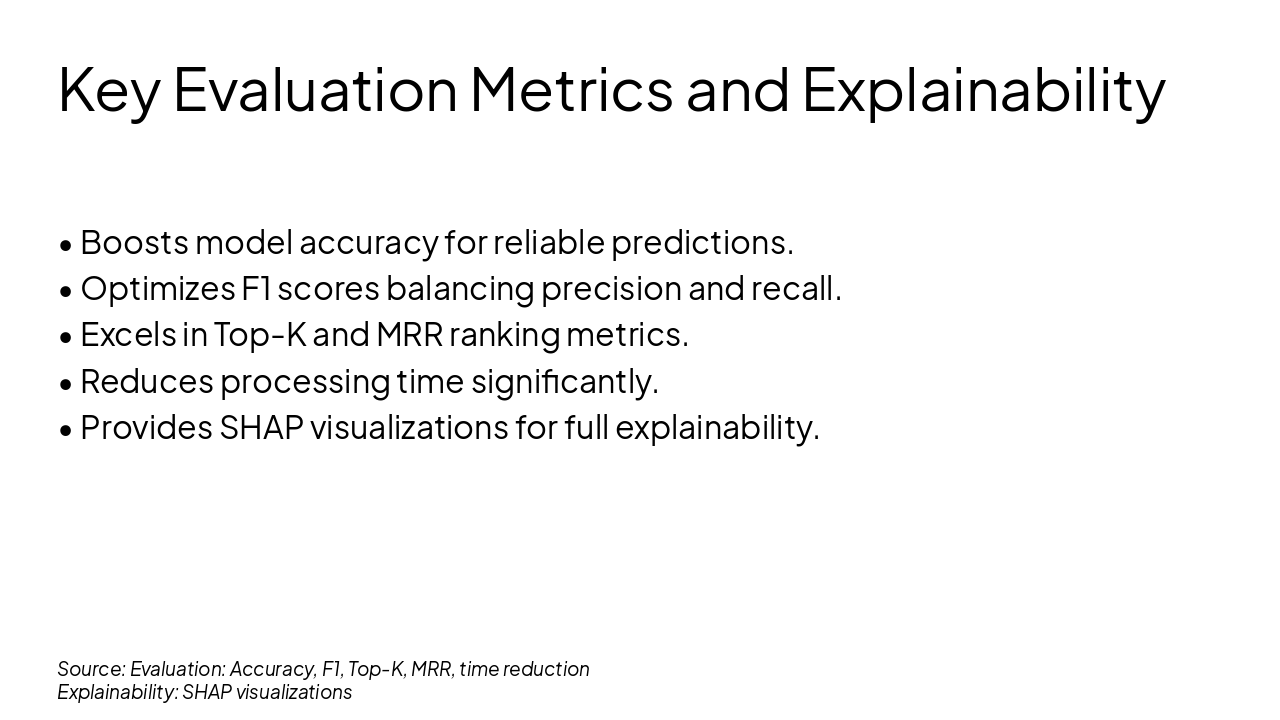
Slide 2 - Key Evaluation Metrics and Explainability

  • Boosts model accuracy for reliable predictions.
  • Optimizes F1 scores balancing precision and recall.
  • Excels in Top-K and MRR ranking metrics.
  • Reduces processing time significantly.
  • Provides SHAP visualizations for full explainability.
Slide 2 - Key Evaluation Metrics and Explainability
Slide 3 of 19

Slide 3 - 1.4 Research Objectives

  • Achieve ML model >70% Top-3 accuracy
  • Compare TF-IDF+RF/XGBoost vs DistilBERT
  • Provide SHAP explanations for predictions
  • Build Django prototype with Jira/GitHub integration
Slide 3 - 1.4 Research Objectives
Slide 4 of 19

Slide 4 - 1.1 Background

  • Agile development relies on efficient bug triage in Jira.
  • Manual triage creates bottlenecks from time, inconsistency, knowledge gaps.
  • AI/ML leverages historical data for accurate recommendations.
Slide 4 - 1.1 Background
Slide 5 of 19

Slide 5 - Conclusion

ML Excellence Delivered

Explore GitHub repo: models, charts, SHAP toolkit.

Slide 5 - Conclusion
Slide 6 of 19

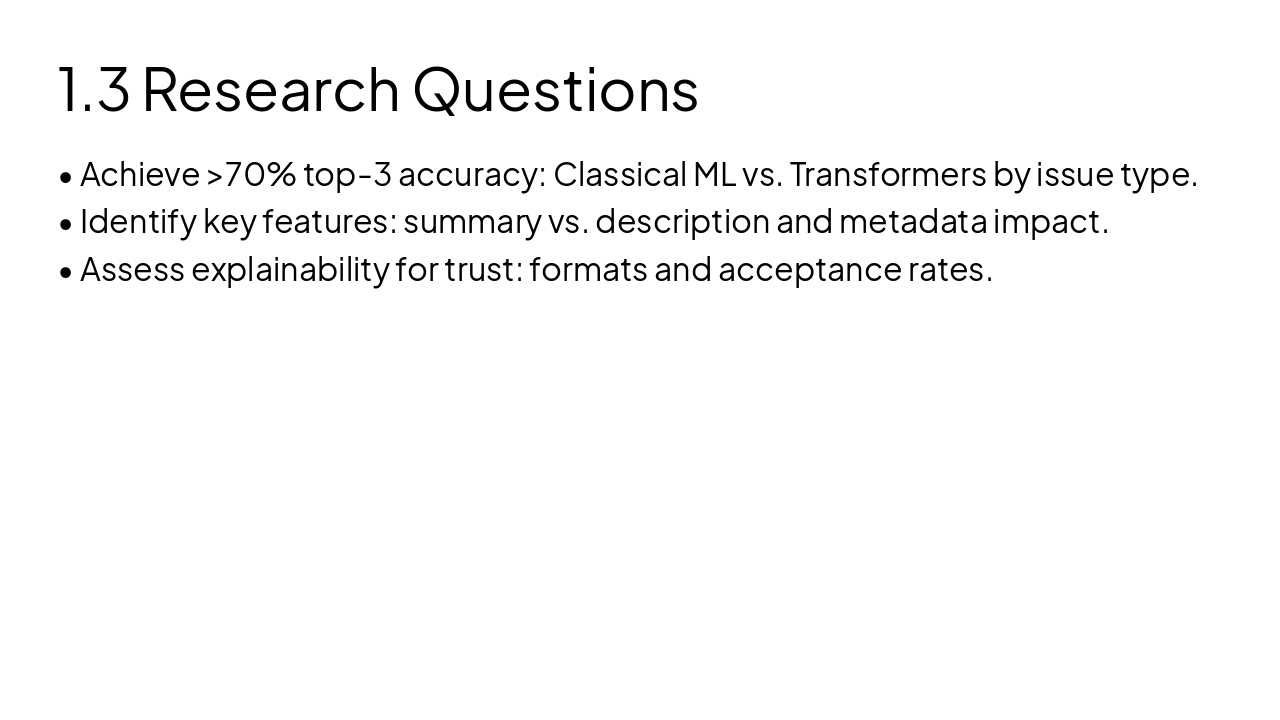
Slide 6 - 1.3 Research Questions

  • Achieve >70% top-3 accuracy: Classical ML vs. Transformers by issue type.
  • Identify key features: summary vs. description and metadata impact.
  • Assess explainability for trust: formats and acceptance rates.
Slide 6 - 1.3 Research Questions
Slide 7 of 19

Slide 7 - Research Gaps Summary

  • Datasets limited in size restrict model training.
  • Models achieve low accuracy on complex text.
  • Methods fail to capture text semantics.
  • Explainability remains absent in current approaches.
  • No integration with existing frameworks exists.
Slide 7 - Research Gaps Summary
Slide 8 of 19

Slide 8 - Literature Review

Slide 8 - Literature Review
Slide 9 of 19

Slide 9 - 3.2.2 Preprocessing: Tokenization, TF-IDF/BERT embeddings, imbalance handling, feature extraction

  • Tokenize text into words or subwords.
  • Apply TF-IDF or BERT for embeddings.
  • Handle class imbalance via resampling.
  • Extract relevant features for modeling.
Slide 9 - 3.2.2 Preprocessing: Tokenization, TF-IDF/BERT embeddings, imbalance handling, feature extraction
Slide 10 of 19

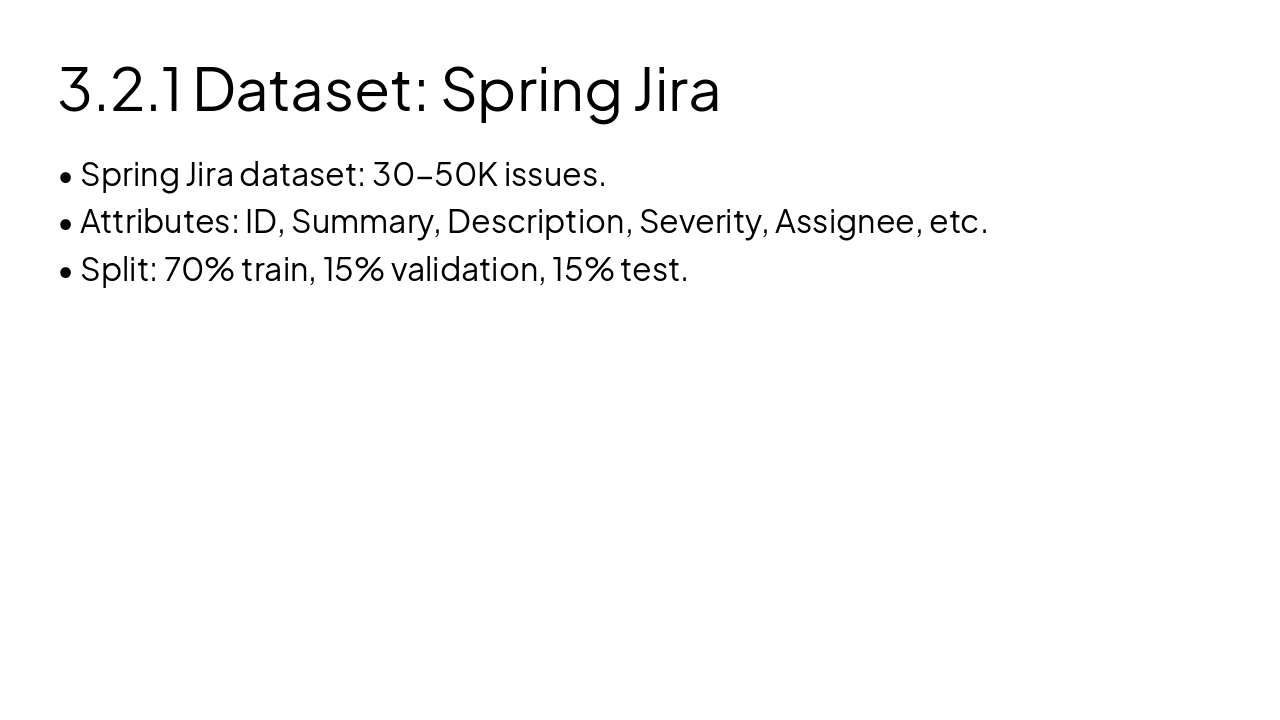
Slide 10 - 3.2.1 Dataset: Spring Jira

  • Spring Jira dataset: 30-50K issues.
  • Attributes: ID, Summary, Description, Severity, Assignee, etc.
  • Split: 70% train, 15% validation, 15% test.
Slide 10 - 3.2.1 Dataset: Spring Jira
Slide 11 of 19

Slide 11 - ML Evolution and Gaps

  • Evolved from Naive Bayes/SVM to CNN/LSTM.
  • Advanced to BERT/DistilBERT for superior NLP.
  • Gap: Lacking real-time deployment capabilities.
  • Gap: Needs workload balancing for scaling.
  • Gap: Missing Jira integration for workflows.
  • Gap: Enhance explainability for transparency.
Slide 11 - ML Evolution and Gaps
Slide 12 of 19

Slide 12 - Introduction

Slide 12 - Introduction
Slide 13 of 19

Slide 13 - Research Methodology

Slide 13 - Research Methodology
Slide 14 of 19

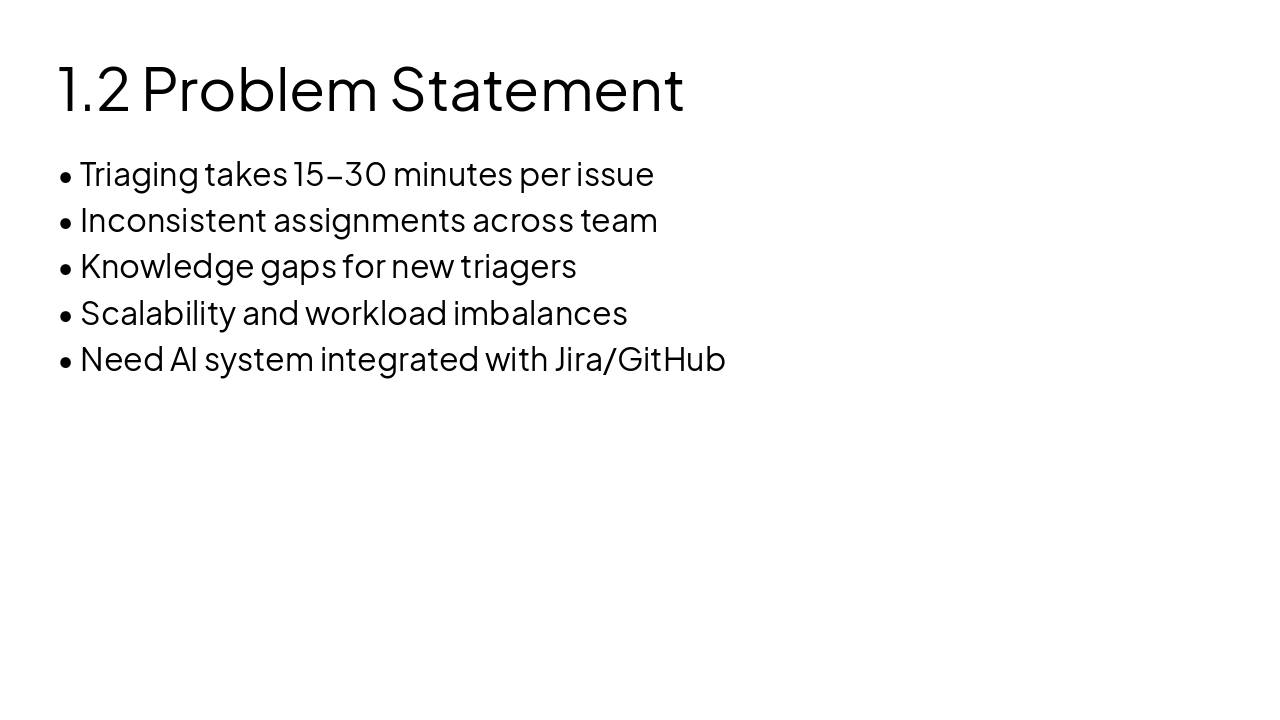
Slide 14 - 1.2 Problem Statement

  • Triaging takes 15-30 minutes per issue
  • Inconsistent assignments across team
  • Knowledge gaps for new triagers
  • Scalability and workload imbalances
  • Need AI system integrated with Jira/GitHub
Slide 14 - 1.2 Problem Statement
Slide 15 of 19

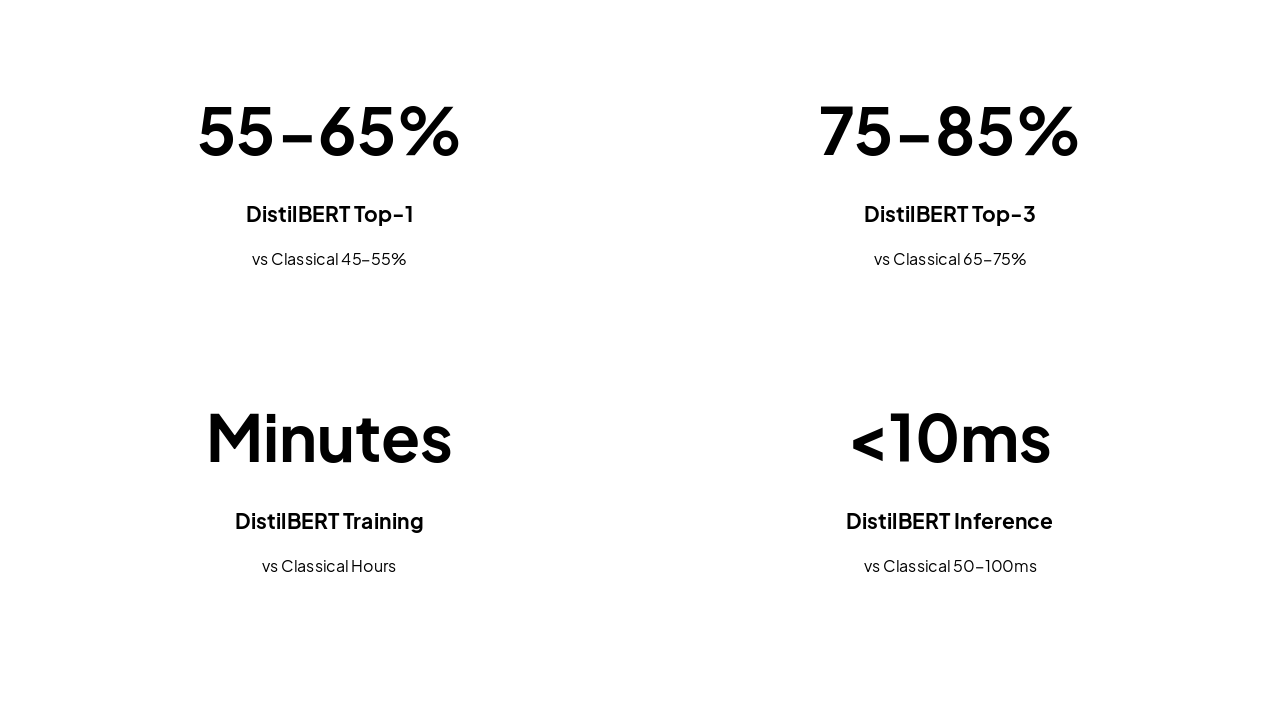
Slide 15 - Expected Results Top-1: Classical 45-55%, DistilBERT 55-65% Top-3: 65-75% vs 75-85% Training: Min vs Hours, Inference <10ms vs 50-100ms

Slide 15 - Expected Results
Top-1: Classical 45-55%, DistilBERT 55-65%
Top-3: 65-75% vs 75-85%
Training: Min vs Hours, Inference <10ms vs 50-100ms
Slide 16 of 19

Slide 16 - 1.5 Scope & 1.6 Significance

  • Analyzes Spring Jira dataset comprising 30-50K issues.
  • Delivers top-3 recommendations while applying exclusions.
  • Facilitates faster assignments of issues to developers.
  • Reduces overall workload for development teams.
  • Promotes balanced distribution of workload across teams.
  • Provides significant impact on real-world DevOps practices.
Slide 16 - 1.5 Scope & 1.6 Significance
Slide 17 of 19

Slide 17 - Literature Matrix

Slide 17 - Literature Matrix
Slide 18 of 19

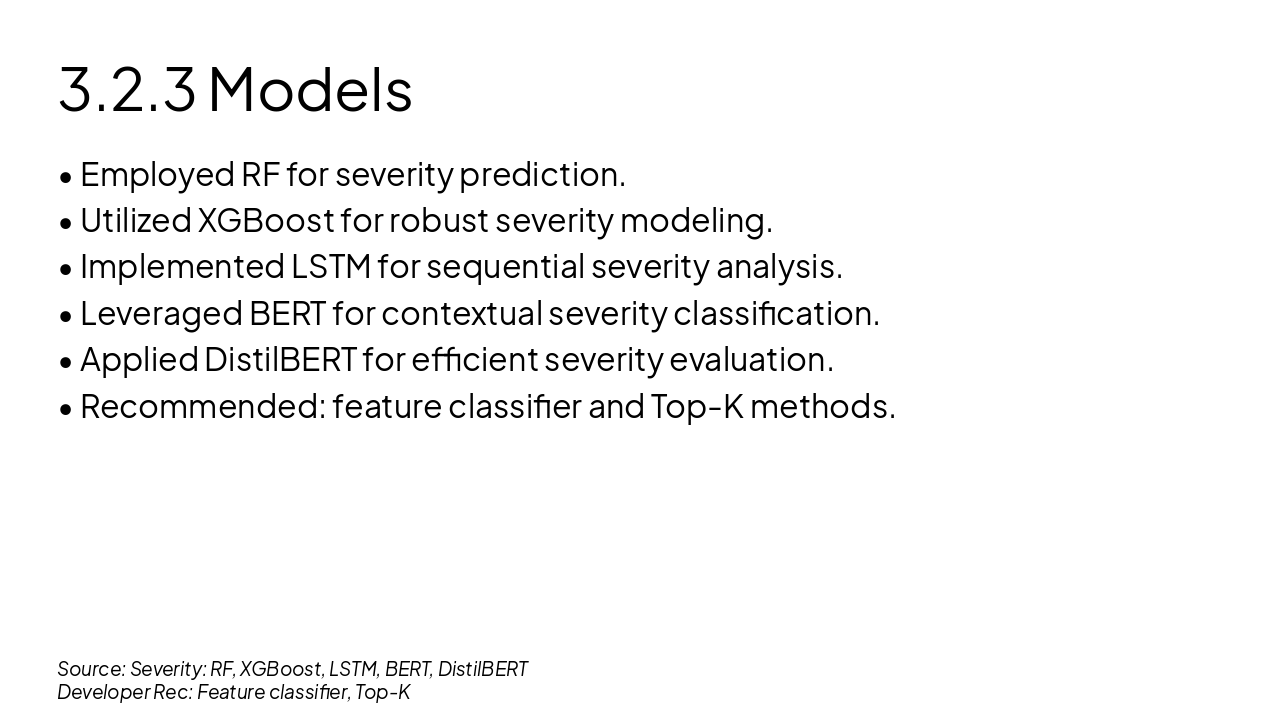
Slide 18 - 3.2.3 Models

  • Employed RF for severity prediction.
  • Utilized XGBoost for robust severity modeling.
  • Implemented LSTM for sequential severity analysis.
  • Leveraged BERT for contextual severity classification.
  • Applied DistilBERT for efficient severity evaluation.
  • Recommended: feature classifier and Top-K methods.
Slide 18 - 3.2.3 Models
Slide 19 of 19

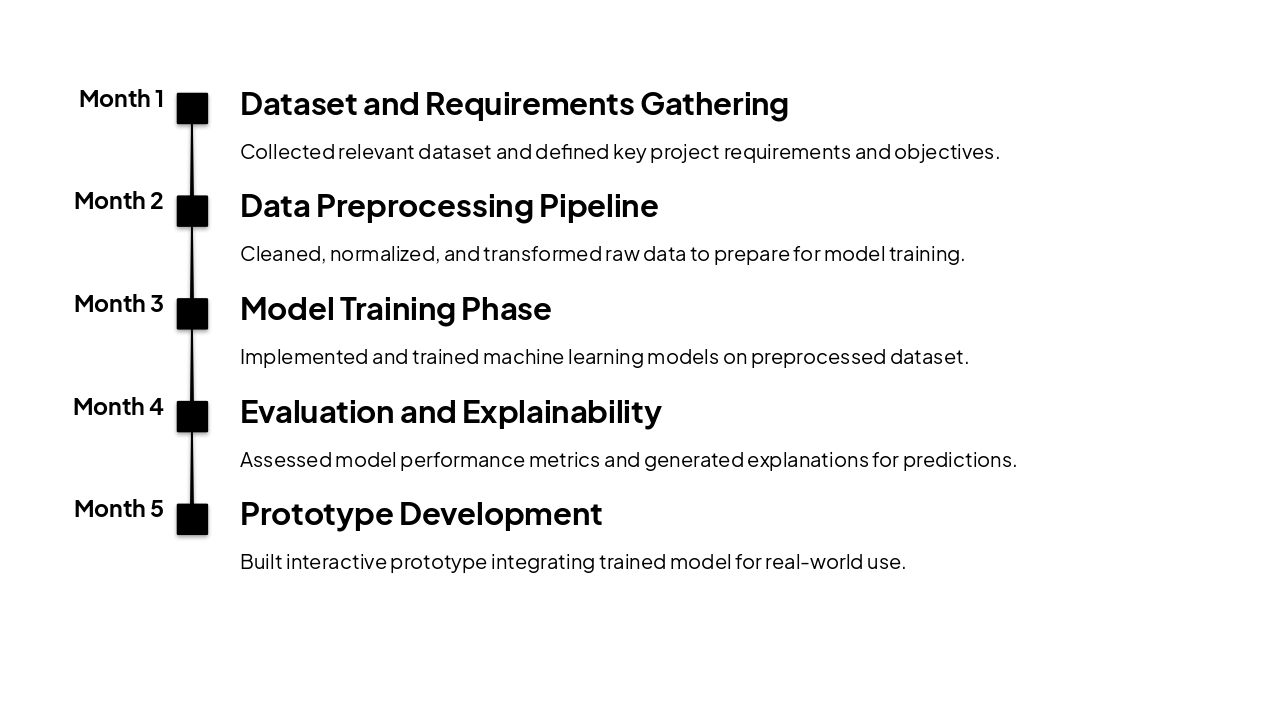
Slide 19 - Timeline Month 1: Dataset/Reqs 2: Preprocessing 3: Training 4: Eval/Explain 5: Prototype 6: Docs/Thesis

Slide 19 - Timeline
Month 1: Dataset/Reqs
2: Preprocessing
3: Training
4: Eval/Explain
5: Prototype
6: Docs/Thesis

Discover More Presentations

Explore thousands of AI-generated presentations for inspiration

Browse Presentations
Powered by AI

Create Your Own Presentation

Generate professional presentations in seconds with Karaf's AI. Customize this presentation or start from scratch.

Create New Presentation

Powered by Karaf.ai — AI-Powered Presentation Generator