The Death of the Author: Barthes' Literary Revolution

Generated from prompt:

Create a thesis presentation on Roland Barthes' essay "The Death of the Author." Include slides covering: introduction to Barthes, historical context, key arguments of the essay, explanation of author vs reader, concept of text as multi-dimensional space, implications for literary criticism, examples, criticisms of the theory, modern relevance (including digital media), and conclusion. Make it academic, clear, and structured for a university-level presentation with around 12-15 slides.

Explore Roland Barthes' groundbreaking 1967 essay 'The Death of the Author.' This thesis presentation covers his biography, 1960s French intellectual context, core arguments decentering the author in favor of the reader, the text as a multi-layered '

April 8, 202613 slides
Slide 1 of 13

Slide 1 - Thesis Presentation

The Death of the Author

An Analysis of Roland Barthes' seminal essay on literary theory
Slide 1 - Thesis Presentation
Slide 2 of 13

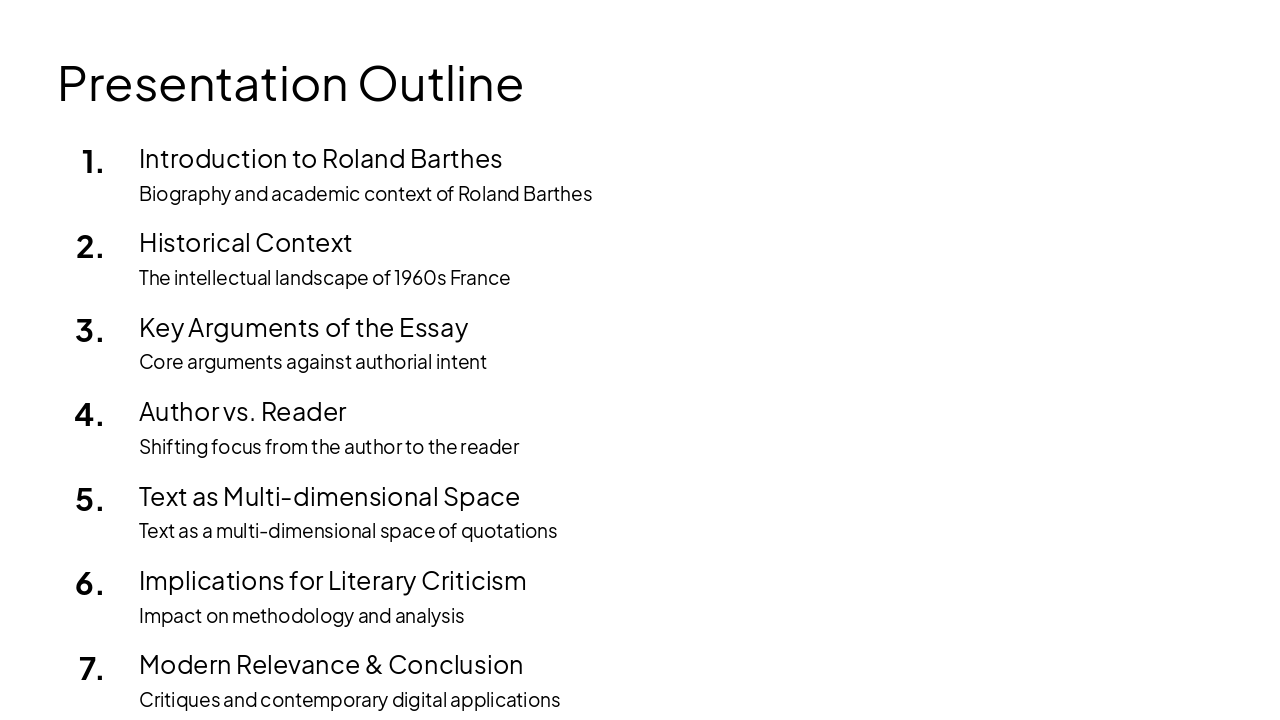
Slide 2 - Presentation Outline

  • Introduction to Roland Barthes: Biography and academic context of Roland Barthes
  • Historical Context: The intellectual landscape of 1960s France
  • Key Arguments of the Essay: Core arguments against authorial intent
  • Author vs. Reader: Shifting focus from the author to the reader
  • Text as Multi-dimensional Space: Text as a multi-dimensional space of quotations
  • Implications for Literary Criticism: Impact on methodology and analysis
  • Modern Relevance & Conclusion: Critiques and contemporary digital applications
Slide 2 - Presentation Outline
Slide 3 of 13

Slide 3 - Section 1

1

Introduction to Roland Barthes

French literary theorist, philosopher, and semiotician (1915-1980)
Slide 3 - Section 1
Slide 4 of 13

Slide 4 - Who Was Roland Barthes?

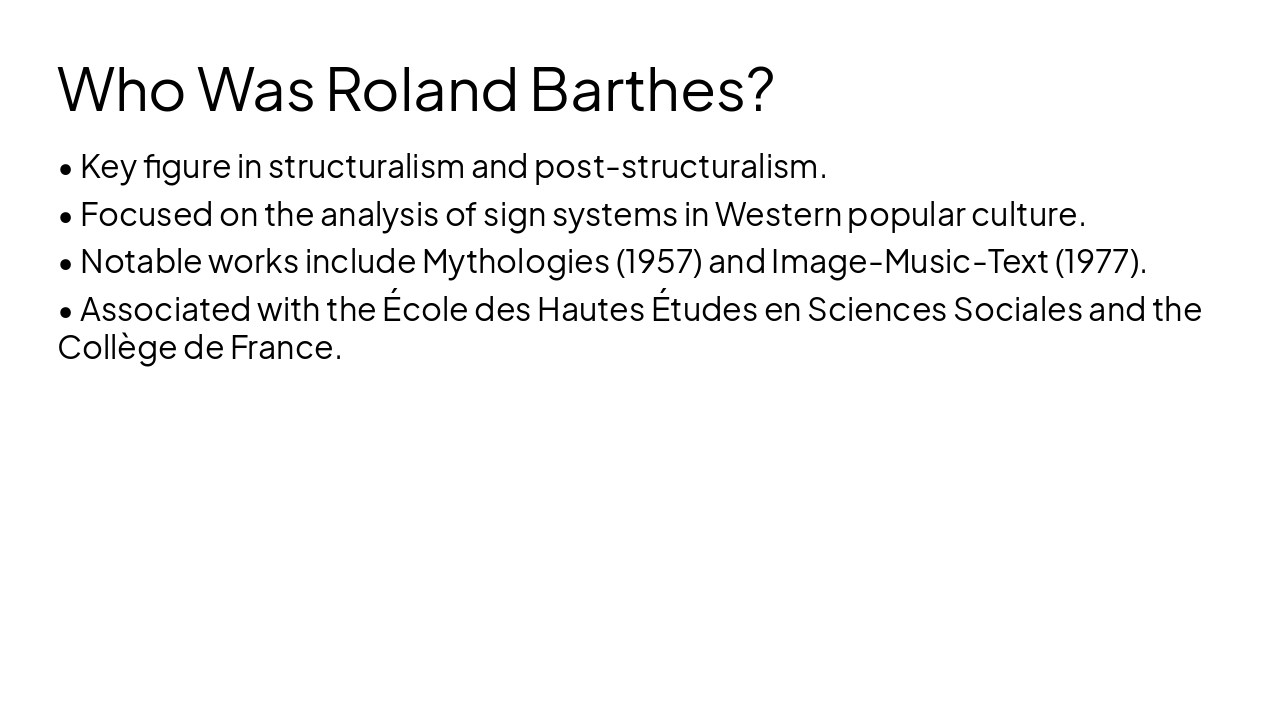
  • Key figure in structuralism and post-structuralism.
  • Focused on the analysis of sign systems in Western popular culture.
  • Notable works include Mythologies (1957) and Image-Music-Text (1977).
  • Associated with the École des Hautes Études en Sciences Sociales and the Collège de France.
Slide 4 - Who Was Roland Barthes?
Slide 5 of 13

Slide 5 - Section 2

2

Context and Key Arguments

Understanding the 1967 breakthrough essay
Slide 5 - Section 2
Slide 6 of 13

Slide 6 - The Death of the Author: Core Arguments

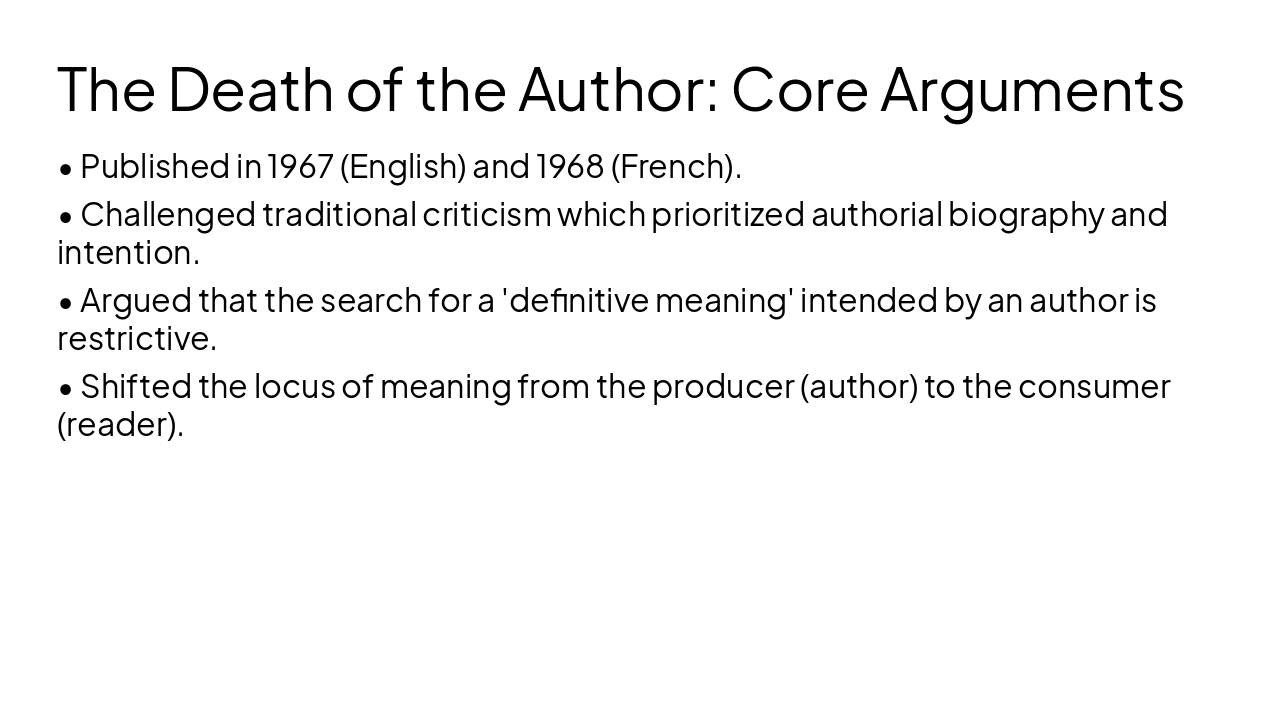
  • Published in 1967 (English) and 1968 (French).
  • Challenged traditional criticism which prioritized authorial biography and intention.
  • Argued that the search for a 'definitive meaning' intended by an author is restrictive.
  • Shifted the locus of meaning from the producer (author) to the consumer (reader).
Slide 6 - The Death of the Author: Core Arguments
Slide 7 of 13

Slide 7 - The Shift: Author vs. Reader

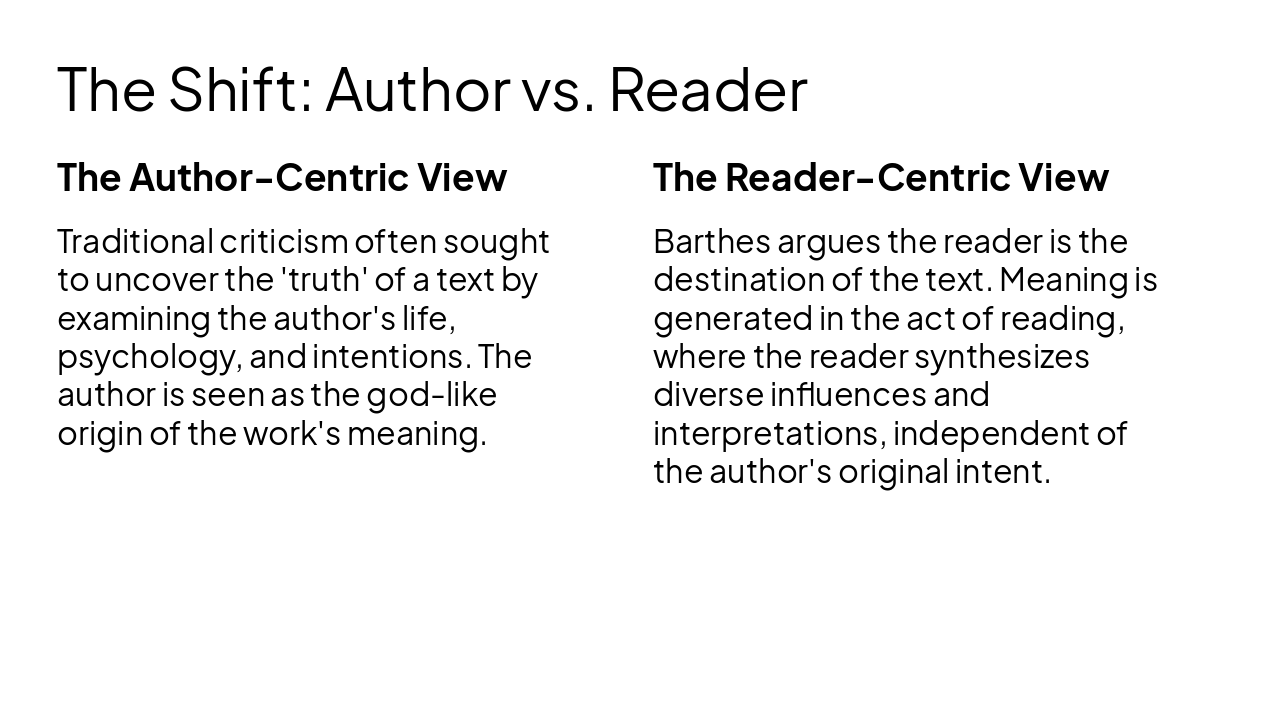
The Author-Centric View Traditional criticism often sought to uncover the 'truth' of a text by examining the author's life, psychology, and intentions. The author is seen as the god-like origin of the work's meaning.

The Reader-Centric View Barthes argues the reader is the destination of the text. Meaning is generated in the act of reading, where the reader synthesizes diverse influences and interpretations, independent of the author's original intent.
Slide 7 - The Shift: Author vs. Reader
Slide 8 of 13

Slide 8 - Key Insight

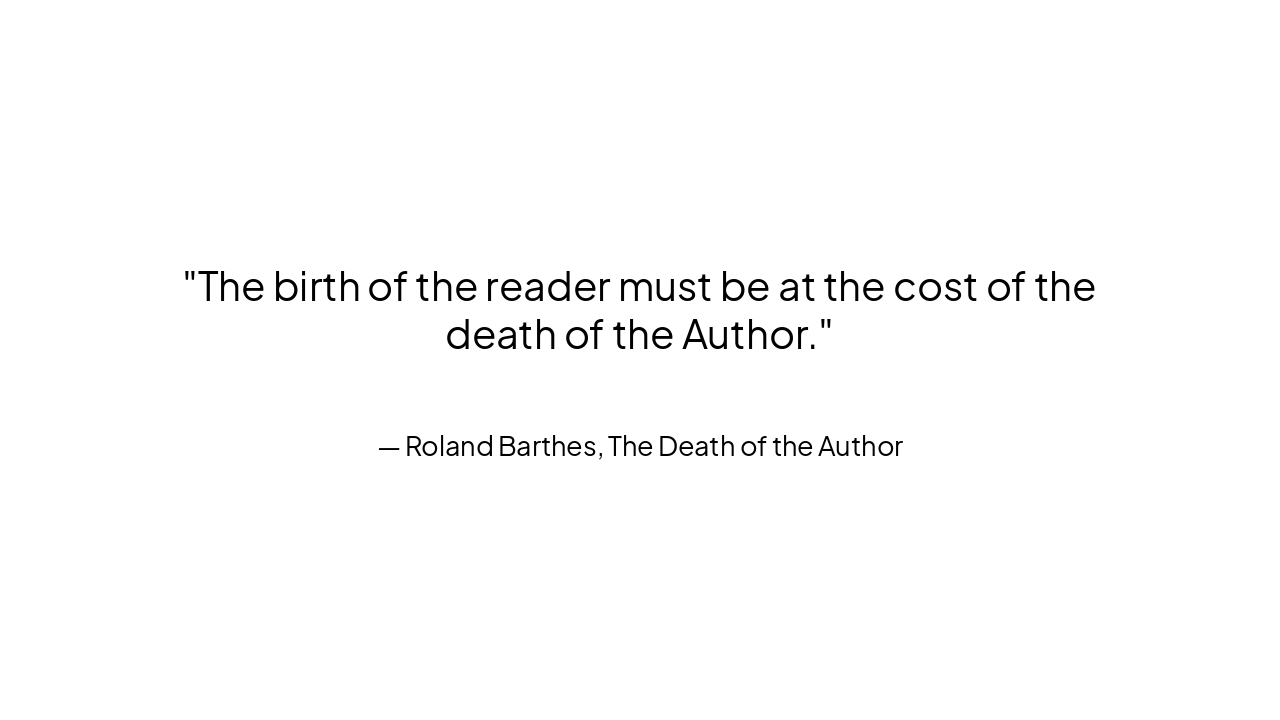
> The birth of the reader must be at the cost of the death of the Author.

— Roland Barthes, The Death of the Author
Slide 8 - Key Insight
Slide 9 of 13

Slide 9 - Text as Multi-dimensional Space

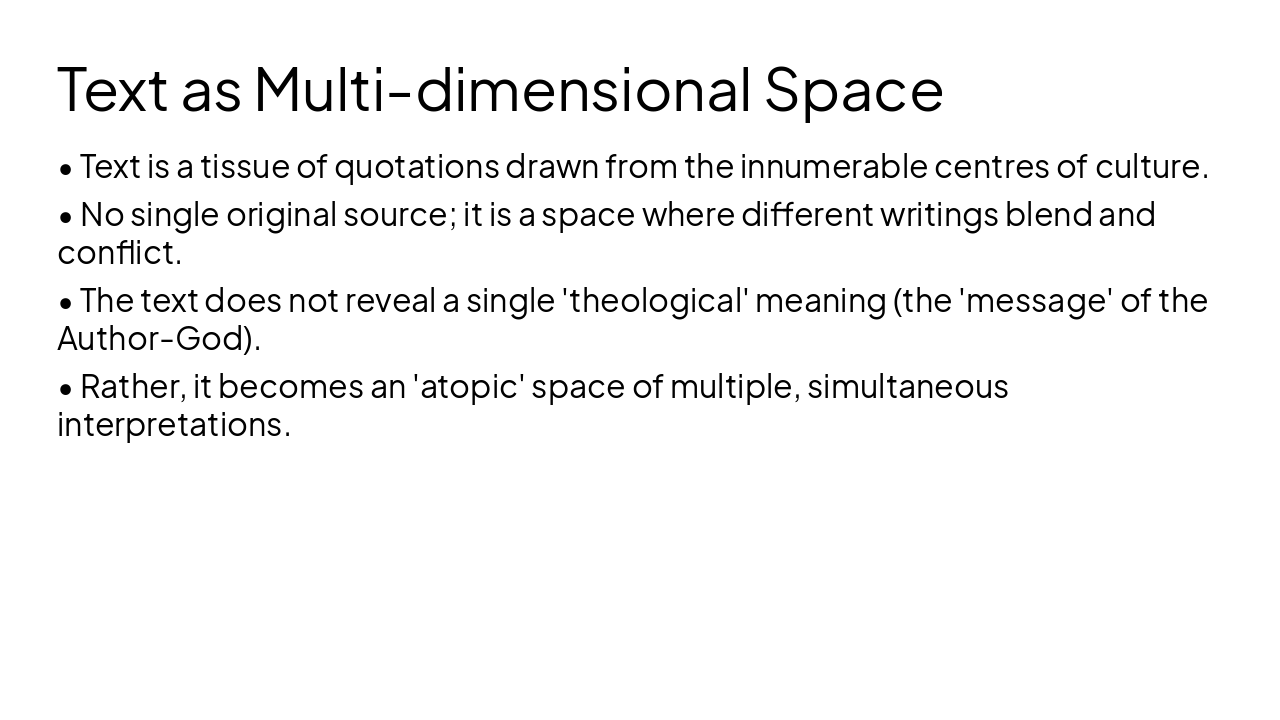
  • Text is a tissue of quotations drawn from the innumerable centres of culture.
  • No single original source; it is a space where different writings blend and conflict.
  • The text does not reveal a single 'theological' meaning (the 'message' of the Author-God).
  • Rather, it becomes an 'atopic' space of multiple, simultaneous interpretations.
Slide 9 - Text as Multi-dimensional Space
Slide 10 of 13

Slide 10 - Implications for Literary Criticism

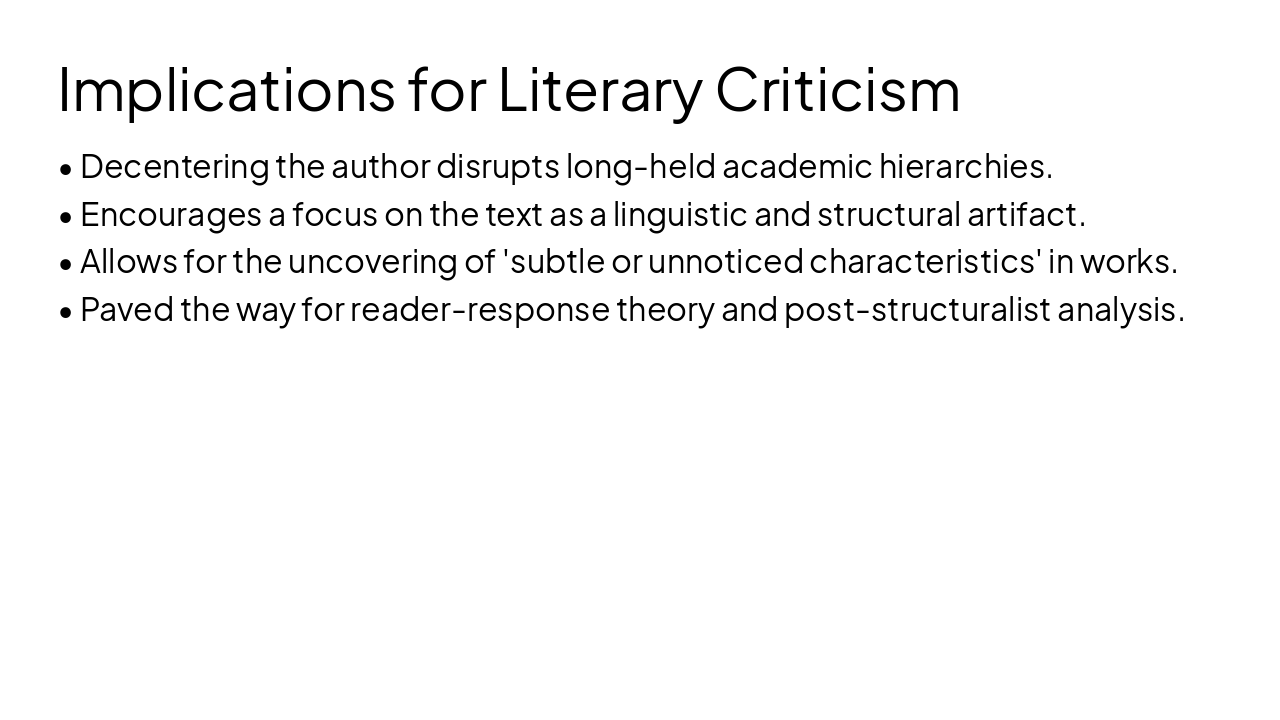
  • Decentering the author disrupts long-held academic hierarchies.
  • Encourages a focus on the text as a linguistic and structural artifact.
  • Allows for the uncovering of 'subtle or unnoticed characteristics' in works.
  • Paved the way for reader-response theory and post-structuralist analysis.
Slide 10 - Implications for Literary Criticism
Slide 11 of 13

Slide 11 - Criticisms of the Theory

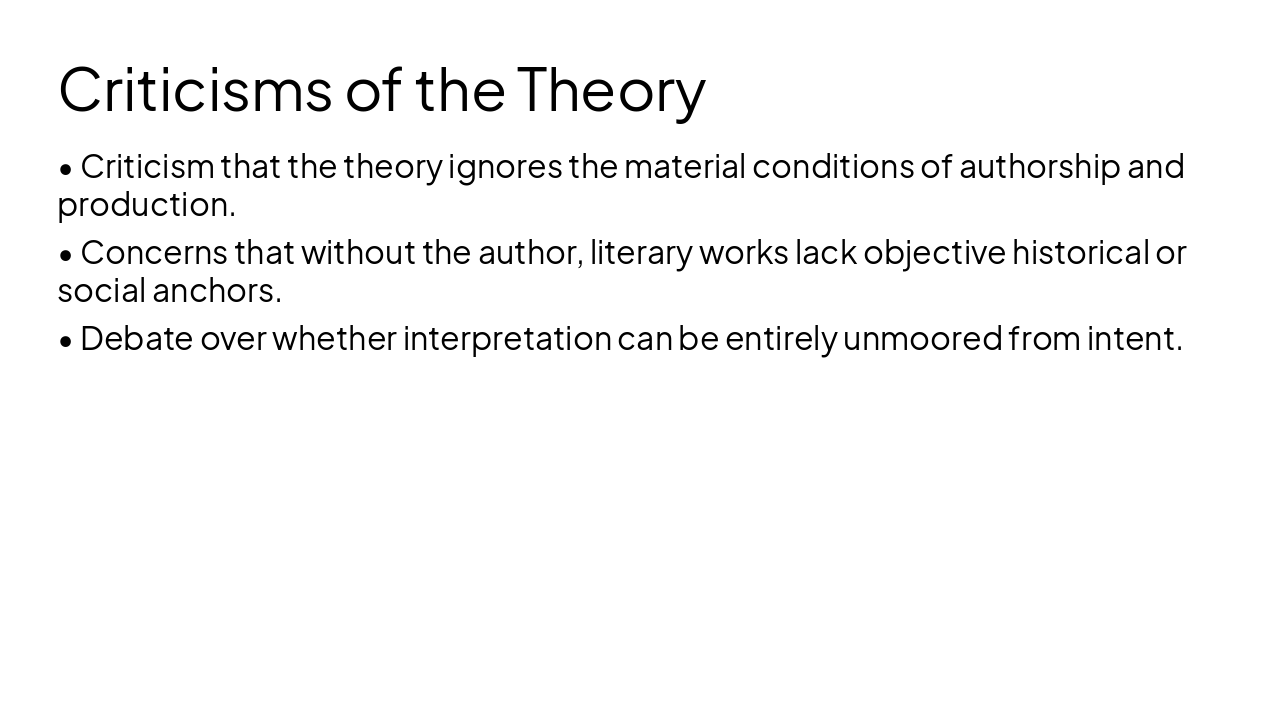
  • Criticism that the theory ignores the material conditions of authorship and production.
  • Concerns that without the author, literary works lack objective historical or social anchors.
  • Debate over whether interpretation can be entirely unmoored from intent.
Slide 11 - Criticisms of the Theory
Slide 12 of 13

Slide 12 - Modern Relevance: Digital Media & Beyond

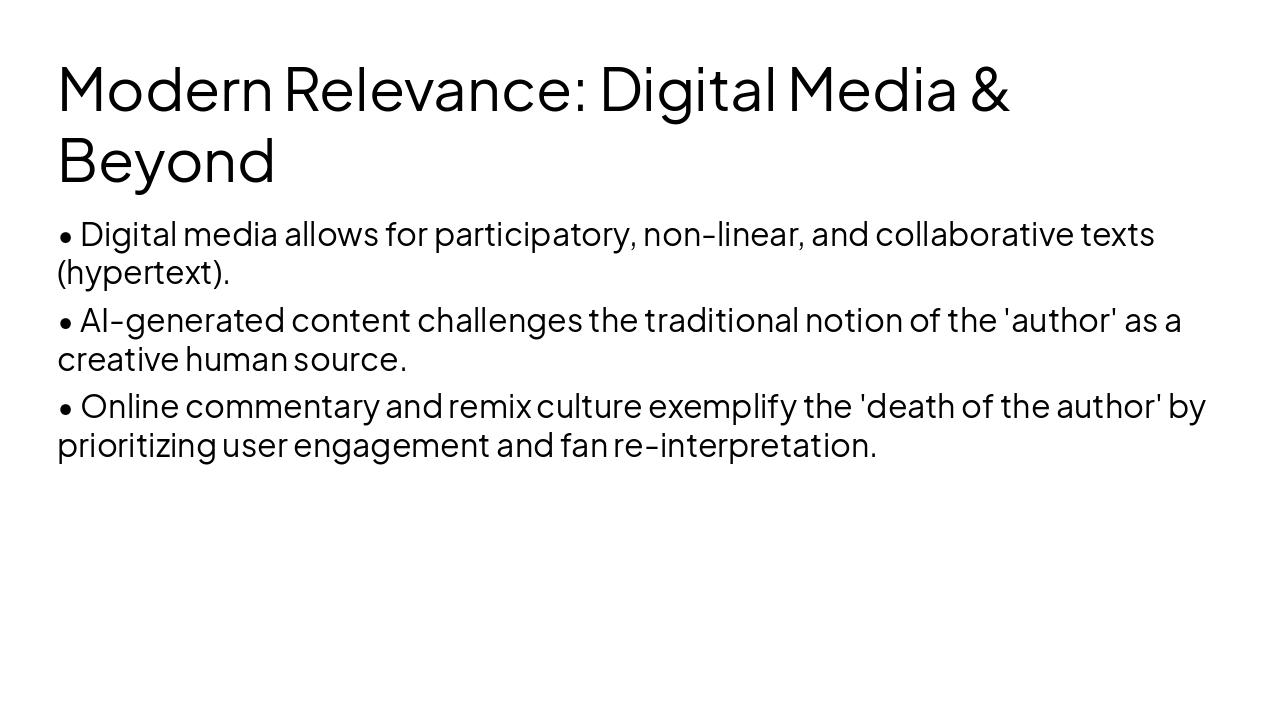
  • Digital media allows for participatory, non-linear, and collaborative texts (hypertext).
  • AI-generated content challenges the traditional notion of the 'author' as a creative human source.
  • Online commentary and remix culture exemplify the 'death of the author' by prioritizing user engagement and fan re-interpretation.
Slide 12 - Modern Relevance: Digital Media & Beyond
Slide 13 of 13

Slide 13 - Conclusion

The Death of the Author remains a foundational text for critical inquiry into the nature of meaning.

Barthes' legacy continues to shape how we understand the relationship between creators, texts, and audiences in the modern world.
Slide 13 - Conclusion

Discover More Presentations

Explore thousands of AI-generated presentations for inspiration

Browse Presentations
Powered by AI

Create Your Own Presentation

Generate professional presentations in seconds with Karaf's AI. Customize this presentation or start from scratch.

Create New Presentation

Powered by Karaf.ai — AI-Powered Presentation Generator