Programme Management & Delivery Plan: Months 7-12 Roadmap

Generated from prompt:

Improve and redesign the uploaded presentation into a professional, consistent slide deck. Apply a clean modern consulting style (McKinsey/BCG-inspired): consistent color palette (dark blue, white, accent teal), clear typography hierarchy, strong visual structure, icons, and minimal text per slide. Reorganize content logically. Slides outline: 1. Title slide – Programme Management & Delivery Plan (Month 7–12) 2. Situation Assessment – key issues + diagnosis (use icons) 3. Immediate Actions (First 2 Weeks) – timeline visual 4. Replanning & Delivery Strategy – objective + approach 5. Prioritization Framework – tiered model (Tier 1/2/3) 6. Delivery Model – 6 countries, missions visual (map or grid) 7. Team Management & Communication Strategy 8. Financial Strategy – budget allocation visual (€300k remaining) 9. Budget Details & Buffer Strategy 10. Financial & Operational Controls 11. Expected Results (Month 12) – impact + delivery + recovery 12. Key Success Factors Design requirements: - Use consistent layout grid - Convert paragraphs into concise bullet points - Add icons and visual diagrams (traffic light system, tiers, timelines) - Highlight key numbers (€, %, missions) - Ensure each slide has a clear headline takeaway - Keep slides clean, executive-level, visually engaging Output as a polished PPTX suitable for donor presentation.

Strategic roadmap for months 7-12 of programme execution, diagnosing operational challenges, outlining immediate actions, replanning with prioritization framework, delivery model across 6 countries, team communication, financial controls, and key成功因素

April 7, 202613 slides
Slide 1 of 13

Slide 1 - Title

Programme Management & Delivery Plan

Strategic Roadmap for Months 7–12 of Programme Execution

---

Photo by Nastuh Abootalebi on Unsplash

Slide 1 - Title
Slide 2 of 13

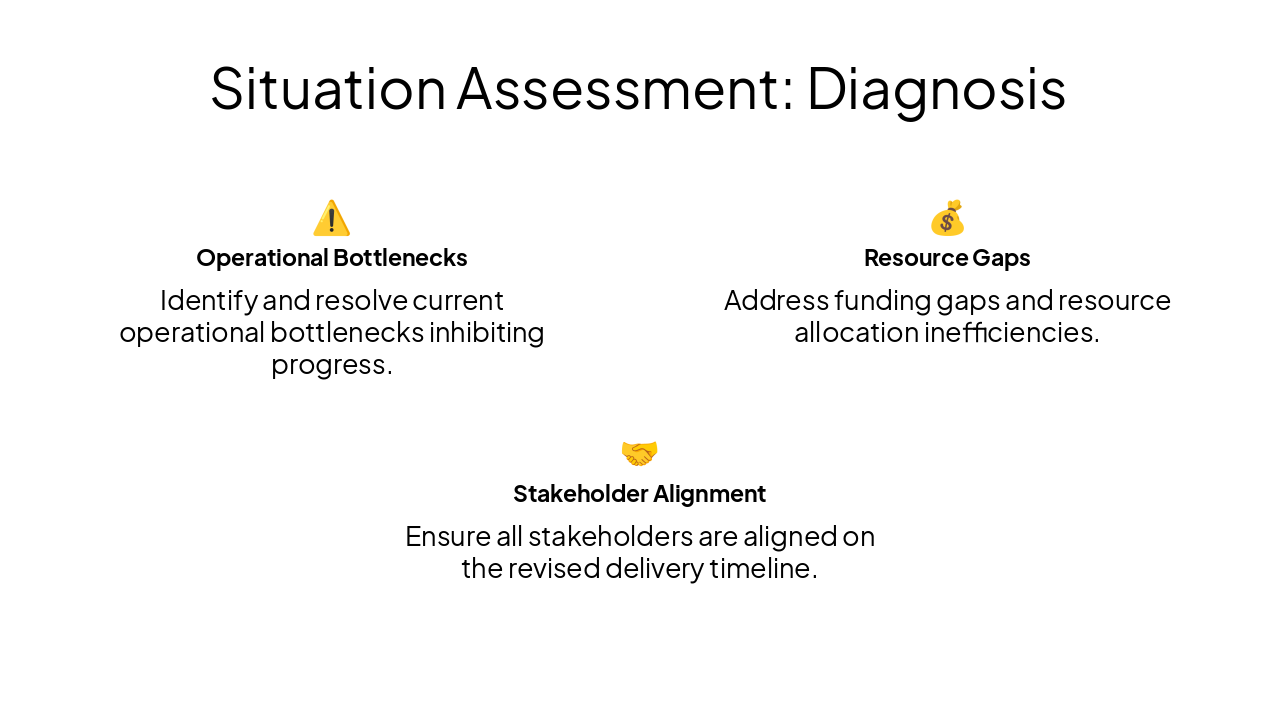
Slide 2 - Situation Assessment: Diagnosis

⚠️ Operational Bottlenecks Identify and resolve current operational bottlenecks inhibiting progress.

💰 Resource Gaps Address funding gaps and resource allocation inefficiencies.

🤝 Stakeholder Alignment Ensure all stakeholders are aligned on the revised delivery timeline.
Slide 2 - Situation Assessment: Diagnosis
Slide 3 of 13

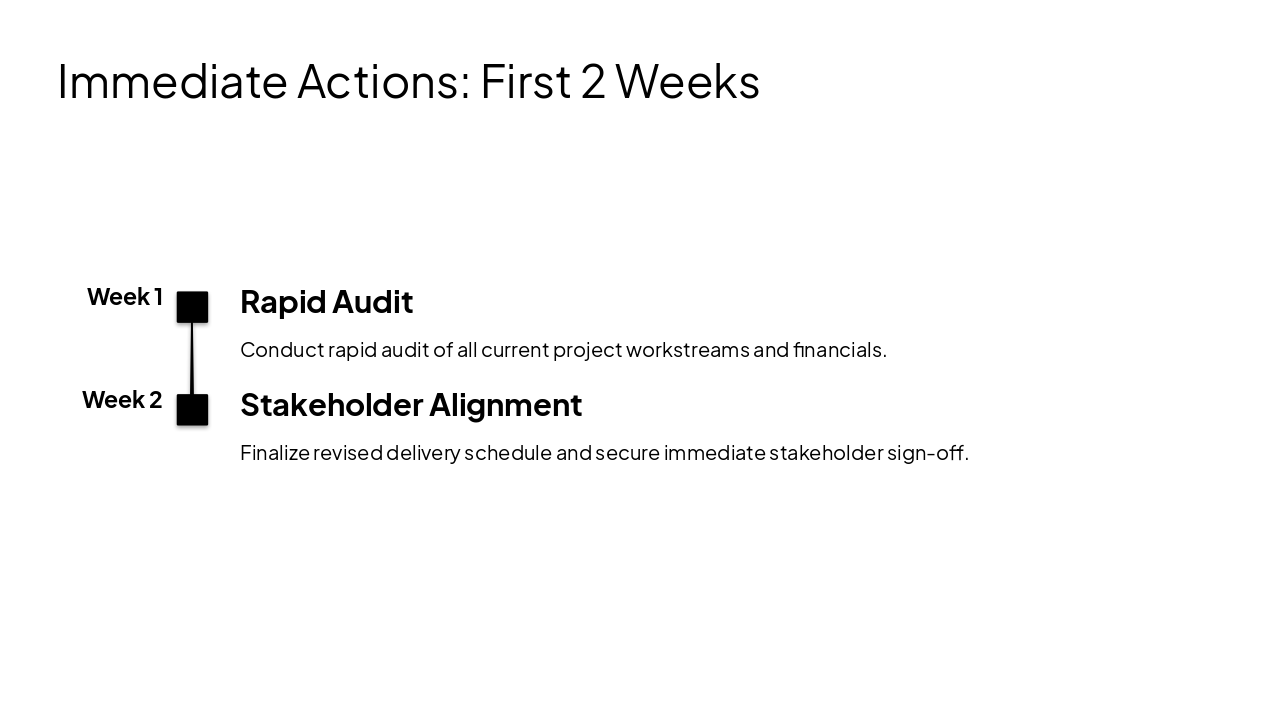
Slide 3 - Immediate Actions: First 2 Weeks

Week 1: Rapid Audit Conduct rapid audit of all current project workstreams and financials. Week 2: Stakeholder Alignment Finalize revised delivery schedule and secure immediate stakeholder sign-off.
Slide 3 - Immediate Actions: First 2 Weeks
Slide 4 of 13

Slide 4 - Replanning & Delivery Strategy

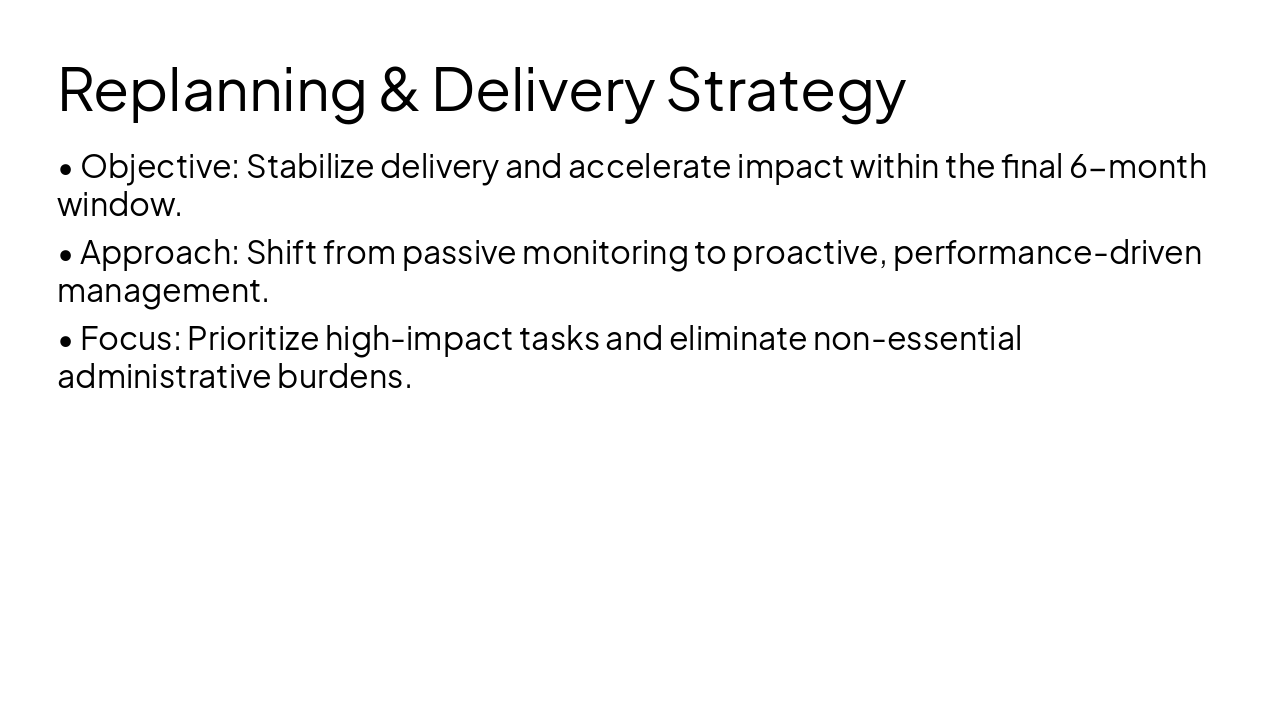
  • Objective: Stabilize delivery and accelerate impact within the final 6-month window.
  • Approach: Shift from passive monitoring to proactive, performance-driven management.
  • Focus: Prioritize high-impact tasks and eliminate non-essential administrative burdens.
Slide 4 - Replanning & Delivery Strategy
Slide 5 of 13

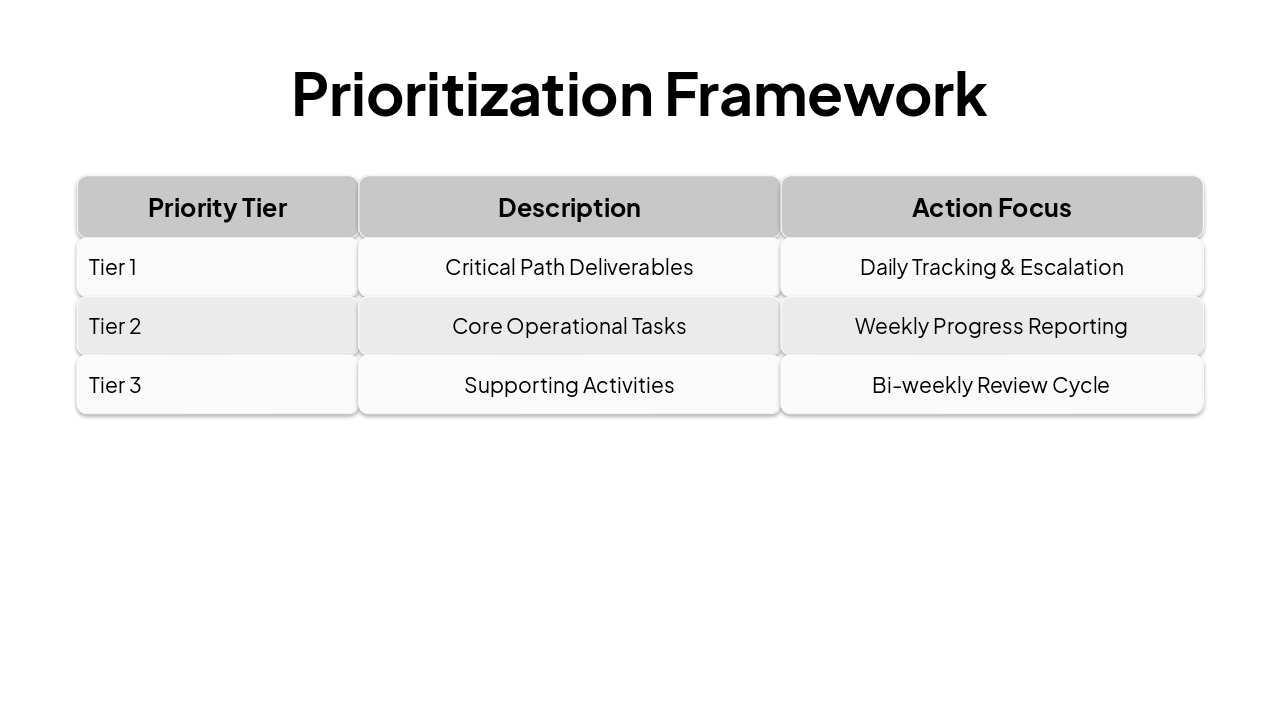
Slide 5 - Prioritization Framework

Priority TierDescriptionAction Focus
Tier 1Critical Path DeliverablesDaily Tracking & Escalation
Tier 2Core Operational TasksWeekly Progress Reporting
Tier 3Supporting ActivitiesBi-weekly Review Cycle
Slide 5 - Prioritization Framework
Slide 6 of 13

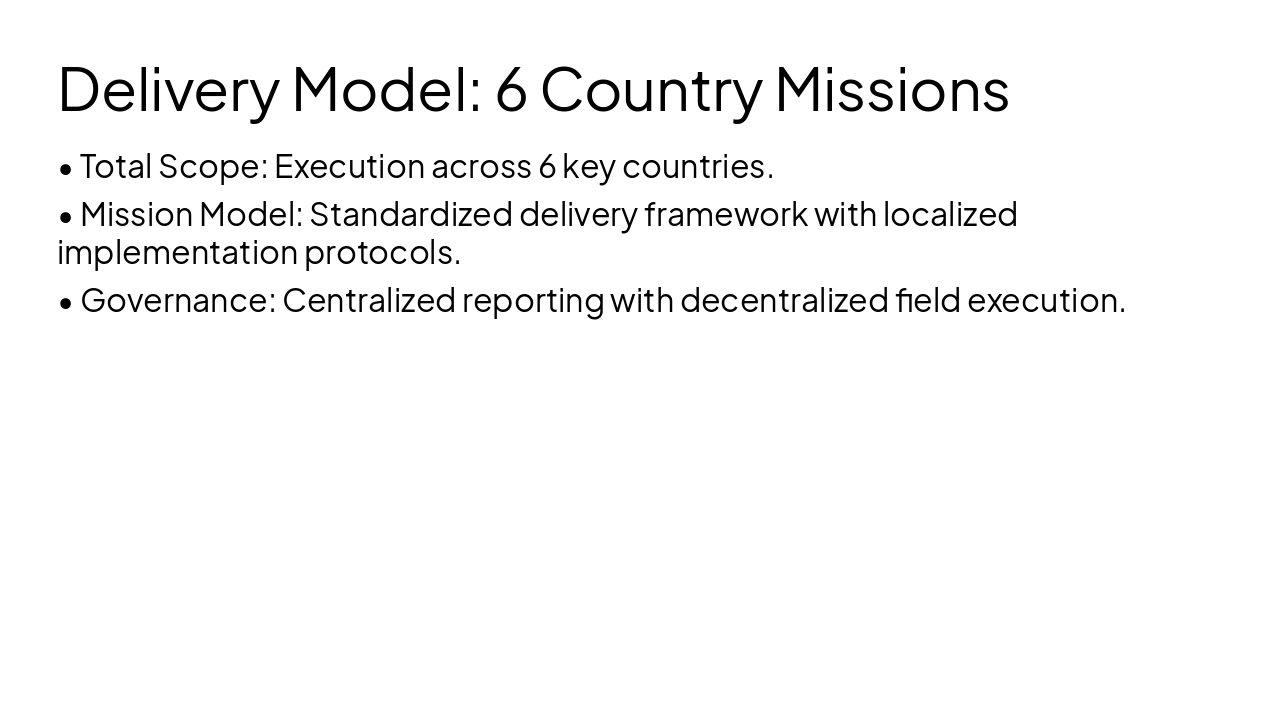
Slide 6 - Delivery Model: 6 Country Missions

  • Total Scope: Execution across 6 key countries.
  • Mission Model: Standardized delivery framework with localized implementation protocols.
  • Governance: Centralized reporting with decentralized field execution.
Slide 6 - Delivery Model: 6 Country Missions
Slide 7 of 13

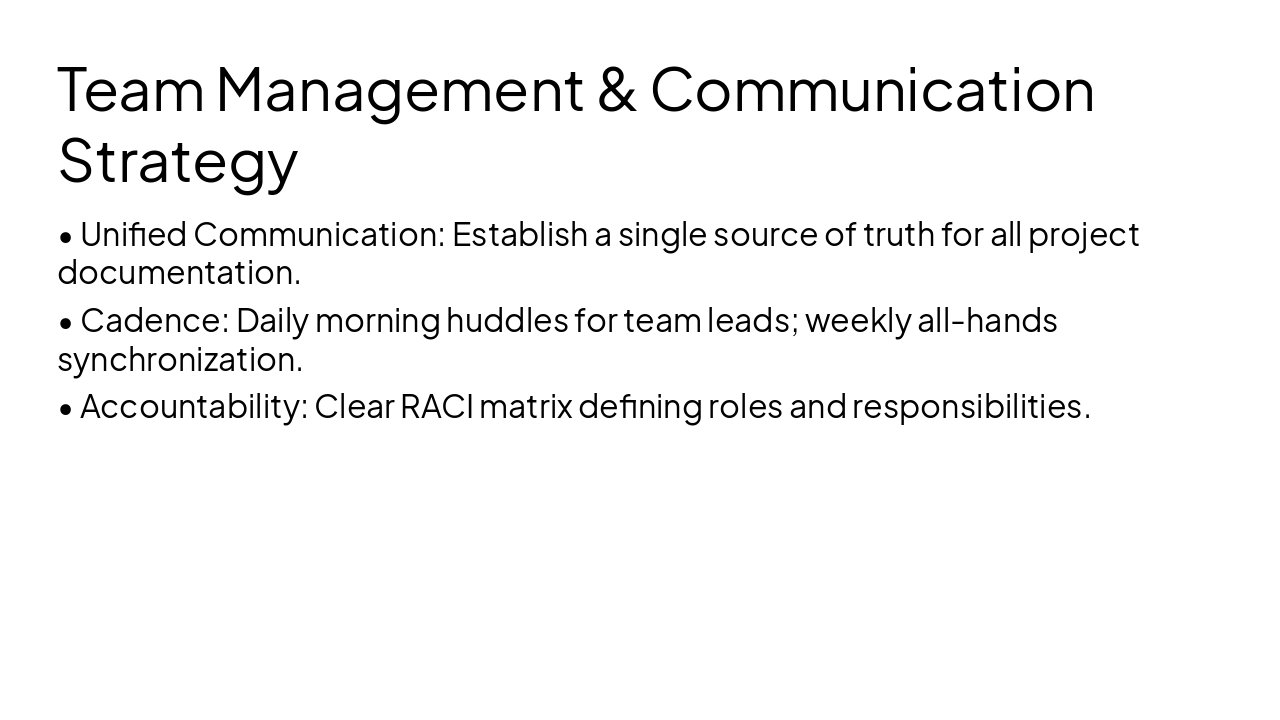
Slide 7 - Team Management & Communication Strategy

  • Unified Communication: Establish a single source of truth for all project documentation.
  • Cadence: Daily morning huddles for team leads; weekly all-hands synchronization.
  • Accountability: Clear RACI matrix defining roles and responsibilities.
Slide 7 - Team Management & Communication Strategy
Slide 8 of 13

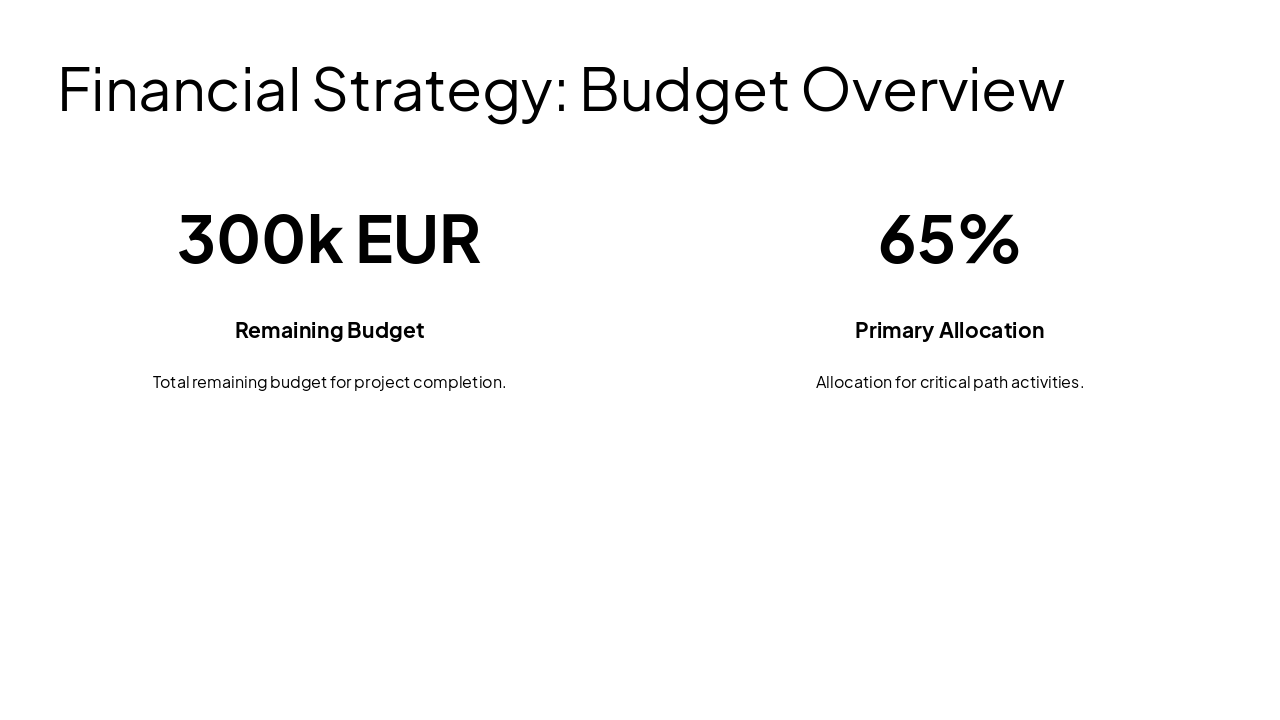
Slide 8 - Financial Strategy: Budget Overview

  • 300k EUR: Remaining Budget
  • 65%: Primary Allocation
Slide 8 - Financial Strategy: Budget Overview
Slide 9 of 13

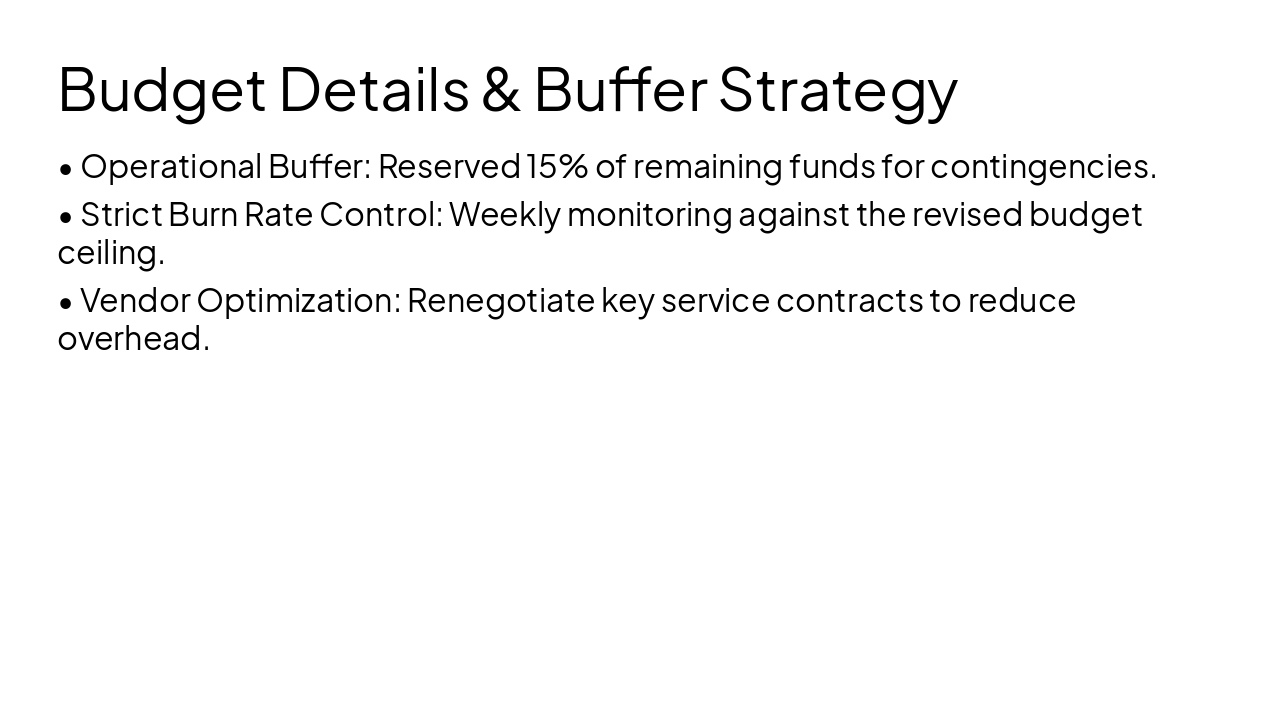
Slide 9 - Budget Details & Buffer Strategy

  • Operational Buffer: Reserved 15% of remaining funds for contingencies.
  • Strict Burn Rate Control: Weekly monitoring against the revised budget ceiling.
  • Vendor Optimization: Renegotiate key service contracts to reduce overhead.
Slide 9 - Budget Details & Buffer Strategy
Slide 10 of 13

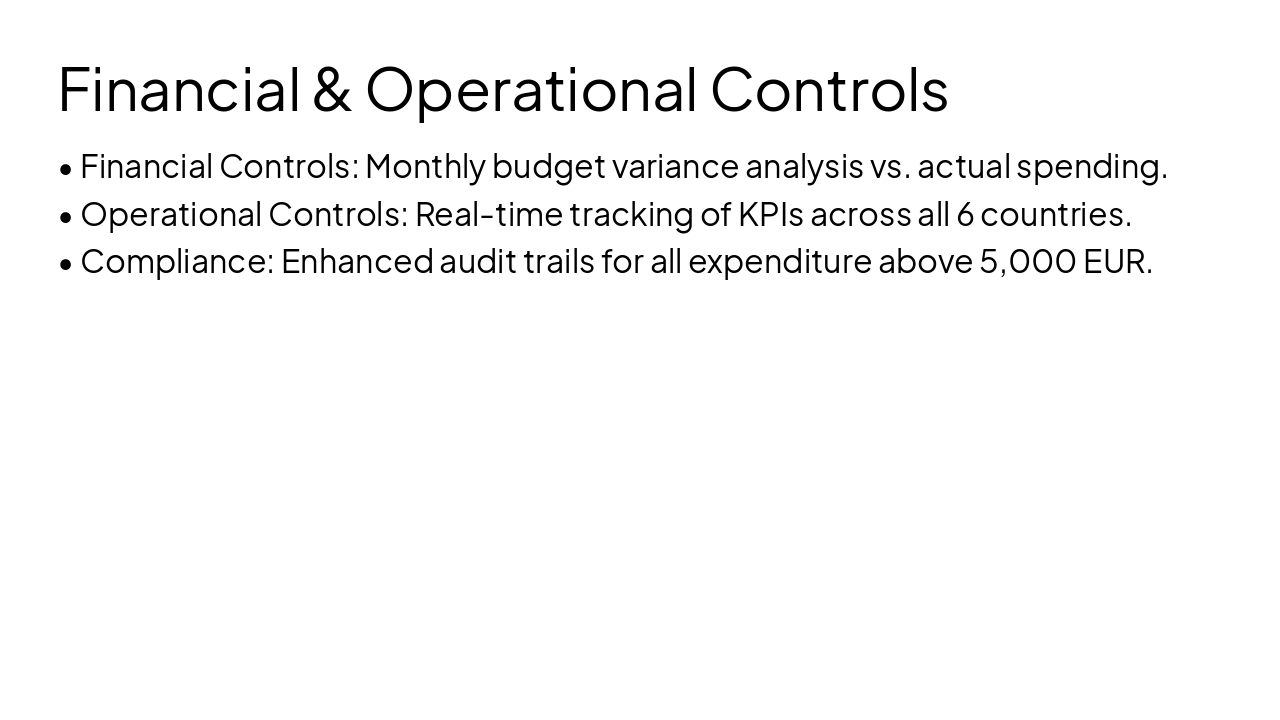
Slide 10 - Financial & Operational Controls

  • Financial Controls: Monthly budget variance analysis vs. actual spending.
  • Operational Controls: Real-time tracking of KPIs across all 6 countries.
  • Compliance: Enhanced audit trails for all expenditure above 5,000 EUR.
Slide 10 - Financial & Operational Controls
Slide 11 of 13

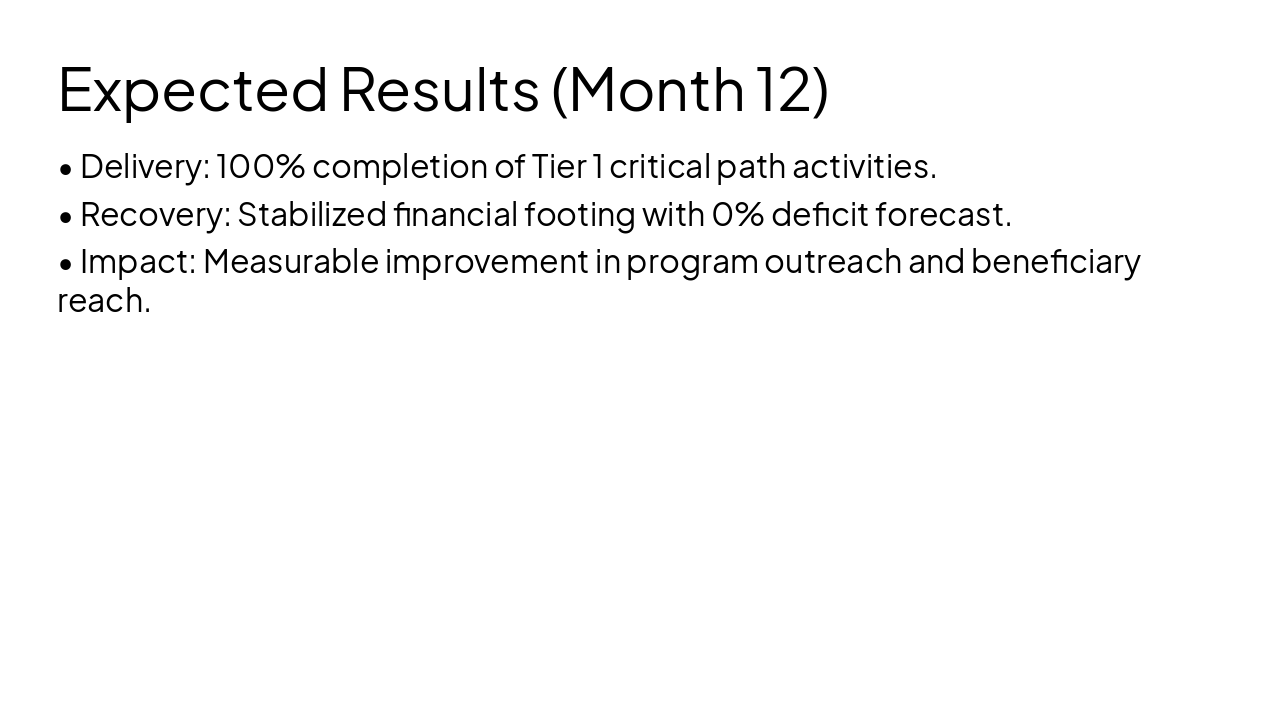
Slide 11 - Expected Results (Month 12)

  • Delivery: 100% completion of Tier 1 critical path activities.
  • Recovery: Stabilized financial footing with 0% deficit forecast.
  • Impact: Measurable improvement in program outreach and beneficiary reach.
Slide 11 - Expected Results (Month 12)
Slide 12 of 13

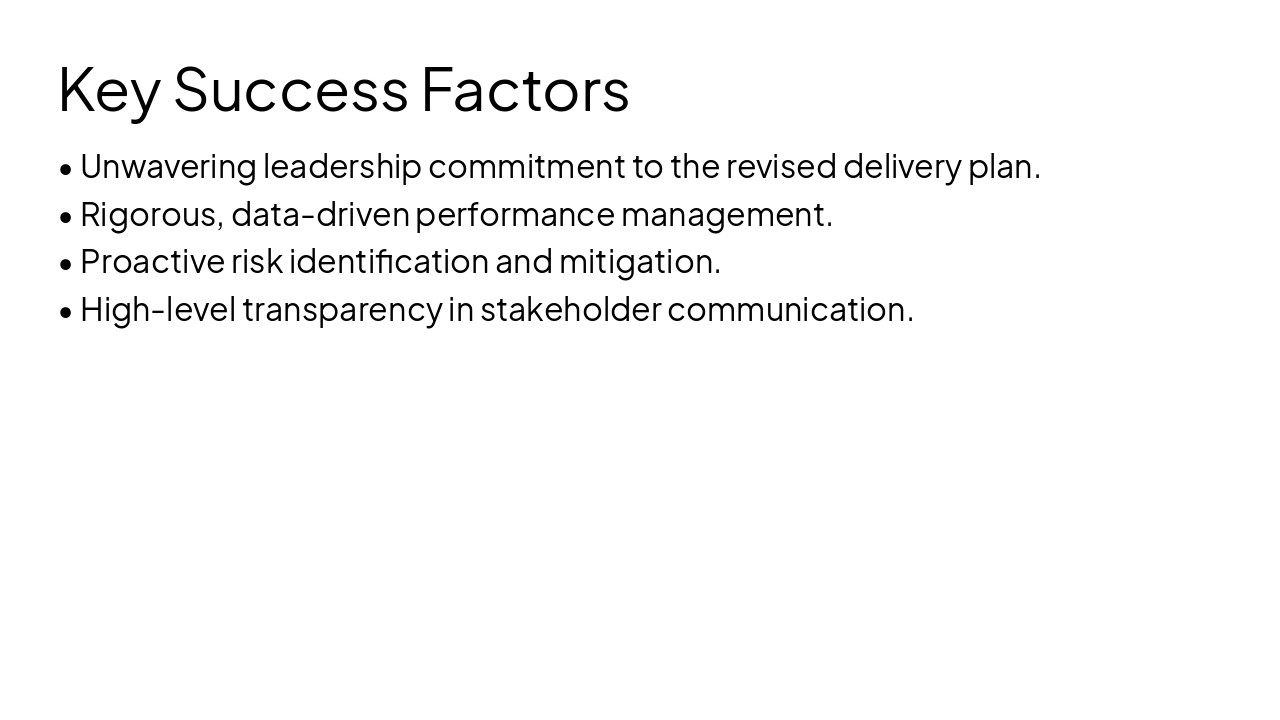
Slide 12 - Key Success Factors

  • Unwavering leadership commitment to the revised delivery plan.
  • Rigorous, data-driven performance management.
  • Proactive risk identification and mitigation.
  • High-level transparency in stakeholder communication.
Slide 12 - Key Success Factors
Slide 13 of 13

Slide 13 - Closing

Questions & Discussion

Thank you for your ongoing support and partnership.
Slide 13 - Closing

Discover More Presentations

Explore thousands of AI-generated presentations for inspiration

Browse Presentations
Powered by AI

Create Your Own Presentation

Generate professional presentations in seconds with Karaf's AI. Customize this presentation or start from scratch.

Create New Presentation

Powered by Karaf.ai — AI-Powered Presentation Generator