Deferred Infra via CI-Controlled Deployment (38 chars)

Generated from prompt:

Title: Deferred Infrastructure Creation with CI-Controlled Variables Slide 1: Overview - Two-phase deployment pattern - Separation of infrastructure and application deployment - Ensures clean, repeatable deployments Slide 2: Phase 1 – Infrastructure Setup (Manual or Once) - Creates Resource Group (RG) - Creates Virtual Network (VNET) - Creates Virtual Machine (VM) - Creates Azure Container Registry (ACR) - Does NOT create ACI (create_aci = false) Slide 3: Phase 2 – Application Deployment (CI/CD) - CI builds Docker image - Push image to ACR - Terraform run creates ACI - ACI uses existing infra from Phase 1 - Clean and automated application rollout Slide 4: Architecture Diagram - Developer → CI/CD Pipeline → Terraform → Azure Cloud - Azure Cloud contains RG, VNET, VM, ACR, and new ACI Slide 5: Process Flow 1. Developer commits code 2. CI builds Docker image 3. Image pushed to ACR 4. Terraform creates ACI 5. Application runs in ACI Slide 6: Key Benefits - Separation of concerns (infra vs app) - Controlled environment setup - Faster deployments - Reduced risk of misconfiguration - Easy rollback & scaling Slide 7: Summary - One-time infra setup + CI-driven app deployment - Called “Deferred Infrastructure Creation with CI-Controlled Variables”

Two-phase strategy: manual infra setup (RG, VNET, VM, ACR), then CI/CD builds/pushes Docker image to ACR & Terraform deploys ACI. Enables clean, fast, low-risk app rollouts with easy scaling/rollback.

December 14, 20258 slides
Slide 1 of 8

Slide 1 - Deferred Infrastructure Creation with CI-Controlled Variables

This title slide is titled "Deferred Infrastructure Creation with CI-Controlled Variables." It offers an overview of a two-phase deployment: infrastructure first, then CI-driven app deployment.

Deferred Infrastructure Creation with CI-Controlled Variables

Overview of two-phase deployment: infra first, then CI-driven app.

Source: Overview of two-phase deployment: infra first, then CI-driven app.

Slide 1 - Deferred Infrastructure Creation with CI-Controlled Variables
Slide 2 of 8

Slide 2 - Overview

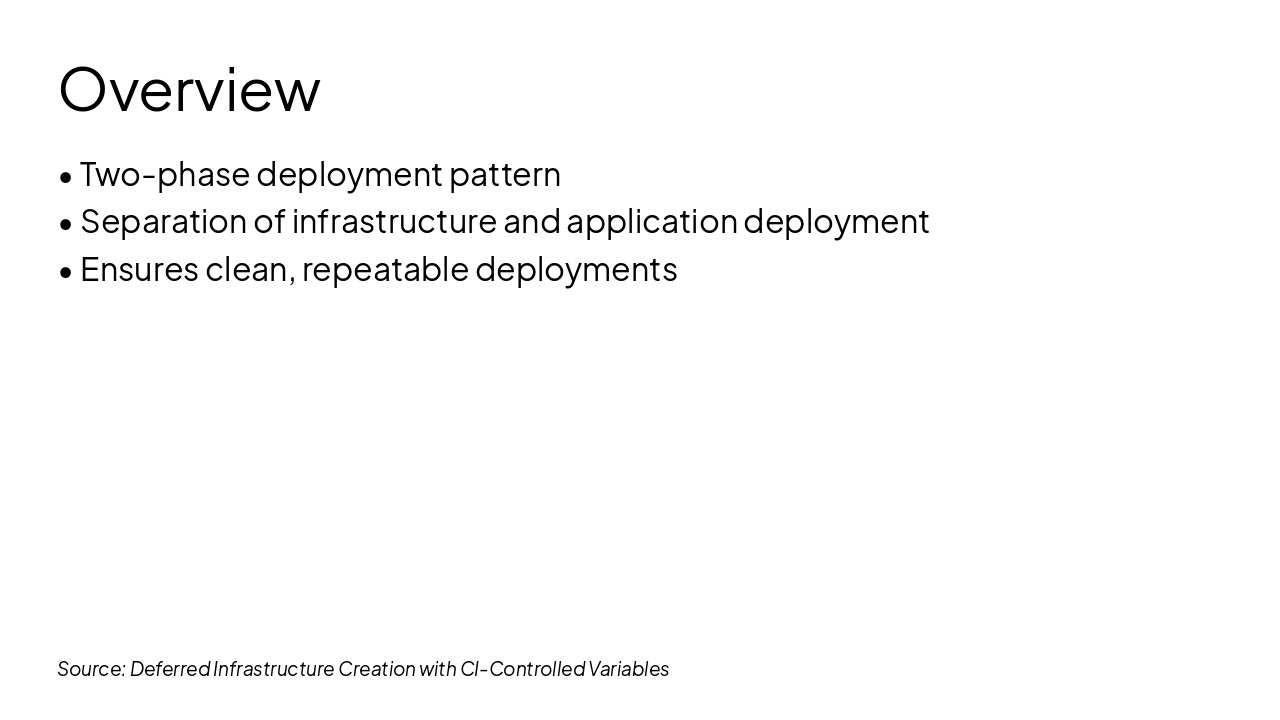
This slide overviews a two-phase deployment pattern. It highlights separation of infrastructure and application deployments to ensure clean, repeatable processes.

Overview

  • Two-phase deployment pattern
  • Separation of infrastructure and application deployment
  • Ensures clean, repeatable deployments

Source: Deferred Infrastructure Creation with CI-Controlled Variables

Slide 2 - Overview
Slide 3 of 8

Slide 3 - Phase 1 – Infrastructure Setup (Manual or Once)

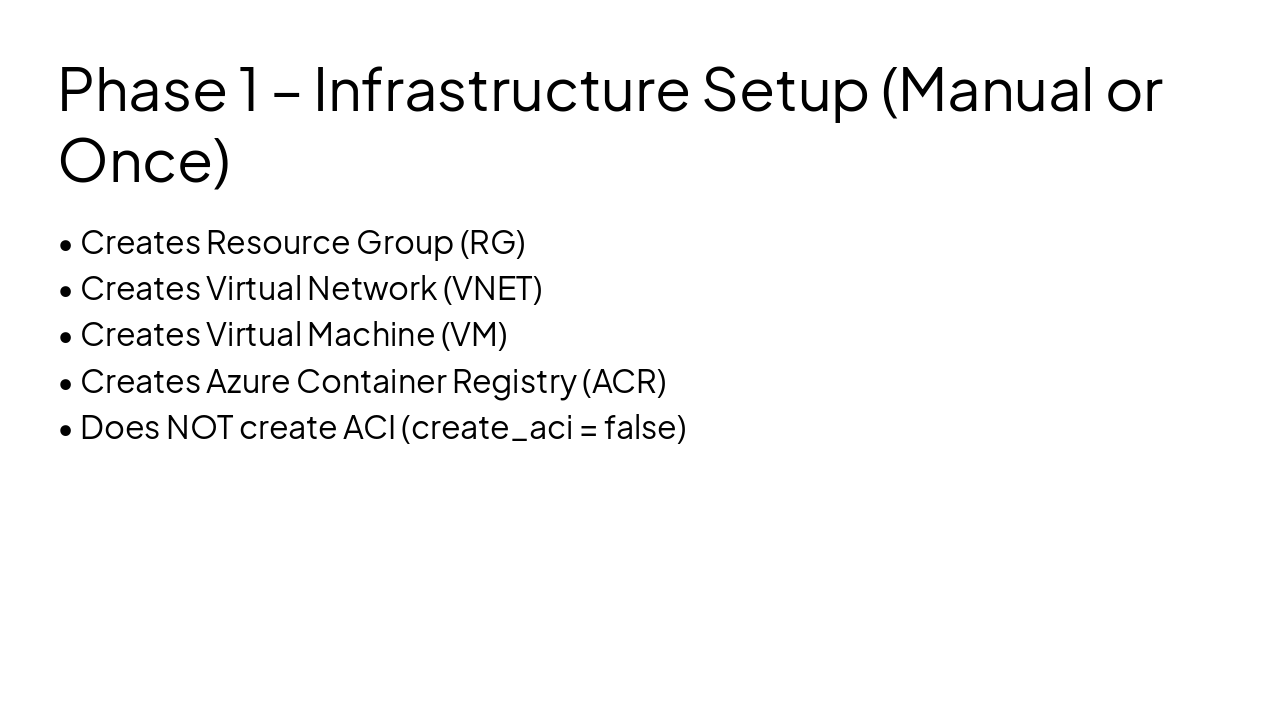
Phase 1 sets up essential Azure infrastructure once or manually by creating a Resource Group, Virtual Network, Virtual Machine, and Azure Container Registry. It does not create an Azure Container Instance (createaci = false).

Phase 1 – Infrastructure Setup (Manual or Once)

  • Creates Resource Group (RG)
  • Creates Virtual Network (VNET)
  • Creates Virtual Machine (VM)
  • Creates Azure Container Registry (ACR)
  • Does NOT create ACI (createaci = false)
Slide 3 - Phase 1 – Infrastructure Setup (Manual or Once)
Slide 4 of 8

Slide 4 - Phase 2 – Application Deployment (CI/CD)

In Phase 2 (Application Deployment via CI/CD), CI builds a Docker image and pushes it to ACR, while Terraform creates an ACI using Phase 1 infrastructure. This enables a clean, automated rollout.

Phase 2 – Application Deployment (CI/CD)

  • CI builds Docker image
  • Pushes image to ACR
  • Terraform creates ACI
  • ACI uses Phase 1 infrastructure
  • Enables clean, automated rollout
Slide 4 - Phase 2 – Application Deployment (CI/CD)
Slide 5 of 8

Slide 5 - Architecture Diagram

The workflow starts with a developer committing code, triggering the CI/CD pipeline to build and push a Docker image to ACR. Terraform then deploys using CI variables to create ACI, hosted by Azure Cloud alongside RG, VNET, VM, ACR, and ACI.

Architecture Diagram

{ "headers": [ "Component", "Action", "Outputs" ], "rows": [ [ "Developer", "Commits code", "Triggers CI/CD Pipeline" ], [ "CI/CD Pipeline", "Builds Docker image & pushes", "Image to ACR" ], [ "Terraform", "Deploys with CI variables", "ACI created" ], [ "Azure Cloud", "Hosts infrastructure", "RG, VNET, VM, ACR, ACI" ] ] }

Source: Developer → CI/CD Pipeline → Terraform → Azure Cloud (RG, VNET, VM, ACR, ACI)

Speaker Notes
High-level flow: Developer triggers CI/CD, which uses Terraform to deploy ACI on pre-existing Azure infrastructure (RG, VNET, VM, ACR).
Slide 5 - Architecture Diagram
Slide 6 of 8

Slide 6 - Process Flow

The timeline depicts a CI/CD process flow: a developer commits code, triggering CI to build and push a Docker image to Azure Container Registry (ACR). Terraform then provisions an Azure Container Instance (ACI) with the image, where the application deploys and runs.

Process Flow

1: Developer Commits Code Developer pushes code changes to the version control repository. 2: CI Builds Docker Image CI pipeline automatically builds Docker image from committed code. 3: Image Pushed to ACR Built Docker image is securely pushed to Azure Container Registry. 4: Terraform Creates ACI Terraform run provisions Azure Container Instance with new image. 5: Application Runs in ACI Application deploys and starts running in the ACI environment.

Slide 6 - Process Flow
Slide 7 of 8

Slide 7 - Key Benefits

The "Key Benefits" slide features a grid of five advantages: separation of concerns for better maintainability, controlled environment setups for consistency, faster CI/CD deployments, reduced misconfiguration risks, and easy rollback with scaling. These highlights emphasize reliable, efficient infrastructure and application management.

Key Benefits

{ "features": [ { "icon": "🧩", "heading": "Separation of Concerns", "description": "Isolates infrastructure from application deployments for better maintainability." }, { "icon": "🔒", "heading": "Controlled Environment Setup", "description": "Pre-configured infra ensures consistent and reliable environments every time." }, { "icon": "🚀", "heading": "Faster Deployments", "description": "CI/CD automates app rollouts, speeding up delivery significantly." }, { "icon": "🛡️", "heading": "Reduced Misconfiguration Risk", "description": "Standardized setups minimize errors and deployment failures." }, { "icon": "🔄", "heading": "Easy Rollback & Scaling", "description": "Quick recovery from issues and effortless resource scaling." } ] }

Slide 7 - Key Benefits
Slide 8 of 8

Slide 8 - Summary

This conclusion slide summarizes the key approach as a one-time infrastructure setup paired with CI-driven app deployment. It recommends adopting deferred infrastructure creation using CI-controlled variables.

Summary

One-time infra setup + CI-driven app deployment.

Adopt Deferred Infrastructure Creation with CI-Controlled Variables.

Slide 8 - Summary

Discover More Presentations

Explore thousands of AI-generated presentations for inspiration

Browse Presentations
Powered by AI

Create Your Own Presentation

Generate professional presentations in seconds with Karaf's AI. Customize this presentation or start from scratch.

Create New Presentation

Powered by Karaf.ai — AI-Powered Presentation Generator