3 FDA Mistakes Med Founders Must Avoid

Generated from prompt:

Create a professional thesis-style presentation based on the document titled 'Three Critical Early-Stage FDA Mistakes First-Time Medical Product Founders Must Avoid.' The presentation should include the following slides: 1. **Title Slide** – Title, author, date, and subtitle highlighting 'Regulatory Lessons for Medical Innovators'. 2. **Introduction** – Overview of the importance of early regulatory planning in medical product development. 3. **Mistake #1: Skipping Early FDA Engagement** – Explain the consequences and provide real-world examples (e.g., Theranos) and best practices. 4. **Mistake #2: Inadequate Preclinical Safety Planning** – Describe the risks, historical examples (TGN1412, Fialuridine), and recommendations. 5. **Mistake #3: Poor Quality in Documentation (CMC & Data Presentation)** – Explain the importance of IND quality, clarity, and organization, with examples. 6. **Global Relevance** – Show how FDA-aligned practices impact global markets, including African regulatory harmonization (CTD, AMA). 7. **Conclusion** – Summarize the three key lessons and emphasize early engagement, thorough safety planning, and strong documentation. 8. **Q&A / Discussion** – Closing slide inviting questions or reflections. Style: Academic, clean, professional. Include visuals for FDA processes, regulatory timelines, and global harmonization. Use consistent fonts and minimalistic color palette (white, blue, grey).

Thesis-style presentation on 3 critical early-stage FDA errors: skipping engagement, poor preclinical safety, and weak documentation. Covers consequences, examples, best practices, global relevance, a

January 5, 20268 slides
Slide 1 of 8

Slide 1 - Three Critical Early-Stage FDA Mistakes First-Time Medical Product Founders Must Avoid

This title slide highlights "Three Critical Early-Stage FDA Mistakes First-Time Medical Product Founders Must Avoid." Its subtitle emphasizes "Regulatory Lessons for Medical Innovators."

Three Critical Early-Stage FDA Mistakes

First-Time Medical Product Founders Must Avoid

Regulatory Lessons for Medical Innovators

Source: Regulatory Lessons for Medical Innovators | Author: [Your Name] | Date: [Today]

Slide 1 - Three Critical Early-Stage FDA Mistakes First-Time Medical Product Founders Must Avoid
Slide 2 of 8

Slide 2 - Introduction

The slide emphasizes the importance of early regulatory planning in medical product development to avoid costly delays, rejections, and safety risks. It presents a thesis on three critical mistakes to sidestep for achieving FDA success.

Introduction

  • Importance of early regulatory planning in med product dev
  • Avoid costly delays, rejections, safety risks
  • Thesis: 3 critical mistakes to sidestep for FDA success

Source: Three Critical Early-Stage FDA Mistakes First-Time Medical Product Founders Must Avoid

Slide 2 - Introduction
Slide 3 of 8

Slide 3 - Mistake #1: Skipping Early FDA Engagement

Mistake #1: Skipping Early FDA Engagement warns that avoiding early interactions with the FDA leads to delays, major pivots, and even company collapses like Theranos. It recommends engaging early through Q-Sub and Pre-IND meetings to mitigate these risks.

Mistake #1: Skipping Early FDA Engagement

03

Mistake #1: Skipping Early FDA Engagement

Delays, Pivots, and Theranos Collapse – Engage Early with Q-Sub & Pre-IND Meetings

Source: Three Critical Early-Stage FDA Mistakes First-Time Medical Product Founders Must Avoid

Speaker Notes
Visual: FDA pre-IND meeting timeline. Highlight consequences like delays, pivots (e.g., Theranos collapse). Best practices: Initiate Q-Sub and pre-IND meetings early to mitigate risks.
Slide 3 - Mistake #1: Skipping Early FDA Engagement
Slide 4 of 8

Slide 4 - Mistake #2: Inadequate Preclinical Safety Planning

Mistake #2 highlights the risks of inadequate preclinical safety planning, such as toxicity oversights that led to disasters like the TGN1412 trials hospitalizing 6 volunteers and fialuridine causing 5 deaths from overlooked liver toxicity. Recommendations include conducting robust toxicology studies across species, using relevant animal models that mimic human physiology, and ensuring comprehensive safety pharmacology before IND submission.

Mistake #2: Inadequate Preclinical Safety Planning

Risks: Toxicity OversightsRecommendations
Failure to identify toxicities preclinically leads to human disasters. Ex: TGN1412 trials hospitalized 6 volunteers; Fialuridine caused 5 deaths due to overlooked liver toxicity.Conduct robust toxicology studies across species. Use relevant animal models mimicking human physiology. Ensure comprehensive safety pharmacology to mitigate risks before IND submission.

Source: 'Three Critical Early-Stage FDA Mistakes First-Time Medical Product Founders Must Avoid'

Speaker Notes
Highlight the devastating real-world examples of TGN1412 (6 hospitalized in Phase I) and Fialuridine (5 deaths in trials). Stress that robust preclinical tox studies in relevant animal models can prevent such catastrophes and ensure IND approval.
Slide 4 - Mistake #2: Inadequate Preclinical Safety Planning
Slide 5 of 8

Slide 5 - Mistake #3: Poor Quality in Documentation (CMC & Data Presentation)

Mistake #3 in IND submissions involves poor documentation quality, with rejections often due to unclear CMC sections and disorganized data, plus FDA citing formatting issues in 30% of cases. To fix this, use the standardized CTD format, incorporate clear visuals for better comprehension, and add executive summaries for quick reviewer insights.

Mistake #3: Poor Quality in Documentation (CMC & Data Presentation)

  • IND rejections stem from unclear CMC and disorganized data
  • FDA cites formatting issues in 30% of IND submissions
  • Use CTD format for standardized, compliant structure
  • Incorporate clear visuals to enhance data comprehension
  • Add executive summaries for quick reviewer insights

Source: Three Critical Early-Stage FDA Mistakes First-Time Medical Product Founders Must Avoid

Slide 5 - Mistake #3: Poor Quality in Documentation (CMC & Data Presentation)
Slide 6 of 8

Slide 6 - Global Relevance

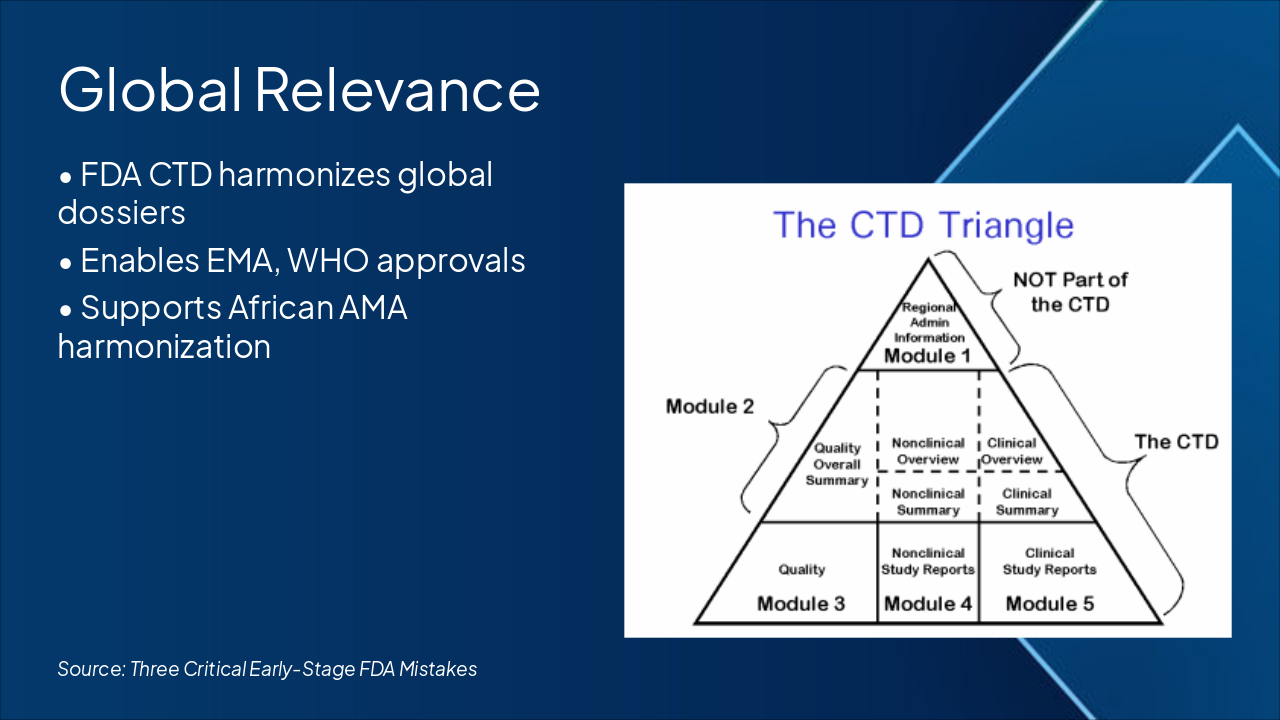
The slide titled "Global Relevance" highlights how the FDA CTD format harmonizes global regulatory dossiers. It enables approvals from EMA and WHO, while supporting harmonization efforts by African regulatory authorities.

Global Relevance

!Image

  • FDA CTD harmonizes global dossiers
  • Enables EMA, WHO approvals
  • Supports African AMA harmonization

Source: Three Critical Early-Stage FDA Mistakes

Speaker Notes
FDA-CTD harmonization facilitates global approvals; enables EMA, WHO, and African AMA pathways.
Slide 6 - Global Relevance
Slide 7 of 8

Slide 7 - Conclusion

The slide's key lessons emphasize engaging the FDA early, prioritizing safety planning, and excelling in documentation to achieve faster global market access. It closes with a call to avoid mistakes, succeed globally, and start regulatory planning today.

Conclusion

**Key Lessons

  1. Engage FDA early
  2. Prioritize safety planning
  3. Excel in documentation

Early action = faster global market access.

Closing: Avoid mistakes, succeed globally.

Call-to-Action: Start regulatory planning today.**

Source: Three Critical Early-Stage FDA Mistakes

Speaker Notes
Summarize key lessons: Engage FDA early for guidance; prioritize safety to avoid disasters; excel in documentation for approval success. Early action accelerates global access. Closing: Act now.
Slide 7 - Conclusion
Slide 8 of 8

Slide 8 - Q&A / Discussion

This title slide invites questions and reflections on regulatory strategies for medical product journeys. It concludes with a thank you message to encourage discussion.

Questions?

Reflections? Let's discuss regulatory strategies for your med product journey. Thank you!

Source: Closing slide for regulatory strategies presentation

Speaker Notes
Invite questions on regulatory strategies for med product journey. Thank you!
Slide 8 - Q&A / Discussion

Discover More Presentations

Explore thousands of AI-generated presentations for inspiration

Browse Presentations
Powered by AI

Create Your Own Presentation

Generate professional presentations in seconds with Karaf's AI. Customize this presentation or start from scratch.

Create New Presentation

Powered by Karaf.ai — AI-Powered Presentation Generator