Exploring AI: From Origins to Art

Generated from prompt:

Create a presentation about artificial intelligence

This presentation introduces AI's history, types like narrow and general, machine vs. deep learning, market growth, applications in healthcare and vehicles, and a case study on AI-generated art winnin

November 9, 202513 slides
Slide 1 of 13

Slide 1 - Introduction to Artificial Intelligence

The slide serves as the title for an "Introduction to Artificial Intelligence" presentation. Its subtitle highlights exploring AI from foundational concepts to emerging future possibilities.

Introduction to Artificial Intelligence

Exploring the world of AI from fundamentals to future possibilities.
Slide 1
Slide 2 of 13

Slide 2 - Presentation Agenda

The presentation agenda outlines four main sections on artificial intelligence, starting with an introduction that defines AI and its core concepts. It then covers the history and types of AI, key applications including its role in art, and concludes with future trends and final thoughts on AI's impact.

Presentation Agenda

  1. Introduction to AI

Defining artificial intelligence and its core concepts.

  1. History and Types of AI

Evolution, milestones, and classifications of AI systems.

  1. Key Applications and AI in Art

Practical uses across industries and creative applications.

  1. Future Trends and Conclusion

Emerging developments and final thoughts on AI's impact.

Source: Artificial Intelligence Presentation

Slide 2
Slide 3 of 13

Slide 3 - What is Artificial Intelligence?

This section header slide, titled "What is Artificial Intelligence?" and numbered as 01, introduces the core concept of AI. It defines AI as a technology that simulates human intelligence in machines, allowing them to learn, reason, and self-correct.

What is Artificial Intelligence?

01

What is Artificial Intelligence?

AI simulates human intelligence in machines, enabling learning, reasoning, and self-correction.

--- Speaker Notes: Definition: AI simulates human intelligence in machines. Includes learning, reasoning, and self-correction. Enables tasks like speech recognition and decision-making.

Slide 3
Slide 4 of 13

Slide 4 - History of AI

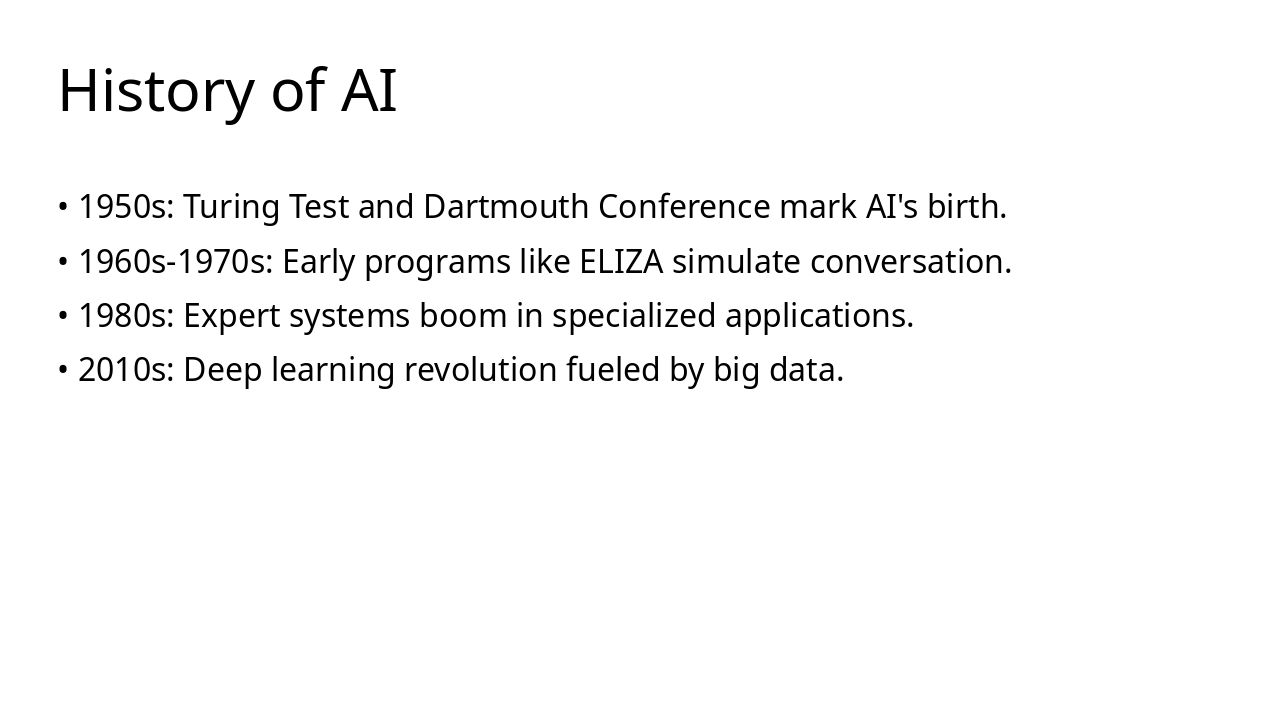
The history of AI began in the 1950s with the Turing Test and Dartmouth Conference, followed by early conversational programs like ELIZA in the 1960s and 1970s. The 1980s saw a boom in expert systems for specialized uses, while the 2010s brought a revolution in deep learning powered by big data.

History of AI

  • 1950s: Turing Test and Dartmouth Conference mark AI's birth.
  • 1960s-1970s: Early programs like ELIZA simulate conversation.
  • 1980s: Expert systems boom in specialized applications.
  • 2010s: Deep learning revolution fueled by big data.
Slide 4
Slide 5 of 13

Slide 5 - Key Milestones in AI

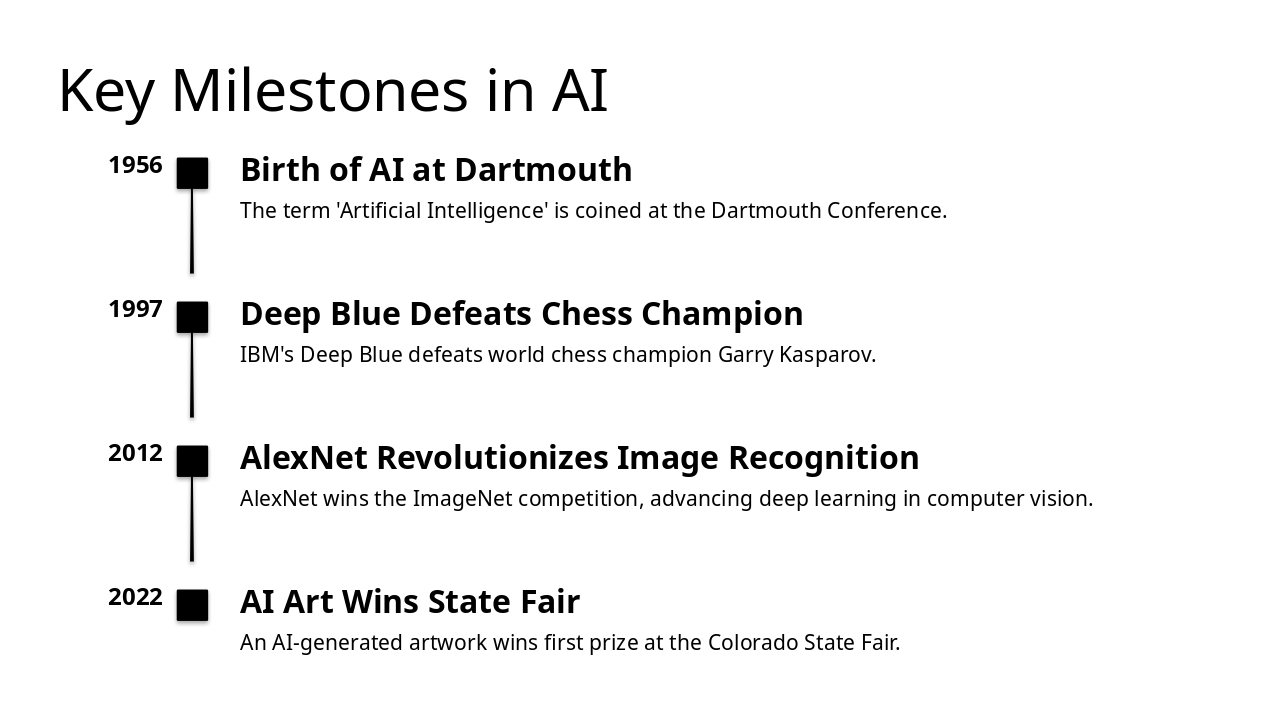
The timeline slide "Key Milestones in AI" highlights pivotal events starting with the 1956 Dartmouth Conference, where the term "Artificial Intelligence" was coined. It then covers IBM's Deep Blue defeating chess champion Garry Kasparov in 1997, AlexNet's breakthrough in image recognition via the 2012 ImageNet competition, and an AI-generated artwork winning first prize at the 2022 Colorado State Fair.

Key Milestones in AI

1956: Birth of AI at Dartmouth The term 'Artificial Intelligence' is coined at the Dartmouth Conference. 1997: Deep Blue Defeats Chess Champion IBM's Deep Blue defeats world chess champion Garry Kasparov. 2012: AlexNet Revolutionizes Image Recognition AlexNet wins the ImageNet competition, advancing deep learning in computer vision. 2022: AI Art Wins State Fair An AI-generated artwork wins first prize at the Colorado State Fair.

Slide 5
Slide 6 of 13

Slide 6 - Types of AI

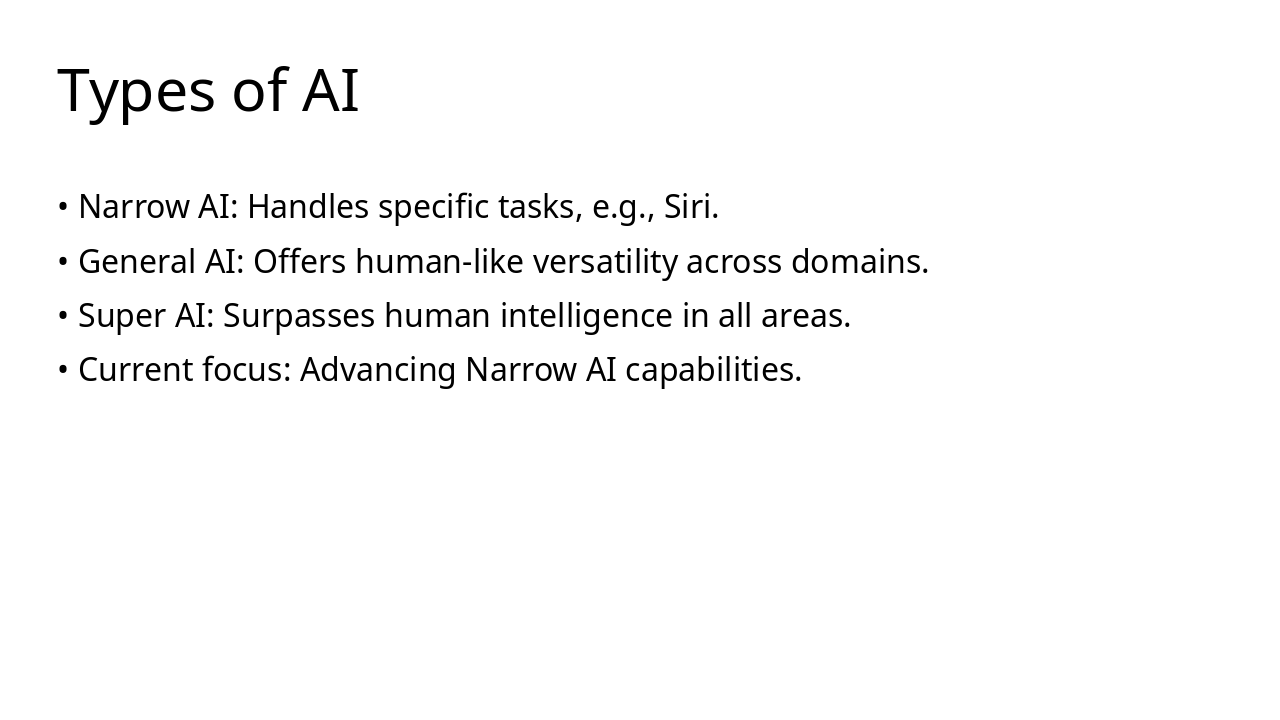
The slide outlines three main types of AI: Narrow AI, which excels at specific tasks like Siri; General AI, which mimics human-like versatility across various domains; and Super AI, which exceeds human intelligence in every aspect. It also notes that current efforts are primarily focused on enhancing Narrow AI capabilities.

Types of AI

  • Narrow AI: Handles specific tasks, e.g., Siri.
  • General AI: Offers human-like versatility across domains.
  • Super AI: Surpasses human intelligence in all areas.
  • Current focus: Advancing Narrow AI capabilities.
Slide 6
Slide 7 of 13

Slide 7 - Machine Learning vs. Deep Learning

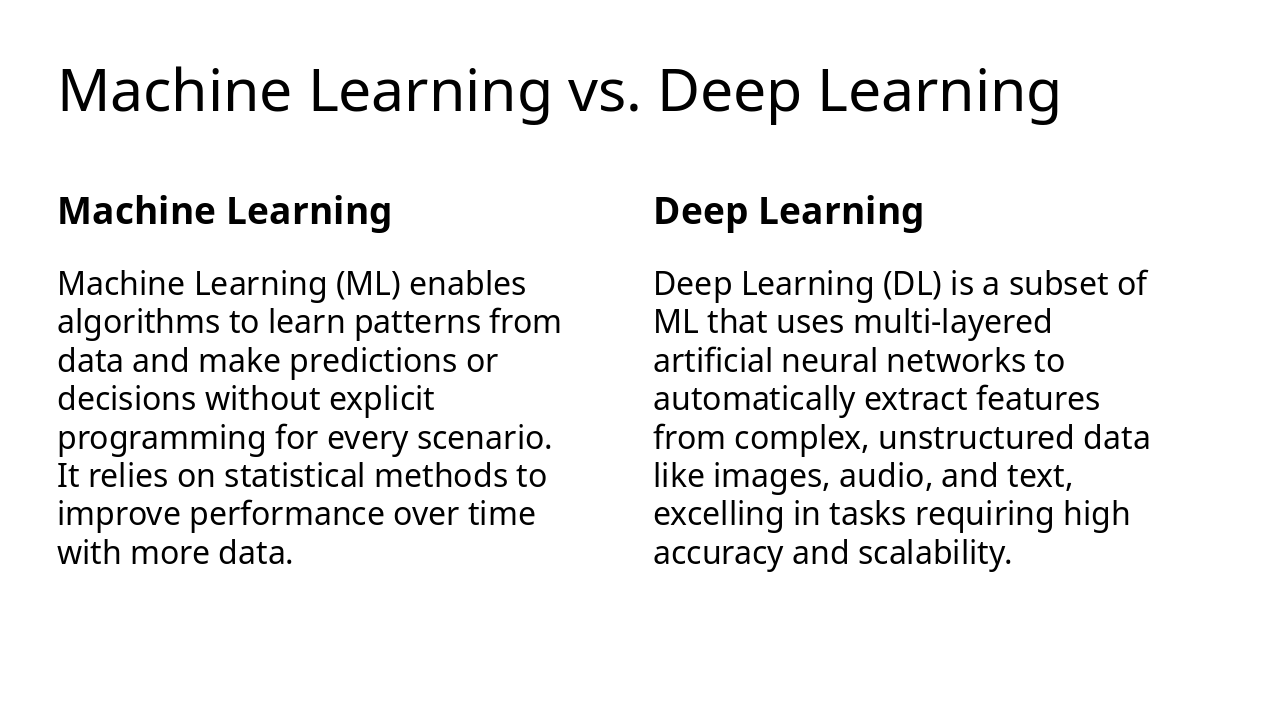
Machine Learning (ML) empowers algorithms to learn patterns from data and make predictions or decisions without explicit programming, relying on statistical methods that improve with more data. Deep Learning (DL), a subset of ML, employs multi-layered neural networks to automatically extract features from complex unstructured data like images and text, excelling in high-accuracy, scalable tasks.

Machine Learning vs. Deep Learning

Machine LearningDeep Learning
Machine Learning (ML) enables algorithms to learn patterns from data and make predictions or decisions without explicit programming for every scenario. It relies on statistical methods to improve performance over time with more data.Deep Learning (DL) is a subset of ML that uses multi-layered artificial neural networks to automatically extract features from complex, unstructured data like images, audio, and text, excelling in tasks requiring high accuracy and scalability.
Slide 7
Slide 8 of 13

Slide 8 - AI Market Growth

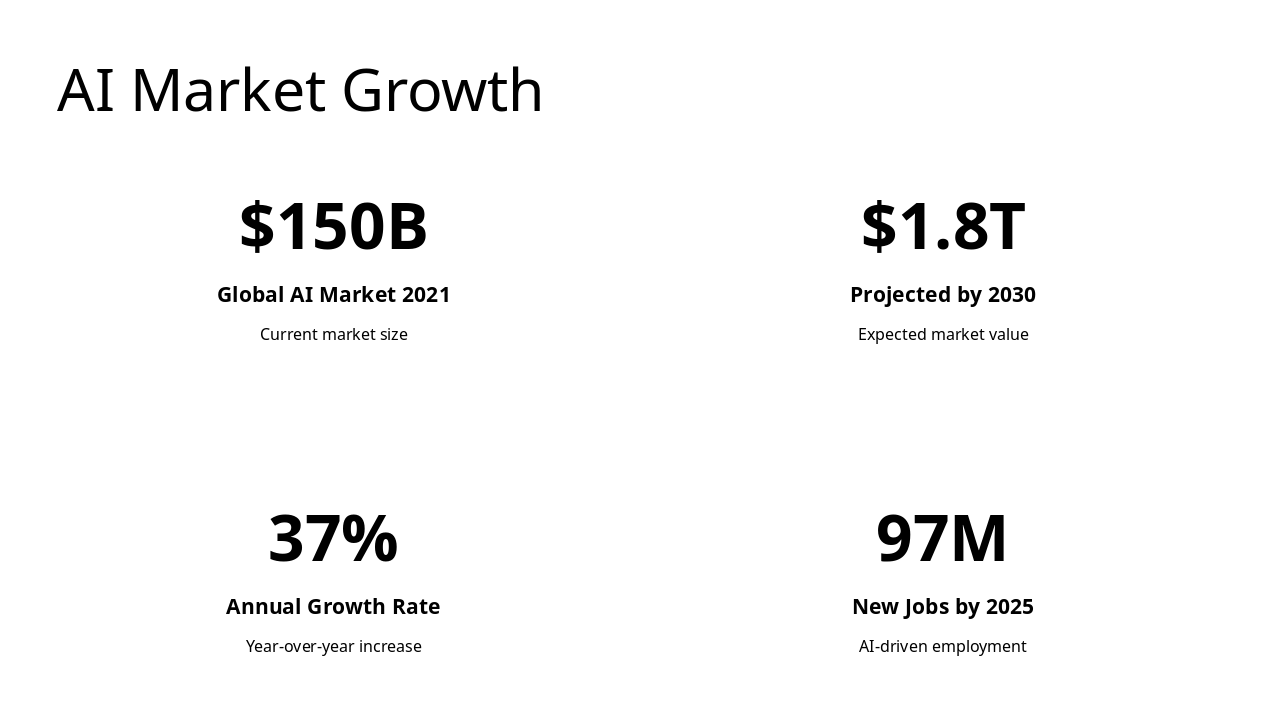
The global AI market was valued at $150 billion in 2021 and is projected to reach $1.8 trillion by 2030, driven by a 37% annual growth rate. Additionally, AI is expected to create 97 million new jobs by 2025.

AI Market Growth

  • $150B: Global AI Market 2021

Current market size

  • $1.8T: Projected by 2030

Expected market value

  • 37%: Annual Growth Rate

Year-over-year increase

  • 97M: New Jobs by 2025

AI-driven employment

Slide 8
Slide 9 of 13

Slide 9 - AI Applications

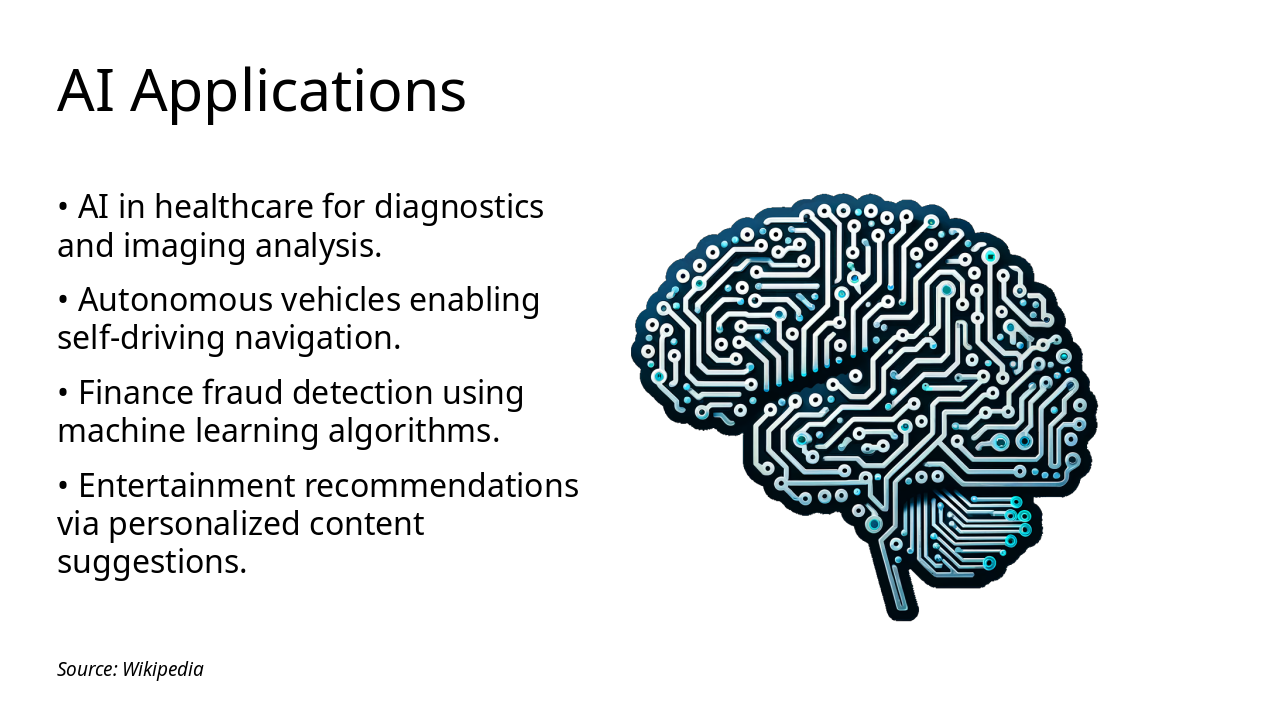
The slide titled "AI Applications" features an image alongside four key examples of AI in real-world sectors. These include AI enhancing healthcare diagnostics and imaging, powering autonomous vehicles for self-driving, detecting fraud in finance through machine learning, and delivering personalized recommendations in entertainment.

AI Applications

!Image

  • AI in healthcare for diagnostics and imaging analysis.
  • Autonomous vehicles enabling self-driving navigation.
  • Finance fraud detection using machine learning algorithms.
  • Entertainment recommendations via personalized content suggestions.

Source: Wikipedia

Slide 9
Slide 10 of 13

Slide 10 - AI in Digital Art

This section header slide is titled "AI in Digital Art." It features a subtitle highlighting how generative AI tools like Midjourney are revolutionizing creativity by challenging traditional artistic boundaries.

AI in Digital Art

AI in Digital Art

Generative AI revolutionizes creativity with tools like Midjourney challenging traditional boundaries.

Source: Presentation about artificial intelligence

--- Speaker Notes: Generative AI transforms creativity. Example: Midjourney creates stunning visuals, challenging traditional art boundaries.

Slide 10
Slide 11 of 13

Slide 11 - Case Study: Théâtre D'opéra Spatial

The slide discusses "Théâtre D'opéra Spatial," an artwork created by Jason M. Allen using Midjourney generative AI, which won a $300 prize in the 2022 Colorado State Fair digital art competition. This marked the first major victory for AI-generated art and sparked widespread debates on copyright and the nature of AI creativity.

Case Study: Théâtre D'opéra Spatial

  • Created by Jason M. Allen using Midjourney generative AI.
  • Won $300 prize at 2022 Colorado State Fair digital art.
  • First major victory for AI-generated artwork.
  • Ignited debates on copyright and AI creativity issues.
Slide 11
Slide 12 of 13

Slide 12 - A Famous Quote on AI

The slide, titled "A Famous Quote on AI," features a cautionary statement from renowned physicist Stephen Hawking. It quotes him warning that the development of full artificial intelligence could spell the end of the human race.

A Famous Quote on AI

> The development of full artificial intelligence could spell the end of the human race.

— Stephen Hawking, renowned physicist

--- Speaker Notes: Reflects both promise and peril.

Slide 12
Slide 13 of 13

Slide 13 - Conclusion: The AI Frontier

The conclusion slide, titled "The AI Frontier," emphasizes that AI propels innovation while necessitating ethical oversight, with a forward-looking vision of collaboration between humans and machines. It wraps up with a subtitle thanking the audience and inviting questions.

Conclusion: The AI Frontier

AI drives innovation but requires ethical oversight. Future: Collaboration between humans and machines.

Thank you! Questions?

--- Speaker Notes: Closing message: Thank you for your attention! (4 words) Call-to-action: Let's collaborate on ethical AI advancements. (5 words)

Slide 13
Powered by AI

Create Your Own Presentation

Generate professional presentations in seconds with Karaf's AI. Customize this presentation or start from scratch.

Create New Presentation

Powered by Karaf.ai — AI-Powered Presentation Generator