Emphysema in Pediatrics: Diagnosis and Management

Generated from prompt:

Create a clean, modern medical PowerPoint presentation titled "Emphysema in Pediatrics" with the following slides: 1. Title Slide: Emphysema in Pediatrics, Presented by Gauri Narkar, Roll No: 92 2. Definition 3. Classification – Based on Etiology 4. Classification – Based on Pathology (Panacinar, Centrilobular, Paraseptal, Irregular) 5. Etiology (Congenital, Acquired, Genetic – Alpha-1 Antitrypsin Deficiency) 6. Pathophysiology (Flow sequence diagram style) 7. Clinical Features (Infants CLE, Genetic Emphysema) 8. Investigations 9. Management – General & Medical 10. Management – Surgical 11. Complications Use a professional medical theme with subtle blue tones, clean layout, bullet formatting, and section divider slides.

Comprehensive overview of emphysema in pediatric patients, including definition, classification (congenital, acquired, genetic), etiology (CLE, AATD), pathophysiology, clinical features, investigations (CXR, HRCT, PFTs), management (supportive, ATaug

February 22, 202610 slides
Slide 1 of 10

Slide 1 - Emphysema in Pediatrics

Emphysema in Pediatrics

Presented by Gauri Narkar Roll No: 92

---

Photo by julien Tromeur on Unsplash
Slide 1 - Emphysema in Pediatrics
Slide 2 of 10

Slide 2 - Definition

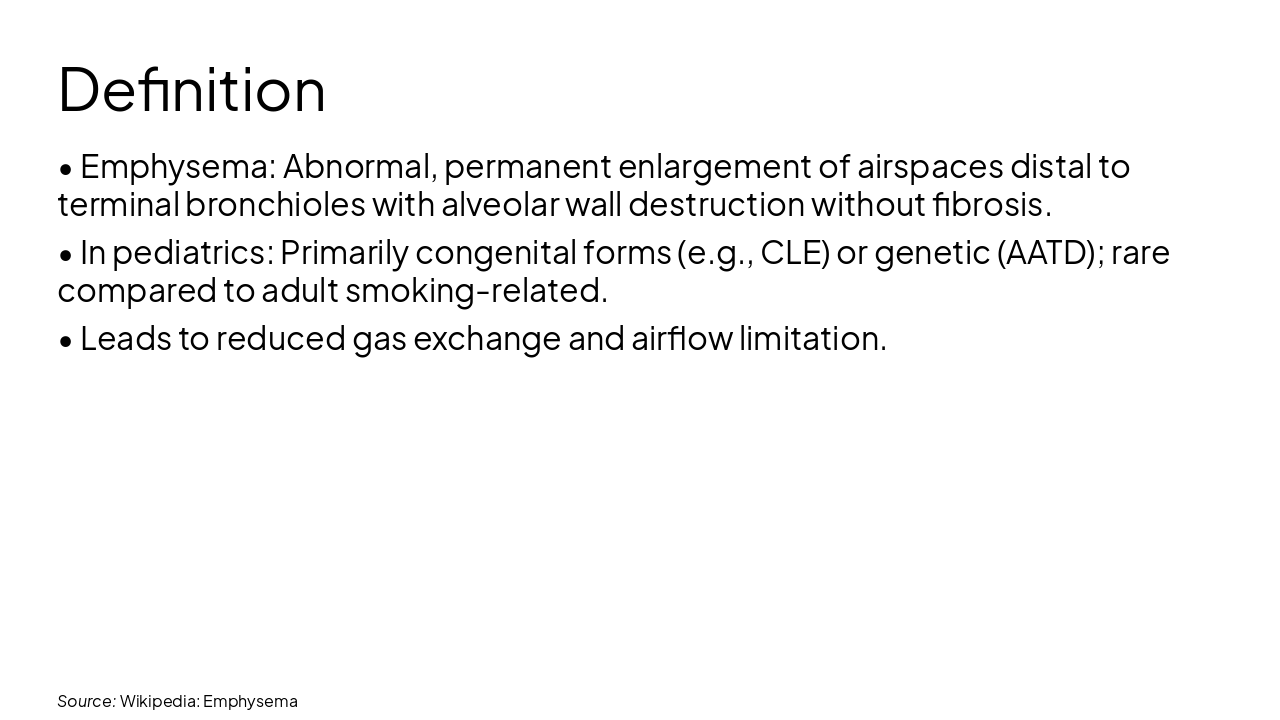
  • Emphysema: Abnormal, permanent enlargement of airspaces distal to terminal bronchioles with alveolar wall destruction without fibrosis.
  • In pediatrics: Primarily congenital forms (e.g., CLE) or genetic (AATD); rare compared to adult smoking-related.
  • Leads to reduced gas exchange and airflow limitation.

Source: Wikipedia: Emphysema

Slide 2 - Definition
Slide 3 of 10

Slide 3 - Classification

Based on Etiology

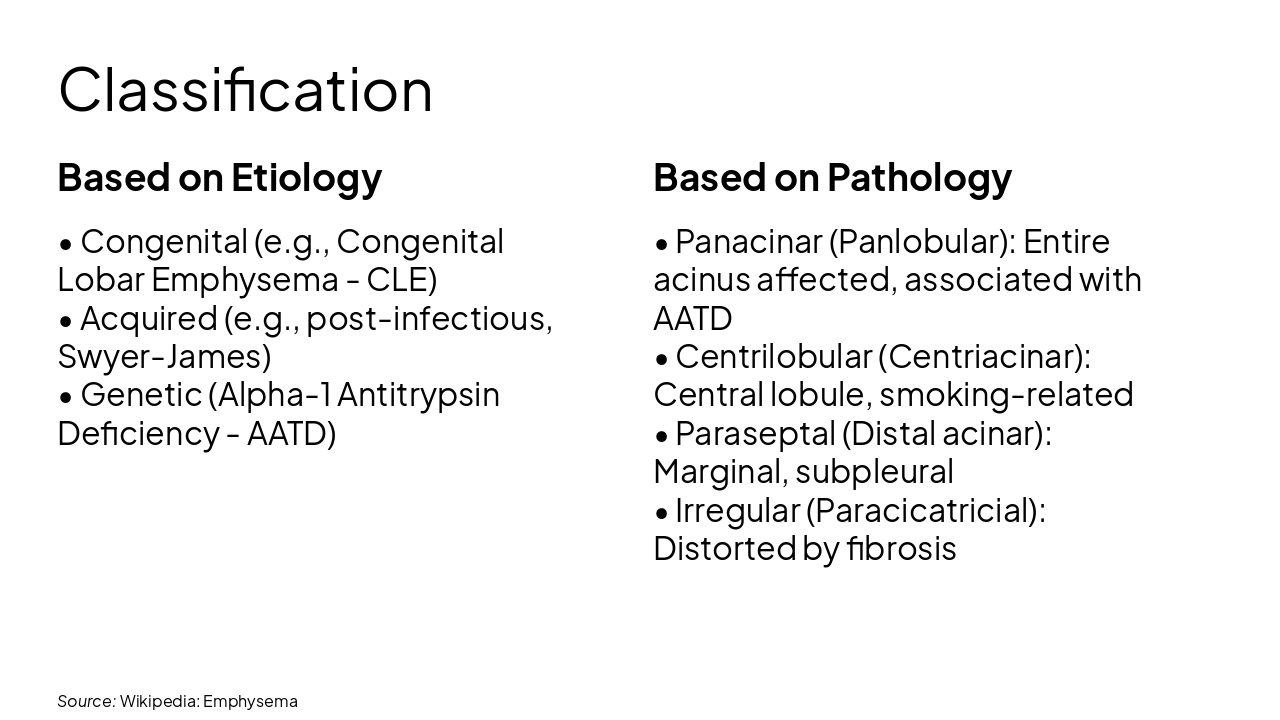
  • Congenital (e.g., Congenital Lobar Emphysema - CLE)
  • Acquired (e.g., post-infectious, Swyer-James)
  • Genetic (Alpha-1 Antitrypsin Deficiency - AATD)

Based on Pathology

  • Panacinar (Panlobular): Entire acinus affected, associated with AATD
  • Centrilobular (Centriacinar): Central lobule, smoking-related
  • Paraseptal (Distal acinar): Marginal, subpleural
  • Irregular (Paracicatricial): Distorted by fibrosis

Source: Wikipedia: Emphysema

Slide 3 - Classification
Slide 4 of 10

Slide 4 - Etiology

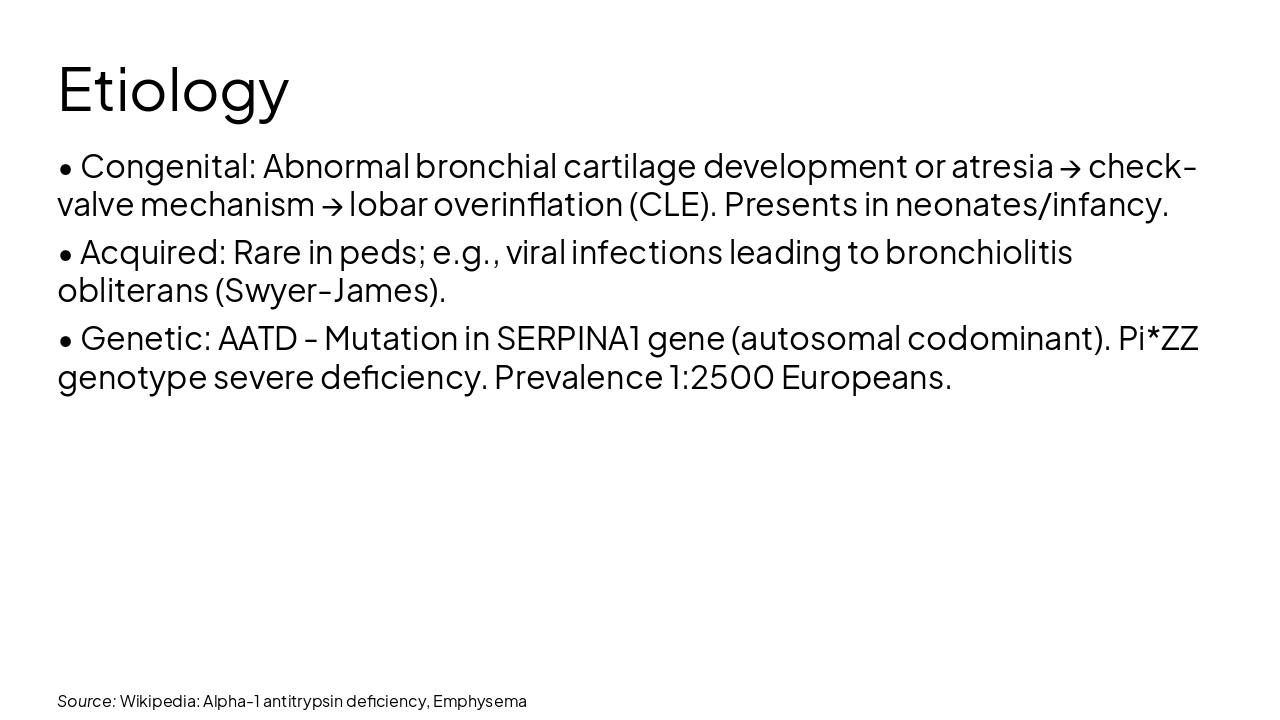
  • Congenital: Abnormal bronchial cartilage development or atresia → check-valve mechanism → lobar overinflation (CLE). Presents in neonates/infancy.
  • Acquired: Rare in peds; e.g., viral infections leading to bronchiolitis obliterans (Swyer-James).
  • Genetic: AATD - Mutation in SERPINA1 gene (autosomal codominant). Pi*ZZ genotype severe deficiency. Prevalence 1:2500 Europeans.

Source: Wikipedia: Alpha-1 antitrypsin deficiency, Emphysema
Slide 4 - Etiology
Slide 5 of 10

Slide 5 - Pathophysiology

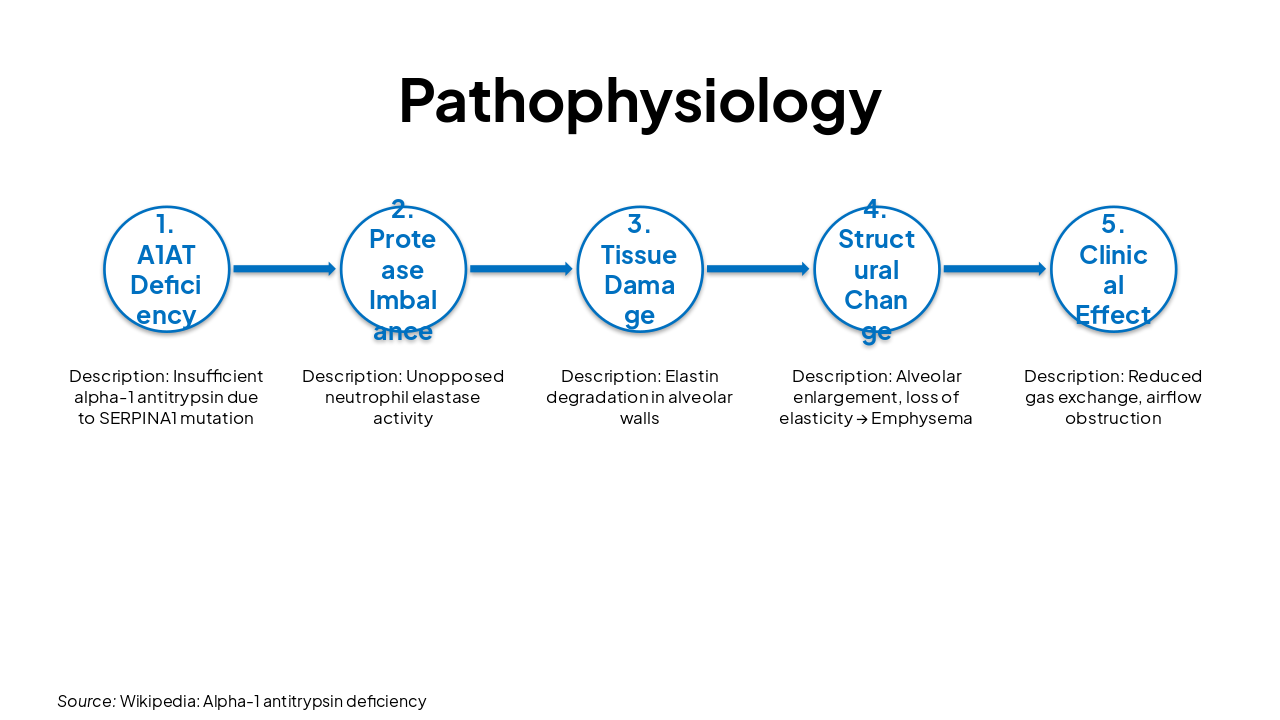
StageDescription
1. A1AT DeficiencyInsufficient alpha-1 antitrypsin due to SERPINA1 mutation
2. Protease ImbalanceUnopposed neutrophil elastase activity
3. Tissue DamageElastin degradation in alveolar walls
4. Structural ChangeAlveolar enlargement, loss of elasticity → Emphysema
5. Clinical EffectReduced gas exchange, airflow obstruction

Source: Wikipedia: Alpha-1 antitrypsin deficiency
Slide 5 - Pathophysiology
Slide 6 of 10

Slide 6 - Clinical Features

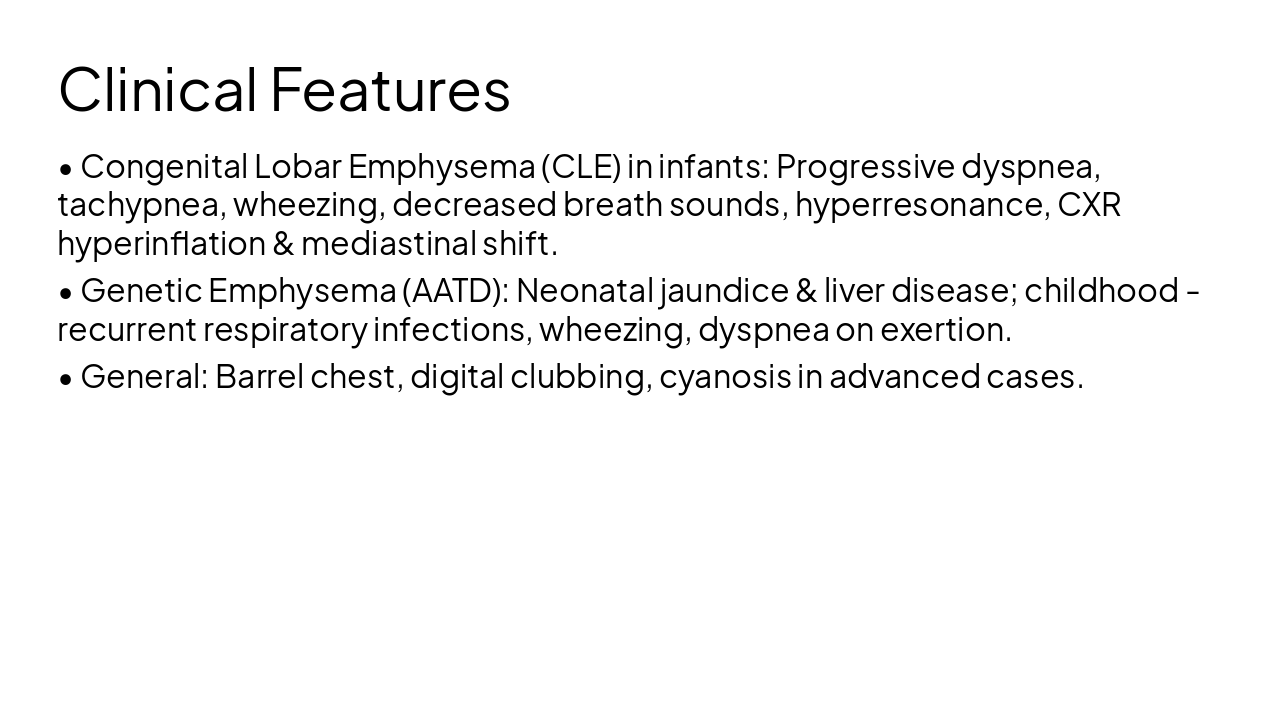
  • Congenital Lobar Emphysema (CLE) in infants: Progressive dyspnea, tachypnea, wheezing, decreased breath sounds, hyperresonance, CXR hyperinflation & mediastinal shift.
  • Genetic Emphysema (AATD): Neonatal jaundice & liver disease; childhood - recurrent respiratory infections, wheezing, dyspnea on exertion.
  • General: Barrel chest, digital clubbing, cyanosis in advanced cases.
Slide 6 - Clinical Features
Slide 7 of 10

Slide 7 - Investigations

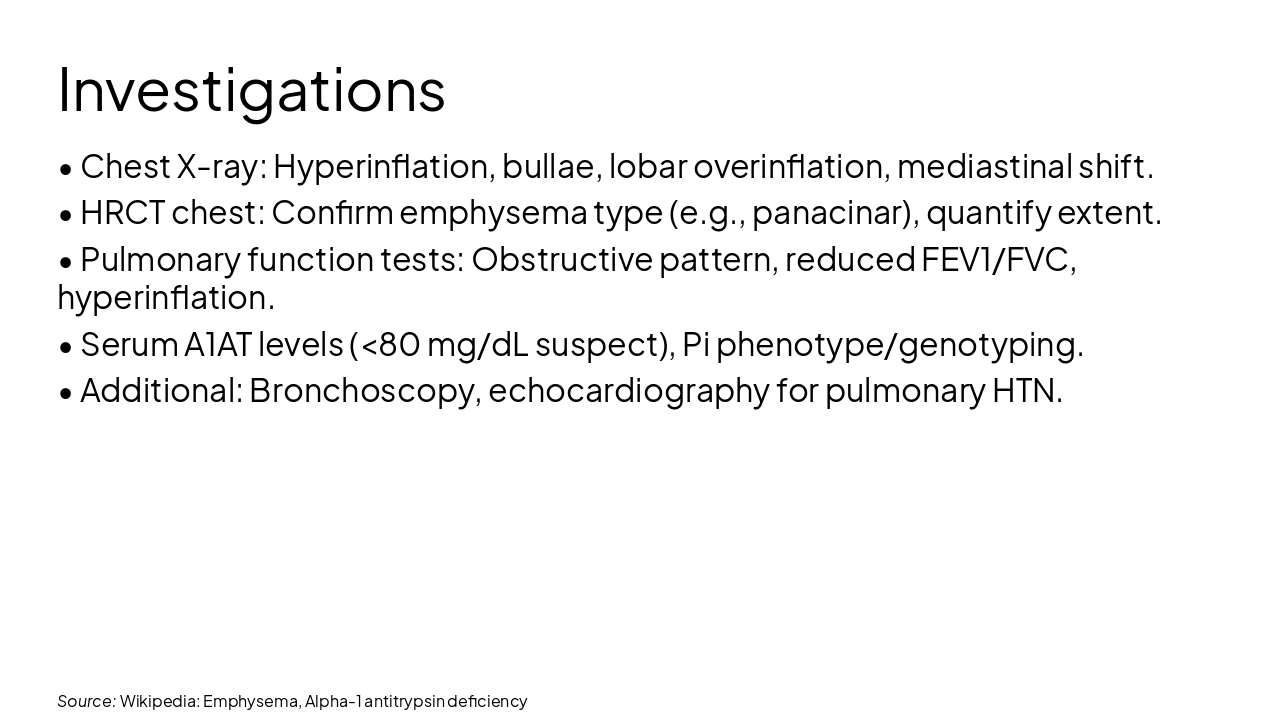
  • Chest X-ray: Hyperinflation, bullae, lobar overinflation, mediastinal shift.
  • HRCT chest: Confirm emphysema type (e.g., panacinar), quantify extent.
  • Pulmonary function tests: Obstructive pattern, reduced FEV1/FVC, hyperinflation.
  • Serum A1AT levels (<80 mg/dL suspect), Pi phenotype/genotyping.
  • Additional: Bronchoscopy, echocardiography for pulmonary HTN.

Source: Wikipedia: Emphysema, Alpha-1 antitrypsin deficiency

Slide 7 - Investigations
Slide 8 of 10

Slide 8 - Management

General & Medical

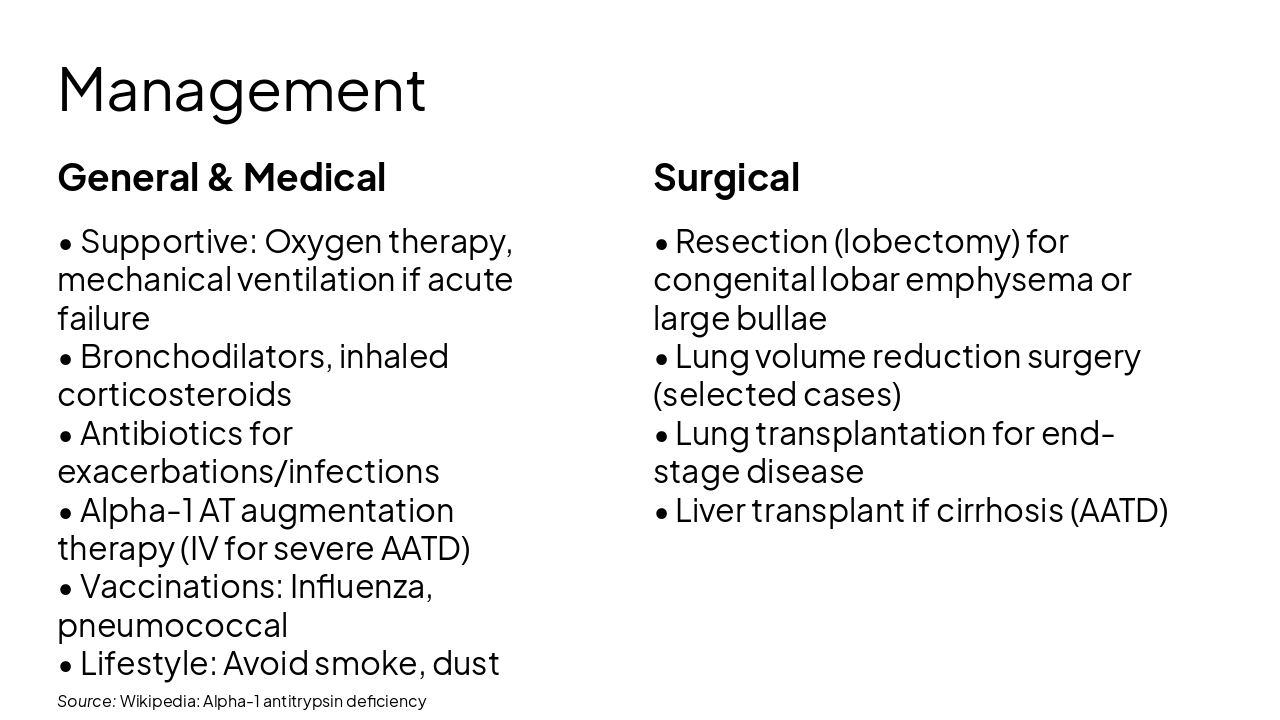
  • Supportive: Oxygen therapy, mechanical ventilation if acute failure
  • Bronchodilators, inhaled corticosteroids
  • Antibiotics for exacerbations/infections
  • Alpha-1 AT augmentation therapy (IV for severe AATD)
  • Vaccinations: Influenza, pneumococcal
  • Lifestyle: Avoid smoke, dust

Surgical

  • Resection (lobectomy) for congenital lobar emphysema or large bullae
  • Lung volume reduction surgery (selected cases)
  • Lung transplantation for end-stage disease
  • Liver transplant if cirrhosis (AATD)

Source: Wikipedia: Alpha-1 antitrypsin deficiency
Slide 8 - Management
Slide 9 of 10

Slide 9 - Complications

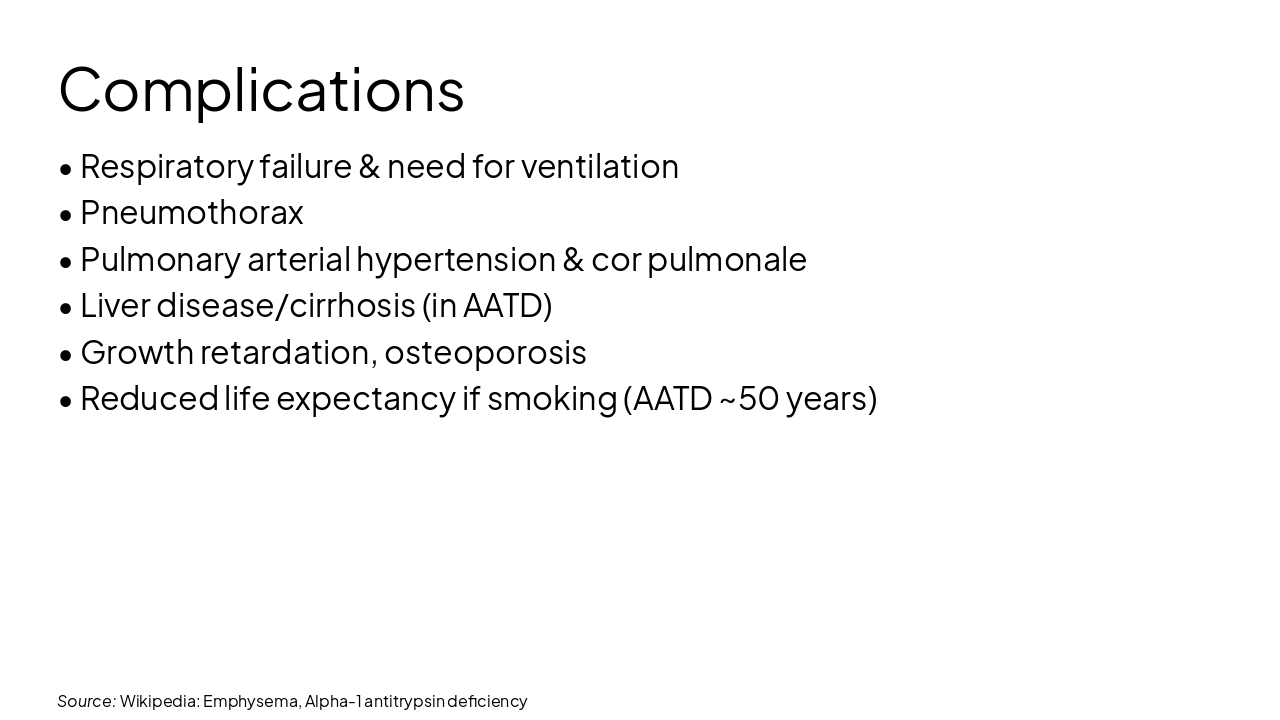
  • Respiratory failure & need for ventilation
  • Pneumothorax
  • Pulmonary arterial hypertension & cor pulmonale
  • Liver disease/cirrhosis (in AATD)
  • Growth retardation, osteoporosis
  • Reduced life expectancy if smoking (AATD ~50 years)

Source: Wikipedia: Emphysema, Alpha-1 antitrypsin deficiency
Slide 9 - Complications
Slide 10 of 10

Slide 10 - Conclusion

Emphysema in Pediatrics: Rare condition requiring early diagnosis and etiology-directed management to prevent complications.

Thank you for your attention! Presented by Gauri Narkar, Roll No: 92 Questions?

---

Photo by Etactics Inc on Unsplash
Slide 10 - Conclusion

Discover More Presentations

Explore thousands of AI-generated presentations for inspiration

Browse Presentations
Powered by AI

Create Your Own Presentation

Generate professional presentations in seconds with Karaf's AI. Customize this presentation or start from scratch.

Create New Presentation

Powered by Karaf.ai — AI-Powered Presentation Generator