Fiber Optics Fundamentals: TIR, Acceptance Angle & NA

Generated from prompt:

Create a professional 10-slide student presentation titled 'Optical Principles: Total Internal Reflection, Acceptance Angle, and Numerical Aperture'. Include clean academic design. Slide 1: Title Slide – Optical Principles with student name placeholder. Slide 2: Introduction to Fiber Optics and Light Propagation. Slide 3: Refraction and Snell’s Law (include simple ray diagram). Slide 4: Total Internal Reflection – Definition and Conditions (include labeled diagram). Slide 5: Critical Angle Formula and Explanation (include diagram showing critical angle). Slide 6: Applications of Total Internal Reflection in Optical Fibers (include fiber diagram). Slide 7: Acceptance Angle – Definition and Physical Meaning (include cone diagram). Slide 8: Numerical Aperture – Definition and Formula NA = n sin(theta) (include diagram). Slide 9: Relationship Between TIR, Acceptance Angle, and Numerical Aperture (summary diagram). Slide 10: Conclusion and Key Takeaways. Each principle must include a clear labeled diagram suitable for a student academic presentation. Use professional formatting, minimal text per slide, bullet points, and clean visuals.

This student presentation delves into key optical principles for fiber optics: Total Internal Reflection (TIR), critical angle, acceptance angle, and Numerical Aperture (NA). Covers Snell's law, light propagation, fiber structure, and applications in

March 2, 202611 slides
Slide 1 of 11

Slide 1 - Optical Principles: Total Internal Reflection, Acceptance Angle, and Numerical Aperture

Optical Principles: Total Internal Reflection, Acceptance Angle, and Numerical Aperture

Student Presentation [Your Name]

Slide 1 - Optical Principles: Total Internal Reflection, Acceptance Angle, and Numerical Aperture
Slide 2 of 11

Slide 2 - Optical Principles: Total Internal Reflection, Acceptance Angle, and Numerical Aperture

Optical Principles: Total Internal Reflection, Acceptance Angle, and Numerical Aperture

Student Presentation [Your Name]

Slide 2 - Optical Principles: Total Internal Reflection, Acceptance Angle, and Numerical Aperture
Slide 3 of 11

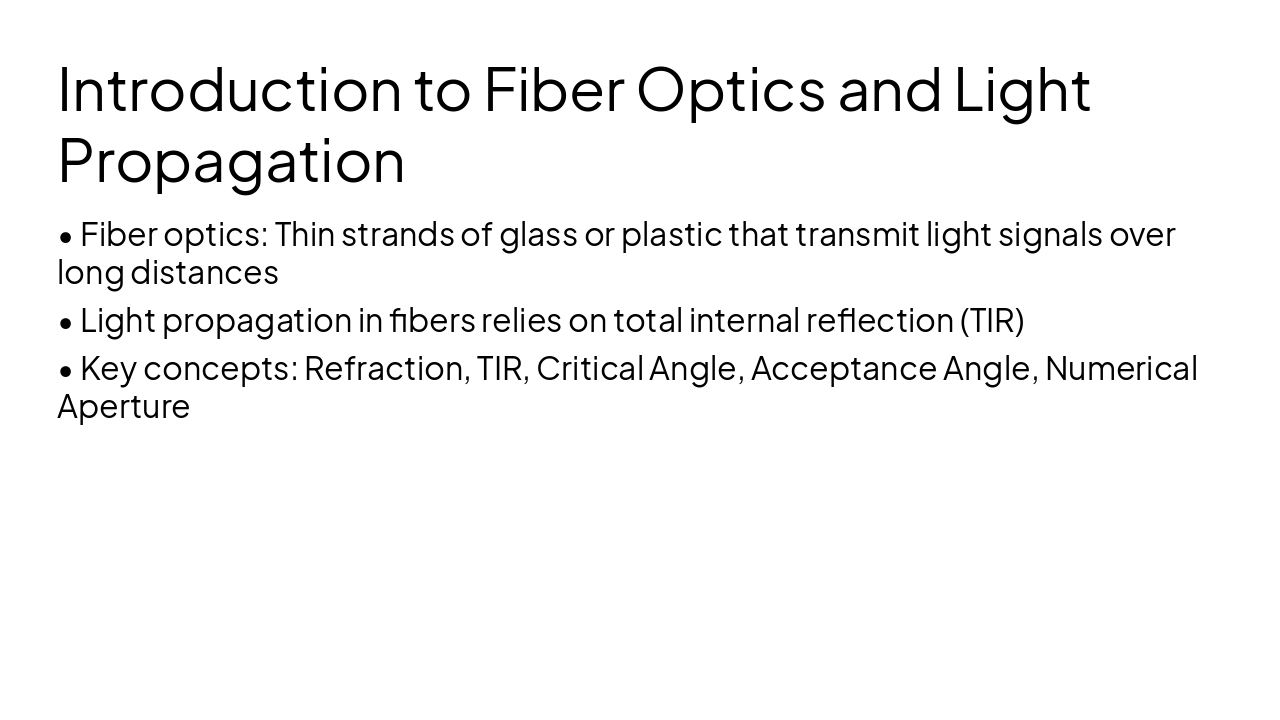
Slide 3 - Introduction to Fiber Optics and Light Propagation

  • Fiber optics: Thin strands of glass or plastic that transmit light signals over long distances
  • Light propagation in fibers relies on total internal reflection (TIR)
  • Key concepts: Refraction, TIR, Critical Angle, Acceptance Angle, Numerical Aperture
Slide 3 - Introduction to Fiber Optics and Light Propagation
Slide 4 of 11

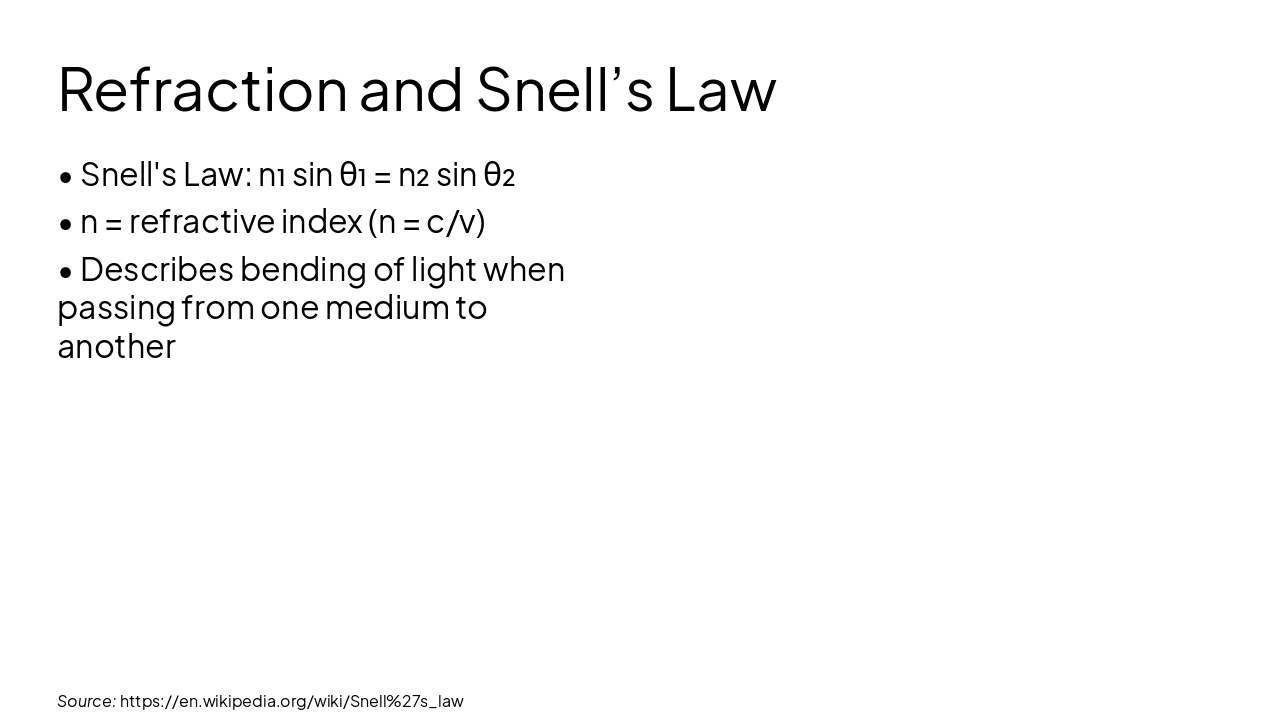
Slide 4 - Refraction and Snell’s Law

  • Snell's Law: n₁ sin θ₁ = n₂ sin θ₂
  • n = refractive index (n = c/v)
  • Describes bending of light when passing from one medium to another

Source: https://en.wikipedia.org/wiki/Snell%27s_law
Slide 4 - Refraction and Snell’s Law
Slide 5 of 11

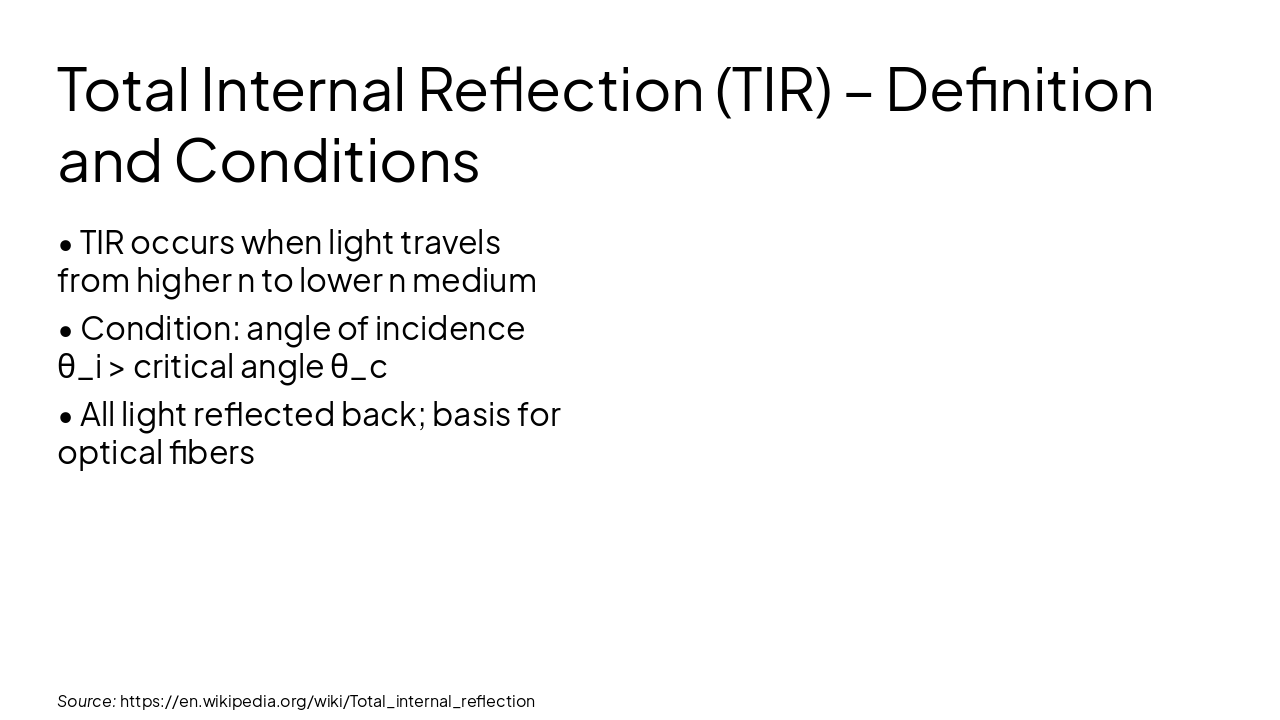
Slide 5 - Total Internal Reflection (TIR) – Definition and Conditions

  • TIR occurs when light travels from higher n to lower n medium
  • Condition: angle of incidence θi > critical angle θc
  • All light reflected back; basis for optical fibers

Source: https://en.wikipedia.org/wiki/Total_internal_reflection
Slide 5 - Total Internal Reflection (TIR) – Definition and Conditions
Slide 6 of 11

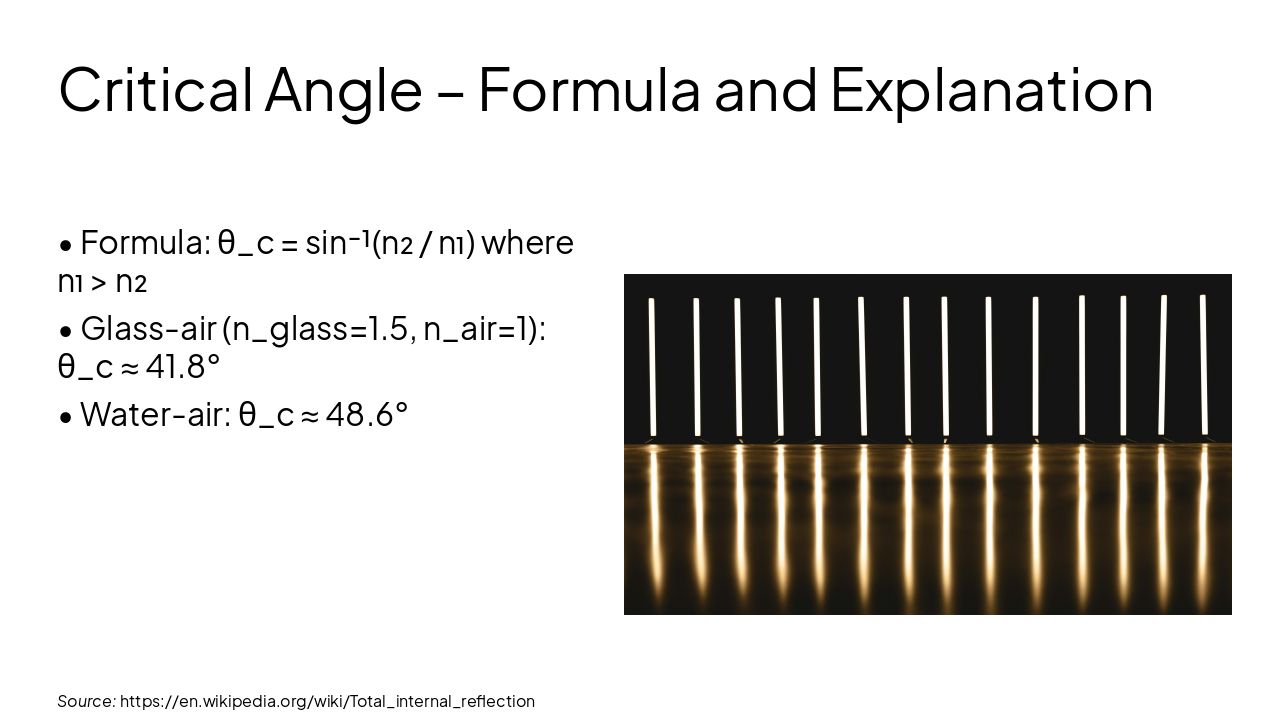
Slide 6 - Critical Angle – Formula and Explanation

  • Formula: θc = sin⁻¹(n₂ / n₁) where n₁ > n₂
  • Glass-air (nglass=1.5, nair=1): θc ≈ 41.8°
  • Water-air: θ_c ≈ 48.6°

---

Photo by Kyler Payne on Unsplash

Source: https://en.wikipedia.org/wiki/Total_internal_reflection
Slide 6 - Critical Angle – Formula and Explanation
Slide 7 of 11

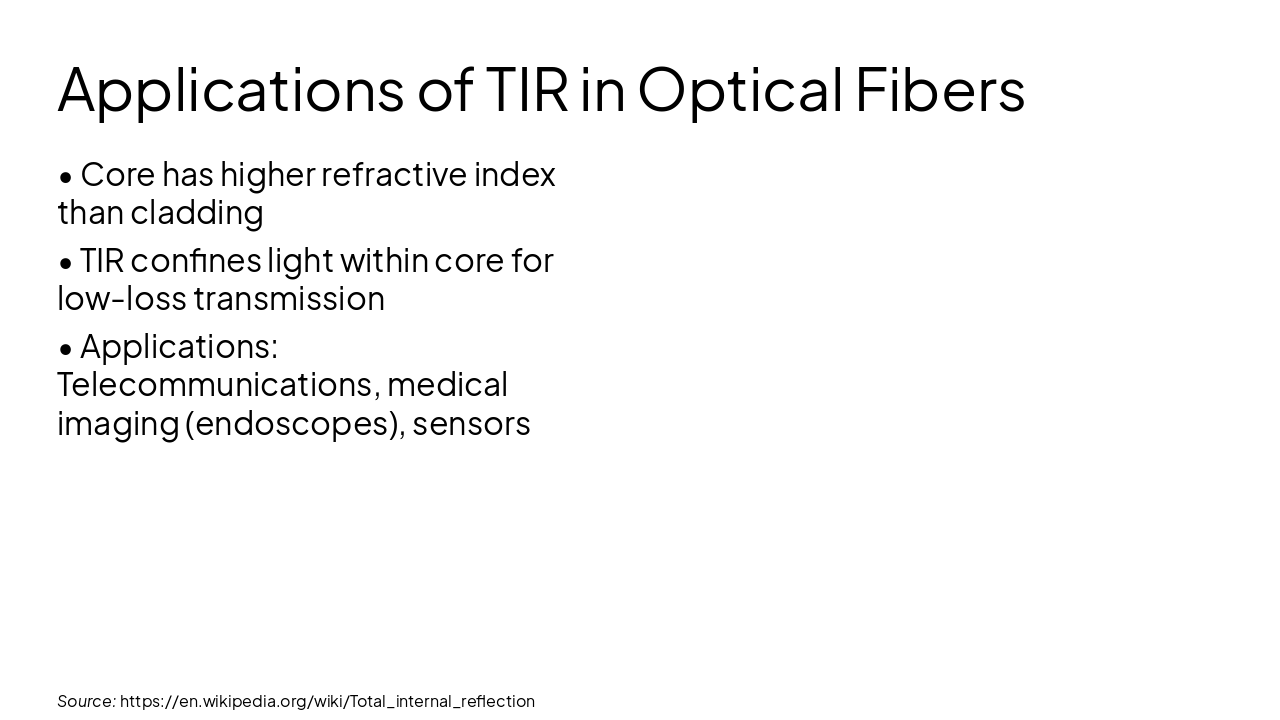
Slide 7 - Applications of TIR in Optical Fibers

  • Core has higher refractive index than cladding
  • TIR confines light within core for low-loss transmission
  • Applications: Telecommunications, medical imaging (endoscopes), sensors

Source: https://en.wikipedia.org/wiki/Total_internal_reflection
Slide 7 - Applications of TIR in Optical Fibers
Slide 8 of 11

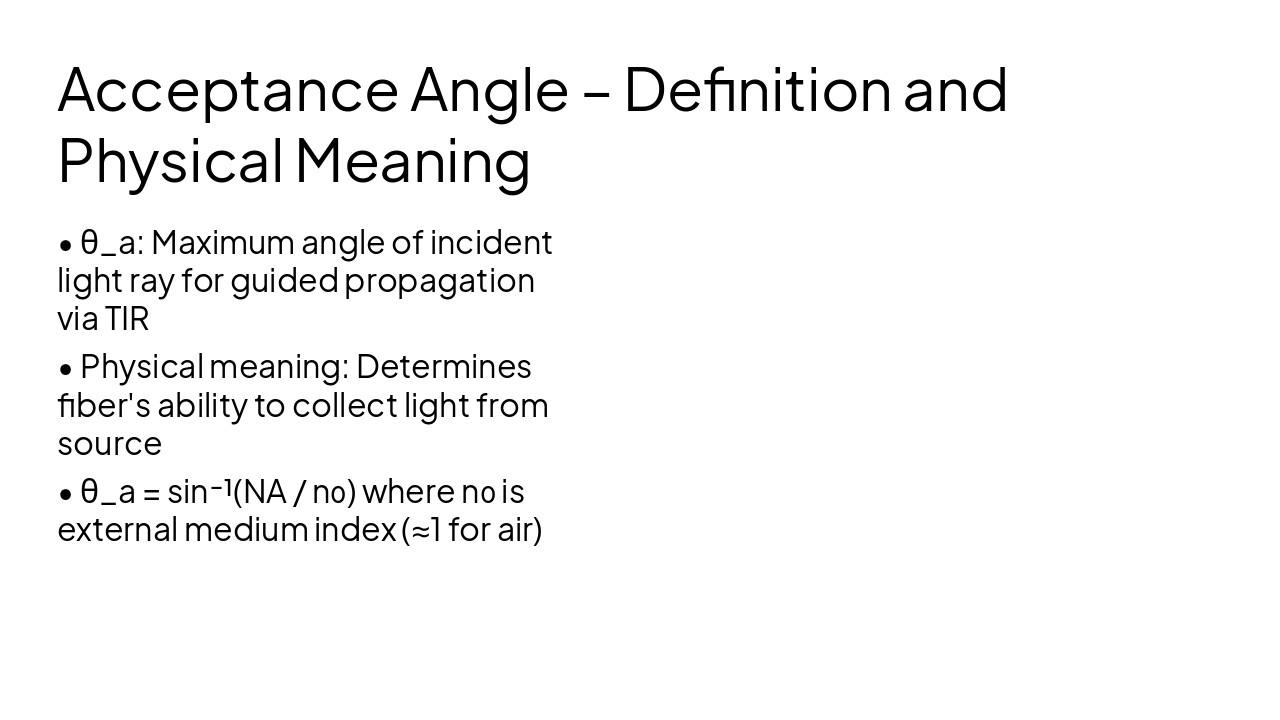
Slide 8 - Acceptance Angle – Definition and Physical Meaning

  • θa: Maximum angle of incident light ray for guided propagation via TIR
  • Physical meaning: Determines fiber's ability to collect light from source
  • θa = sin⁻¹(NA / n₀) where n₀ is external medium index (≈1 for air)
Slide 8 - Acceptance Angle – Definition and Physical Meaning
Slide 9 of 11

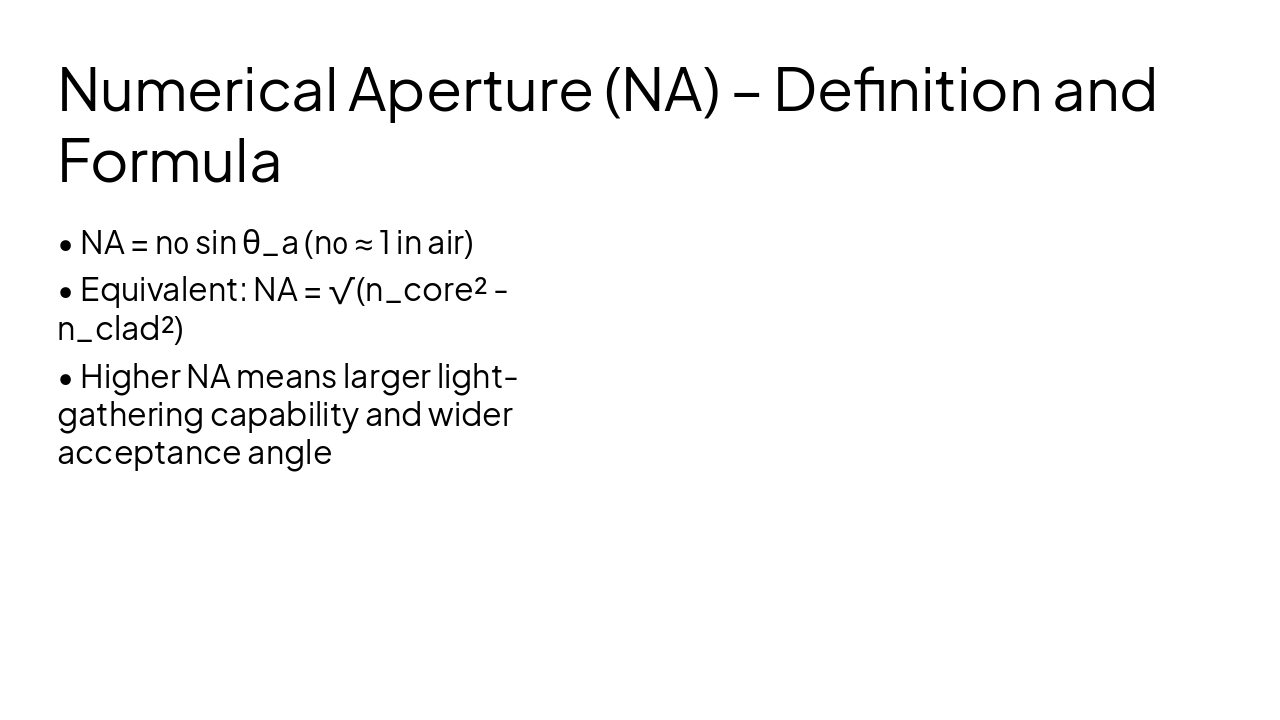
Slide 9 - Numerical Aperture (NA) – Definition and Formula

  • NA = n₀ sin θa (n₀ ≈ 1 in air)
  • Equivalent: NA = √(ncore² - n_clad²)
  • Higher NA means larger light-gathering capability and wider acceptance angle
Slide 9 - Numerical Aperture (NA) – Definition and Formula
Slide 10 of 11

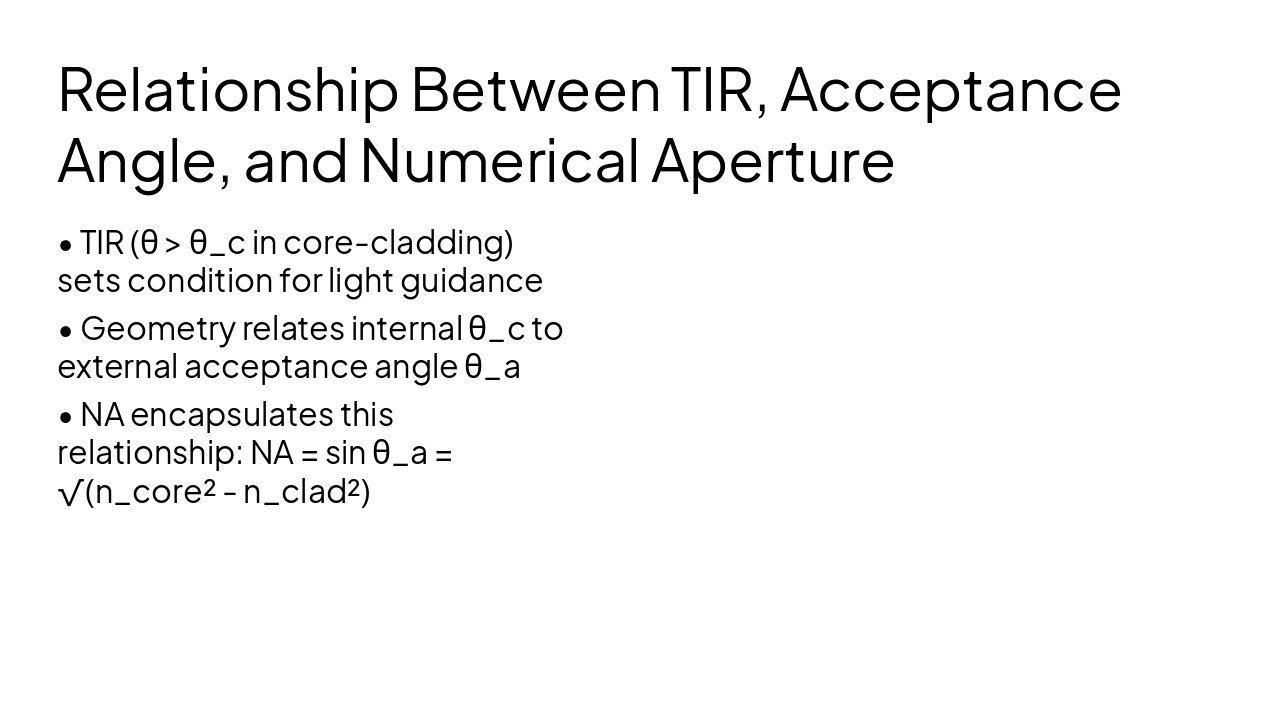
Slide 10 - Relationship Between TIR, Acceptance Angle, and Numerical Aperture

  • TIR (θ > θc in core-cladding) sets condition for light guidance
  • Geometry relates internal θc to external acceptance angle θa
  • NA encapsulates this relationship: NA = sin θa = √(ncore² - nclad²)
Slide 10 - Relationship Between TIR, Acceptance Angle, and Numerical Aperture
Slide 11 of 11

Slide 11 - Conclusion and Key Takeaways

Total Internal Reflection enables light guidance in fibers. Acceptance Angle defines entry limit. Numerical Aperture quantifies performance.

Essential for fiber optic technology.

Thank you! Questions?
Slide 11 - Conclusion and Key Takeaways

Discover More Presentations

Explore thousands of AI-generated presentations for inspiration

Browse Presentations
Powered by AI

Create Your Own Presentation

Generate professional presentations in seconds with Karaf's AI. Customize this presentation or start from scratch.

Create New Presentation

Powered by Karaf.ai — AI-Powered Presentation Generator