India's Digital Tax Evolution

Generated from prompt:

Prepare a 10-slide PowerPoint presentation based on the research report titled 'An Evolution of Digital Tax Administration and E-Filing System in India' by Bhagyashree Mandloi. Include slides: 1) Title Page, 2) Abstract, 3) Objectives, 4) Research Questions & Hypotheses, 5) Methodology, 6) Key Findings (Primary Data), 7) Key Findings (Secondary Data), 8) Discussion, 9) Recommendations, 10) Conclusion. Style it with professional academic design and minimal text per slide.

10-slide overview of digital tax admin & e-filing evolution in India. Covers objectives, mixed-methods research (n=200 surveys + govt data), key findings (80% paperwork cut, rural gaps), discussion, r

December 14, 202510 slides
Slide 1 of 10

Slide 1 - Title Page

This title slide presents "Evolution of Digital Tax Administration in India" as the main topic. The subtitle specifies a research report presentation on the E-Filing System by Bhagyashree Mandloi.

Evolution of Digital Tax Administration in India

E-Filing System | Research Report Presentation by Bhagyashree Mandloi

Source: An Evolution of Digital Tax Administration and E-Filing System in India By Bhagyashree Mandloi [Date] Research Report Presentation

Slide 1 - Title Page
Slide 2 of 10

Slide 2 - Abstract

This slide's abstract overviews digital transformation in India's tax administration and the evolution of e-filing from manual to digital systems. It highlights implementation challenges and explores future implications for tax efficiency.

Abstract

  • Overview of digital transformation in India's tax administration
  • Evolution of e-filing from manual to digital systems
  • Highlights challenges in implementation and adoption
  • Explores future implications for tax efficiency

Source: An Evolution of Digital Tax Administration and E-Filing System in India by Bhagyashree Mandloi

Slide 2 - Abstract
Slide 3 of 10

Slide 3 - Objectives

This slide, titled "Objectives," outlines four key goals for studying e-filing systems. They include tracing their historical evolution, analyzing impacts on tax compliance and efficiency, evaluating technological advancements and user adoption, and proposing recommendations for improvement.

Objectives

  • Trace historical evolution of e-filing systems.
  • Analyze impact on tax compliance and efficiency.
  • Evaluate technological advancements and user adoption.
  • Propose recommendations for improvement.

Source: An Evolution of Digital Tax Administration and E-Filing System in India by Bhagyashree Mandloi

Slide 3 - Objectives
Slide 4 of 10

Slide 4 - Research Questions & Hypotheses

The slide outlines key research questions on the evolution of e-filing in India and factors influencing its adoption. It also presents hypotheses that digital tools improve compliance and user training boosts efficiency.

Research Questions & Hypotheses

Key QuestionsHypotheses

| • How has e-filing evolved in India?

  • What factors influence adoption? | • Digital tools improve compliance.
  • User training boosts efficiency. |
Slide 4 - Research Questions & Hypotheses
Slide 5 of 10

Slide 5 - Methodology

The methodology slide outlines a mixed-methods approach, featuring primary data from surveys of 200 taxpayers, secondary data from government reports and the Income Tax Department, and qualitative expert interviews. Data analysis involves SPSS for quantitative work and thematic coding for qualitative insights.

Methodology

  • Mixed methods: surveys (primary data, n=200 taxpayers)
  • Secondary data from govt reports, Income Tax Dept.
  • Qualitative interviews with experts
  • Data analysis via SPSS and thematic coding

Source: Bhagyashree Mandloi, 'An Evolution of Digital Tax Administration and E-Filing System in India'

Slide 5 - Methodology
Slide 6 of 10

Slide 6 - Key Findings: Primary Data

Key Findings from primary data show 75% of users prefer e-filing over manual filing, with 60% reporting faster processing times. However, 40% cite technical glitches as the main challenges.

Key Findings: Primary Data

  • 75%: Prefer E-Filing
  • Over manual filing

  • 60%: Faster Processing
  • Reported by users

  • 40%: Technical Glitches

Main challenges cited Source: Primary Data Survey

Slide 6 - Key Findings: Primary Data
Slide 7 of 10

Slide 7 - Key Findings: Secondary Data

The slide features a table titled "Key Findings: Secondary Data" listing major milestones by year. It covers ITR-1 e-filing launch in 2006, PAN-Aadhaar linkage in 2010, GSTN portal in 2017, and faceless assessment in 2023.

Key Findings: Secondary Data

{ "headers": [ "Year", "Milestone" ], "rows": [ [ "2006", "ITR-1 e-filing launch" ], [ "2010", "PAN-Aadhaar linkage" ], [ "2017", "GSTN portal" ], [ "2023", "Faceless assessment" ] ] }

Slide 7 - Key Findings: Secondary Data
Slide 8 of 10

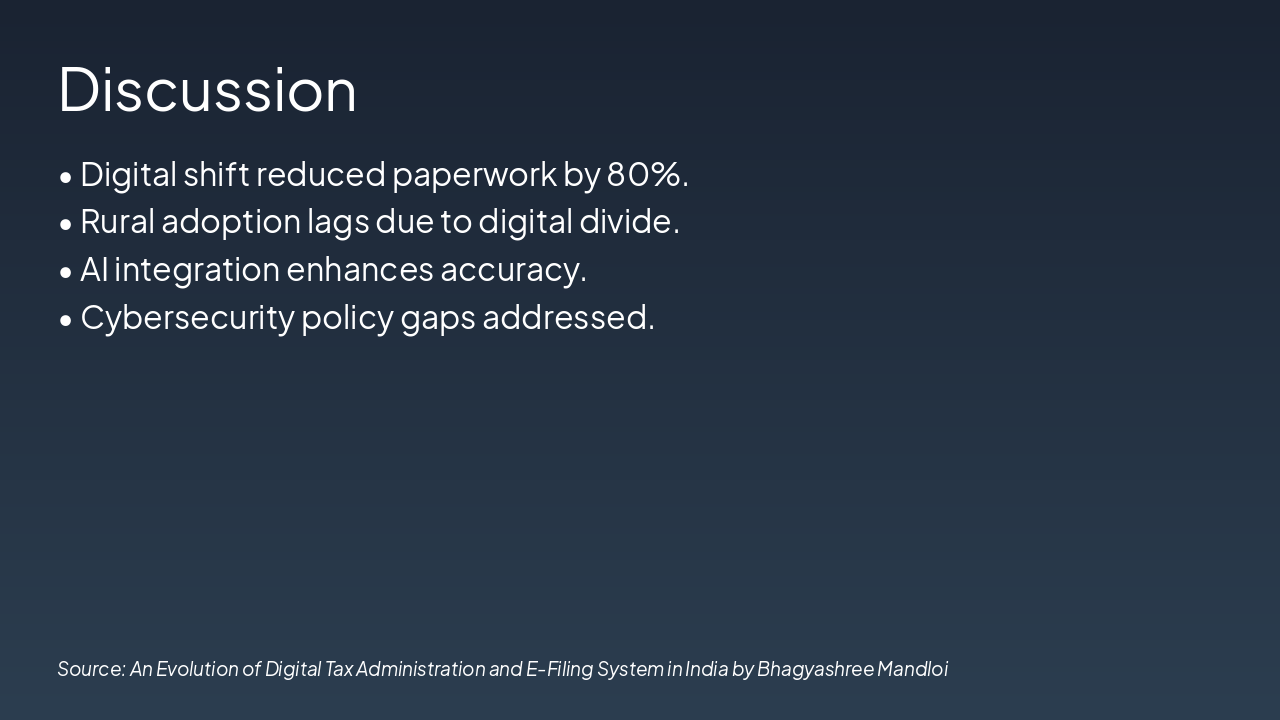
Slide 8 - Discussion

The slide discusses how the digital shift reduced paperwork by 80% and AI integration enhances accuracy. It also highlights rural adoption lags due to the digital divide and addressed cybersecurity policy gaps.

Discussion

  • Digital shift reduced paperwork by 80%.
  • Rural adoption lags due to digital divide.
  • AI integration enhances accuracy.
  • Cybersecurity policy gaps addressed.

Source: An Evolution of Digital Tax Administration and E-Filing System in India by Bhagyashree Mandloi

Slide 8 - Discussion
Slide 9 of 10

Slide 9 - Recommendations

The Recommendations slide lists four key action items. They include enhancing user training, improving portal UI/UX for accessibility, strengthening data security, and promoting mobile e-filing apps.

Recommendations

  • Enhance user training programs.
  • Improve portal UI/UX for accessibility.
  • Strengthen data security measures.
  • Promote mobile e-filing apps.

Source: An Evolution of Digital Tax Administration and E-Filing System in India by Bhagyashree Mandloi

Slide 9 - Recommendations
Slide 10 of 10

Slide 10 - Conclusion

Digital tax administration has revolutionized India's revenue system, with e-filing improving efficiency and compliance. The slide envisions a future with AI and blockchain for seamless taxation, followed by thanks and a Q&A invitation.

Conclusion

• Digital tax admin revolutionized India's revenue system.

  • E-filing boosts efficiency and compliance.
  • Future: AI, blockchain for seamless taxation.

Thank you for your attention! Q&A

Source: An Evolution of Digital Tax Administration and E-Filing System in India by Bhagyashree Mandloi

Speaker Notes
Digital tax administration has revolutionized India's revenue system. E-filing enhances efficiency and compliance. Future innovations like AI and blockchain promise seamless taxation. Closing message: Thank you for your attention! Call-to-action: Open for Q&A.
Slide 10 - Conclusion

Discover More Presentations

Explore thousands of AI-generated presentations for inspiration

Browse Presentations
Powered by AI

Create Your Own Presentation

Generate professional presentations in seconds with Karaf's AI. Customize this presentation or start from scratch.

Create New Presentation

Powered by Karaf.ai — AI-Powered Presentation Generator