The Death of the Author: Barthes' Literary Revolution
Generated from prompt:
Create a thesis presentation on Roland Barthes' essay "The Death of the Author." Include slides covering: introduction to Barthes, historical context, key arguments of the essay, explanation of author vs reader, concept of text as multi-dimensional space, implications for literary criticism, examples, criticisms of the theory, modern relevance (including digital media), and conclusion. Make it academic, clear, and structured for a university-level presentation with around 12-15 slides.
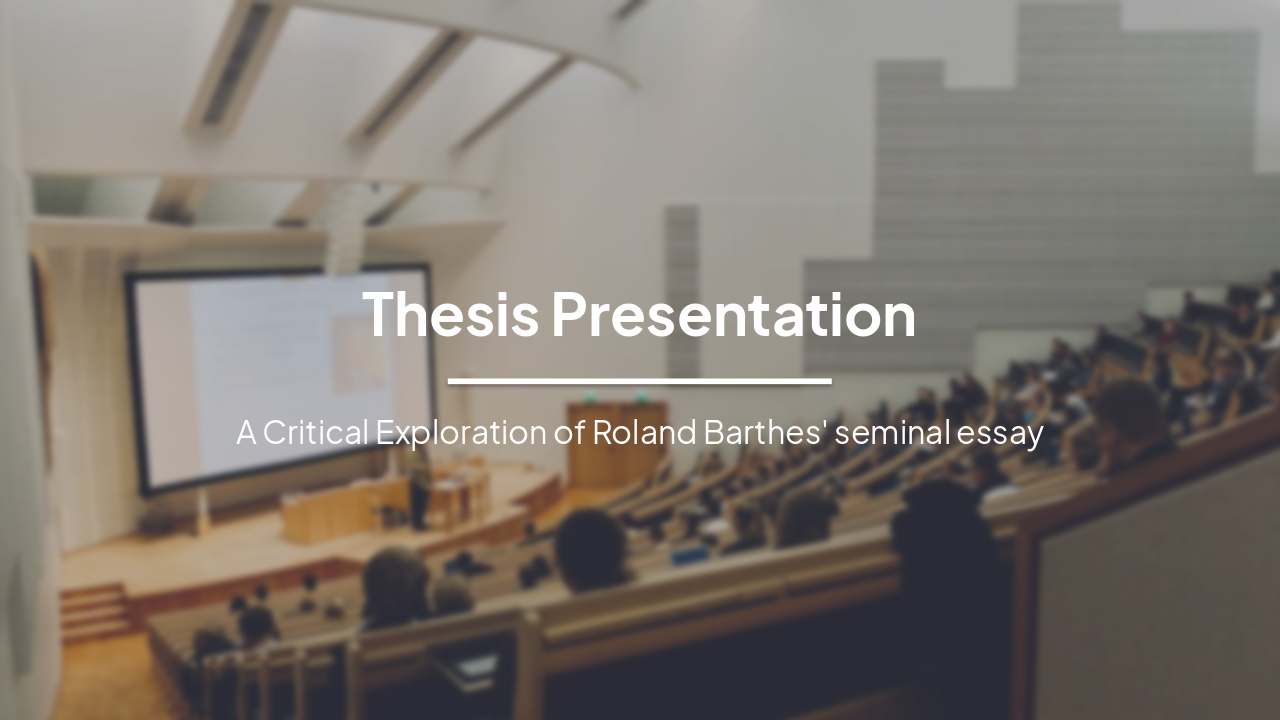
This thesis presentation explores Roland Barthes' 1967 essay 'The Death of the Author,' covering its historical context, core arguments decentering the author in favor of the reader, the text as a multi-dimensional space, implications for literary批评,
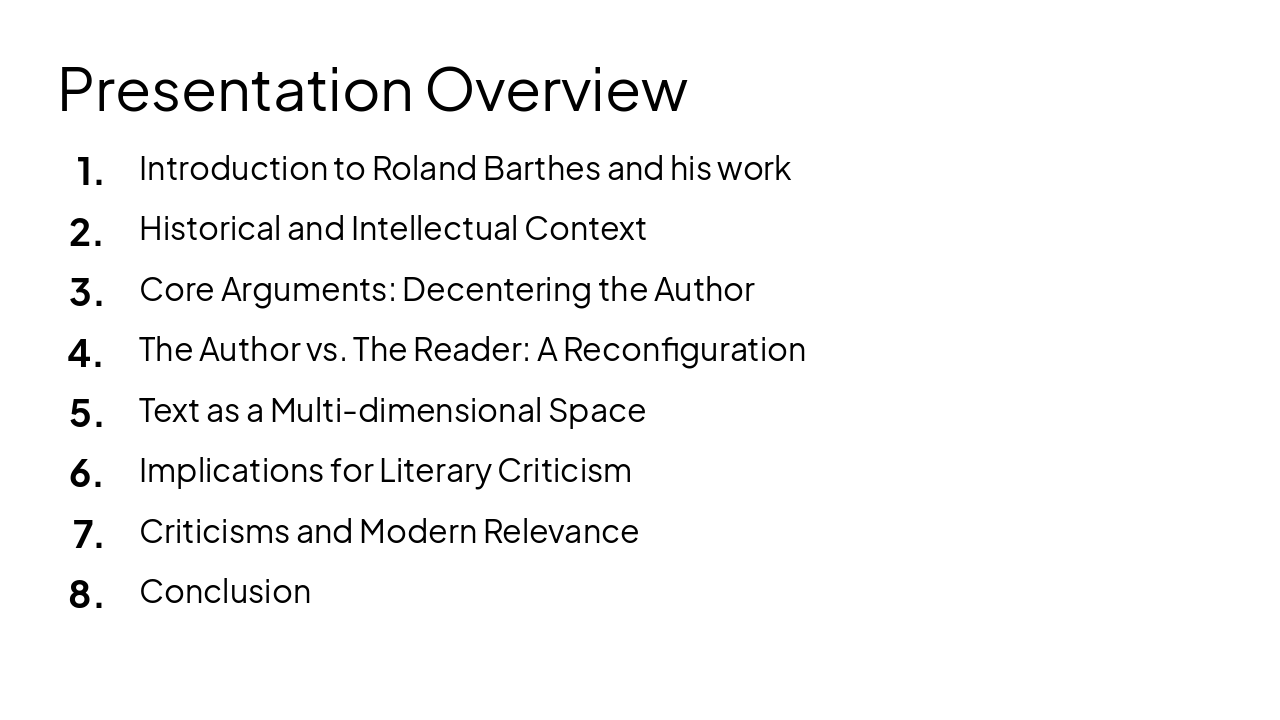
Slide 2 - Presentation Overview
- Introduction to Roland Barthes and his work
- Historical and Intellectual Context
- Core Arguments: Decentering the Author
- The Author vs. The Reader: A Reconfiguration
- Text as a Multi-dimensional Space
- Implications for Literary Criticism
- Criticisms and Modern Relevance
- Conclusion
Slide 3 - Context
1
Contextualizing the Author
Understanding Roland Barthes and the intellectual environment of 1967
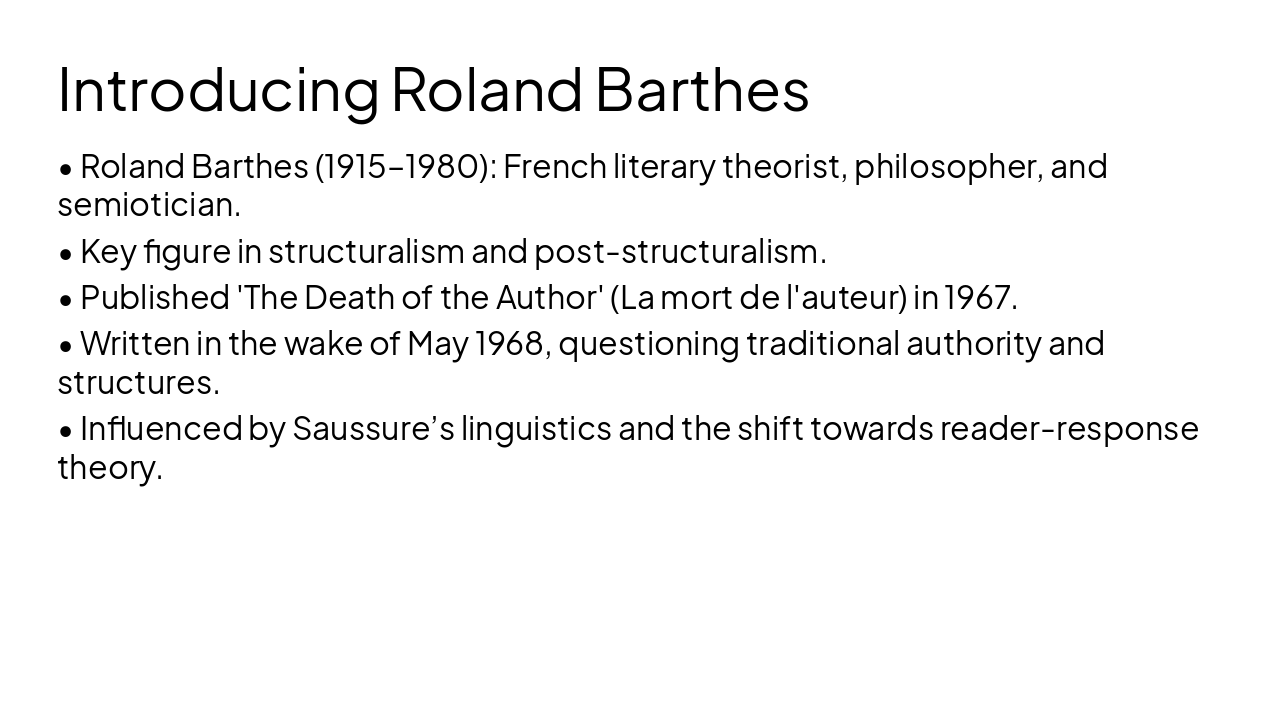
Slide 4 - Introducing Roland Barthes
- Roland Barthes (1915–1980): French literary theorist, philosopher, and semiotician.
- Key figure in structuralism and post-structuralism.
- Published 'The Death of the Author' (La mort de l'auteur) in 1967.
- Written in the wake of May 1968, questioning traditional authority and structures.
- Influenced by Saussure’s linguistics and the shift towards reader-response theory.
Slide 5 - Theory
2
Core Theoretical Arguments
Deconstructing the traditional role of the creator
Slide 6 - Decentering the Author
- The Author as an 'institution': Traditionally viewed as the sole origin of meaning.
- The myth of the 'Author-God': The belief that an author’s biography/intent explains the text.
- Barthes' Thesis: The author is a 'scriptor' who assembles pre-existing language.
- 'Scriptor': Lacks the past, is born simultaneously with the text.
- Meaning is not a destination to be found, but a process to be experienced.
Slide 7 - The Author vs. The Reader
Traditional View The author is the authority, the parent of the work. The text is a 'line of words' releasing a single, theological meaning. Interpretation focuses on deciphering authorial intent.
Barthes' View The text is a 'fabric of quotations' drawn from infinite centers of culture. The reader is the destination of the work, where the unity of the text is finally realized.
Slide 8 - Text as Multi-dimensional Space
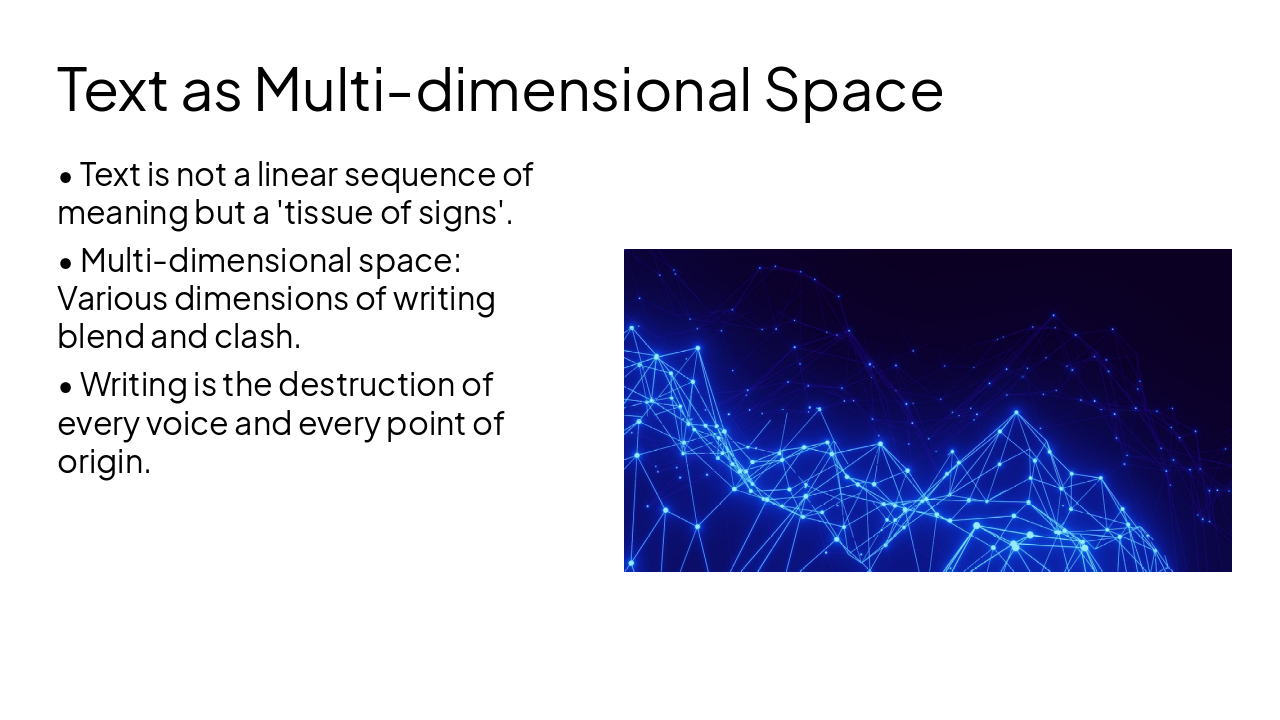
- Text is not a linear sequence of meaning but a 'tissue of signs'.
- Multi-dimensional space: Various dimensions of writing blend and clash.
- Writing is the destruction of every voice and every point of origin.
---
Photo by Conny Schneider on Unsplash
Slide 9 - Implications
3
Implications and Criticisms
The legacy and challenges of the theory
Slide 10 - Implications for Literary Criticism
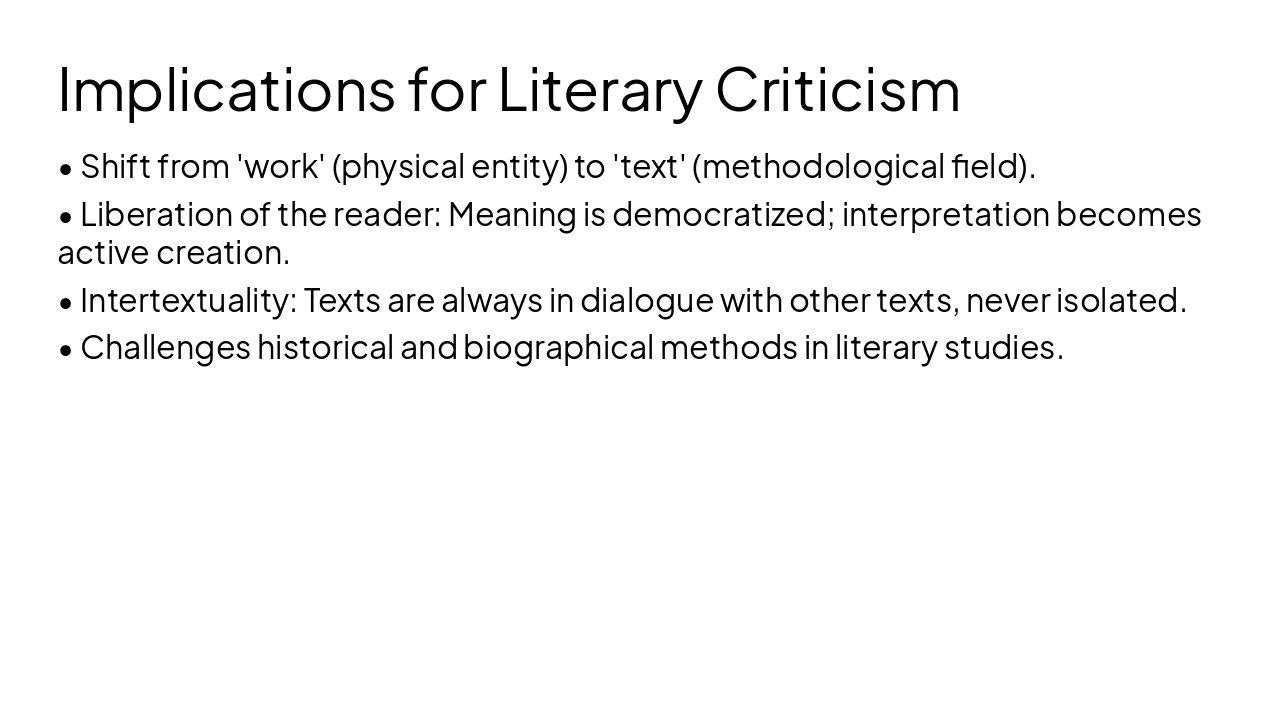
- Shift from 'work' (physical entity) to 'text' (methodological field).
- Liberation of the reader: Meaning is democratized; interpretation becomes active creation.
- Intertextuality: Texts are always in dialogue with other texts, never isolated.
- Challenges historical and biographical methods in literary studies.
Slide 11 - Criticisms of the Theory
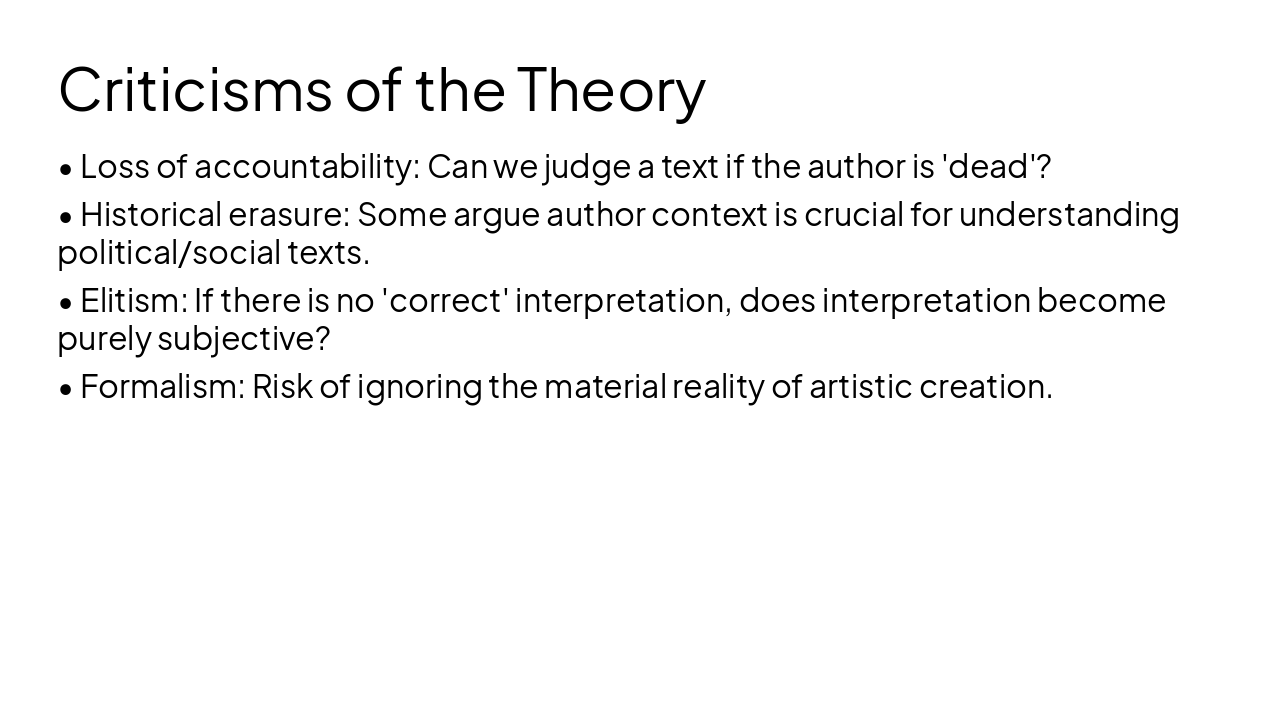
- Loss of accountability: Can we judge a text if the author is 'dead'?
- Historical erasure: Some argue author context is crucial for understanding political/social texts.
- Elitism: If there is no 'correct' interpretation, does interpretation become purely subjective?
- Formalism: Risk of ignoring the material reality of artistic creation.
Slide 12 - Modern Relevance
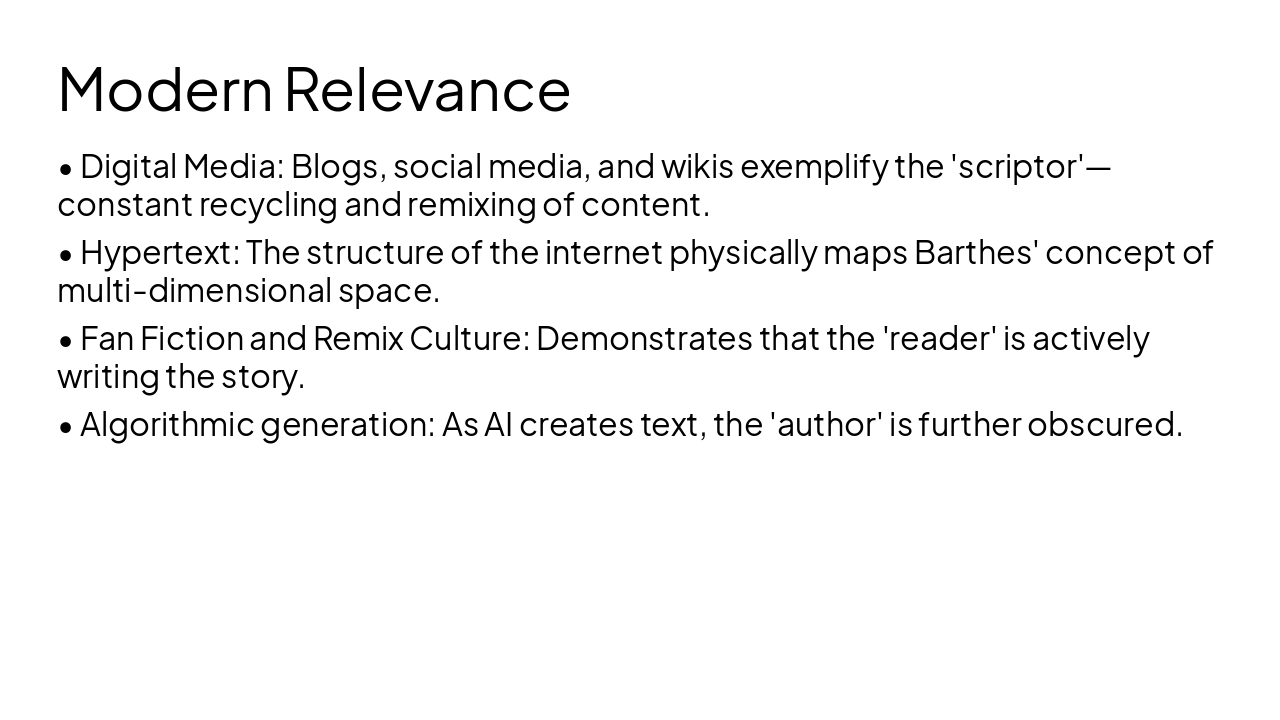
- Digital Media: Blogs, social media, and wikis exemplify the 'scriptor'—constant recycling and remixing of content.
- Hypertext: The structure of the internet physically maps Barthes' concept of multi-dimensional space.
- Fan Fiction and Remix Culture: Demonstrates that the 'reader' is actively writing the story.
- Algorithmic generation: As AI creates text, the 'author' is further obscured.
Slide 13 - Concluding Thought
> The birth of the reader must be at the cost of the death of the author.
— Roland Barthes, 'The Death of the Author' (1967)
Slide 14 - Conclusion
Barthes' provocation remains a cornerstone for navigating textuality in the digital age.
Summary: From author-centric meaning to reader-centric potential.
---
Photo by Iñaki del Olmo on Unsplash
Discover More Presentations
Explore thousands of AI-generated presentations for inspiration
Create Your Own Presentation
Generate professional presentations in seconds with Karaf's AI. Customize this presentation or start from scratch.