Design of Satellite Attitude Control: Key Concepts, Components, and Historical Examples
Generated from prompt:
Design of satellite attitude control
This presentation provides an overview of satellite attitude control, covering the process of orienting satellites in space through attitude determination using sensors and control via actuators and algorithms. It includes real-world examples such as the historic TRAAC satellite launched in 1961 and modern magnetorquer systems, highlighting advancements from early experiments to current technologies essential for mission success.

Slide 2 - Presentation Agenda
- Introduction to Attitude Control
- Attitude Determination
- Attitude Control Mechanisms
- Historical Example: TRAAC
- Modern Actuator: Magnetorquer
- Key Takeaways
---
Photo by Igor Saikin on Unsplash

Slide 4 - What is Satellite Attitude Control?
- Process of controlling satellite orientation relative to inertial frames, celestial sphere, magnetic fields, or nearby objects
- Actuators apply torques to achieve desired attitude
- Algorithms command actuators using current vs. desired attitude data
- Requires prior attitude determination via sensors
Source: https://en.wikipedia.org/wiki/Spacecraft_attitude_determination_and_control
Slide 5 - Attitude Determination & Control
Attitude Determination Sensors measure absolute or relative attitude Provides data on current orientation
Attitude Control Actuators apply torques Algorithms process sensor data to command actuators toward desired attitude
Source: https://en.wikipedia.org/wiki/Spacecraft_attitude_determination_and_control
Slide 6 - Examples

Slide 7 - TRAAC Satellite
- Transit Research and Attitude Control (TRAAC) satellite
- Launched by U.S. Navy from Cape Canaveral
- Alongside Transit 4B on November 15, 1961
- Early experiment in satellite attitude control
Source: https://en.wikipedia.org/wiki/Transit_Research_and_Attitude_Control
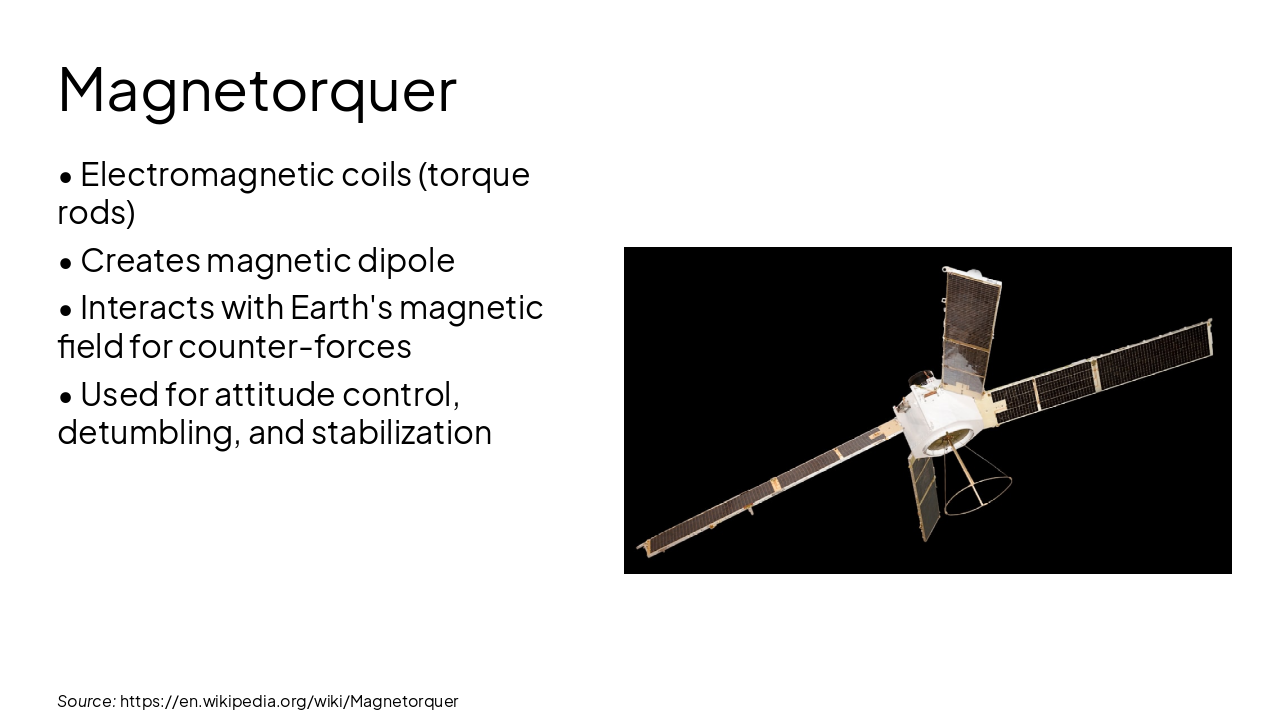
Slide 8 - Magnetorquer
- Electromagnetic coils (torque rods)
- Creates magnetic dipole
- Interacts with Earth's magnetic field for counter-forces
- Used for attitude control, detumbling, and stabilization
---
Photo by Smithsonian on Unsplash
Source: https://en.wikipedia.org/wiki/Magnetorquer
Slide 9 - Key Takeaways

Discover More Presentations
Explore thousands of AI-generated presentations for inspiration
Create Your Own Presentation
Generate professional presentations in seconds with Karaf's AI. Customize this presentation or start from scratch.