AI-HMT: Enhancing FPV Drone Targeting Precision

Generated from prompt:

Create a professional military-style dissertation presentation titled 'AI-Enabled Human-Machine Teaming for Enhancing FPV Drone Targeting Precision' for Simranjeet Singh Raina. Include 23 slides: Title, Background (FPV drones, Ukraine conflict), Problem Statement, Research Gap, Aim & Objectives, Hypothesis, FPV Drone Overview, Limitations of Conventional FPV, Need for AI, Human-Machine Teaming concept, AI Techniques (YOLO, CNN-LSTM, Vision Transformers), Advantages of AI, Challenges of AI, Literature Review Insights (Ukraine hit rate improvement), Indian Defence Context (Operation Sindoor, 100k drones), Methodology (data pipeline), Dataset (AFT-HMT 2025), AI-HMT Architecture, Performance Metrics, Expected Results, Contributions, Conclusion, Future Work. Use dark military-tech theme, icons, diagrams placeholders, clean academic formatting.

Dissertation presentation on AI-enabled human-machine teaming (HMT) for FPV drones, addressing targeting limitations in high-interference environments. Covers background from Ukraine conflict, technical analysis, proposed YOLO/CNN-LSTM/ViT methods,印度

April 6, 202613 slides
Slide 1 of 13

Slide 1 - AI-Enabled Human-Machine Teaming for Enhancing FPV Drone Targeting Precision

AI-Enabled Human-Machine Teaming for Enhancing FPV Drone Targeting Precision

Dissertation Presentation | Prepared by: Simranjeet Singh Raina
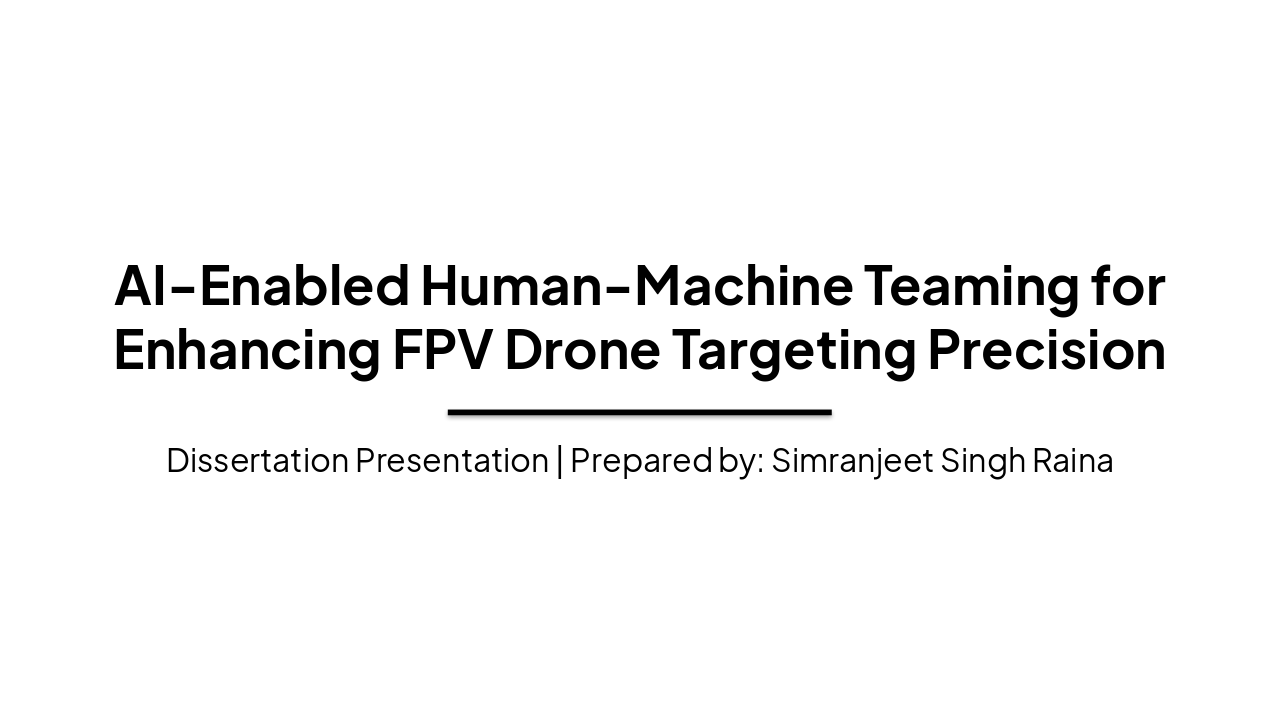
Slide 1 - AI-Enabled Human-Machine Teaming for Enhancing FPV Drone Targeting Precision
Slide 2 of 13

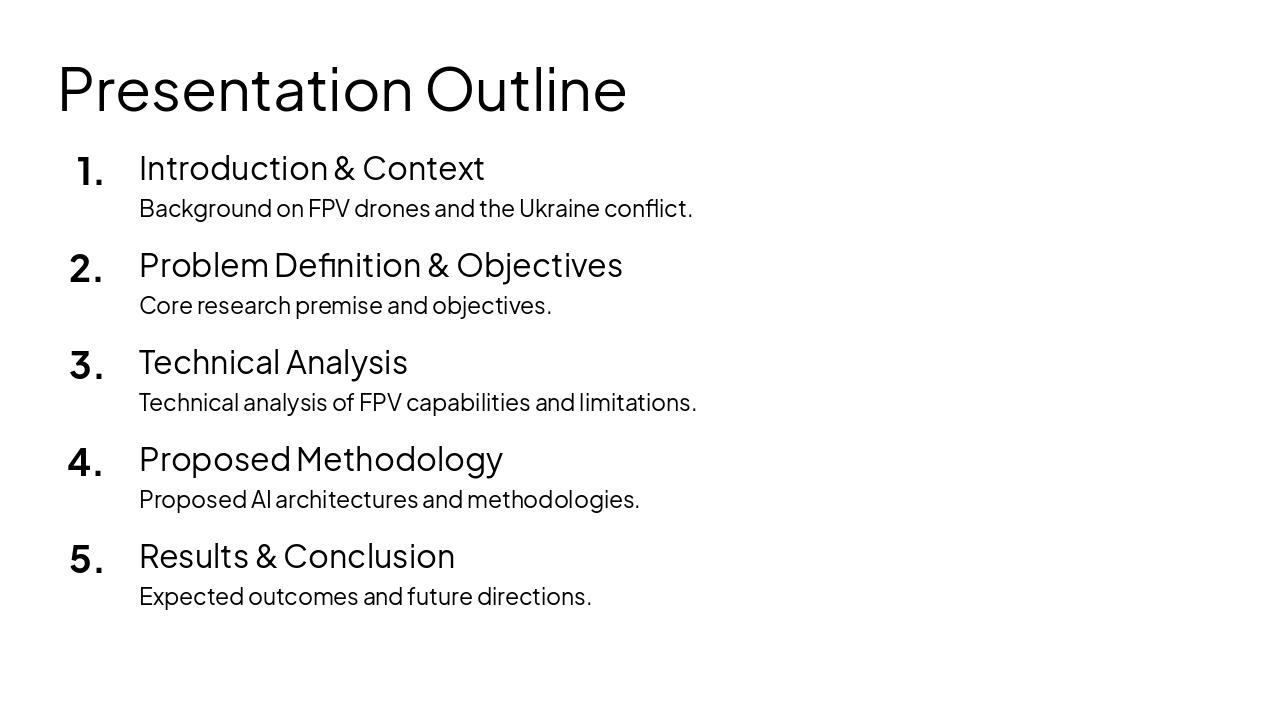
Slide 2 - Presentation Outline

  • Introduction & Context: Background on FPV drones and the Ukraine conflict.
  • Problem Definition & Objectives: Core research premise and objectives.
  • Technical Analysis: Technical analysis of FPV capabilities and limitations.
  • Proposed Methodology: Proposed AI architectures and methodologies.
  • Results & Conclusion: Expected outcomes and future directions.
Slide 2 - Presentation Outline
Slide 3 of 13

Slide 3 - Background: FPV Drones and the Ukraine Conflict

  • Rise of First-Person View (FPV) drones as tactical asymmetric weapons.
  • Extensive combat use in the Ukraine conflict showing low-cost high-impact capability.
  • Evolution from civilian hobby equipment to critical battlefield asset.
  • Current reliance on pilot skill for high-precision targeting.

---

Photo by Simon Fitall on Unsplash
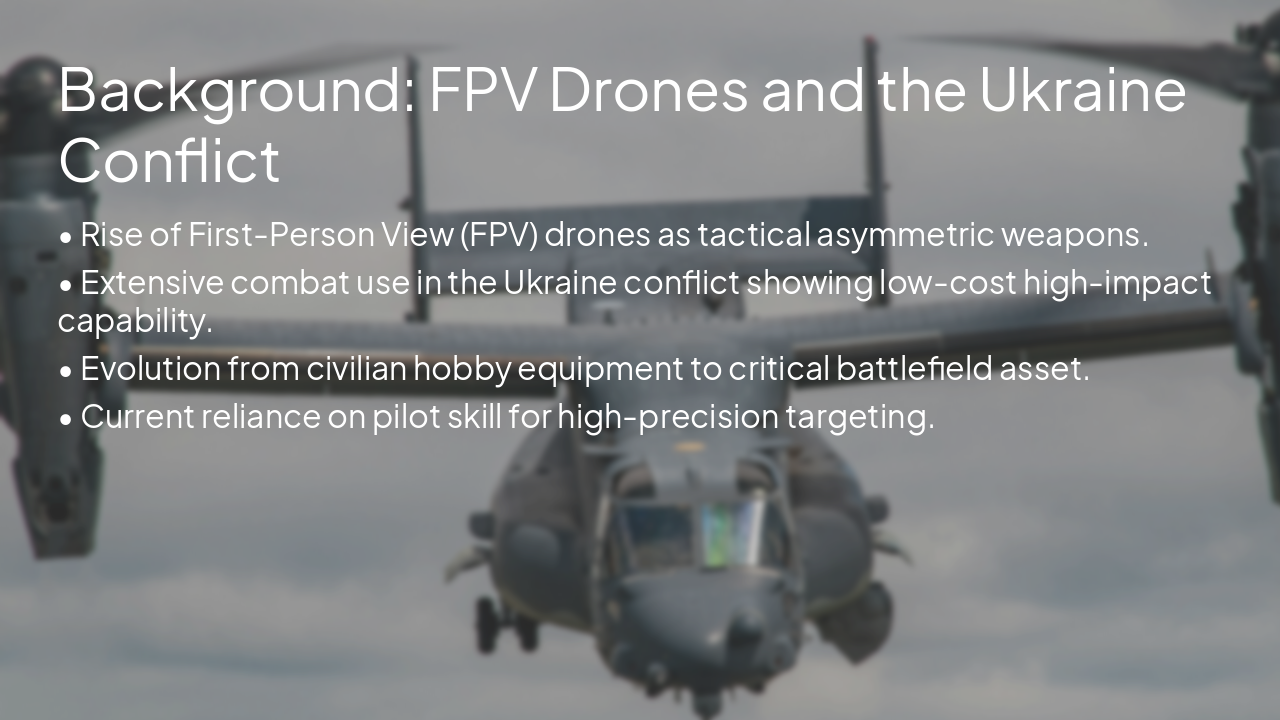
Slide 3 - Background: FPV Drones and the Ukraine Conflict
Slide 4 of 13

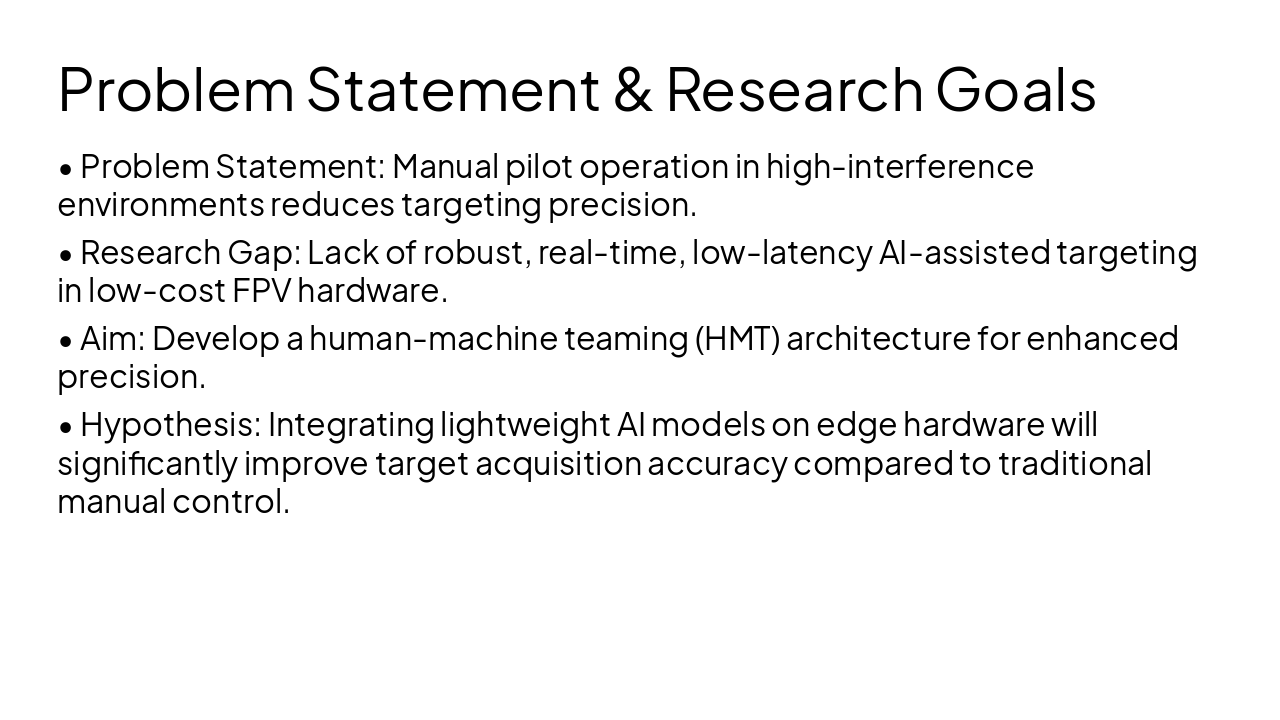
Slide 4 - Problem Statement & Research Goals

  • Problem Statement: Manual pilot operation in high-interference environments reduces targeting precision.
  • Research Gap: Lack of robust, real-time, low-latency AI-assisted targeting in low-cost FPV hardware.
  • Aim: Develop a human-machine teaming (HMT) architecture for enhanced precision.
  • Hypothesis: Integrating lightweight AI models on edge hardware will significantly improve target acquisition accuracy compared to traditional manual control.
Slide 4 - Problem Statement & Research Goals
Slide 5 of 13

Slide 5 - Technical Analysis: FPV and AI-HMT Necessity

  • FPV Drone: Agile, low cost, high mobility.
  • Conventional Limitations: Manual control is highly susceptible to electromagnetic interference (EMI) and fatigue.
  • The Need for AI: AI-enabled HMT enables target tracking, path prediction, and autonomous stabilization in degraded visual environments.

---

Photo by Sergey Koznov on Unsplash
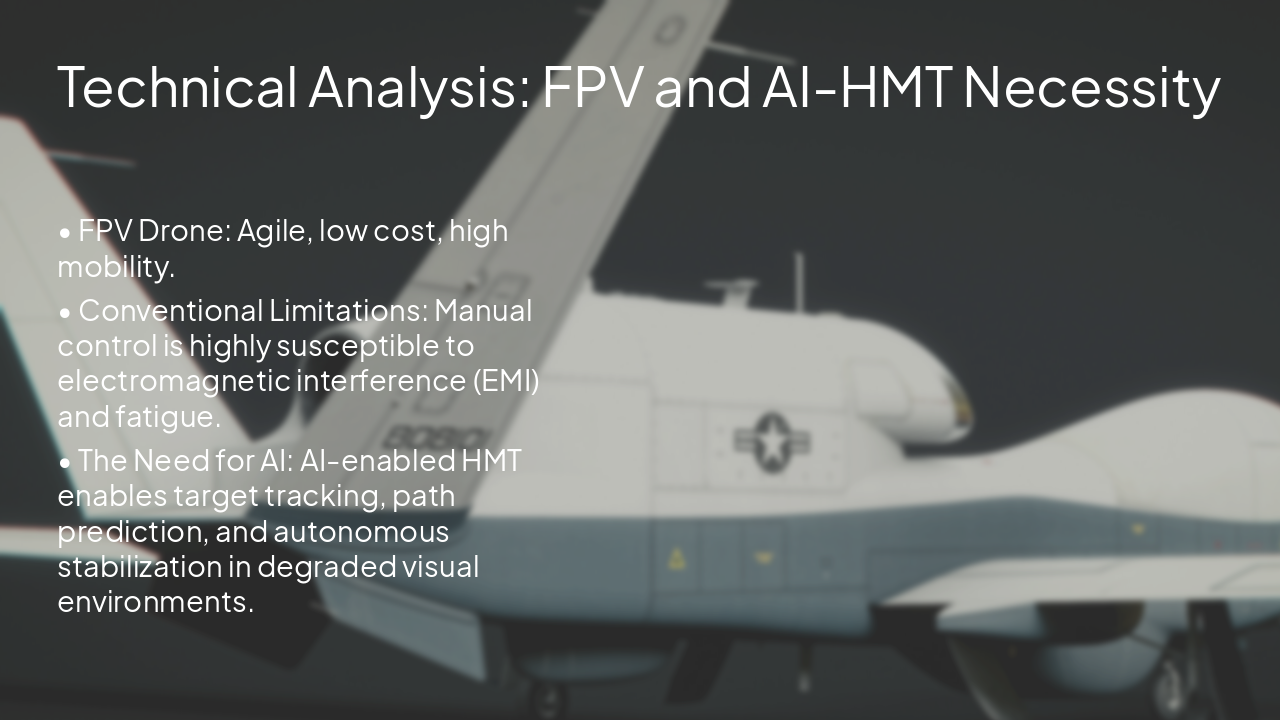
Slide 5 - Technical Analysis: FPV and AI-HMT Necessity
Slide 6 of 13

Slide 6 - AI Techniques & Operational Considerations

  • YOLO (You Only Look Once): Real-time, fast object detection on edge devices.
  • CNN-LSTM: Temporal sequence processing for tracking moving targets.
  • Vision Transformers (ViT): Feature extraction and attention mechanisms for complex environments.
  • Advantages: Increased hit rate, reduced pilot fatigue, mission success in high-threat zones.
  • Challenges: Power consumption, latency in inference, model size vs. memory constraints.

---

Photo by Conny Schneider on Unsplash
Slide 6 - AI Techniques & Operational Considerations
Slide 7 of 13

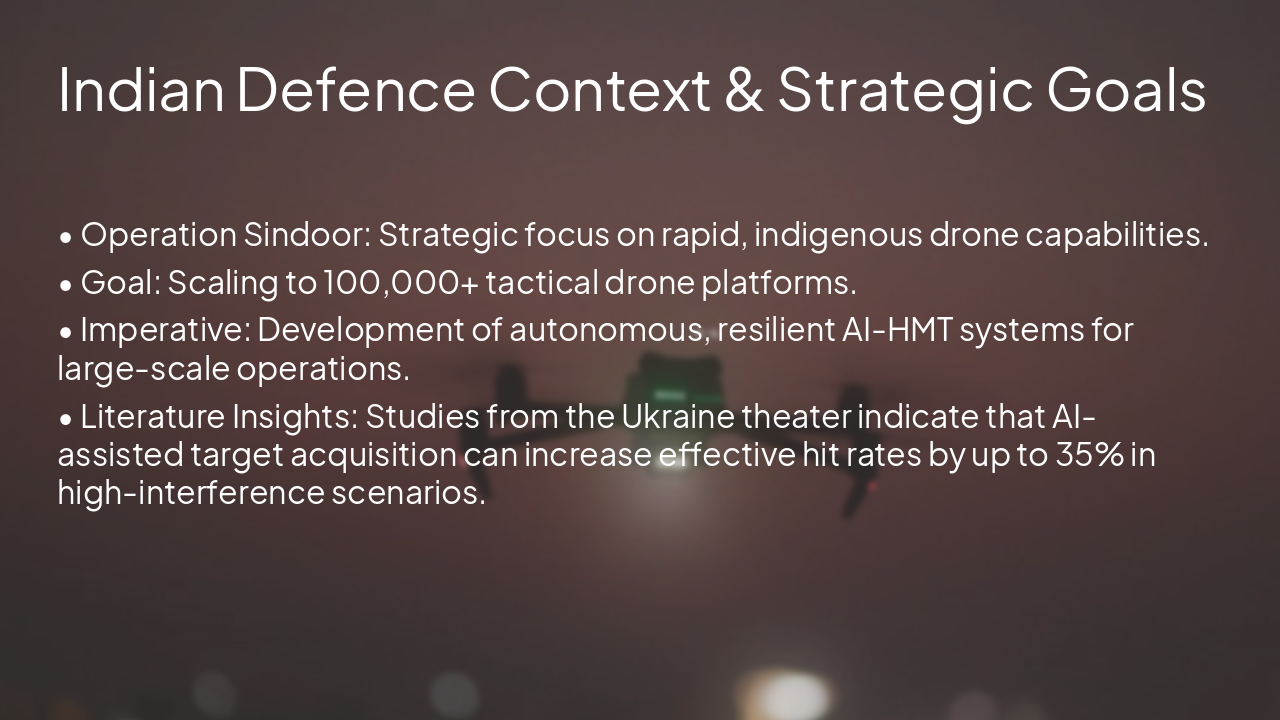
Slide 7 - Indian Defence Context & Strategic Goals

  • Operation Sindoor: Strategic focus on rapid, indigenous drone capabilities.
  • Goal: Scaling to 100,000+ tactical drone platforms.
  • Imperative: Development of autonomous, resilient AI-HMT systems for large-scale operations.
  • Literature Insights: Studies from the Ukraine theater indicate that AI-assisted target acquisition can increase effective hit rates by up to 35% in high-interference scenarios.

---

Photo by I'M ZION on Unsplash

Slide 7 - Indian Defence Context & Strategic Goals
Slide 8 of 13

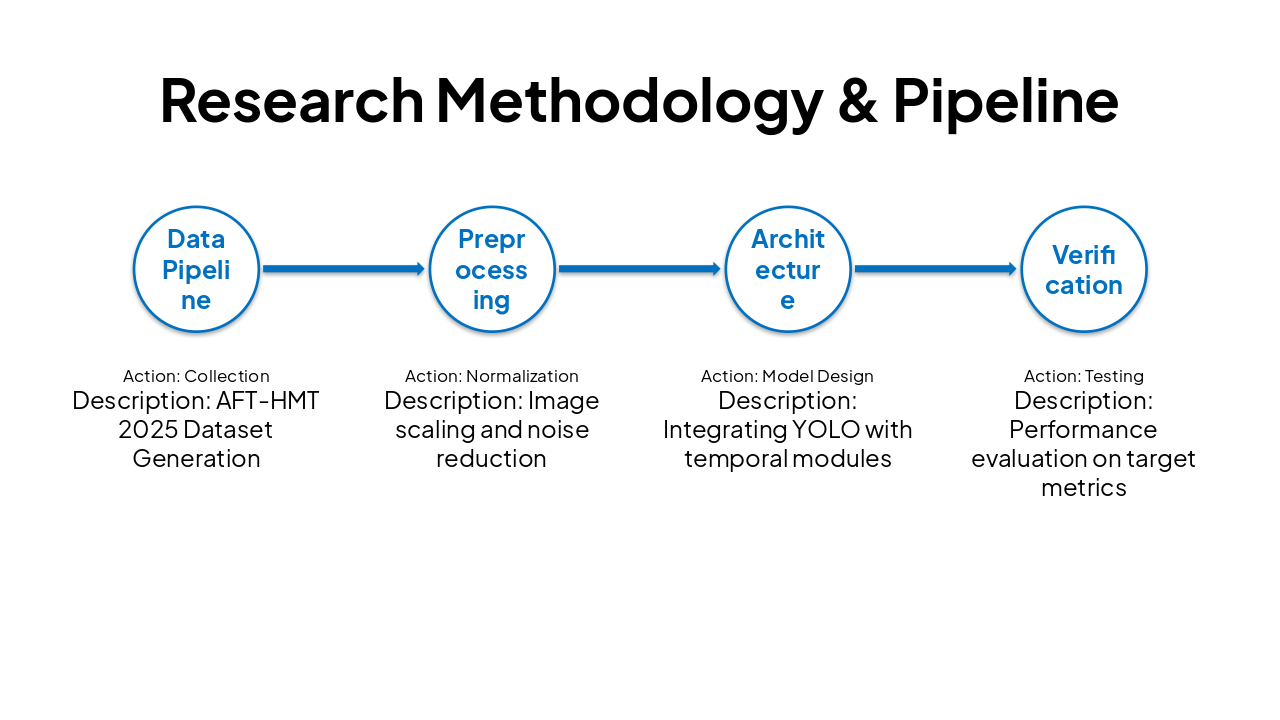
Slide 8 - Research Methodology & Pipeline

StepActionDescription
Data PipelineCollectionAFT-HMT 2025 Dataset Generation
PreprocessingNormalizationImage scaling and noise reduction
ArchitectureModel DesignIntegrating YOLO with temporal modules
VerificationTestingPerformance evaluation on target metrics
Slide 8 - Research Methodology & Pipeline
Slide 9 of 13

Slide 9 - Key Performance Metrics & Expectations

  • Dataset: AFT-HMT 2025 - 50,000+ annotated tactical drone flight frames.
  • Architecture: Multi-stage HMT - Edge Processing Unit (EPU) + Pilot HMI (Human-Machine Interface).
  • Performance Metrics: Latency (ms), Precision/Recall (IOU), Mean Average Precision (mAP), and Power Efficiency (mWh).
  • Expected Results: > 90% target detection under 20ms inference time.

---

Photo by Sergey Koznov on Unsplash
Slide 9 - Key Performance Metrics & Expectations
Slide 10 of 13

Slide 10 - Conclusion & Key Contributions

Advancing FPV Precision through Human-Machine Teaming: A Strategic Leap for Future Operations.

Summary of AI-Enabled HMT Dissertation Research

---

Photo by Joash Viriah on Unsplash

Slide 10 - Conclusion & Key Contributions
Slide 11 of 13

Slide 11 - Future Directions & Research Scope

  • Future Work: Transitioning from edge-inference to federated learning models.
  • Refining robustness against adversarial electronic warfare (EW) countermeasures.
  • Scaling HMT modules for multi-agent autonomous drone swarms.
  • Expanding AFT-HMT 2025 dataset with heterogeneous terrain scenarios.

---

Photo by Winston Chen on Unsplash
Slide 11 - Future Directions & Research Scope
Slide 12 of 13

Slide 12 - Key Takeaway

> Strategic superiority in modern combat is defined by our ability to seamlessly integrate artificial intelligence with human operational intuition.

— Simranjeet Singh Raina

---

Photo by Joash Viriah on Unsplash

Slide 12 - Key Takeaway
Slide 13 of 13

Slide 13 - Conclusion

Thank you for your attention. Open to Q&A.

Final Remarks

Slide 13 - Conclusion

Discover More Presentations

Explore thousands of AI-generated presentations for inspiration

Browse Presentations
Powered by AI

Create Your Own Presentation

Generate professional presentations in seconds with Karaf's AI. Customize this presentation or start from scratch.

Create New Presentation

Powered by Karaf.ai — AI-Powered Presentation Generator