Introduction to QuickCheck Testing

Generated from prompt:

Quick test presentation

This presentation explores QuickCheck, a Haskell testing tool developed in 1999 by Claessen and Hughes. It covers its history, origins, automated property verification, pros/cons, usage stats, timelin

November 9, 202510 slides
Slide 1 of 10

Slide 1 - Introduction to QuickCheck

This title slide introduces QuickCheck as the main topic. The subtitle welcomes viewers to an overview of QuickCheck, highlighting it as a powerful tool for software testing in Haskell.

Introduction to QuickCheck

Welcome to this overview of QuickCheck, a powerful tool for software testing in Haskell.

Source: Quick test presentation
Slide 1
Slide 2 of 10

Slide 2 - Presentation Agenda

The presentation agenda outlines the structure of the talk on QuickCheck, starting with an introduction to what QuickCheck is. It then covers key features, how it works, benefits with examples, and ends with a conclusion.

Presentation Agenda

  1. What is QuickCheck?
  1. Key Features
  1. How It Works
  1. Benefits and Examples
  1. Conclusion

Source: Quick test presentation

Slide 2
Slide 3 of 10

Slide 3 - What is QuickCheck?

This slide serves as a section header titled "What is QuickCheck?". It introduces QuickCheck as a combinator library in Haskell designed for property-based testing, which automatically generates test cases.

What is QuickCheck?

QuickCheck is a combinator library in Haskell for property-based testing, generating test cases automatically.

Slide 3
Slide 4 of 10

Slide 4 - History and Origins

QuickCheck was developed by Koen Claessen and John Hughes in 1999, drawing inspiration from tools like SmallCheck. It has since gained widespread adoption within functional programming communities.

History and Origins

  • Developed by Koen Claessen and John Hughes in 1999
  • Inspired by SmallCheck and other testing tools
  • Widely adopted in functional programming communities
Slide 4
Slide 5 of 10

Slide 5 - QuickCheck in Action

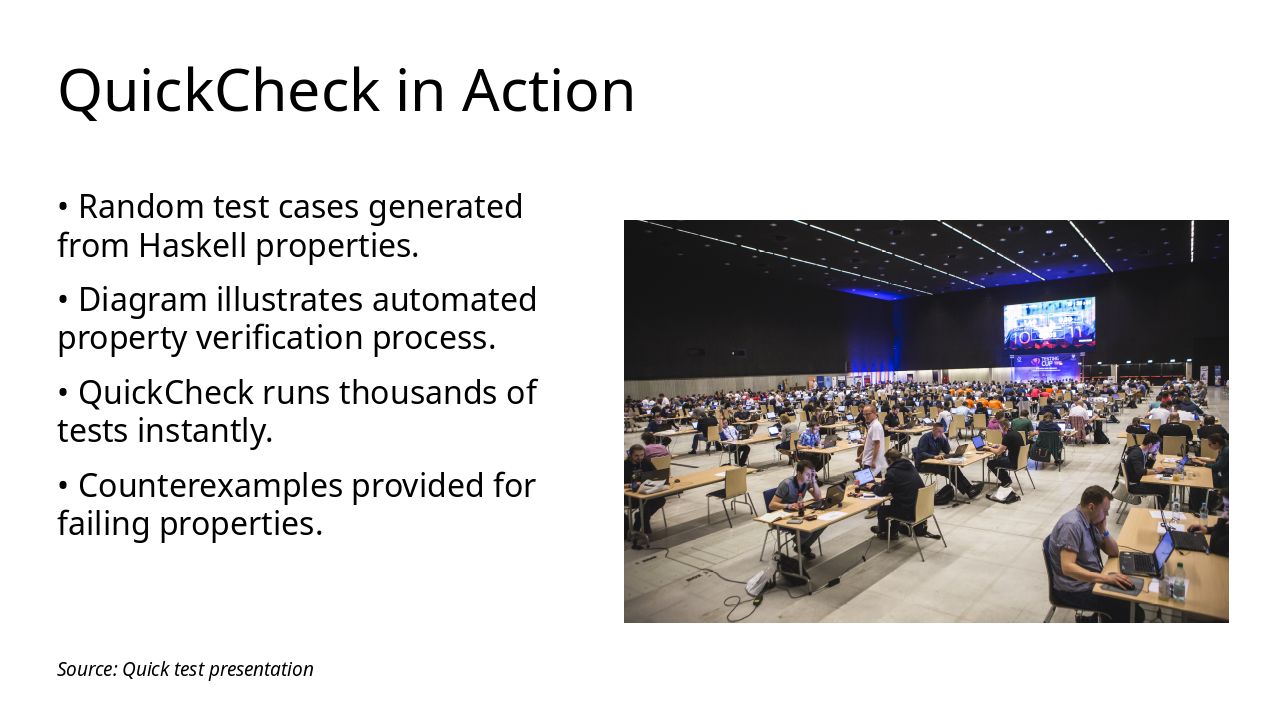
The slide "QuickCheck in Action" features a diagram demonstrating the automated property verification process in Haskell, where random test cases are generated from defined properties. It highlights QuickCheck's ability to run thousands of tests instantly while providing counterexamples for any failing properties.

QuickCheck in Action

!Image

  • Random test cases generated from Haskell properties.
  • Diagram illustrates automated property verification process.
  • QuickCheck runs thousands of tests instantly.
  • Counterexamples provided for failing properties.

Source: Quick test presentation

Slide 5
Slide 6 of 10

Slide 6 - A Quote on QuickCheck

The slide features a quote on QuickCheck, highlighting how it simplifies creating tests that are both concise and comprehensive. The quote is attributed to Koen Claessen, its co-creator.

A Quote on QuickCheck

> QuickCheck makes it easy to write tests that are both concise and comprehensive.

— Koen Claessen, Co-creator

Source: Quick test presentation

Slide 6
Slide 7 of 10

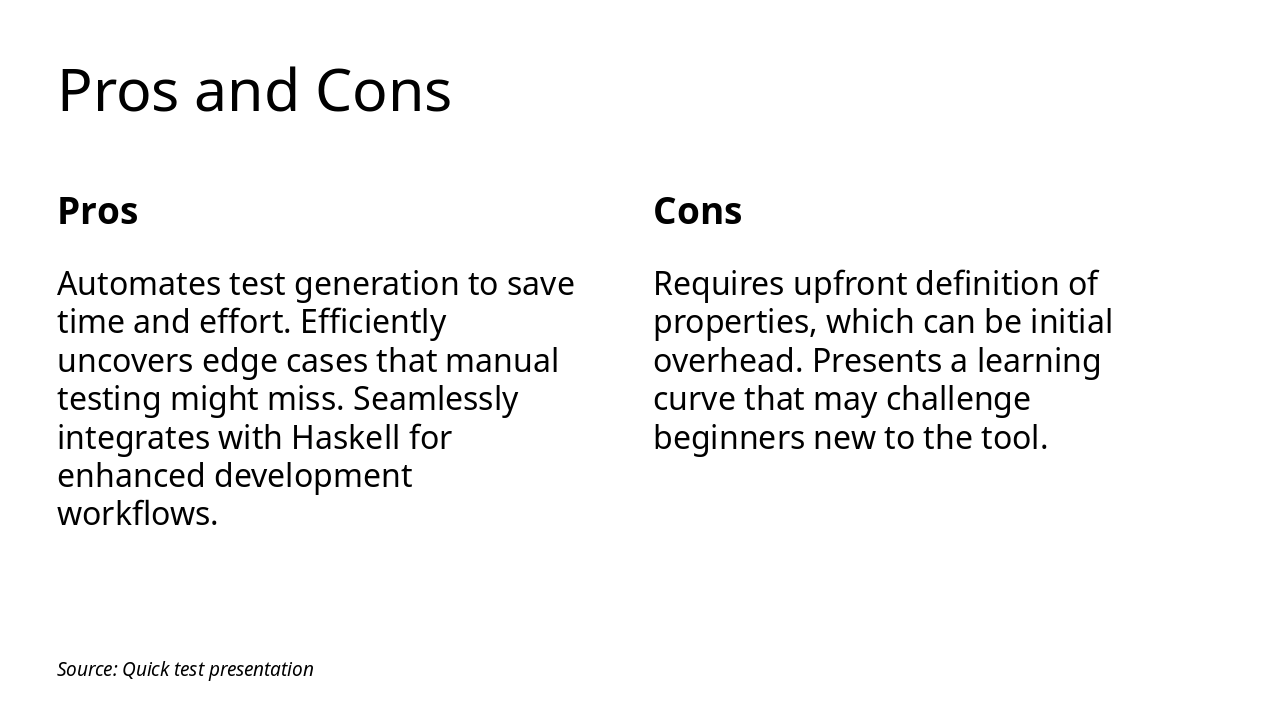
Slide 7 - Pros and Cons

The slide outlines the pros of the tool, highlighting how it automates test generation to save time, efficiently detects missed edge cases, and integrates seamlessly with Haskell for better workflows. On the cons side, it notes the upfront effort needed to define properties and a potential learning curve for beginners.

Pros and Cons

ProsCons
Automates test generation to save time and effort. Efficiently uncovers edge cases that manual testing might miss. Seamlessly integrates with Haskell for enhanced development workflows.Requires upfront definition of properties, which can be initial overhead. Presents a learning curve that may challenge beginners new to the tool.

Source: Quick test presentation

Slide 7
Slide 8 of 10

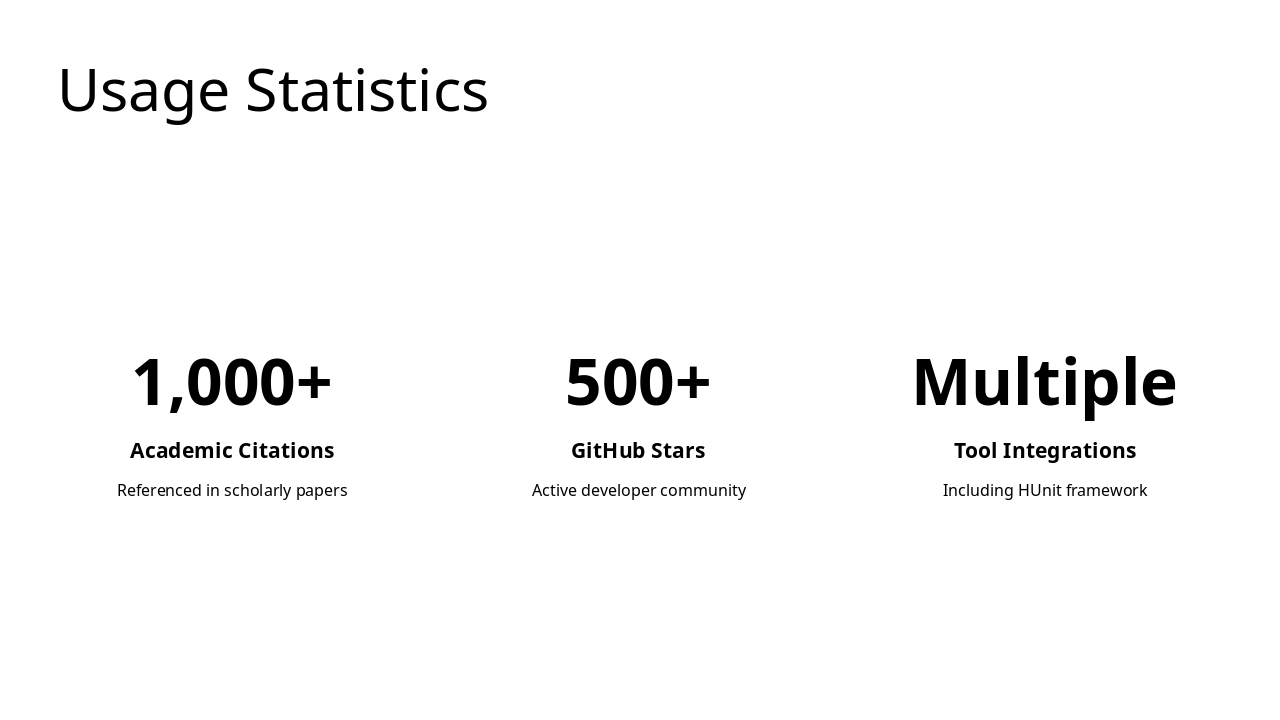
Slide 8 - Usage Statistics

The Usage Statistics slide highlights over 1,000 academic citations, indicating its reference in scholarly papers. It also features more than 500 GitHub stars for an active developer community and multiple tool integrations, including the HUnit framework.

Usage Statistics

  • 1,000+: Academic Citations

Referenced in scholarly papers

  • 500+: GitHub Stars

Active developer community

  • Multiple: Tool Integrations

Including HUnit framework

Slide 8
Slide 9 of 10

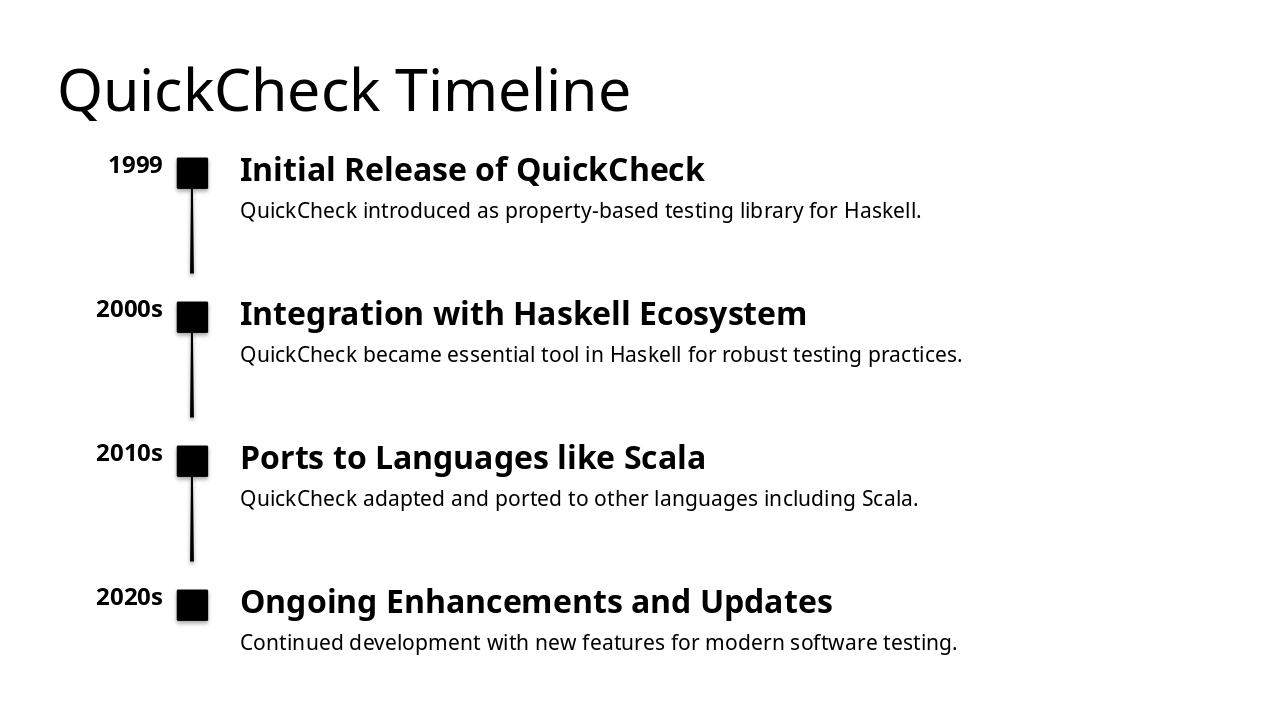
Slide 9 - QuickCheck Timeline

QuickCheck was first released in 1999 as a property-based testing library for Haskell and became an essential tool in the Haskell ecosystem during the 2000s. In the 2010s, it was ported to other languages like Scala, with ongoing enhancements and new features continuing into the 2020s for modern software testing.

QuickCheck Timeline

1999: Initial Release of QuickCheck QuickCheck introduced as property-based testing library for Haskell. 2000s: Integration with Haskell Ecosystem QuickCheck became essential tool in Haskell for robust testing practices. 2010s: Ports to Languages like Scala QuickCheck adapted and ported to other languages including Scala. 2020s: Ongoing Enhancements and Updates Continued development with new features for modern software testing.

--- Speaker Notes: Quick test presentation

Slide 9
Slide 10 of 10

Slide 10 - Conclusion

QuickCheck revolutionizes testing by emphasizing properties, making it ideal for robust Haskell code—try it today. The slide encourages embracing property-based testing and provides resources like Wikipedia and official documentation.

Conclusion

QuickCheck revolutionizes testing by focusing on properties. Try it for robust Haskell code! Resources: Wikipedia, official docs.

Embrace property-based testing now!

Source: QuickCheck Presentation

--- Speaker Notes: Closing message: Revolutionize your Haskell testing! Call-to-action: Dive into QuickCheck docs and start testing properties today.

Slide 10
Powered by AI

Create Your Own Presentation

Generate professional presentations in seconds with Karaf's AI. Customize this presentation or start from scratch.

Create New Presentation

Powered by Karaf.ai — AI-Powered Presentation Generator