Funding Project Spectre: Hybrid Strategy

Generated from prompt:

Financial Strategy Analysis: Funding Project Spectre (£1 Million) Enhancement request: Add more visually engaging and high-quality images to each slide — luxury automotive imagery (Aston Martin cars, R&D lab, futuristic design), sleek financial graphics (funding flowcharts, balance sheet visuals, hybrid finance infographics), and thematic metallic gradients. Include subtle animations, clean icons, and a modern dark theme with gold accents for a premium, engaging aesthetic. Slide Outline: 1. Executive Summary & Strategic Recommendation - Add a dramatic Aston Martin car render with spotlight. - Visual infographic showing Hybrid Funding: CLNs + Operating Leases. 2. Project Context & Financial Constraint - Include background image of balance sheet overlays and market risk graphics. - Add an icon-based visualization of constraints and gearing ratio (219%). 3. Theoretical Framework for Decision Making - Use creative visual diagrams: Trade-off Curve, Pecking Order Pyramid, and MM Theory balance. - Add modern illustrations or charts with minimal text overlays. 4. Evaluation of Long-Term Financing Instruments - Replace simple table with a visual comparison chart or infographic cards for each instrument. - Add finance icons and stylized contrasts for 'Pros' vs 'Cons'. 5. Strategic Recommendation & Justification - Include visuals: CLN to Equity Conversion flow, Asset Lease cycle diagram. - Highlight key terms using icons and soft animation. 6. Conclusion on Value - Finish with a cinematic image of Aston Martin’s Project Spectre concept car. - Overlay final key takeaway: “Optimizing WACC, Managing Risk, Maximizing Shareholder Value.”

This presentation analyzes financial strategies for funding Aston Martin's £1M Project Spectre, recommending hybrid CLN and lease financing amid constraints like 219% gearing. It covers theory, instru

December 3, 20256 slides
Slide 1 of 6

Slide 1 - Executive Summary & Strategic Recommendation

This section header slide, titled "Executive Summary & Strategic Recommendation," introduces the first part of the presentation. It provides an overview of the £1M funding requirements and proposes a strategic hybrid financing approach for Project Spectre.

Executive Summary & Strategic Recommendation

01

Executive Summary & Strategic Recommendation

Overview of £1M funding needs and strategic hybrid financing for Project Spectre.

Source: Financial Strategy Analysis: Funding Project Spectre (£1 Million)

Speaker Notes
Highlight dramatic Aston Martin render with spotlight and infographic on Hybrid Funding (CLNs + Operating Leases). Emphasize £1M needs and strategic approach.
Slide 1 - Executive Summary & Strategic Recommendation
Slide 2 of 6

Slide 2 - Project Context & Financial Constraint

Project Spectre is Aston Martin's innovative luxury electric vehicle project, seeking £1 million in funding to integrate advanced technology and design for sustainable mobility amid fierce market competition. Financial constraints include a 219% high gearing ratio that restricts equity issuance and heightens bankruptcy risk, alongside liquidity strains and volatility, necessitating hybrid financing options like CLNs and leases to preserve ownership without dilution.

Project Context & Financial Constraint

Project Spectre ContextFinancial Constraints
Project Spectre is a groundbreaking luxury electric vehicle initiative by Aston Martin, requiring £1 million in funding for R&D and production. It aims to blend cutting-edge technology with iconic design, positioning the brand in the sustainable automotive future amid competitive market pressures.High gearing ratio of 219% limits equity issuance and increases bankruptcy risk. Balance sheet overlays reveal strained liquidity, while market risk graphics highlight volatility. Icon-based visualization emphasizes need for hybrid financing like CLNs and leases to optimize capital structure without diluting ownership.

Source: Financial Strategy Analysis: Funding Project Spectre (£1 Million)

Slide 2 - Project Context & Financial Constraint
Slide 3 of 6

Slide 3 - Theoretical Framework for Decision Making

The slide titled "Theoretical Framework for Decision Making" outlines key capital structure theories through an image and bullet points. It describes the Trade-off Theory as balancing tax benefits with financial distress costs, the Pecking Order Theory as prioritizing internal funds over debt or equity issuance, and the MM Proposition as assuming irrelevance of capital structure in perfect markets.

Theoretical Framework for Decision Making

!Image

  • Trade-off Theory balances tax benefits against financial distress costs.
  • Pecking Order prioritizes internal funds before debt or equity issuance.
  • MM Proposition assumes perfect markets render structure irrelevant.

Source: Pecking order theory

Speaker Notes
Explain how these theories guide funding decisions for Project Spectre, balancing cost and risk in a high-stakes automotive R&D context.
Slide 3 - Theoretical Framework for Decision Making
Slide 4 of 6

Slide 4 - Evaluation of Long-Term Financing Instruments

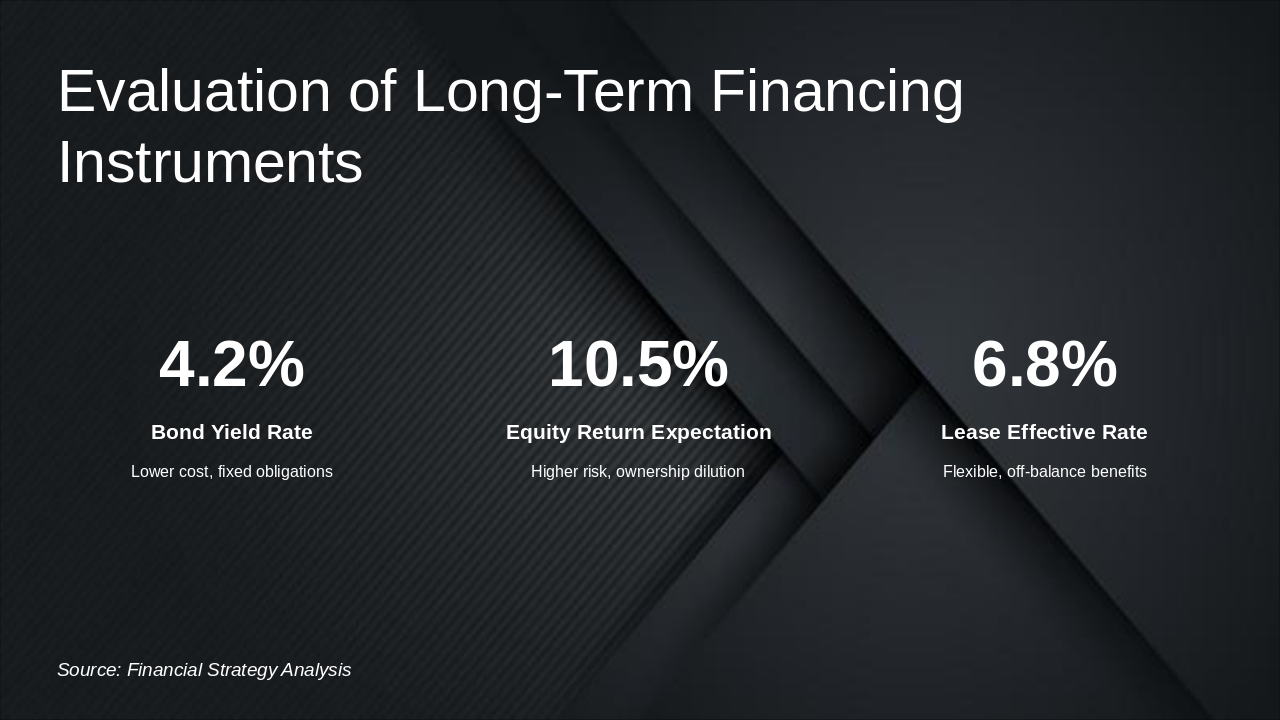
The slide evaluates key long-term financing instruments through comparative stats, highlighting a 4.2% bond yield rate as a lower-cost option with fixed obligations. It contrasts this with a 10.5% equity return expectation involving higher risk and ownership dilution, alongside a 6.8% lease effective rate offering flexibility and off-balance sheet benefits.

Evaluation of Long-Term Financing Instruments

  • 4.2%: Bond Yield Rate
  • Lower cost, fixed obligations

  • 10.5%: Equity Return Expectation
  • Higher risk, ownership dilution

  • 6.8%: Lease Effective Rate

Flexible, off-balance benefits Source: Financial Strategy Analysis

Speaker Notes
Highlight pros and cons visually with infographic cards for bonds, equity, and leases, using luxury automotive and sleek financial graphics in a modern dark theme with gold accents.
Slide 4 - Evaluation of Long-Term Financing Instruments
Slide 5 of 6

Slide 5 - Strategic Recommendation & Justification

The timeline slide outlines a strategic financing plan for Project Spectre, starting in Q1 2024 with issuing Convertible Loan Notes (CLNs) for initial flexible capital. It progresses through Q2 asset acquisition via operating leases to optimize gearing, Q3 conversion of CLNs to equity at milestones for balanced debt, and Q4 implementation of a hybrid model to lower WACC and boost shareholder returns.

Strategic Recommendation & Justification

Q1 2024: Initiate CLN Funding Strategy Issue Convertible Loan Notes to provide flexible initial capital for Project Spectre development. Q2 2024: Acquire Assets Through Leasing Utilize operating leases for luxury automotive assets to maintain optimal gearing ratio. Q3 2024: Execute CLN to Equity Conversion Convert notes to equity upon key milestones, balancing debt and enhancing equity value. Q4 2024: Optimize WACC with Hybrid Model Implement hybrid financing to reduce financial risk and maximize shareholder returns.

Slide 5 - Strategic Recommendation & Justification
Slide 6 of 6

Slide 6 - Conclusion on Value

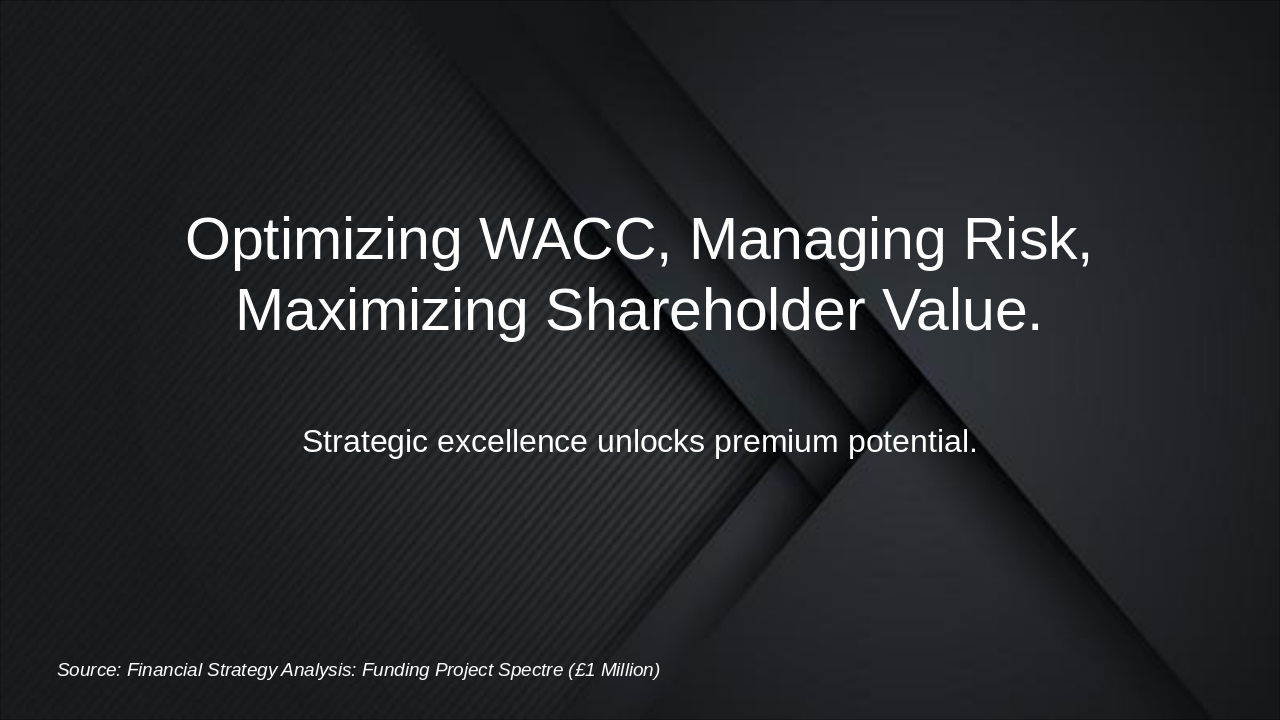
The conclusion slide emphasizes optimizing weighted average cost of capital (WACC), managing risk, and maximizing shareholder value as key strategies. It highlights how achieving strategic excellence can unlock premium potential for the organization.

Conclusion on Value

Optimizing WACC, Managing Risk, Maximizing Shareholder Value.

Strategic excellence unlocks premium potential.

Source: Financial Strategy Analysis: Funding Project Spectre (£1 Million)

Speaker Notes
End with a strong visual of the Spectre concept car to emphasize luxury and innovation. Highlight how the strategy drives value.
Slide 6 - Conclusion on Value

Discover More Presentations

Explore thousands of AI-generated presentations for inspiration

Browse Presentations
Powered by AI

Create Your Own Presentation

Generate professional presentations in seconds with Karaf's AI. Customize this presentation or start from scratch.

Create New Presentation

Powered by Karaf.ai — AI-Powered Presentation Generator