Danone & Evian: Circular Supply Chain Strategy

Generated from prompt:

Improve and professionally redesign this presentation on Danone & Evian circular supply chain strategy. Make it visually modern, structured, and academically strong. Include clear sections: 1) Title Slide, 2) Organizational Context (Danone & Evian overview), 3) Strategic Shift to Circular Economy, 4) Literature Review (Triple Bottom Line, Closed-Loop Supply Chain, Recovery Gap), 5) Circularity Paradox with theory contrast and EU PPWR regulation, 6) Supply Chain Mapping (end-to-end visual), 7) Forward vs Reverse Logistics (closed loop), 8) Theory vs Practice Gap analysis, 9) Methodology (SCM framework), 10) Tool Applications (LCA, Tier analysis, Triple Bottom Line), 11) Strategic Judgement & Risks, 12) Performance & Competitive Advantage, 13) Drivers for Change (Environmental, Legal, Social + impact on supply chain), 14) Future Horizons (industry growth, demand trends), 15) Digital Transformation (technology comparison vs competitors), 16) Strategic Recommendations, 17) Conclusion, 18) References. Improve wording, remove placeholders, add academic tone, include clean diagrams and bullet points, and ensure logical flow.

Case analysis of Danone and Evian's shift to circular economy models in the beverage industry. Covers organizational context, TBL and CLSC theories, EU PPWR regulations, forward/reverse logistics, methodology (LCA & tier analysis), SWOT, and future战略

April 14, 202615 slides
Slide 1 of 15

Slide 1 - Strategic Analysis

Circular Supply Chain Strategy: Danone & Evian

Navigating Circularity in the Beverage Industry: A Case Analysis of Danone & Evian
Slide 1 - Strategic Analysis
Slide 2 of 15

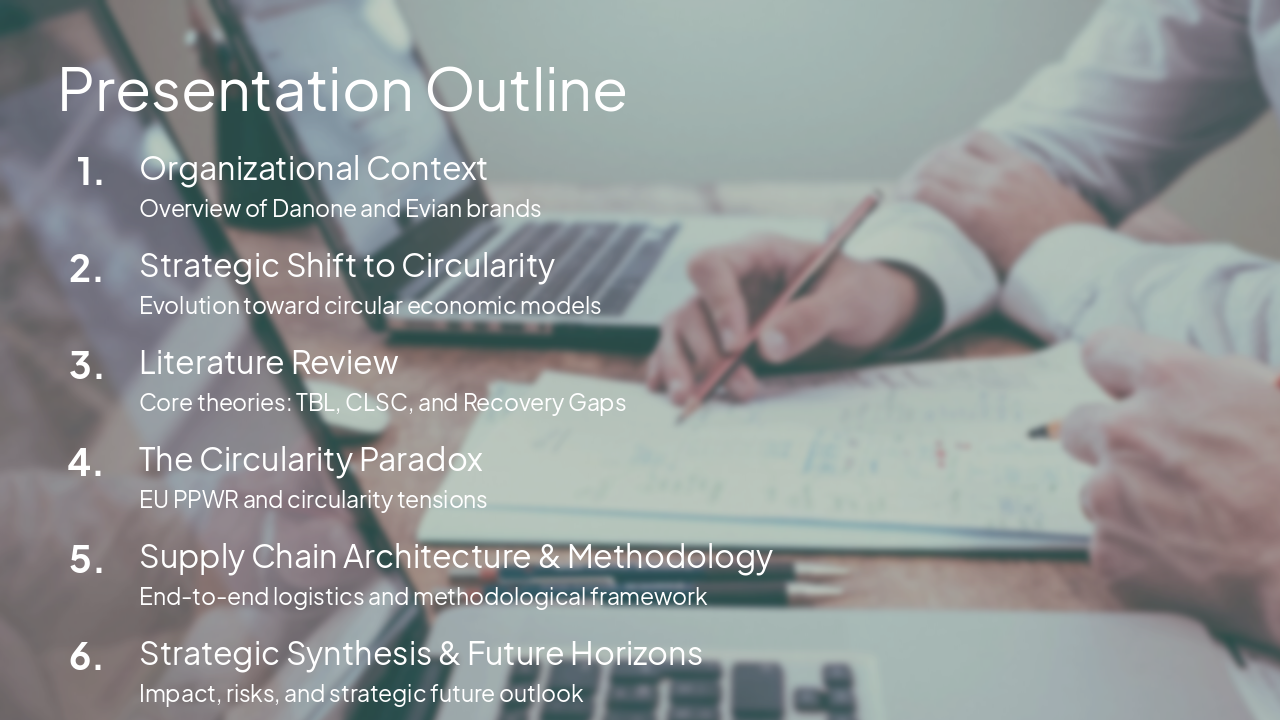
Slide 2 - Presentation Outline

  • Organizational Context: Overview of Danone and Evian brands
  • Strategic Shift to Circularity: Evolution toward circular economic models
  • Literature Review: Core theories: TBL, CLSC, and Recovery Gaps
  • The Circularity Paradox: EU PPWR and circularity tensions
  • Supply Chain Architecture & Methodology: End-to-end logistics and methodological framework
  • Strategic Synthesis & Future Horizons: Impact, risks, and strategic future outlook
Slide 2 - Presentation Outline
Slide 3 of 15

Slide 3 - Organizational Overview

1

Organizational Context & Strategy

Danone's Commitment to Sustainable Growth
Slide 3 - Organizational Overview
Slide 4 of 15

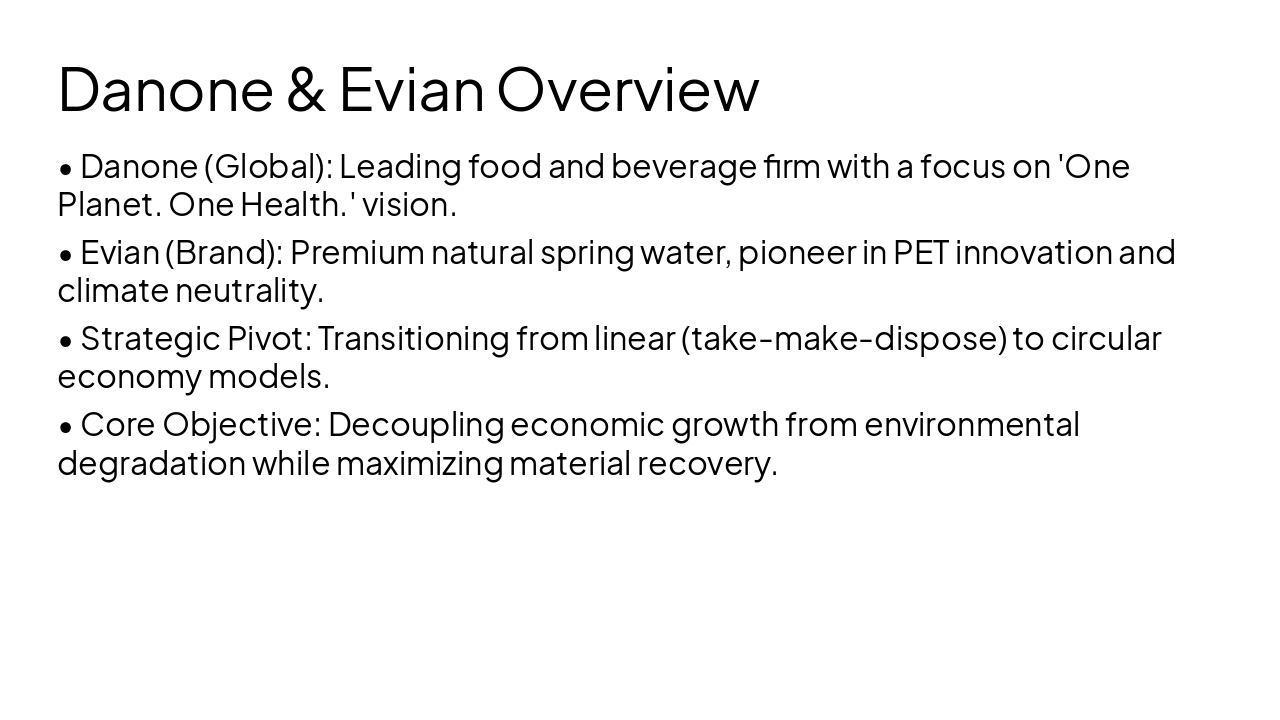
Slide 4 - Danone & Evian Overview

  • Danone (Global): Leading food and beverage firm with a focus on 'One Planet. One Health.' vision.
  • Evian (Brand): Premium natural spring water, pioneer in PET innovation and climate neutrality.
  • Strategic Pivot: Transitioning from linear (take-make-dispose) to circular economy models.
  • Core Objective: Decoupling economic growth from environmental degradation while maximizing material recovery.
Slide 4 - Danone & Evian Overview
Slide 5 of 15

Slide 5 - Literature & Regulations

2

Theoretical Framework & The Circularity Paradox

Bridging Academic Literature and Regulatory Realities
Slide 5 - Literature & Regulations
Slide 6 of 15

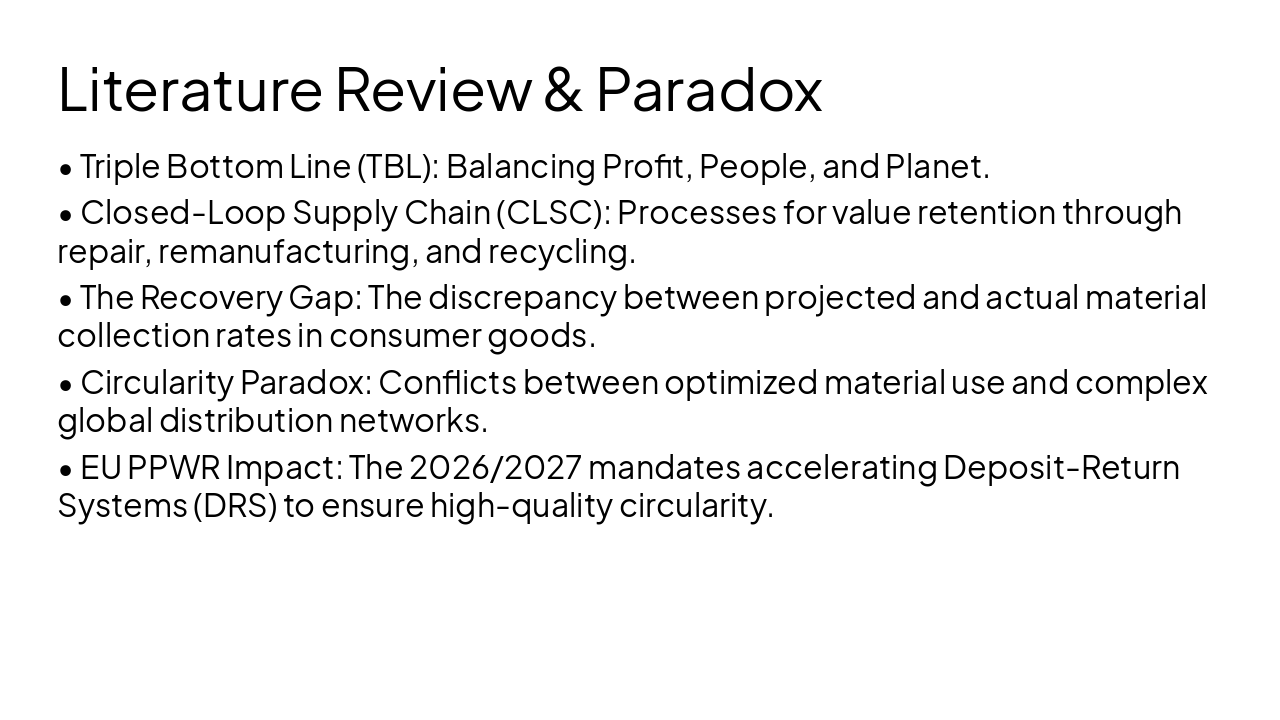
Slide 6 - Literature Review & Paradox

  • Triple Bottom Line (TBL): Balancing Profit, People, and Planet.
  • Closed-Loop Supply Chain (CLSC): Processes for value retention through repair, remanufacturing, and recycling.
  • The Recovery Gap: The discrepancy between projected and actual material collection rates in consumer goods.
  • Circularity Paradox: Conflicts between optimized material use and complex global distribution networks.
  • EU PPWR Impact: The 2026/2027 mandates accelerating Deposit-Return Systems (DRS) to ensure high-quality circularity.
Slide 6 - Literature Review & Paradox
Slide 7 of 15

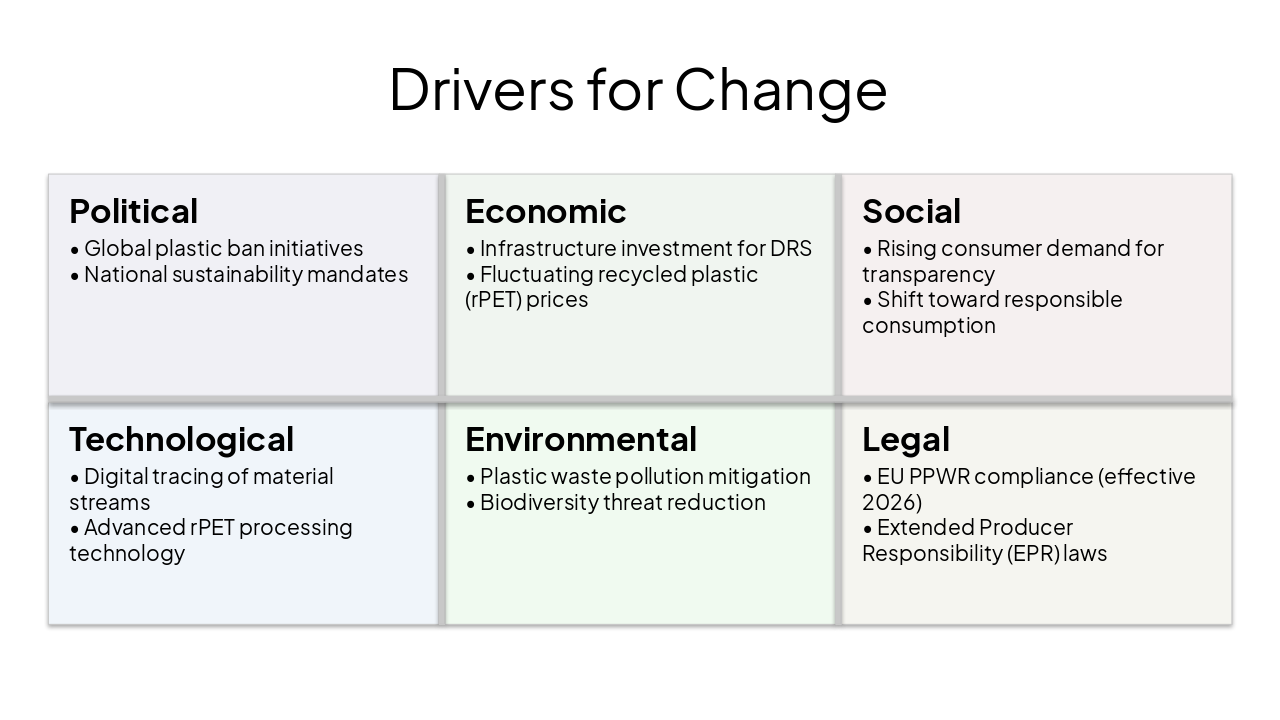
Slide 7 - Drivers for Change

Political

  • Global plastic ban initiatives
  • National sustainability mandates

Economic

  • Infrastructure investment for DRS
  • Fluctuating recycled plastic (rPET) prices

Social

  • Rising consumer demand for transparency
  • Shift toward responsible consumption

Technological

  • Digital tracing of material streams
  • Advanced rPET processing technology

Environmental

  • Plastic waste pollution mitigation
  • Biodiversity threat reduction

Legal

  • EU PPWR compliance (effective 2026)
  • Extended Producer Responsibility (EPR) laws
Slide 7 - Drivers for Change
Slide 8 of 15

Slide 8 - Operations & Methodology

3

Operational Analysis & Methodology

Mapping the End-to-End Circular Network
Slide 8 - Operations & Methodology
Slide 9 of 15

Slide 9 - Forward vs. Reverse Logistics

Forward Logistics Linear flow from source to consumer. Focus on production, packaging, and distribution. Efficiency and speed are paramount.

Reverse Logistics Cyclical flow from consumer back to plant. Focus on collection, sorting, and decontamination. Essential for closing the loop.
Slide 9 - Forward vs. Reverse Logistics
Slide 10 of 15

Slide 10 - Methodology & Application Tools

  • Methodology: Applied SCM framework combining LCA (Life Cycle Assessment) and Tier Analysis.
  • LCA Application: Measuring the cradle-to-cradle environmental impact of PET packaging.
  • Tier Analysis: Assessing suppliers based on material efficiency and circularity readiness.
  • Gap Analysis: Comparing theoretical ideal-state circularity against real-world logistical constraints.
Slide 10 - Methodology & Application Tools
Slide 11 of 15

Slide 11 - Strategic Synthesis

4

Strategy, Risks, and Future Outlook

Driving Competitive Advantage Through Circularity
Slide 11 - Strategic Synthesis
Slide 12 of 15

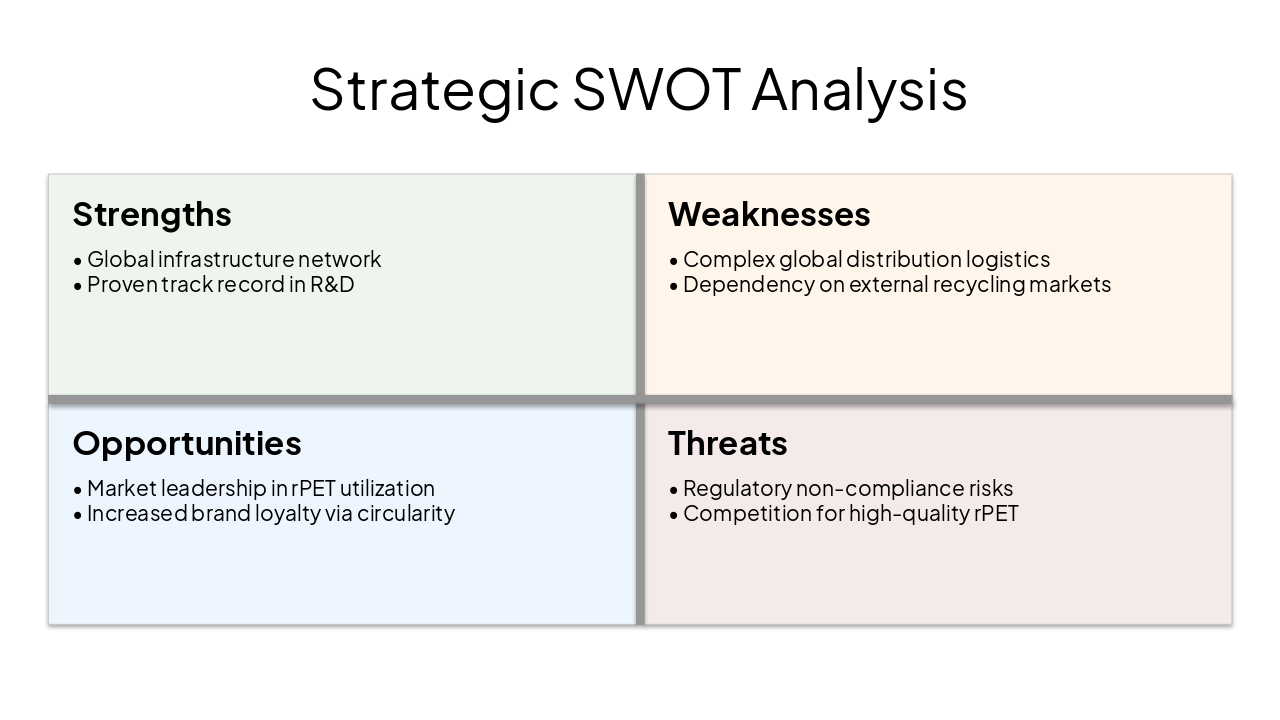
Slide 12 - Strategic SWOT Analysis

Strengths

  • Global infrastructure network
  • Proven track record in R&D

Weaknesses

  • Complex global distribution logistics
  • Dependency on external recycling markets

Opportunities

  • Market leadership in rPET utilization
  • Increased brand loyalty via circularity

Threats

  • Regulatory non-compliance risks
  • Competition for high-quality rPET
Slide 12 - Strategic SWOT Analysis
Slide 13 of 15

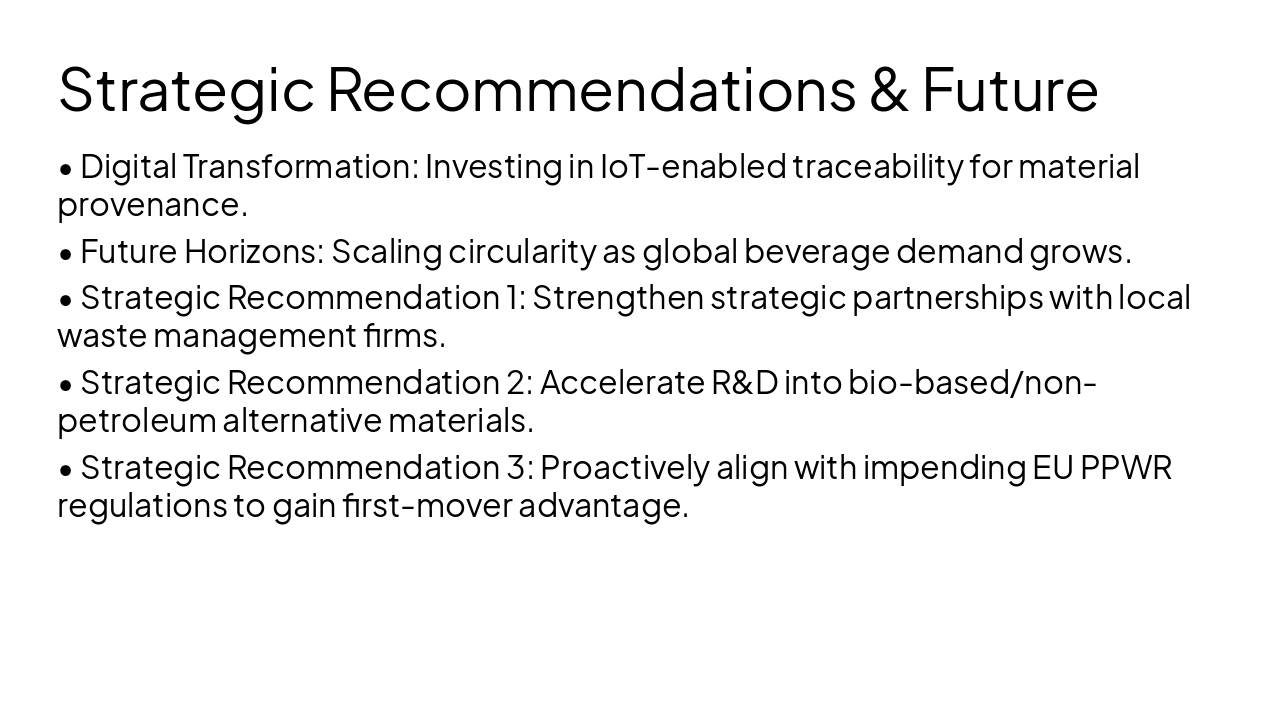
Slide 13 - Strategic Recommendations & Future

  • Digital Transformation: Investing in IoT-enabled traceability for material provenance.
  • Future Horizons: Scaling circularity as global beverage demand grows.
  • Strategic Recommendation 1: Strengthen strategic partnerships with local waste management firms.
  • Strategic Recommendation 2: Accelerate R&D into bio-based/non-petroleum alternative materials.
  • Strategic Recommendation 3: Proactively align with impending EU PPWR regulations to gain first-mover advantage.
Slide 13 - Strategic Recommendations & Future
Slide 14 of 15

Slide 14 - Concluding Remarks

Conclusion: Toward a Circular Future

Transitioning toward a truly regenerative supply chain.
Slide 14 - Concluding Remarks
Slide 15 of 15

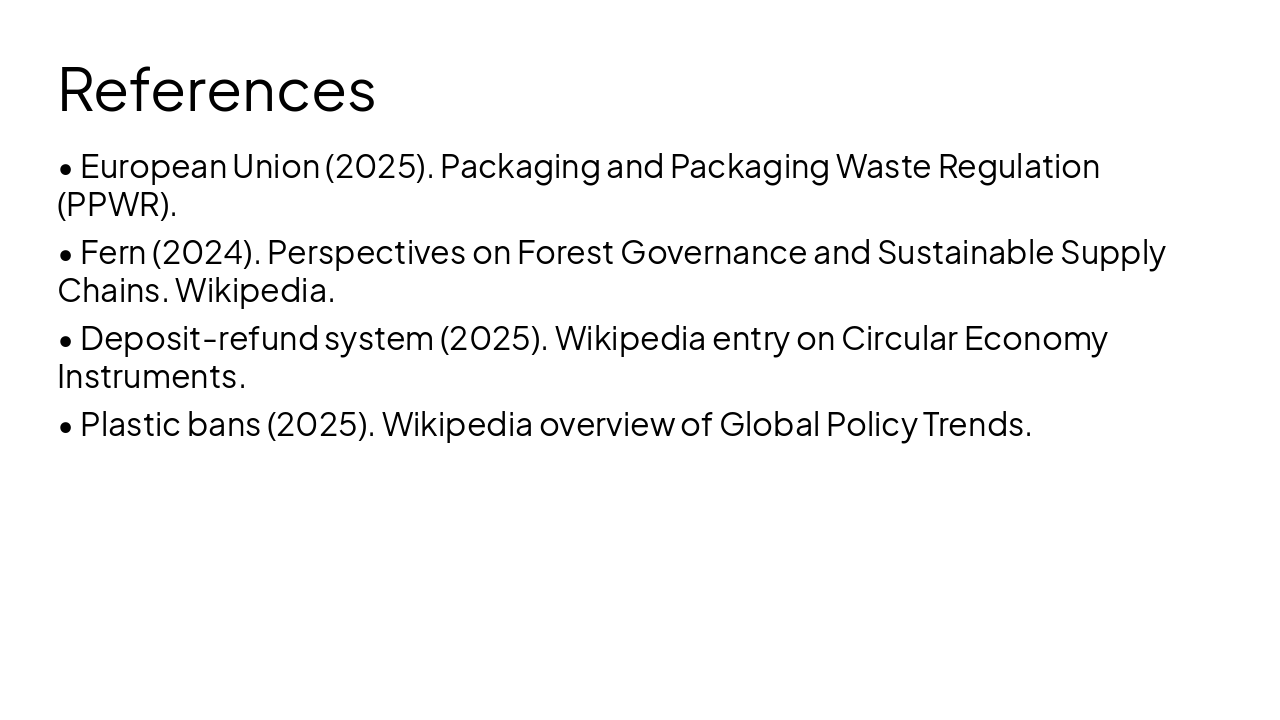
Slide 15 - References

  • European Union (2025). Packaging and Packaging Waste Regulation (PPWR).
  • Fern (2024). Perspectives on Forest Governance and Sustainable Supply Chains. Wikipedia.
  • Deposit-refund system (2025). Wikipedia entry on Circular Economy Instruments.
  • Plastic bans (2025). Wikipedia overview of Global Policy Trends.
Slide 15 - References

Discover More Presentations

Explore thousands of AI-generated presentations for inspiration

Browse Presentations
Powered by AI

Create Your Own Presentation

Generate professional presentations in seconds with Karaf's AI. Customize this presentation or start from scratch.

Create New Presentation

Powered by Karaf.ai — AI-Powered Presentation Generator