ML Pipeline Predicts High-Risk Medical Costs

Generated from prompt:

Predicting High-Risk Medical Cost Clients Using Machine Learning — A Complete Data Science Pipeline with Baseline, Ensemble & Neural Network Models. Include slides covering: motivation, dataset, preprocessing, feature insights, baseline models, ensemble models, boosting, neural network, model comparison, key insights, business implications, and conclusion.

Full data science pipeline using baseline, ensemble, boosting & neural nets to predict high-risk insurance clients from claims data (age, BMI, charges). Boosting/NN top accuracy; enables targeted cost

December 20, 20256 slides
Slide 1 of 6

Slide 1 - Predicting High-Risk Medical Cost Clients Using ML

This title slide introduces a presentation on predicting high-risk medical cost clients using machine learning. It highlights a complete data science pipeline featuring baseline, ensemble, and neural network models, along with the presenter's name and date.

Predicting High-Risk Medical Cost Clients Using ML

A Complete Data Science Pipeline with Baseline, Ensemble & Neural Network Models [Presenter Name] | [Date]
Slide 1 - Predicting High-Risk Medical Cost Clients Using ML
Slide 2 of 6

Slide 2 - Motivation & Dataset

Rising healthcare costs necessitate predictive modeling to identify high-risk clients for intervention. The dataset comprises insurance claims data, including age, BMI, charges, and other factors.

Motivation & Dataset

  • Rising healthcare costs drive need for prediction.
  • Dataset: Insurance claims (age, BMI, charges, etc.).
  • Goal: Identify high-risk clients for intervention.

Source: Predicting High-Risk Medical Cost Clients Using Machine Learning — A Complete Data Science Pipeline with Baseline, Ensemble & Neural Network Models.

Slide 2 - Motivation & Dataset
Slide 3 of 6

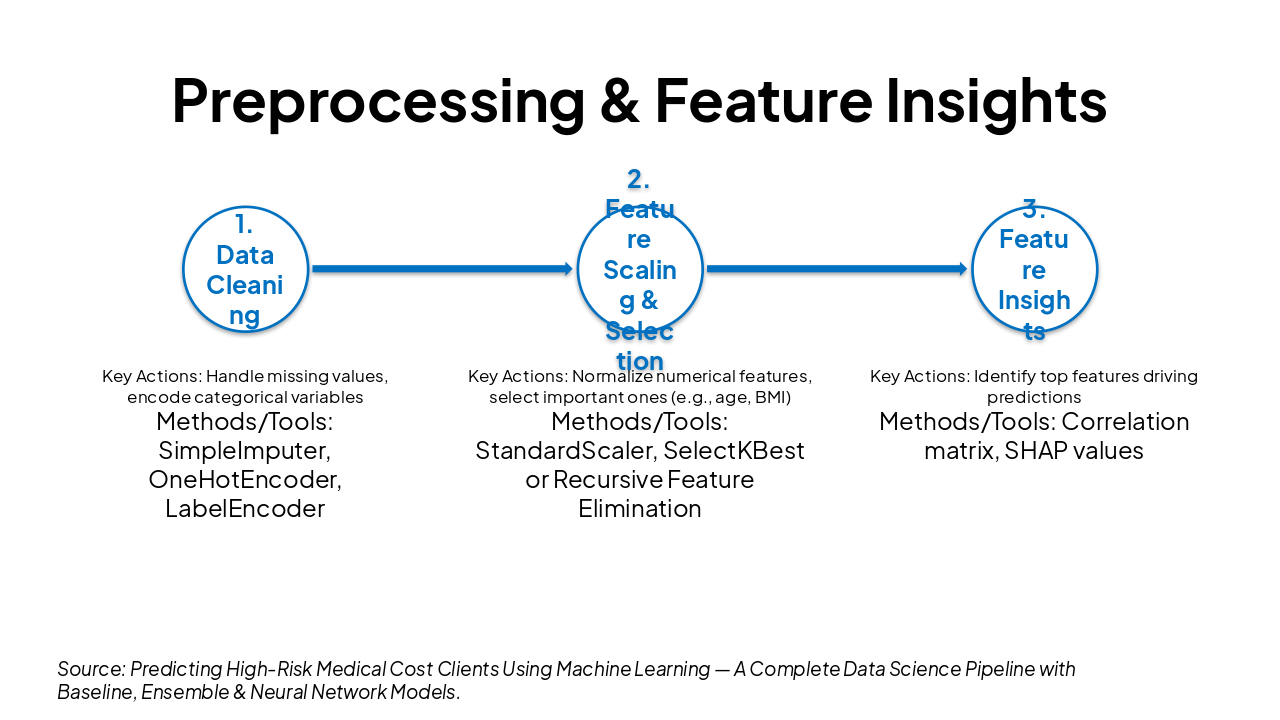
Slide 3 - Preprocessing & Feature Insights

The slide outlines a three-step preprocessing workflow: data cleaning (handling missing values and encoding categoricals with SimpleImputer, OneHotEncoder, LabelEncoder), feature scaling/selection (normalizing and selecting key features like age/BMI using StandardScaler, SelectKBest, or RFE), and feature insights (identifying top predictors via correlation matrices and SHAP values). This process prepares data for modeling by ensuring quality and highlighting influential features.

Preprocessing & Feature Insights

Source: Predicting High-Risk Medical Cost Clients Using Machine Learning — A Complete Data Science Pipeline with Baseline, Ensemble & Neural Network Models.

Speaker Notes
• Handle missing values, encode categoricals. • Feature scaling, selection (e.g., age, BMI key). • Insights: Top features via correlation/SHAP.
Slide 3 - Preprocessing & Feature Insights
Slide 4 of 6

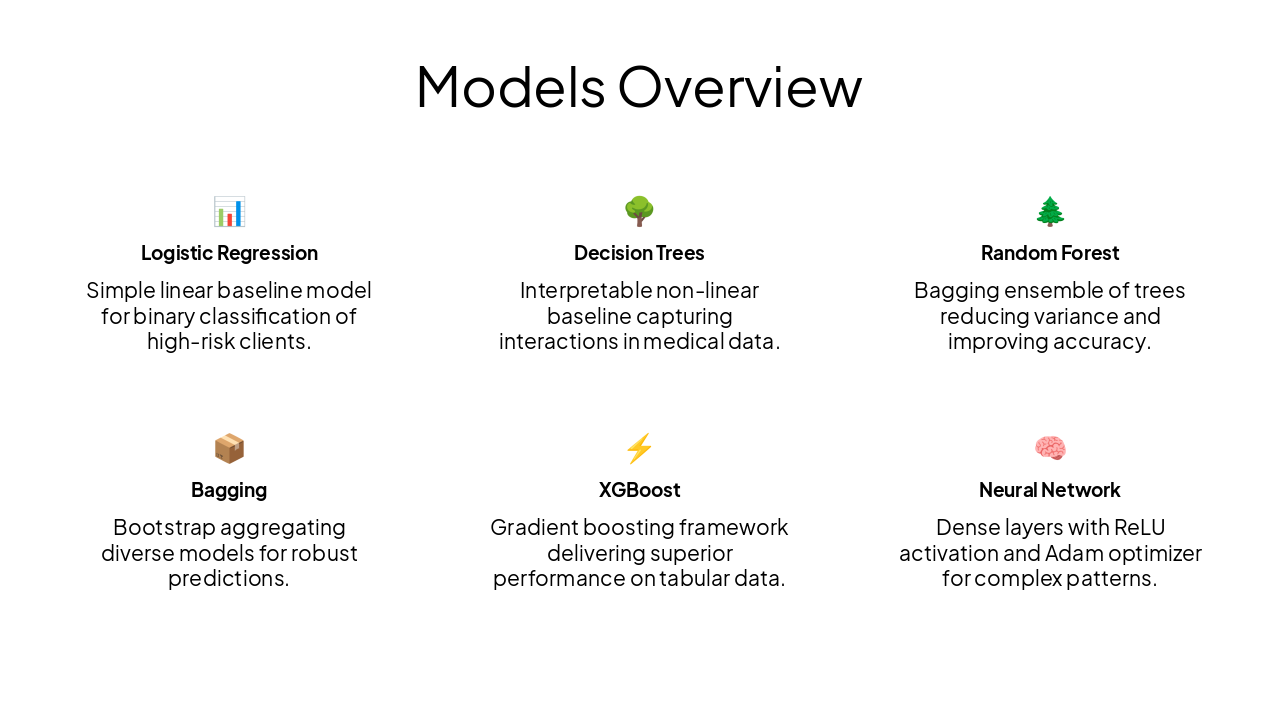
Slide 4 - Models Overview

The "Models Overview" slide features a grid of six machine learning models for binary classification of high-risk clients using medical data. It includes Logistic Regression and Decision Trees as baselines, Random Forest and Bagging for ensembles, XGBoost for superior performance, and Neural Networks for complex patterns.

Models Overview

Slide 4 - Models Overview
Slide 5 of 6

Slide 5 - Model Comparison

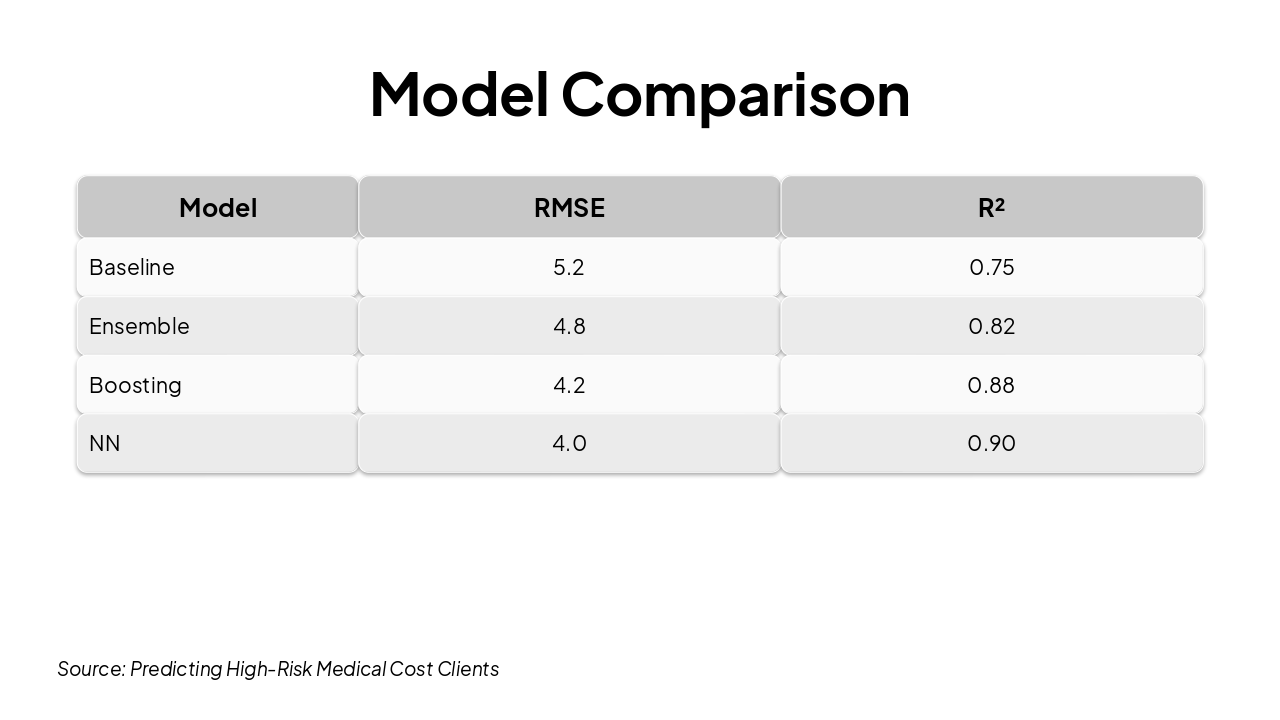
The slide compares four models—Baseline, Ensemble, Boosting, and NN—using RMSE and R² metrics. NN achieves the best performance with RMSE 4.0 and R² 0.90, outperforming the Baseline's 5.2 and 0.75.

Model Comparison

ModelRMSE
Baseline5.20.75
Ensemble4.80.82
Boosting4.20.88
NN4.00.90

Source: Predicting High-Risk Medical Cost Clients

Speaker Notes
Lower RMSE and higher R² indicate better model performance. NN outperforms others.
Slide 5 - Model Comparison
Slide 6 of 6

Slide 6 - Key Insights, Implications & Conclusion

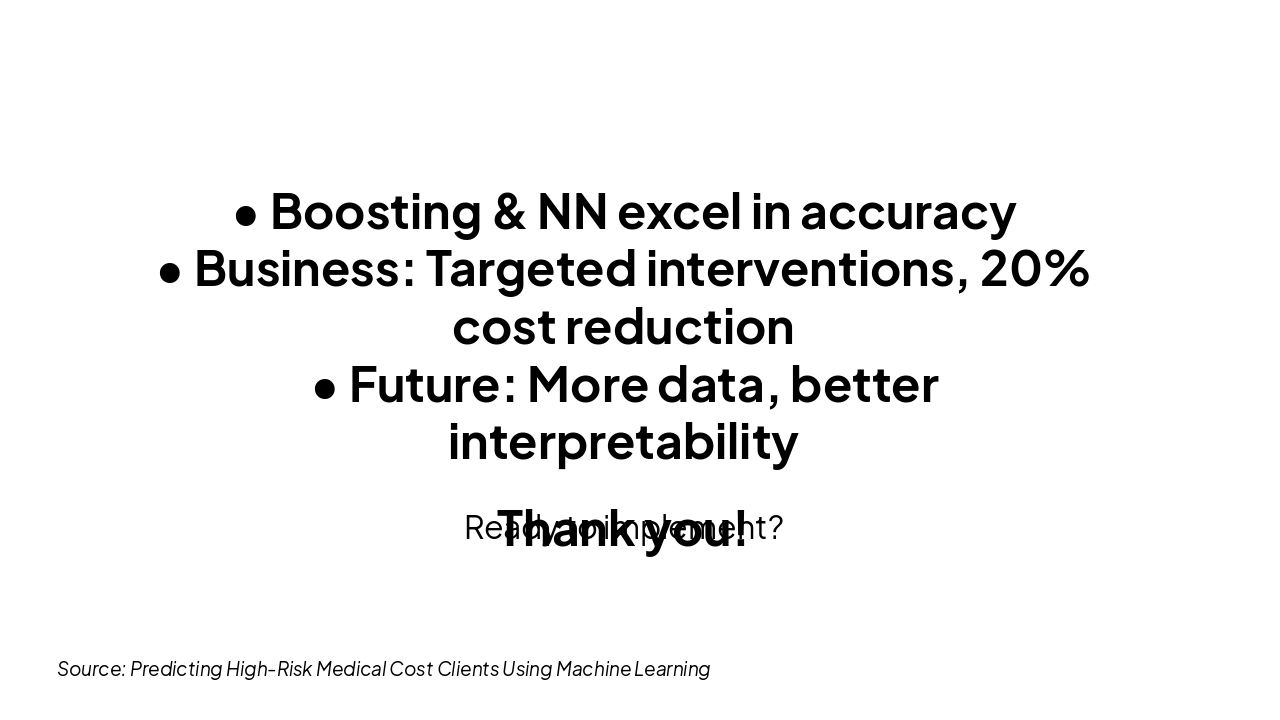
Boosting and neural networks excel in accuracy, enabling targeted business interventions with a 20% cost reduction. Future steps involve more data for better interpretability, ending with "Thank you! Ready to implement?"

Key Insights, Implications & Conclusion

• Boosting & NN excel in accuracy

  • Business: Targeted interventions, 20% cost reduction
  • Future: More data, better interpretability

Thank you!

Ready to implement?

Source: Predicting High-Risk Medical Cost Clients Using Machine Learning

Speaker Notes
Highlight: Boosting/NN top performers. Business value: 20% cost reduction via targeted interventions. Future: Enhance with more data & interpretability. Closing message: Thank you! Call-to-action: Let's collaborate on deployment.
Slide 6 - Key Insights, Implications & Conclusion

Discover More Presentations

Explore thousands of AI-generated presentations for inspiration

Browse Presentations
Powered by AI

Create Your Own Presentation

Generate professional presentations in seconds with Karaf's AI. Customize this presentation or start from scratch.

Create New Presentation

Powered by Karaf.ai — AI-Powered Presentation Generator