AGRHYMET: Drought EWS to Impact-Based Forecasting (48 chars)

Generated from prompt:

Presentation on AGRHYMET’s current drought early warning system and future plans for drought Impact-Based Forecasting (IbF). Include background on AGRHYMET, description of current early warning systems, data sources and technologies used, limitations of the current system, introduction to impact-based forecasting, steps toward its implementation at AGRHYMET, partnerships and capacity building, and expected outcomes for the Sahel region.

Overview of AGRHYMET's Sahel drought monitoring since 1974, current systems (SPI/VHI bulletins), data/tech, limitations, and shift to IbF via implementation steps, partnerships, capacity building for

December 12, 202511 slides
Slide 1 of 11

Slide 1 - AGRHYMET’s Drought Early Warning & Future IbF

This title slide features "AGRHYMET’s Drought Early Warning System & Future IbF" as the main text. The subtitle emphasizes "Transitioning to Impact-Based Forecasting for the Sahel."

AGRHYMET’s Drought Early Warning System & Future IbF

Transitioning to Impact-Based Forecasting for the Sahel
Slide 1 - AGRHYMET’s Drought Early Warning & Future IbF
Slide 2 of 11

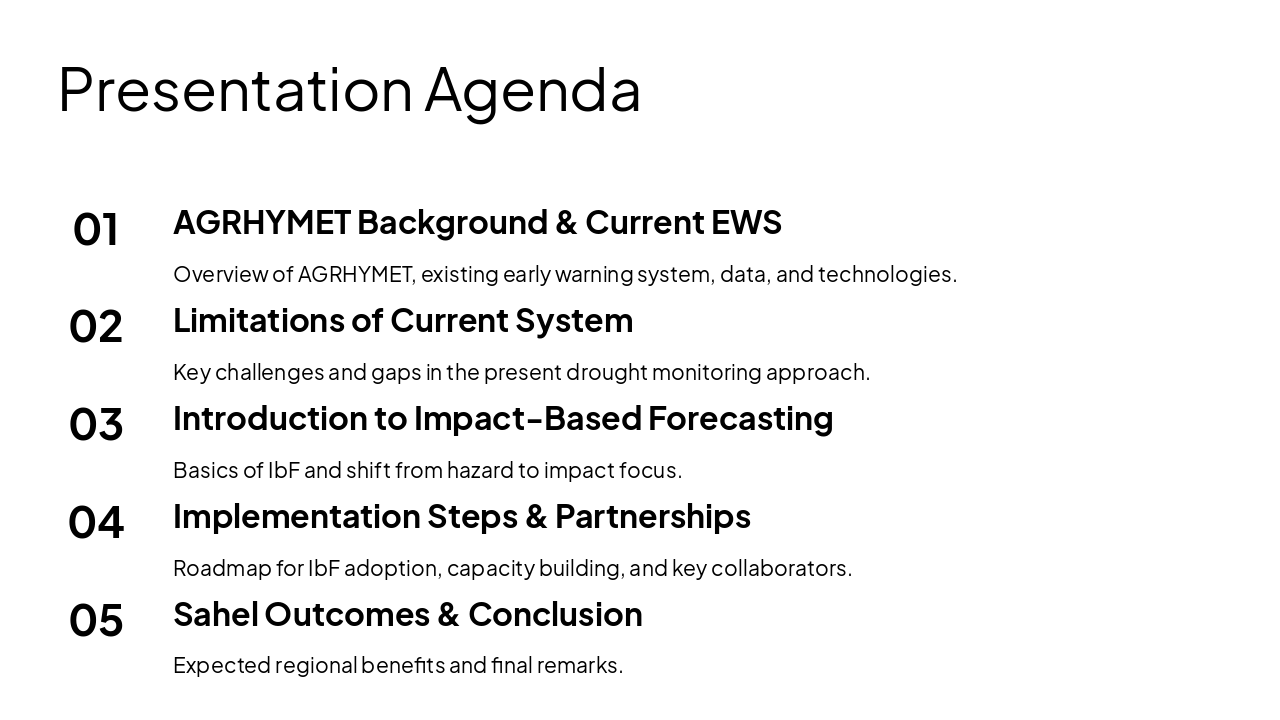
Slide 2 - Presentation Agenda

The presentation agenda outlines AGRHYMET's background, current early warning system, and its key limitations in drought monitoring. It then introduces Impact-Based Forecasting, implementation steps with partnerships, and expected Sahel outcomes.

Presentation Agenda

  1. AGRHYMET Background & Current EWS
  2. Overview of AGRHYMET, existing early warning system, data, and technologies.

  3. Limitations of Current System
  4. Key challenges and gaps in the present drought monitoring approach.

  5. Introduction to Impact-Based Forecasting
  6. Basics of IbF and shift from hazard to impact focus.

  7. Implementation Steps & Partnerships
  8. Roadmap for IbF adoption, capacity building, and key collaborators.

  9. Sahel Outcomes & Conclusion
  10. Expected regional benefits and final remarks.

Speaker Notes
1. AGRHYMET Background 2. Current EWS 3. Data & Tech 4. Limitations 5. IbF Intro 6. Implementation Steps 7. Partnerships 8. Sahel Outcomes 9. Conclusion Context: Presentation on AGRHYMET’s current drought early warning system and future plans for drought Impact-Based Forecasting (IbF).
Slide 2 - Presentation Agenda
Slide 3 of 11

Slide 3 - Background on AGRHYMET

AGRHYMET is the Regional Centre for Agrometeorology (CILSS) that has monitored Sahel droughts since 1974. It serves 9 Sahelian countries by providing agro-climatic bulletins and early warnings.

Background on AGRHYMET

  • Regional Centre for Agrometeorology (CILSS)
  • Sahel drought monitoring since 1974
  • Serves 9 Sahelian countries
  • Provides agro-climatic bulletins & early warnings
Slide 3 - Background on AGRHYMET
Slide 4 of 11

Slide 4 - Current Early Warning Systems

Current Early Warning Systems feature seasonal forecasts, agrometeorological bulletins, drought indices like SPI and VHI, and crop yield predictions. They deliver bi-weekly or monthly updates to farmers and policymakers.

Current Early Warning Systems

  • Seasonal forecasts and agrometeorological bulletins
  • Drought indices: SPI and VHI
  • Crop yield predictions
  • Bi-weekly/monthly updates for farmers and policymakers
Slide 4 - Current Early Warning Systems
Slide 5 of 11

Slide 5 - Data Sources & Technologies

The slide "Data Sources & Technologies" features a table listing key data sources alongside their primary technologies. It covers satellites (MODIS, Landsat), ground stations (rain gauges), models (ECMWF, CHIRPS), and GIS (ArcGIS for mapping).

Data Sources & Technologies

{ "headers": [ "Source", "Technology" ], "rows": [ [ "Satellites", "MODIS, Landsat" ], [ "Ground Stations", "Rain gauges" ], [ "Models", "ECMWF, CHIRPS" ], [ "GIS", "ArcGIS for mapping" ] ] }

Source: AGRHYMET Drought Early Warning System

Speaker Notes
Overview of key data sources and technologies in current system.
Slide 5 - Data Sources & Technologies
Slide 6 of 11

Slide 6 - Limitations of Current System

The slide lists key limitations of the current system, which is probability-based rather than impact-focused and has limited socio-economic data integration. It also notes challenges in real-time data access and varying national capacities.

Limitations of Current System

  • Probability-based, not impact-focused
  • Limited socio-economic data integration
  • Challenges in real-time data access
  • Varying national capacities
Slide 6 - Limitations of Current System
Slide 7 of 11

Slide 7 - Introduction to Impact-Based Forecasting (IbF)

This slide serves as the section header for Section 06: Introduction to Impact-Based Forecasting (IbF). It describes the shift from hazard-probability focus to evaluating impacts on people, economy, and sectors for more actionable warnings.

06

Introduction to Impact-Based Forecasting (IbF)

Shift from hazard-probability to impacts on people, economy, sectors for actionable warnings.

Slide 7 - Introduction to Impact-Based Forecasting (IbF)
Slide 8 of 11

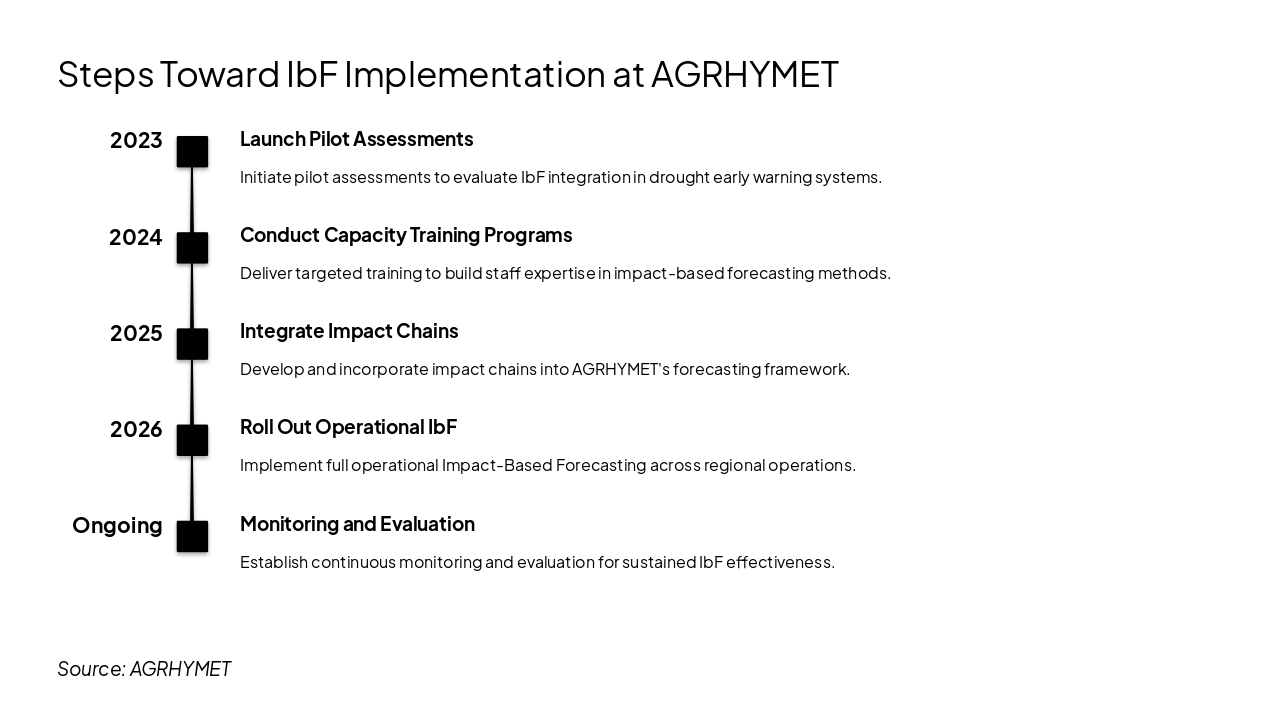
Slide 8 - Steps Toward IbF Implementation at AGRHYMET

The timeline outlines AGRHYMET's steps for Impact-Based Forecasting (IbF) implementation: pilot assessments in 2023, capacity training in 2024, impact chain integration in 2025, and full operational rollout in 2026. Ongoing monitoring and evaluation will sustain its effectiveness.

Steps Toward IbF Implementation at AGRHYMET

2023: Launch Pilot Assessments Initiate pilot assessments to evaluate IbF integration in drought early warning systems. 2024: Conduct Capacity Training Programs Deliver targeted training to build staff expertise in impact-based forecasting methods. 2025: Integrate Impact Chains Develop and incorporate impact chains into AGRHYMET's forecasting framework. 2026: Roll Out Operational IbF Implement full operational Impact-Based Forecasting across regional operations. Ongoing: Monitoring and Evaluation Establish continuous monitoring and evaluation for sustained IbF effectiveness.

Source: AGRHYMET

Speaker Notes
Presentation on AGRHYMET’s current drought early warning system and future plans for drought Impact-Based Forecasting (IbF). Include background on AGRHYMET, description of current early warning systems, data sources and technologies used, limitations of the current system, introduction to impact-based forecasting, steps toward its implementation at AGRHYMET, partnerships and capacity building, and expected outcomes for the Sahel region.
Slide 8 - Steps Toward IbF Implementation at AGRHYMET
Slide 9 of 11

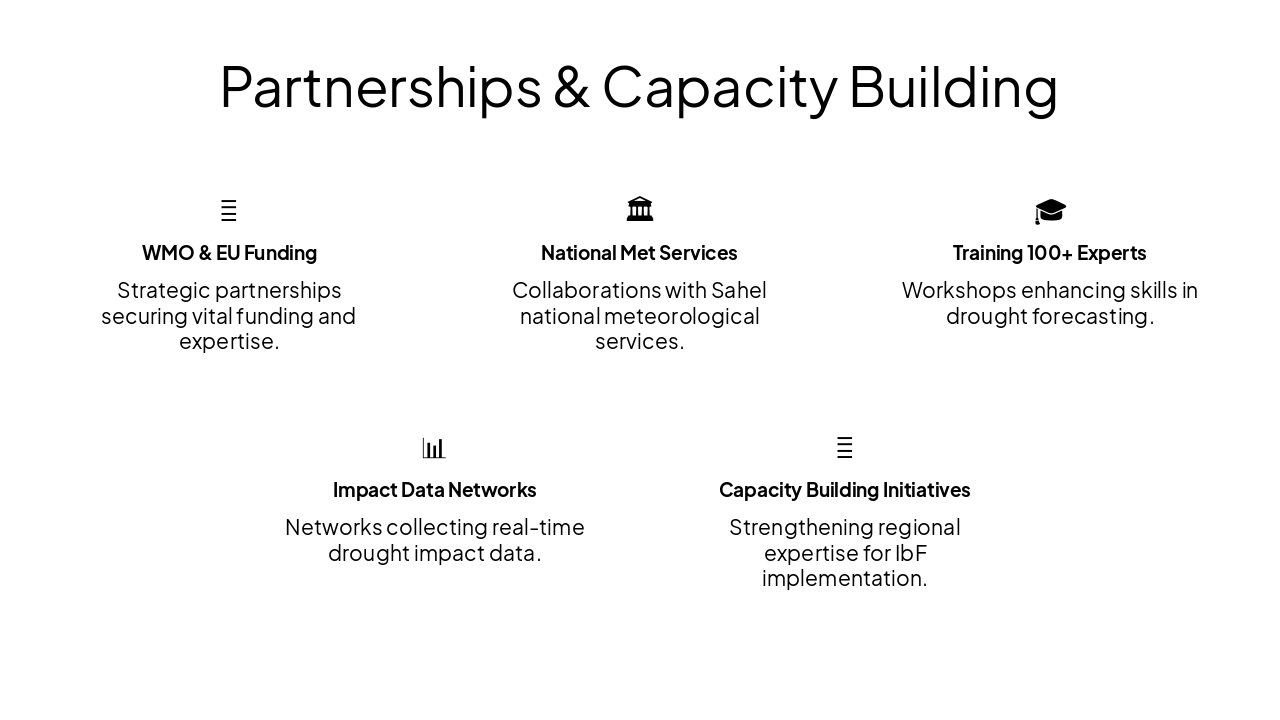
Slide 9 - Partnerships & Capacity Building

The slide "Partnerships & Capacity Building" showcases strategic collaborations with WMO, EU, and Sahel national meteorological services for funding, expertise, and real-time drought impact data networks. It also emphasizes training over 100 experts in drought forecasting and broader initiatives to strengthen regional capacity for IbF implementation.

Partnerships & Capacity Building

{ "features": [ { "icon": "🤝", "heading": "WMO & EU Funding", "description": "Strategic partnerships securing vital funding and expertise." }, { "icon": "🏛️", "heading": "National Met Services", "description": "Collaborations with Sahel national meteorological services." }, { "icon": "🎓", "heading": "Training 100+ Experts", "description": "Workshops enhancing skills in drought forecasting." }, { "icon": "📊", "heading": "Impact Data Networks", "description": "Networks collecting real-time drought impact data." }, { "icon": "💪", "heading": "Capacity Building Initiatives", "description": "Strengthening regional expertise for IbF implementation." } ] }

Slide 9 - Partnerships & Capacity Building
Slide 10 of 11

Slide 10 - Expected Outcomes for Sahel Region

The slide titled "Expected Outcomes for Sahel Region" lists key benefits from an initiative. These include reduced drought vulnerability, improved resource allocation, enhanced food security, and greater resilience for 300 million people.

Expected Outcomes for Sahel Region

  • Reduced drought vulnerability
  • Improved resource allocation
  • Enhanced food security
  • Greater resilience for 300M people
Slide 10 - Expected Outcomes for Sahel Region
Slide 11 of 11

Slide 11 - Conclusion & Next Steps

The conclusion slide announces that AGRHYMET is advancing to IbF for impactful drought warnings in the Sahel. It ends with a thank you and an invitation to contact for collaborations.

Conclusion & Next Steps

AGRHYMET advancing to IbF for impactful drought warnings in the Sahel.

Thank you! Contact for collaborations.

Speaker Notes
AGRHYMET advancing to IbF for impactful warnings. Contact for collaborations. Thank you!
Slide 11 - Conclusion & Next Steps

Discover More Presentations

Explore thousands of AI-generated presentations for inspiration

Browse Presentations
Powered by AI

Create Your Own Presentation

Generate professional presentations in seconds with Karaf's AI. Customize this presentation or start from scratch.

Create New Presentation

Powered by Karaf.ai — AI-Powered Presentation Generator