Semiconductors: Powering the Digital Age (38 chars)

Generated from prompt:

make a presentation about semiconductors

Explores semiconductor basics (silicon/germanium, doping, crystal structure), history (Fairchild pioneers), industry stats, innovation quote, future outlook, and key takeaways on driving tech revoluti

December 5, 202511 slides
Slide 1 of 11

Slide 1 - Semiconductors: Powering the Digital Age

This title slide features the main heading "Semiconductors: Powering the Digital Age." Its subtitle reads "Exploring their crucial role in modern electronics."

Semiconductors: Powering the Digital Age

Exploring their crucial role in modern electronics

--- Speaker Notes: Welcome slide introducing the topic of semiconductors and their crucial role in modern electronics.
Slide 1
Slide 2 of 11

Slide 2 - Presentation Agenda

This agenda slide outlines a presentation on semiconductors, starting with basics and their role in electronics. It covers historical milestones, key manufacturing technologies, major market players, and future trends with concluding remarks.

Presentation Agenda

  1. 1. What are Semiconductors?

Overview of semiconductor basics and their role in electronics.

  1. 2. Historical Milestones

Major historical events and inventions in semiconductor development.

  1. 3. Key Technologies

Essential technologies and processes in semiconductor manufacturing.

  1. 4. Major Players

Prominent companies dominating the semiconductor market today.

  1. 5. Future Trends and Conclusion

Predictions for future advancements and concluding remarks.

Source: Semiconductors Presentation

Slide 2
Slide 3 of 11

Slide 3 - What are Semiconductors?

This slide serves as the section header for Section 02, titled "What are Semiconductors?" It defines semiconductors as fundamental materials like silicon that conduct electricity under specific conditions, enabling transistors and chips.

What are Semiconductors?

02

What are Semiconductors?

Fundamental materials like silicon that conduct electricity under specific conditions, enabling transistors and chips.

Source: Semiconductors Presentation

--- Speaker Notes: Fundamental materials like silicon that conduct electricity under specific conditions, enabling transistors and chips.

Slide 3
Slide 4 of 11

Slide 4 - Semiconductor Basics

Semiconductors are made from silicon and germanium, doped into N-type and P-type materials. Their band gap governs conductivity, enabling diodes, transistors, and ICs.

Semiconductor Basics

  • Made from silicon and germanium
  • Doped into N-type and P-type
  • Band gap governs conductivity
  • Enable diodes, transistors, and ICs
Slide 4
Slide 5 of 11

Slide 5 - Semiconductor Crystal Structure

The slide depicts the diamond cubic lattice structure of silicon atoms in semiconductors. It explains doping with phosphorus for N-type conductivity (adding electrons) and boron for P-type (adding holes).

Semiconductor Crystal Structure

!Image

  • Silicon atoms form diamond cubic lattice structure.
  • Doping introduces impurities to modify conductivity.
  • N-type adds donors like phosphorus for electrons.
  • P-type adds acceptors like boron for holes.

Source: Wikipedia

--- Speaker Notes: Visual of silicon wafer lattice and doping process.

Slide 5
Slide 6 of 11

Slide 6 - History of Semiconductors

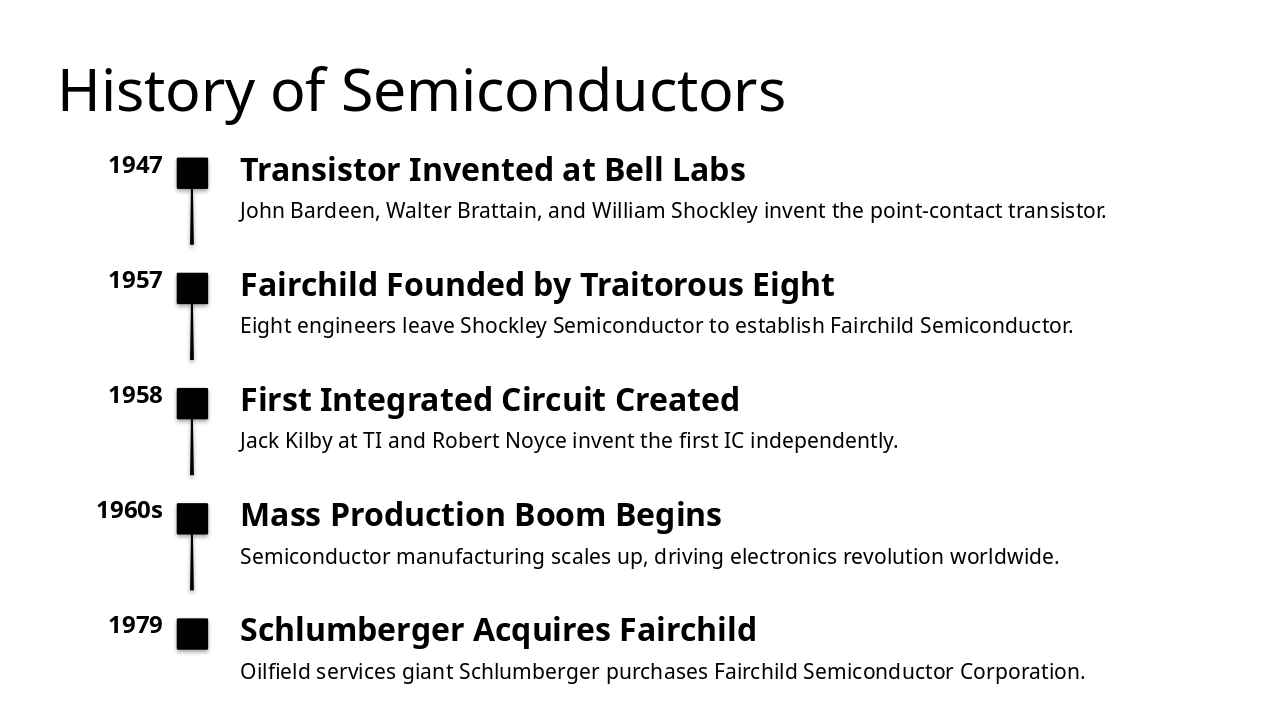
The timeline traces semiconductor history from the 1947 transistor invention at Bell Labs by Bardeen, Brattain, and Shockley, to the 1957 founding of Fairchild by the Traitorous Eight, and the 1958 first integrated circuit by Kilby and Noyce. It highlights the 1960s mass production boom and Schlumberger's 1979 acquisition of Fairchild.

History of Semiconductors

1947: Transistor Invented at Bell Labs John Bardeen, Walter Brattain, and William Shockley invent the point-contact transistor. 1957: Fairchild Founded by Traitorous Eight Eight engineers leave Shockley Semiconductor to establish Fairchild Semiconductor. 1958: First Integrated Circuit Created Jack Kilby at TI and Robert Noyce invent the first IC independently. 1960s: Mass Production Boom Begins Semiconductor manufacturing scales up, driving electronics revolution worldwide. 1979: Schlumberger Acquires Fairchild Oilfield services giant Schlumberger purchases Fairchild Semiconductor Corporation.

--- Speaker Notes: Part of a presentation about semiconductors

Slide 6
Slide 7 of 11

Slide 7 - Fairchild Semiconductor Pioneers

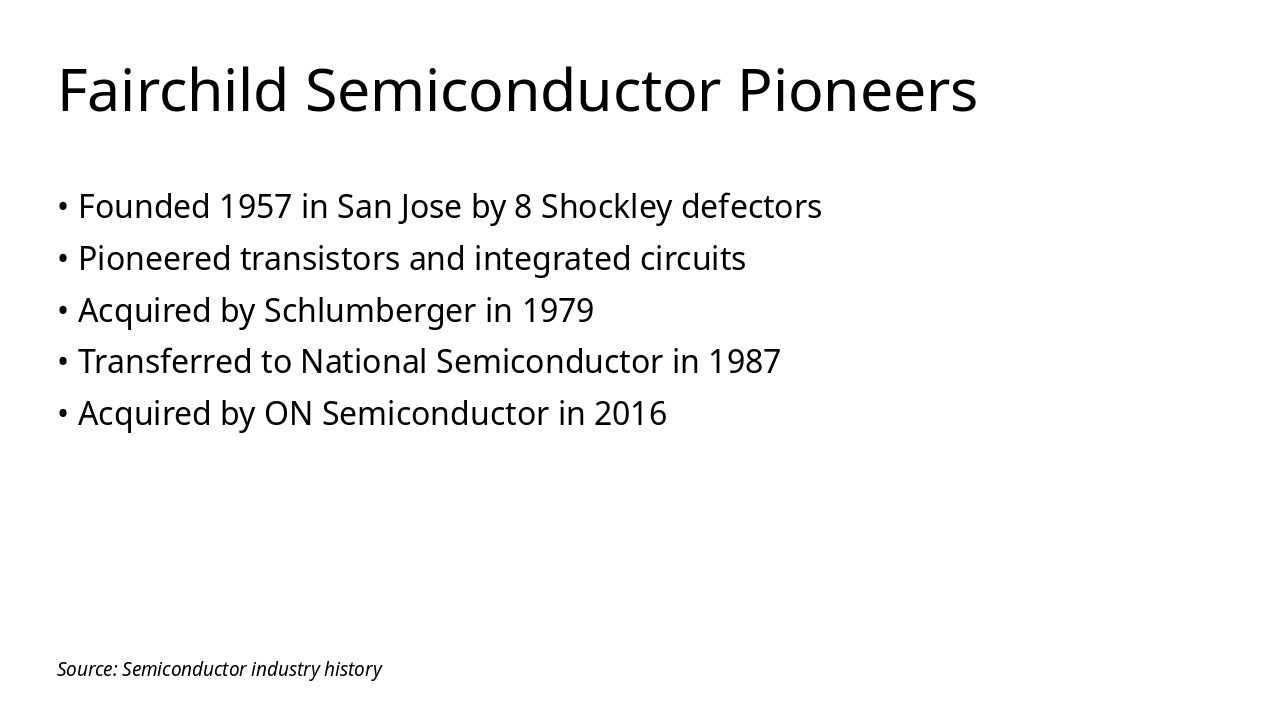
Fairchild Semiconductor was founded in 1957 in San Jose by eight Shockley defectors and pioneered transistors and integrated circuits. It was acquired by Schlumberger in 1979, transferred to National Semiconductor in 1987, and bought by ON Semiconductor in 2016.

Fairchild Semiconductor Pioneers

  • Founded 1957 in San Jose by 8 Shockley defectors
  • Pioneered transistors and integrated circuits
  • Acquired by Schlumberger in 1979
  • Transferred to National Semiconductor in 1987
  • Acquired by ON Semiconductor in 2016

Source: Semiconductor industry history

Slide 7
Slide 8 of 11

Slide 8 - Semiconductor Industry Stats

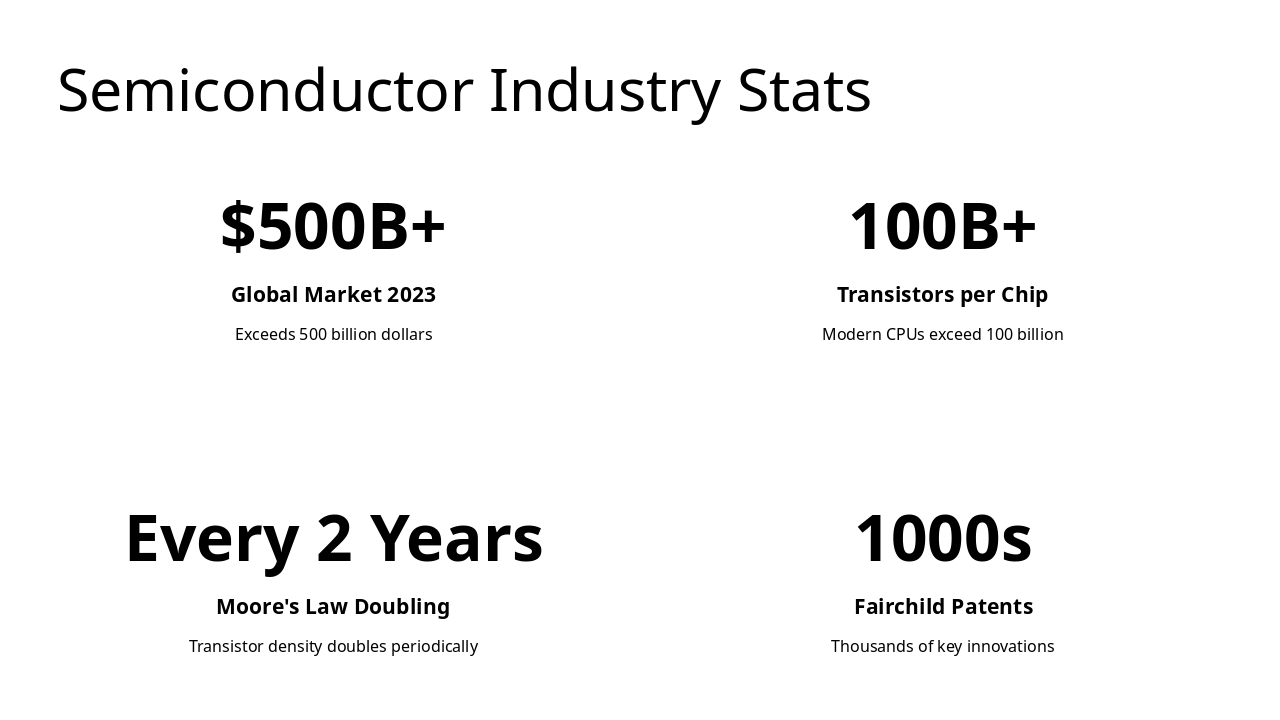
The semiconductor industry's global market exceeded $500 billion in 2023, with modern CPUs packing over 100 billion transistors. Moore's Law drives transistor density to double every two years, bolstered by thousands of key patents from Fairchild.

Semiconductor Industry Stats

  • $500B+: Global Market 2023

Exceeds 500 billion dollars

  • 100B+: Transistors per Chip

Modern CPUs exceed 100 billion

  • Every 2 Years: Moore's Law Doubling

Transistor density doubles periodically

  • 1000s: Fairchild Patents

Thousands of key innovations

Slide 8
Slide 9 of 11

Slide 9 - Innovation Quote

This slide, titled "Innovation Quote," features a statement praising the Traitorous Eight—engineers who left Shockley to found Fairchild Semiconductor—for sparking Silicon Valley's semiconductor revolution and shaping modern technology. The quote is by Jay Last, a co-founder of Fairchild and Silicon Valley pioneer.

Innovation Quote

> The Traitorous Eight—visionary engineers who left Shockley to found Fairchild Semiconductor—changed the world, igniting Silicon Valley's semiconductor revolution and shaping modern technology.

— Jay Last, Co-founder of Fairchild Semiconductor and Silicon Valley Pioneer

Source: Fairchild Semiconductor History

--- Speaker Notes: On Fairchild founders who revolutionized Silicon Valley.

Slide 9
Slide 10 of 11

Slide 10 - Future of Semiconductors

This slide serves as the section header for Section 09: Future of Semiconductors. It highlights trends in quantum computing, AI chips, 3nm nodes, and GaN/SiC materials.

Future of Semiconductors

09

Future of Semiconductors

Exploring quantum computing, AI chips, 3nm nodes, and GaN/SiC materials trends.

Source: Semiconductors Presentation

--- Speaker Notes: Trends: Quantum computing, AI chips, 3nm nodes, GaN/SiC materials.

Slide 10
Slide 11 of 11

Slide 11 - Key Takeaways

The Key Takeaways conclusion slide emphasizes that semiconductors drive the tech revolution, Fairchild's legacy endures, and the future promises smaller, faster, smarter chips. It closes with "Thank you for your attention! Q&A?"

Key Takeaways

• Semiconductors drive the tech revolution.

  • Fairchild's legacy endures.
  • Future: Smaller, faster, smarter chips.

Thank you for your attention! Q&A?

Slide 11
Powered by AI

Create Your Own Presentation

Generate professional presentations in seconds with Karaf's AI. Customize this presentation or start from scratch.

Create New Presentation

Powered by Karaf.ai — AI-Powered Presentation Generator