Chemical Space Coverage in LC-HRMS

Generated from prompt:

create a presenation about my thesis

This presentation investigates chemical space coverage in non-targeted analysis using LC-HRMS. Analyzing 236 setups from RepoRT, it highlights selectivity biases limiting measurability of the exposome, dominated by RPLC, and advocates orthogonal LC-H

April 18, 202610 slides
Slide 1 of 10

Slide 1 - Chemical Space Coverage Thesis

Literature Thesis: Chemical Space Coverage in LC-HRMS

Investigating the chemical space coverage of liquid chromatographic techniques: how selectivity drives measurability
Slide 1 - Chemical Space Coverage Thesis
Slide 2 of 10

Slide 2 - Presentation Agenda

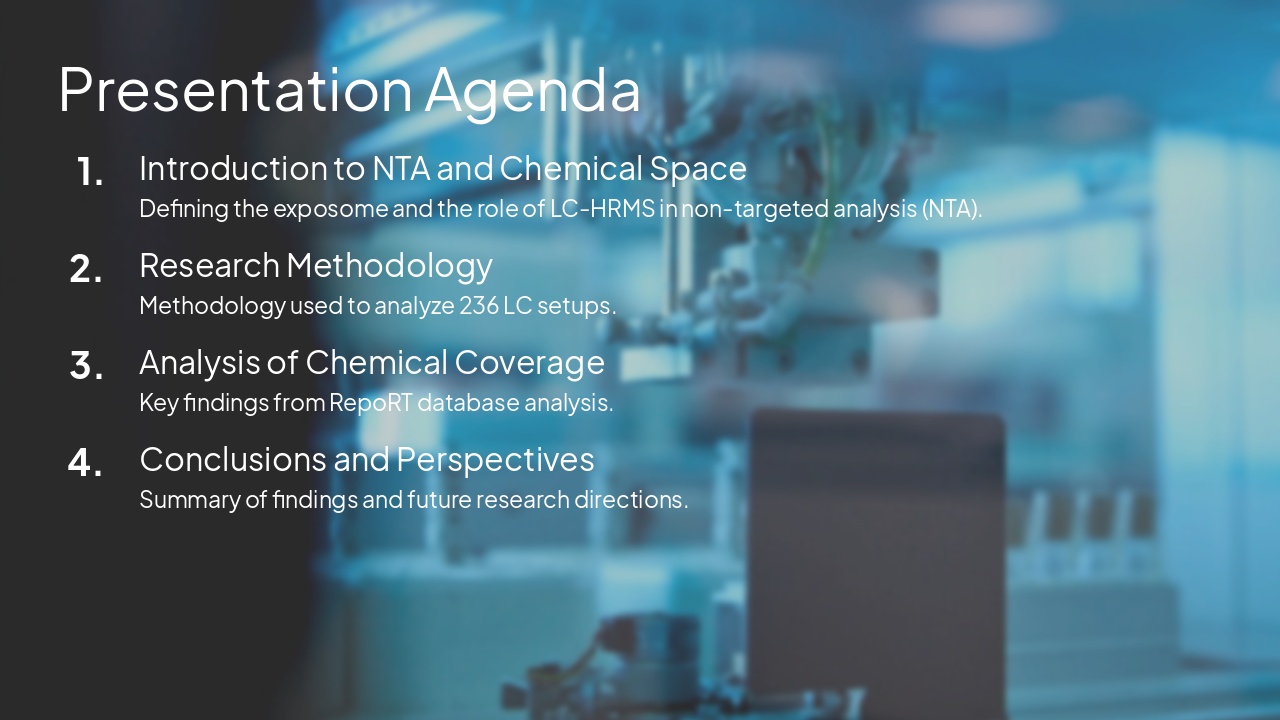
  • Introduction to NTA and Chemical Space: Defining the exposome and the role of LC-HRMS in non-targeted analysis (NTA).
  • Research Methodology: Methodology used to analyze 236 LC setups.
  • Analysis of Chemical Coverage: Key findings from RepoRT database analysis.
  • Conclusions and Perspectives: Summary of findings and future research directions.

---

Photo by Testalize.me on Unsplash

Slide 2 - Presentation Agenda
Slide 3 of 10

Slide 3 - Introduction

1

Introduction to NTA and Chemical Space

Understanding the exposome and the challenges of comprehensive measurability.

---

Photo by Ryan Zazueta on Unsplash
Slide 3 - Introduction
Slide 4 of 10

Slide 4 - Challenges in Exposome Analysis

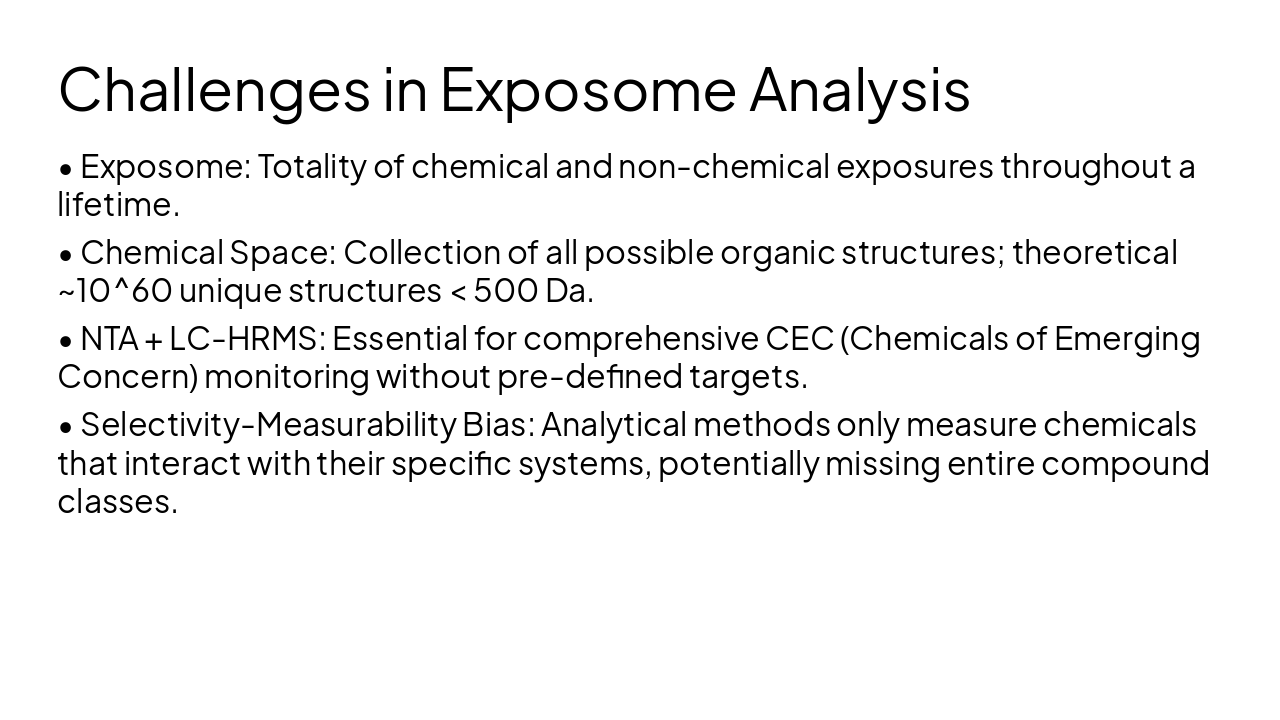
  • Exposome: Totality of chemical and non-chemical exposures throughout a lifetime.
  • Chemical Space: Collection of all possible organic structures; theoretical ~10^60 unique structures < 500 Da.
  • NTA + LC-HRMS: Essential for comprehensive CEC (Chemicals of Emerging Concern) monitoring without pre-defined targets.
  • Selectivity-Measurability Bias: Analytical methods only measure chemicals that interact with their specific systems, potentially missing entire compound classes.
Slide 4 - Challenges in Exposome Analysis
Slide 5 of 10

Slide 5 - Methodology

2

Research Methodology

Data acquisition and analysis of 236 curated LC setups from the RepoRT repository.

---

Photo by Deng Xiang on Unsplash
Slide 5 - Methodology
Slide 6 of 10

Slide 6 - Data Acquisition & Analysis Pipeline

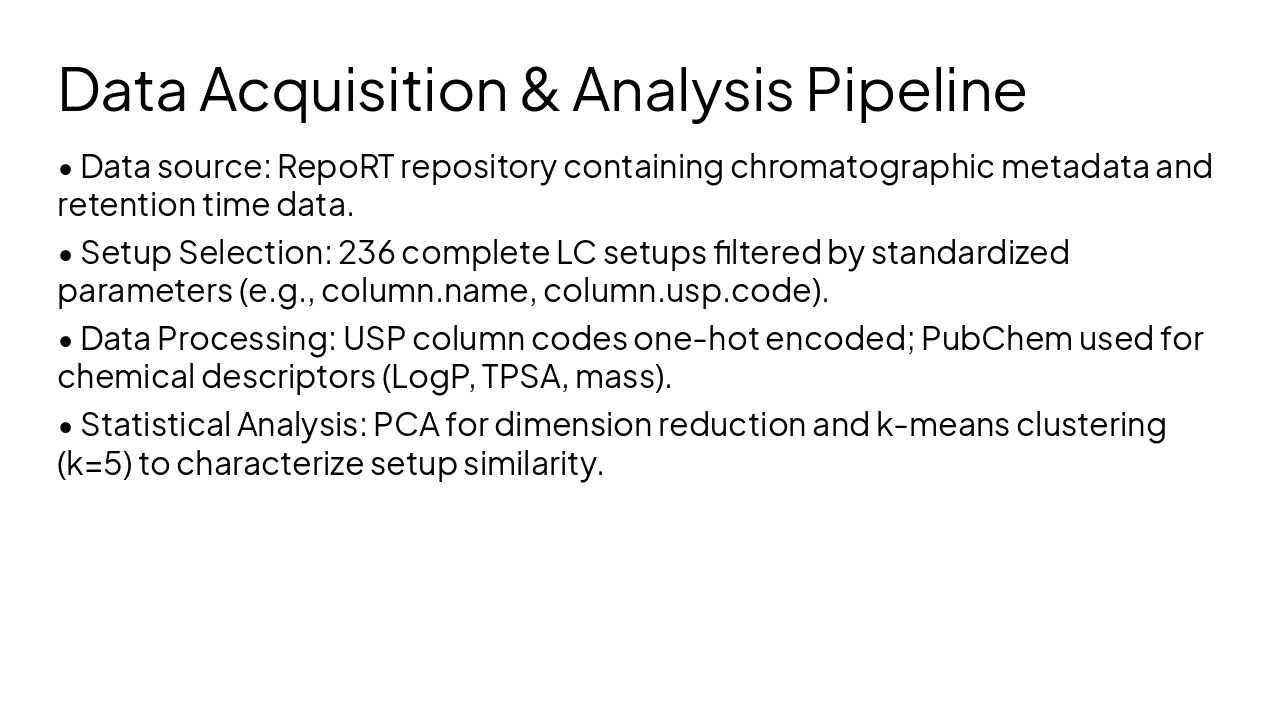
  • Data source: RepoRT repository containing chromatographic metadata and retention time data.
  • Setup Selection: 236 complete LC setups filtered by standardized parameters (e.g., column.name, column.usp.code).
  • Data Processing: USP column codes one-hot encoded; PubChem used for chemical descriptors (LogP, TPSA, mass).
  • Statistical Analysis: PCA for dimension reduction and k-means clustering (k=5) to characterize setup similarity.
Slide 6 - Data Acquisition & Analysis Pipeline
Slide 7 of 10

Slide 7 - Coverage Analysis

3

Analysis of Chemical Coverage

Evaluating the effective chemical space covered by current LC methods.

---

Photo by Deng Xiang on Unsplash
Slide 7 - Coverage Analysis
Slide 8 of 10

Slide 8 - Dataset Summary Stats

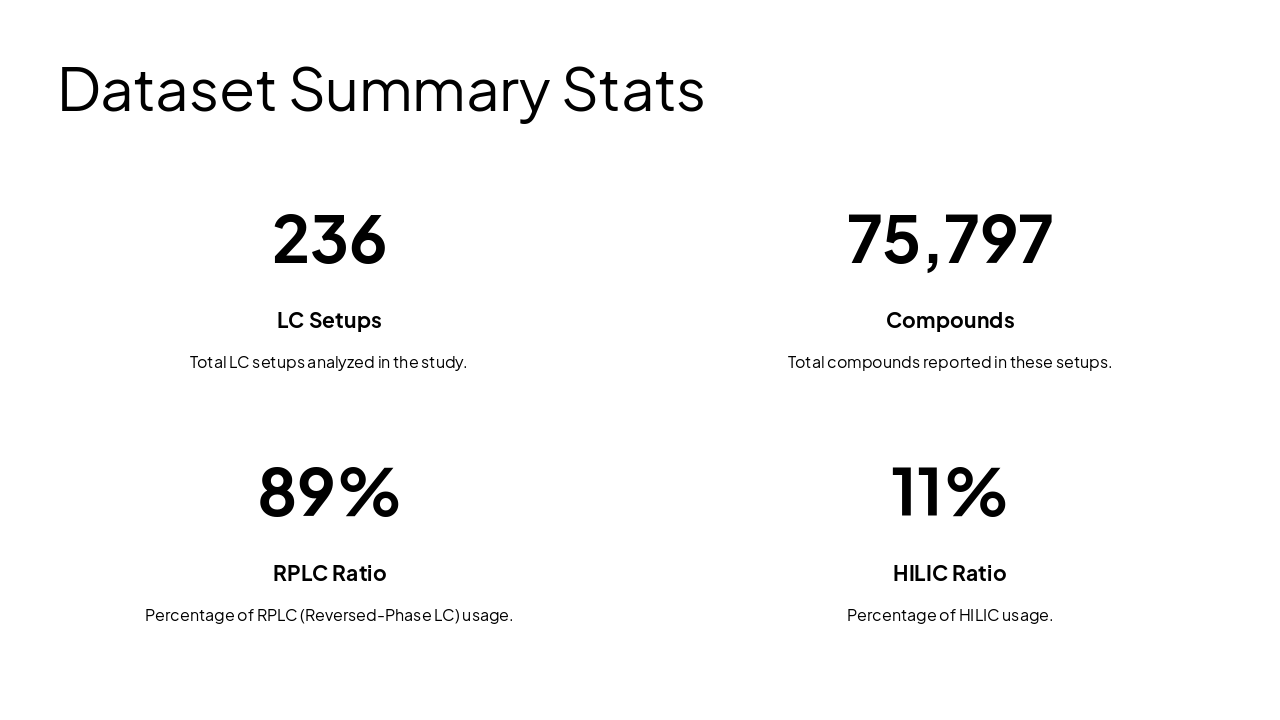
  • 236: LC Setups
  • 75,797: Compounds
  • 89%: RPLC Ratio
  • 11%: HILIC Ratio
Slide 8 - Dataset Summary Stats
Slide 9 of 10

Slide 9 - Key Findings: Constraints on Coverage

  • Dominance of RPLC (89%) over HILIC (11%) significantly constrains covered chemical space.
  • Majority of compounds (94%) cluster within a narrow range: TPSA 0-200 A^2 and log-P -4 to 9.
  • The theoretical chemical space is much broader (TPSA up to 852 A^2; log-P -11 to 26), revealing significant gaps.
  • Lack of orthogonal selectivity limits detection of extreme physicochemical regions (highly polar or extremely hydrophobic).
Slide 9 - Key Findings: Constraints on Coverage
Slide 10 of 10

Slide 10 - Conclusions and Perspectives

Current LC workflows are effective but limited; integrating orthogonal techniques is essential for future NTA.

Moving towards a more comprehensive characterization of the chemical exposome.
Slide 10 - Conclusions and Perspectives

Discover More Presentations

Explore thousands of AI-generated presentations for inspiration

Browse Presentations
Powered by AI

Create Your Own Presentation

Generate professional presentations in seconds with Karaf's AI. Customize this presentation or start from scratch.

Create New Presentation

Powered by Karaf.ai — AI-Powered Presentation Generator