History of Climate Change Science

Generated from prompt:

Create a presentation about climate change

This presentation traces the evolution of climate change science from 19th-century suspicions of ice ages and the greenhouse effect, through key milestones like Fourier's 1824 proposal and Arrhenius's

November 19, 202512 slides
Slide 1 of 12

Slide 1 - The History of Climate Change Science

The slide is titled "The History of Climate Change Science" and serves as an introductory title slide. Its subtitle highlights key scientific discoveries in the field, spanning from the 19th century to the present day.

The History of Climate Change Science

Scientific Discoveries from the 19th Century to Today

--- Speaker Notes: Welcome slide introducing the topic of scientific discoveries in climate change from the 19th century to modern understanding.
Slide 1
Slide 2 of 12

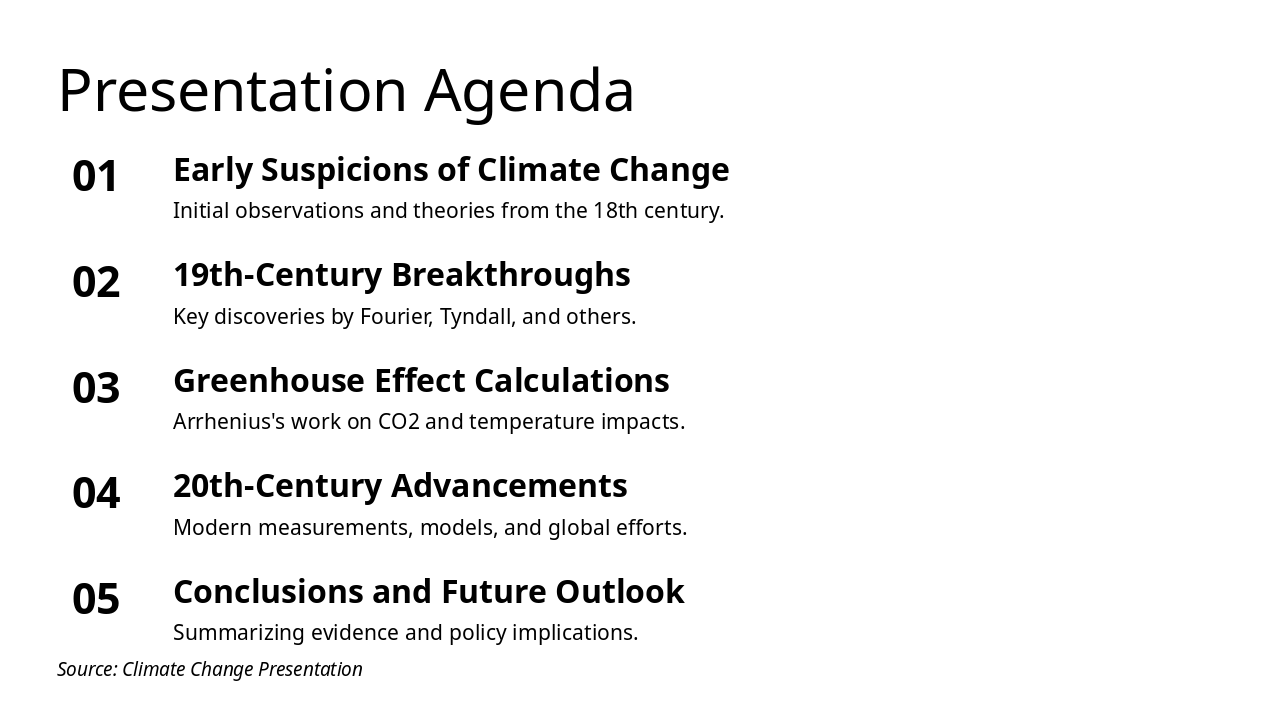
Slide 2 - Presentation Agenda

The agenda outlines the historical progression of climate change science, starting with early suspicions and 18th-century observations. It covers 19th-century breakthroughs by figures like Fourier and Tyndall, Arrhenius's greenhouse effect calculations, 20th-century advancements in measurements and models, and concludes with evidence summaries and future policy implications.

Presentation Agenda

  1. Early Suspicions of Climate Change

Initial observations and theories from the 18th century.

  1. 19th-Century Breakthroughs

Key discoveries by Fourier, Tyndall, and others.

  1. Greenhouse Effect Calculations

Arrhenius's work on CO2 and temperature impacts.

  1. 20th-Century Advancements

Modern measurements, models, and global efforts.

  1. Conclusions and Future Outlook

Summarizing evidence and policy implications.

Source: Climate Change Presentation

Slide 2
Slide 3 of 12

Slide 3 - Early Suspicions of Climate Change

This section header slide introduces the topic of early suspicions regarding climate change. It focuses on pre-20th century concepts related to ice ages and natural variations in paleoclimate.

Early Suspicions of Climate Change

Pre-20th century ideas about ice ages and natural paleoclimate variations

Slide 3
Slide 4 of 12

Slide 4 - 19th Century Foundations

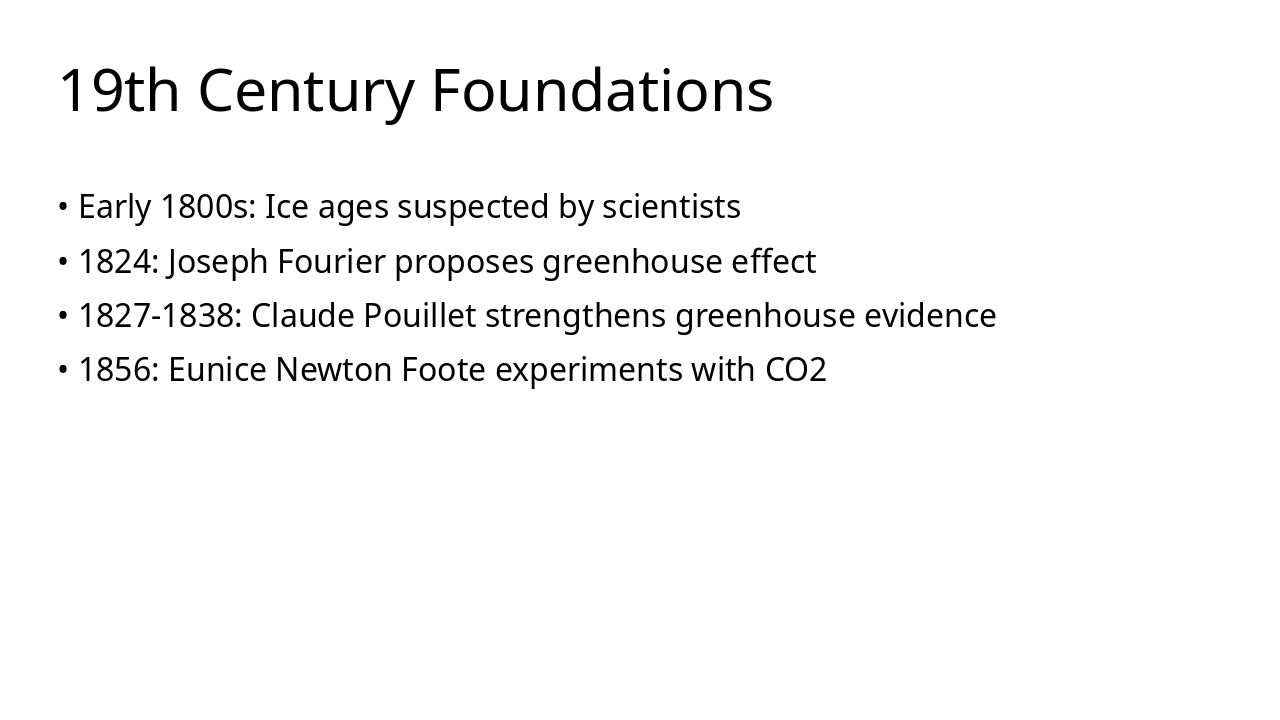
In the early 1800s, scientists began suspecting the existence of ice ages, laying groundwork for climate studies. Key milestones include Joseph Fourier's 1824 proposal of the greenhouse effect, Claude Pouillet's 1827-1838 evidence strengthening it, and Eunice Newton Foote's 1856 experiments with CO2.

19th Century Foundations

  • Early 1800s: Ice ages suspected by scientists
  • 1824: Joseph Fourier proposes greenhouse effect
  • 1827-1838: Claude Pouillet strengthens greenhouse evidence
  • 1856: Eunice Newton Foote experiments with CO2
Slide 4
Slide 5 of 12

Slide 5 - Key Milestones Timeline

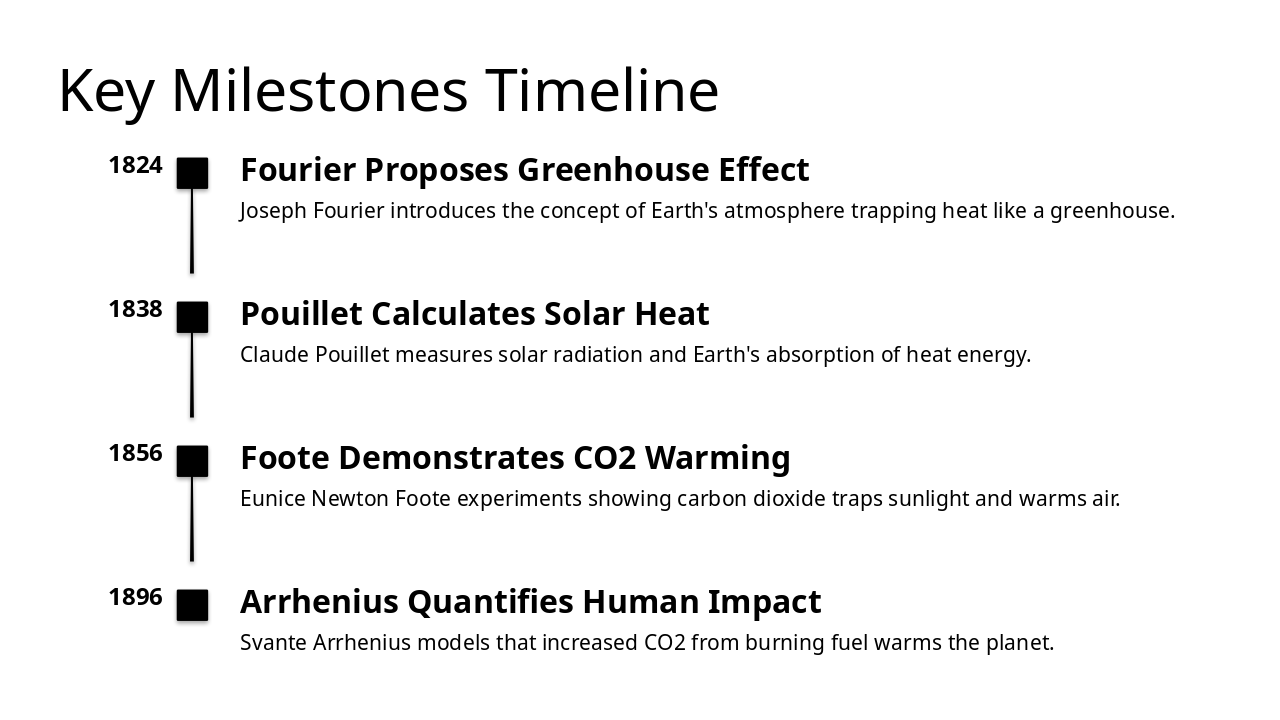
The Key Milestones Timeline slide outlines pivotal early discoveries in climate science from 1824 to 1896. It highlights Joseph Fourier's proposal of the greenhouse effect, Claude Pouillet's measurements of solar heat absorption, Eunice Newton Foote's experiments on CO2 trapping warmth, and Svante Arrhenius's quantification of human-induced CO2 warming from fuel burning.

Key Milestones Timeline

1824: Fourier Proposes Greenhouse Effect Joseph Fourier introduces the concept of Earth's atmosphere trapping heat like a greenhouse. 1838: Pouillet Calculates Solar Heat Claude Pouillet measures solar radiation and Earth's absorption of heat energy. 1856: Foote Demonstrates CO2 Warming Eunice Newton Foote experiments showing carbon dioxide traps sunlight and warms air. 1896: Arrhenius Quantifies Human Impact Svante Arrhenius models that increased CO2 from burning fuel warms the planet.

Slide 5
Slide 6 of 12

Slide 6 - Eunice Newton Foote's Insight

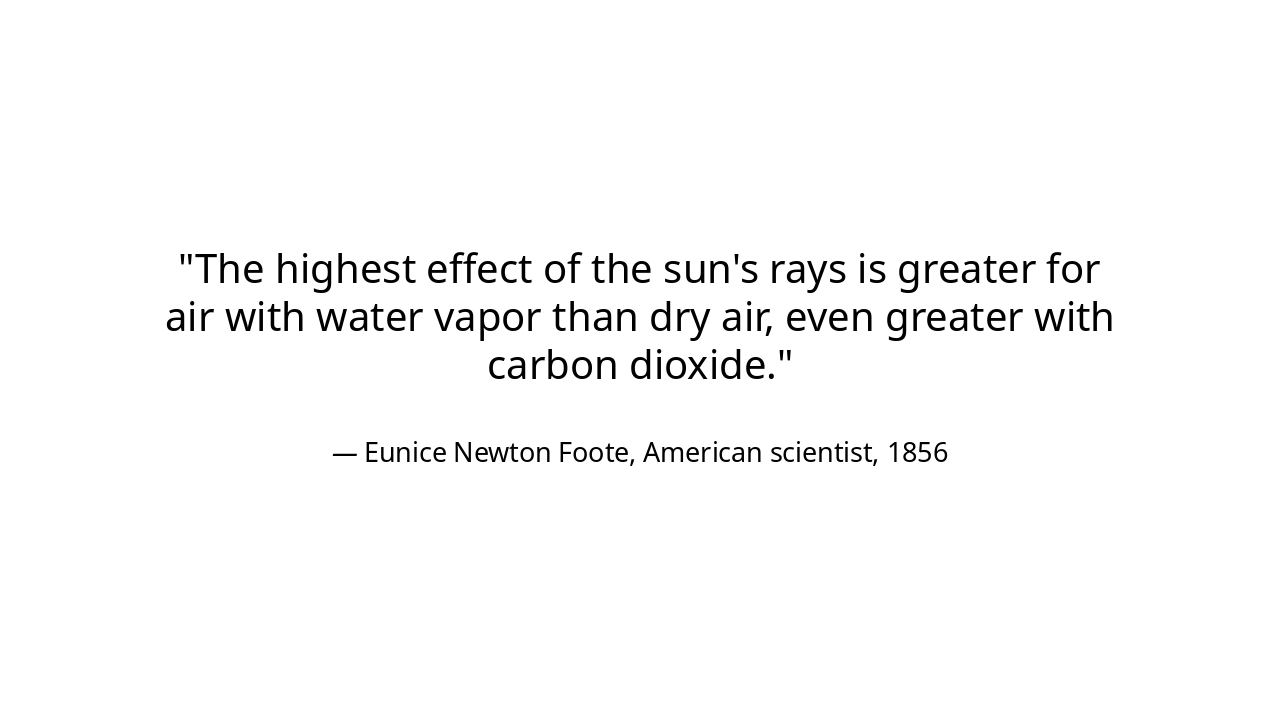
The slide features a historical quote from American scientist Eunice Newton Foote in 1856, highlighting her insight on the sun's rays. It states that the highest effect of these rays is greater in air containing water vapor than in dry air, and even more pronounced with carbon dioxide.

Eunice Newton Foote's Insight

> The highest effect of the sun's rays is greater for air with water vapor than dry air, even greater with carbon dioxide.

— Eunice Newton Foote, American scientist, 1856

Slide 6
Slide 7 of 12

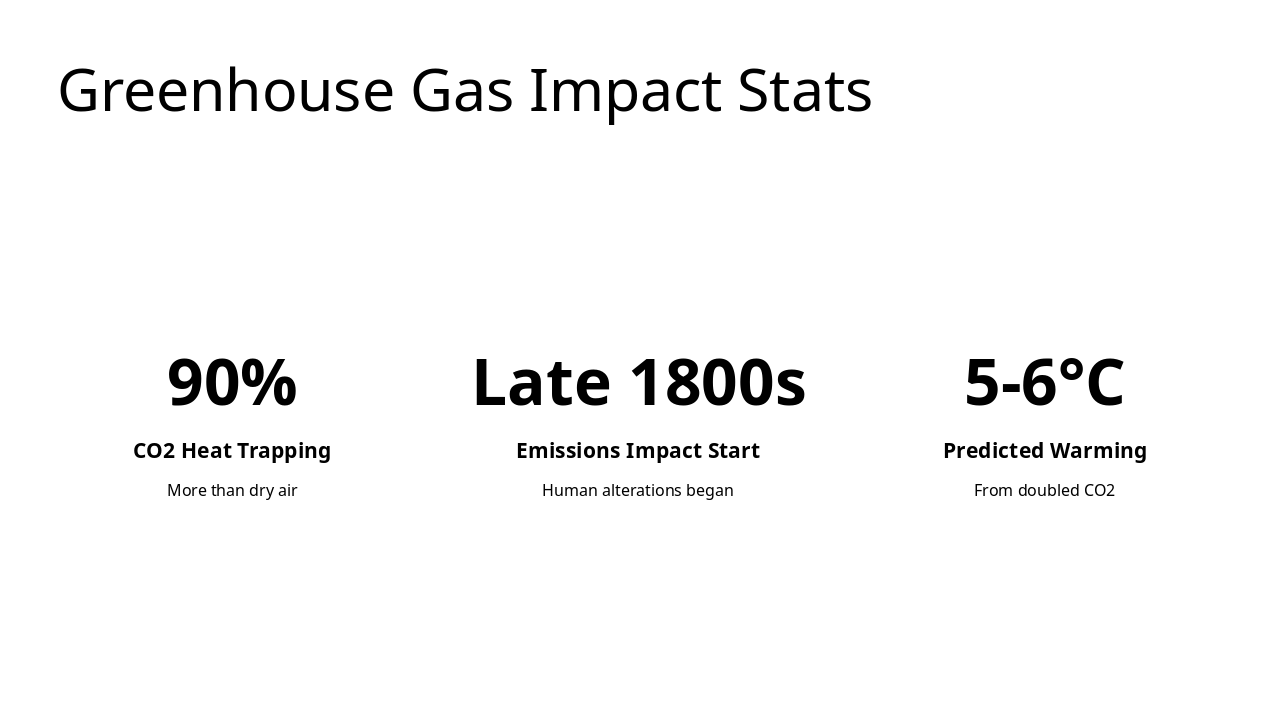
Slide 7 - Greenhouse Gas Impact Stats

The slide highlights that CO2 accounts for 90% of heat trapping in the atmosphere, exceeding that of dry air, with human-induced emissions beginning to impact the climate in the late 1800s. It also predicts a global warming of 5-6°C if atmospheric CO2 levels double.

Greenhouse Gas Impact Stats

  • 90%: CO2 Heat Trapping

More than dry air

  • Late 1800s: Emissions Impact Start

Human alterations began

  • 5-6°C: Predicted Warming

From doubled CO2

Slide 7
Slide 8 of 12

Slide 8 - Visualizing the Greenhouse Effect

The slide illustrates the greenhouse effect through a visual diagram showing sunlight entering Earth's atmosphere freely, where the planet absorbs the energy and re-emits it as infrared heat. Greenhouse gases like CO2 then trap this heat, preventing its escape and thereby warming the surface.

Visualizing the Greenhouse Effect

!Image

  • Sunlight enters Earth's atmosphere unimpeded.
  • Earth absorbs energy and radiates infrared heat.
  • Greenhouse gases like CO2 trap the heat.
  • This process warms the planet's surface.

Source: Diagram of the greenhouse effect

Slide 8
Slide 9 of 12

Slide 9 - Theories vs. Evidence

The slide contrasts natural causes of climate change, such as ice ages and solar variations, which have driven historical temperature shifts without human involvement. It highlights human influences, including fossil fuel burning and emissions, that accelerate warming, supported by paleoclimate studies and evidence of the greenhouse gas effect.

Theories vs. Evidence

Natural CausesHuman Influence
Natural factors like ice ages and solar variations have historically driven climate changes, influencing global temperatures over long periods without human intervention.Human activities, such as burning fossil fuels and releasing emissions, accelerate warming. Paleoclimate studies and early experiments provide evidence confirming the greenhouse gas effect.
Slide 9
Slide 10 of 12

Slide 10 - 20th Century and Beyond

This section header slide is titled "20th Century and Beyond," focusing on the transition to the modern era. It highlights the confirmation of human-caused environmental changes alongside global research efforts.

20th Century and Beyond

Transition to Modern Era: Confirming Human-Caused Change and Global Research Efforts

Slide 10
Slide 11 of 12

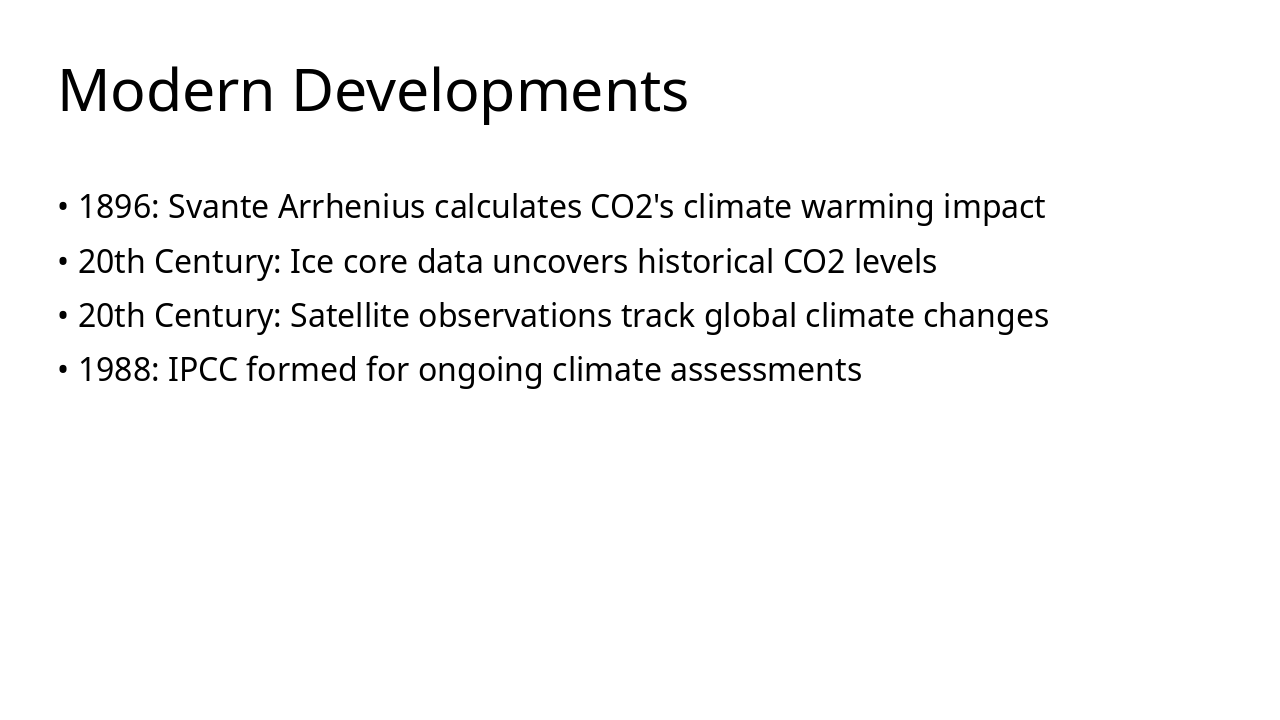
Slide 11 - Modern Developments

In 1896, Svante Arrhenius first calculated the warming impact of CO2 on the climate, marking an early milestone in understanding greenhouse effects. Throughout the 20th century, ice core data revealed historical CO2 levels, satellite observations monitored global changes, and in 1988, the IPCC was established to conduct ongoing climate assessments.

Modern Developments

  • 1896: Svante Arrhenius calculates CO2's climate warming impact
  • 20th Century: Ice core data uncovers historical CO2 levels
  • 20th Century: Satellite observations track global climate changes
  • 1988: IPCC formed for ongoing climate assessments
Slide 11
Slide 12 of 12

Slide 12 - Conclusion: Lessons from History

The conclusion slide, titled "Lessons from History," traces the evolution of scientific discovery from initial suspicion to firm certainty about human-driven climate change, drawing on over 200 years of evidence. It emphasizes the urgent need for immediate action to reduce emissions and secure a sustainable future.

Conclusion: Lessons from History

Scientific discovery evolved from suspicion to certainty of human-driven climate change. Urgent action needed based on 200+ years of evidence.

Reduce emissions now to secure our future!

Slide 12
Powered by AI

Create Your Own Presentation

Generate professional presentations in seconds with Karaf's AI. Customize this presentation or start from scratch.

Create New Presentation

Powered by Karaf.ai — AI-Powered Presentation Generator