Essential First Aid & CPR for Maritime Crews

Generated from prompt:

Create a professional workplace training presentation titled 'Basic First Aid & CPR for Maritime Industry'. Include 14-16 slides tailored to ship crews and offshore workers. Cover: Introduction to Maritime First Aid, Common Maritime Hazards (falls, drowning, burns, machinery injuries), Importance of Immediate Response at Sea, Emergency Action Plan (DRABC adapted for vessels), Communication & Calling for Help (radio protocols), Checking Responsiveness, CPR Overview, Adult CPR Steps (on deck conditions), Child/Infant CPR (if applicable onboard), Use of AED onboard vessels, Drowning Response & Rescue Breathing, Recovery Position (in confined spaces), Treating Severe Bleeding & Wounds, Burns (chemical/thermal), Choking response onboard, Shock management, Hypothermia treatment, Safety precautions for rescuers at sea, and Basic First Aid Kit contents for ships. Include brief bullet points and suggest maritime-themed visuals/icons for each slide.

This training deck covers basic first aid and CPR tailored for ship crews and offshore workers. Key topics include emergency response (DRABC), communication protocols, cardiac arrest procedures, AED usage, drowning response, common injury treatments,

March 25, 202615 slides
Slide 1 of 15

Slide 1 - Basic First Aid & CPR for Maritime Industry

Basic First Aid & CPR for Maritime Industry

Training for Ship Crews and Offshore Workers
Slide 1 - Basic First Aid & CPR for Maritime Industry
Slide 2 of 15

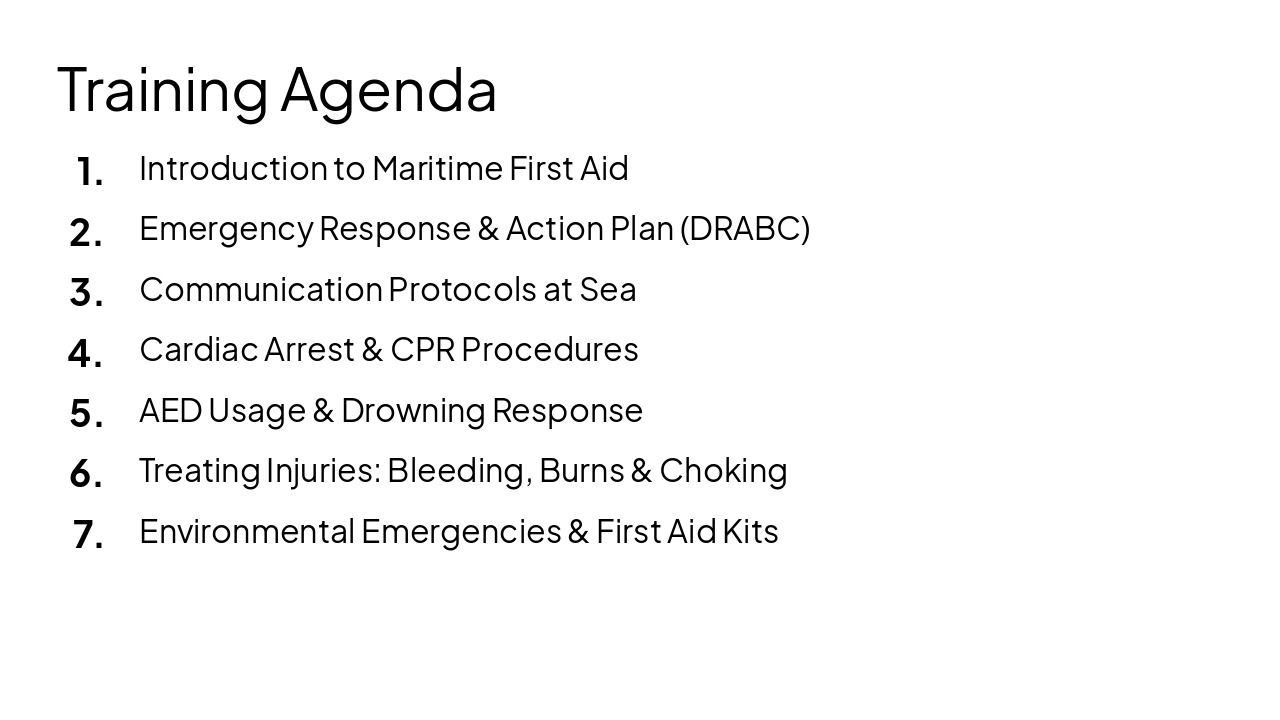
Slide 2 - Training Agenda

  • Introduction to Maritime First Aid
  • Emergency Response & Action Plan (DRABC)
  • Communication Protocols at Sea
  • Cardiac Arrest & CPR Procedures
  • AED Usage & Drowning Response
  • Treating Injuries: Bleeding, Burns & Choking
  • Environmental Emergencies & First Aid Kits
Slide 2 - Training Agenda
Slide 3 of 15

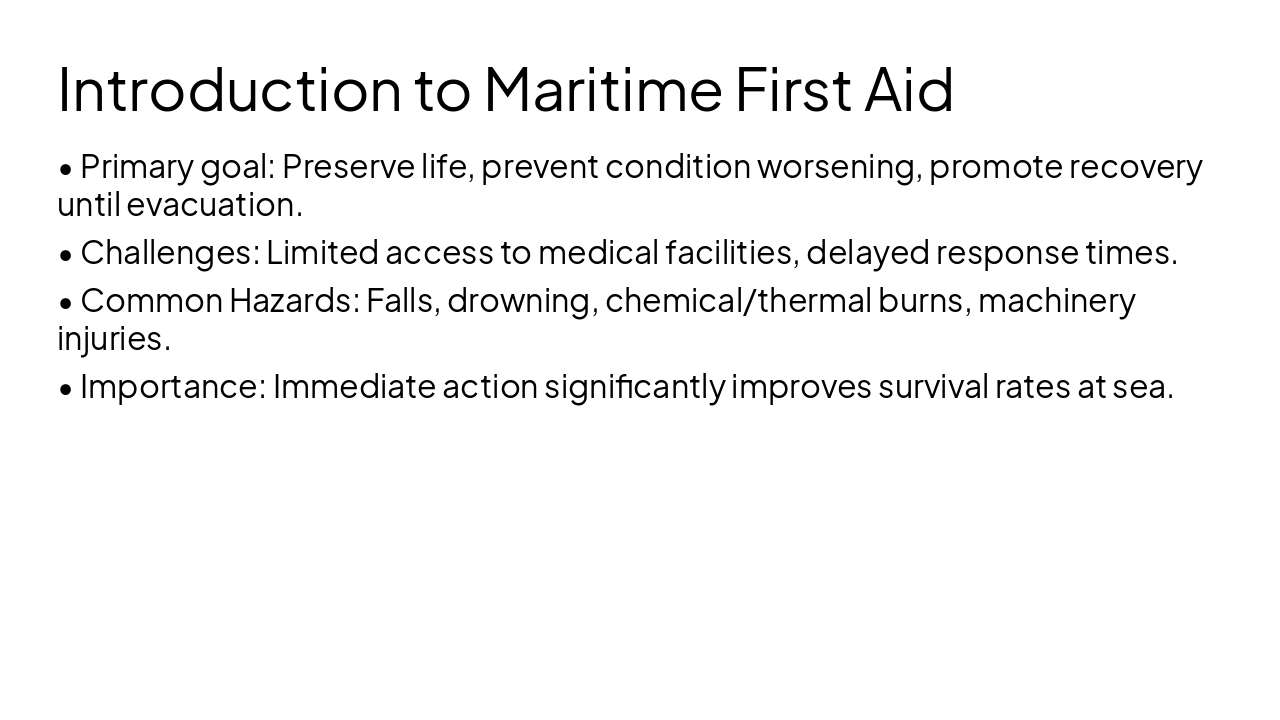
Slide 3 - Introduction to Maritime First Aid

  • Primary goal: Preserve life, prevent condition worsening, promote recovery until evacuation.
  • Challenges: Limited access to medical facilities, delayed response times.
  • Common Hazards: Falls, drowning, chemical/thermal burns, machinery injuries.
  • Importance: Immediate action significantly improves survival rates at sea.
Slide 3 - Introduction to Maritime First Aid
Slide 4 of 15

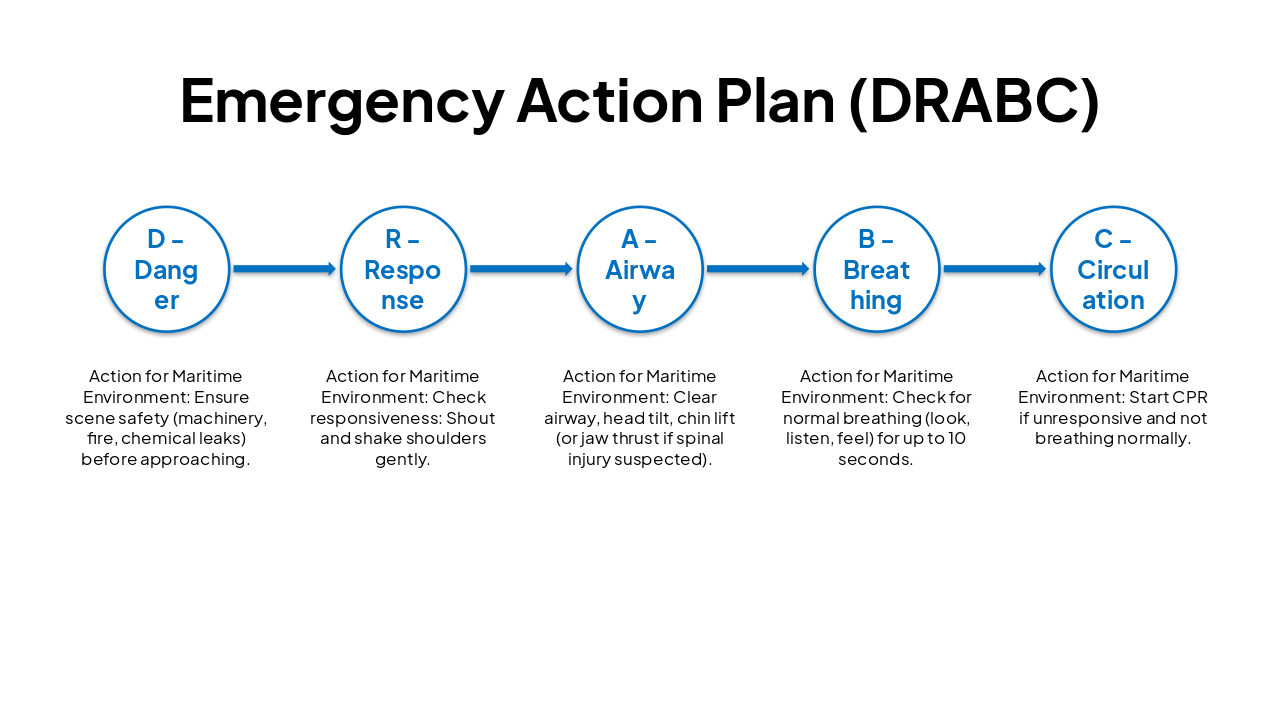
Slide 4 - Emergency Action Plan (DRABC)

StepAction for Maritime Environment
D - DangerEnsure scene safety (machinery, fire, chemical leaks) before approaching.
R - ResponseCheck responsiveness: Shout and shake shoulders gently.
A - AirwayClear airway, head tilt, chin lift (or jaw thrust if spinal injury suspected).
B - BreathingCheck for normal breathing (look, listen, feel) for up to 10 seconds.
C - CirculationStart CPR if unresponsive and not breathing normally.
Slide 4 - Emergency Action Plan (DRABC)
Slide 5 of 15

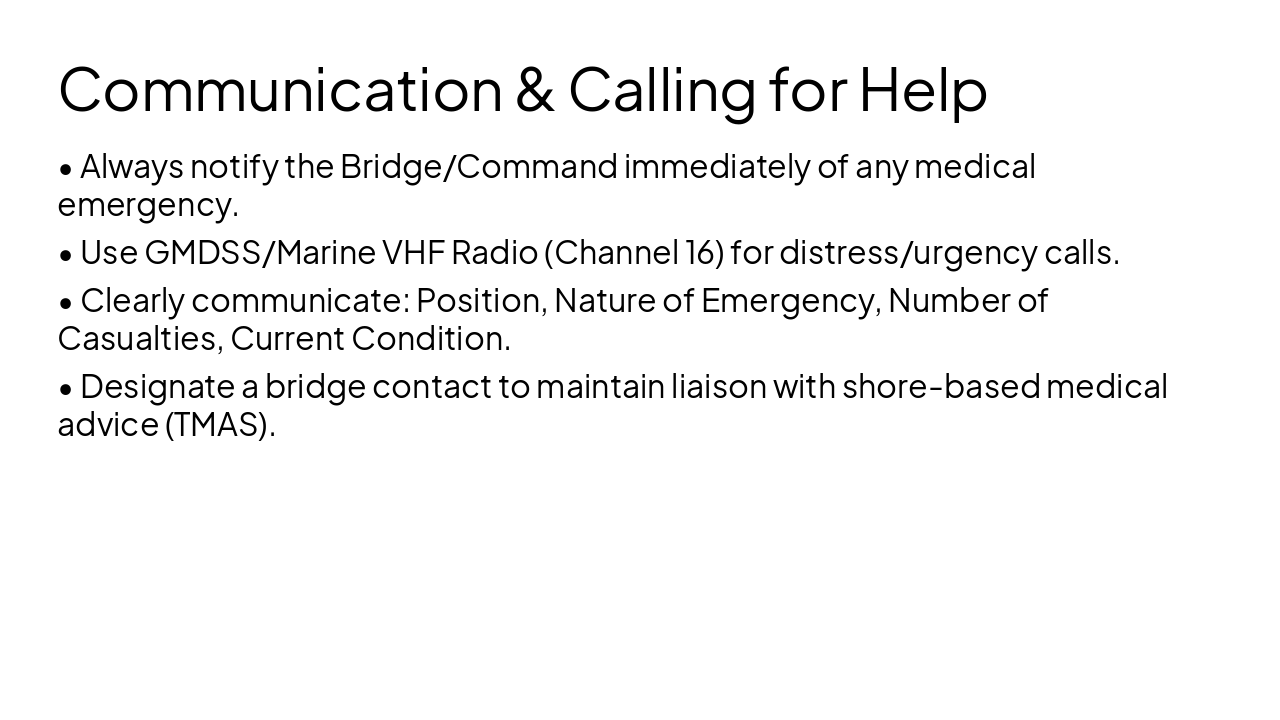
Slide 5 - Communication & Calling for Help

  • Always notify the Bridge/Command immediately of any medical emergency.
  • Use GMDSS/Marine VHF Radio (Channel 16) for distress/urgency calls.
  • Clearly communicate: Position, Nature of Emergency, Number of Casualties, Current Condition.
  • Designate a bridge contact to maintain liaison with shore-based medical advice (TMAS).
Slide 5 - Communication & Calling for Help
Slide 6 of 15

Slide 6 - Safety Precautions for Rescuers

  • Assess surroundings for hazards before approaching.
  • Always wear appropriate PPE (gloves, safety glasses) if available.
  • Do not put your own life at unnecessary risk.
  • Always maintain contact with other crew members.
Slide 6 - Safety Precautions for Rescuers
Slide 7 of 15

Slide 7 - Understanding Cardiac Arrest & CPR

  • Cardiac arrest is the sudden loss of heart function.
  • Recognized by unresponsiveness and absence of normal breathing.
  • Time is critical: Brain cells start dying within minutes.
  • CPR (Cardiopulmonary Resuscitation) preserves brain function and blood flow.
Slide 7 - Understanding Cardiac Arrest & CPR
Slide 8 of 15

Slide 8 - Adult CPR Steps (On Deck)

  • Compression rate: 100-120 per minute.
  • Compression depth: 5-6 cm (2.0-2.4 inches).
  • Ratio: 30 compressions to 2 rescue breaths.
  • Ensure victim is on a firm, flat surface (deck). Use "push hard and fast" technique.
  • Continuous high-quality compressions are prioritized over ventilation.
Slide 8 - Adult CPR Steps (On Deck)
Slide 9 of 15

Slide 9 - Child & Infant CPR Considerations

  • Rare, but requires modification if children/infants are onboard.
  • Children (1-puberty): Use one or two hands, 5cm depth. Ratio 30:2.
  • Infants (<1 yr): Use two fingers in center of chest, 4cm depth. Ratio 30:2.
  • Pediatric arrest is often respiratory-related; early ventilation is crucial.
Slide 9 - Child & Infant CPR Considerations
Slide 10 of 15

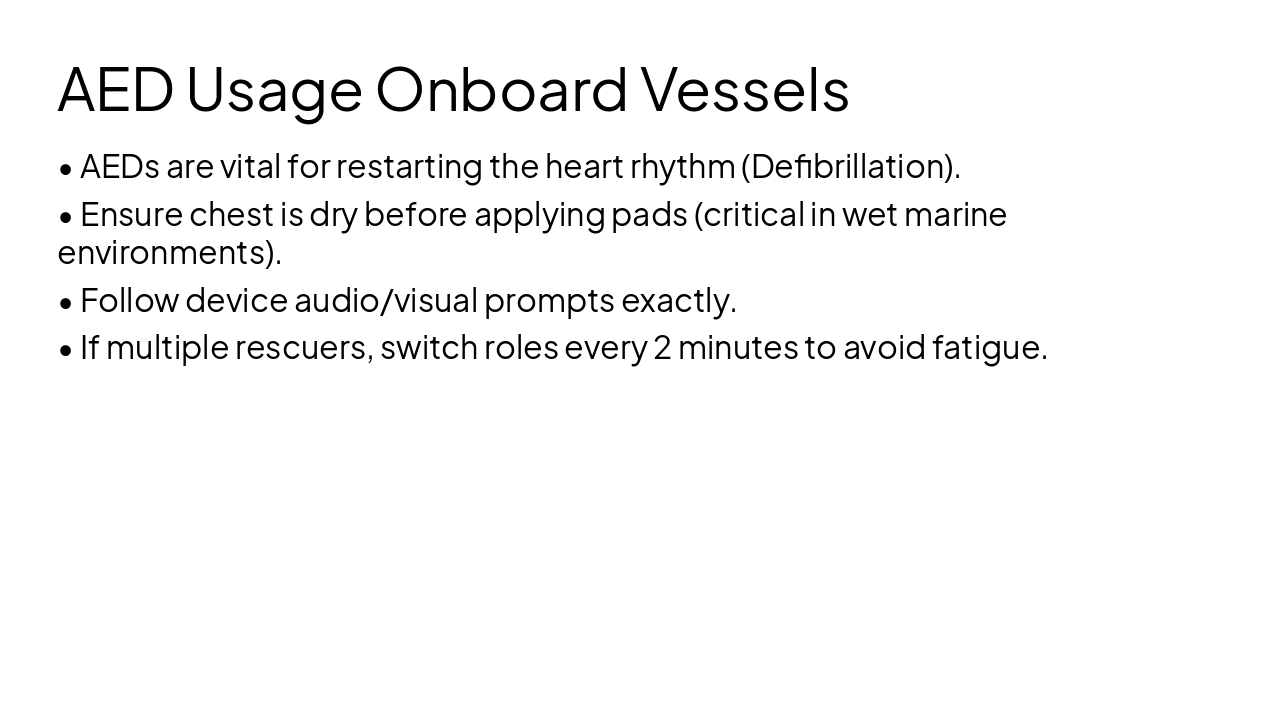
Slide 10 - AED Usage Onboard Vessels

  • AEDs are vital for restarting the heart rhythm (Defibrillation).
  • Ensure chest is dry before applying pads (critical in wet marine environments).
  • Follow device audio/visual prompts exactly.
  • If multiple rescuers, switch roles every 2 minutes to avoid fatigue.
Slide 10 - AED Usage Onboard Vessels
Slide 11 of 15

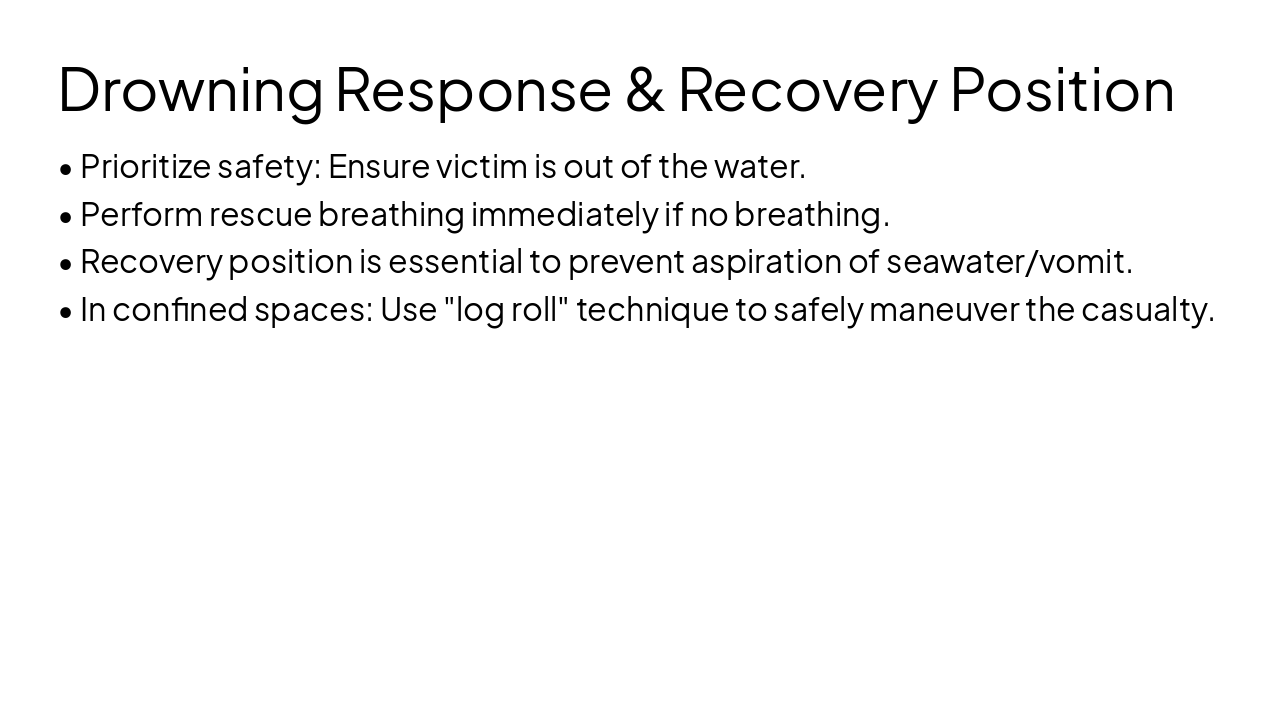
Slide 11 - Drowning Response & Recovery Position

  • Prioritize safety: Ensure victim is out of the water.
  • Perform rescue breathing immediately if no breathing.
  • Recovery position is essential to prevent aspiration of seawater/vomit.
  • In confined spaces: Use "log roll" technique to safely maneuver the casualty.
Slide 11 - Drowning Response & Recovery Position
Slide 12 of 15

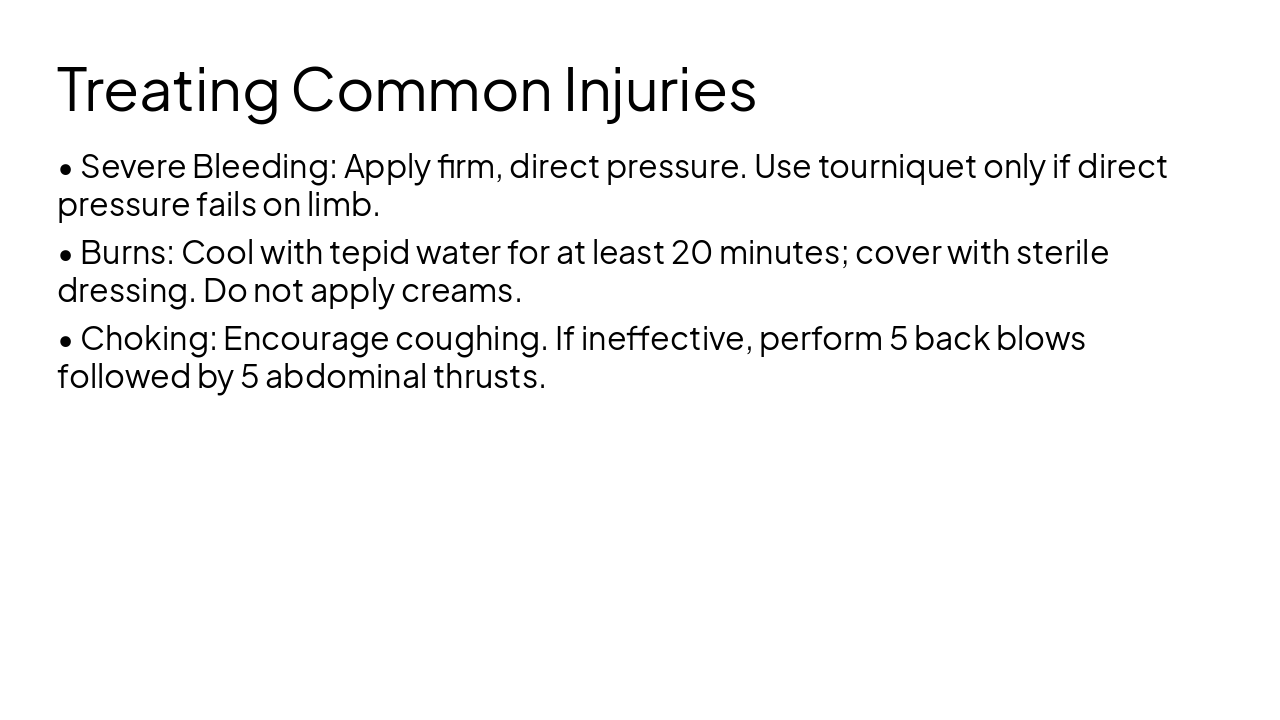
Slide 12 - Treating Common Injuries

  • Severe Bleeding: Apply firm, direct pressure. Use tourniquet only if direct pressure fails on limb.
  • Burns: Cool with tepid water for at least 20 minutes; cover with sterile dressing. Do not apply creams.
  • Choking: Encourage coughing. If ineffective, perform 5 back blows followed by 5 abdominal thrusts.
Slide 12 - Treating Common Injuries
Slide 13 of 15

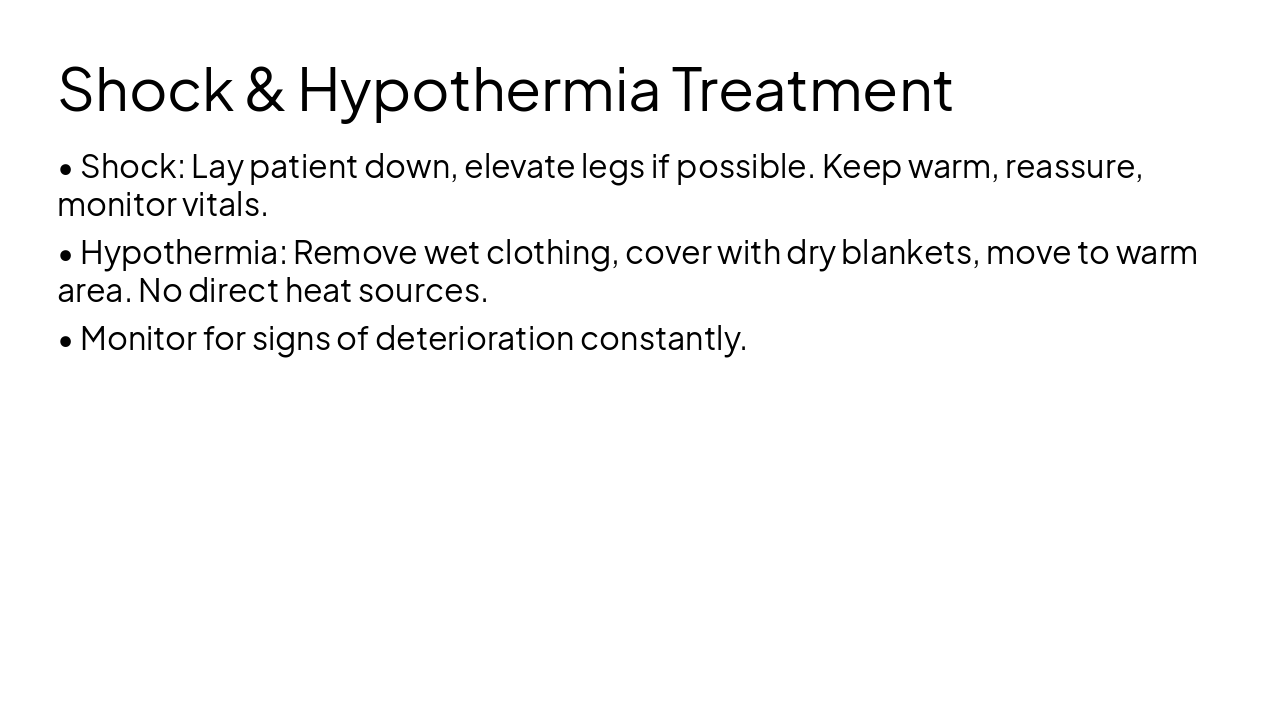
Slide 13 - Shock & Hypothermia Treatment

  • Shock: Lay patient down, elevate legs if possible. Keep warm, reassure, monitor vitals.
  • Hypothermia: Remove wet clothing, cover with dry blankets, move to warm area. No direct heat sources.
  • Monitor for signs of deterioration constantly.
Slide 13 - Shock & Hypothermia Treatment
Slide 14 of 15

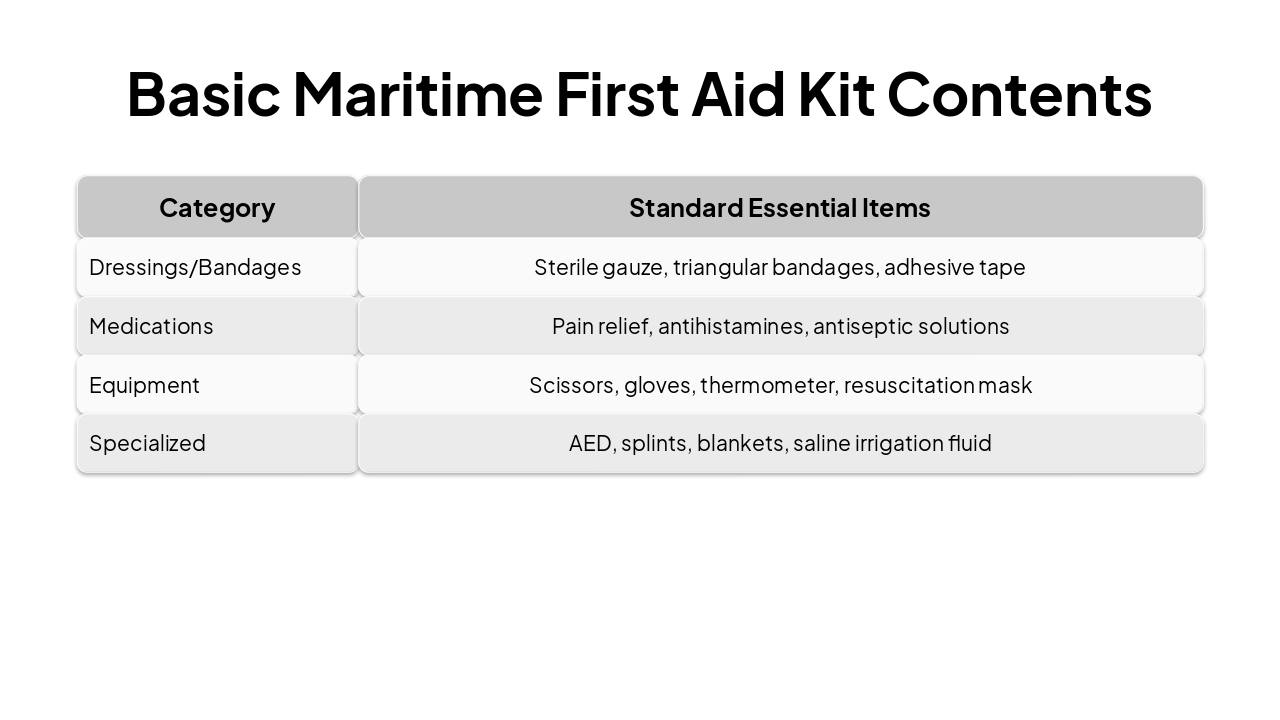
Slide 14 - Basic Maritime First Aid Kit Contents

CategoryStandard Essential Items
Dressings/BandagesSterile gauze, triangular bandages, adhesive tape
MedicationsPain relief, antihistamines, antiseptic solutions
EquipmentScissors, gloves, thermometer, resuscitation mask
SpecializedAED, splints, blankets, saline irrigation fluid
Slide 14 - Basic Maritime First Aid Kit Contents
Slide 15 of 15

Slide 15 - Conclusion

Thank You. Any Questions?

Stay Prepared, Save Lives at Sea.
Slide 15 - Conclusion

Discover More Presentations

Explore thousands of AI-generated presentations for inspiration

Browse Presentations
Powered by AI

Create Your Own Presentation

Generate professional presentations in seconds with Karaf's AI. Customize this presentation or start from scratch.

Create New Presentation

Powered by Karaf.ai — AI-Powered Presentation Generator