Central Kerala Groundwater: PCA & FA Insights (40 chars)

Generated from prompt:

Create a professional scientific PowerPoint presentation titled 'Assessing Groundwater Resources in Central Kerala, India: A Multivariate Statistical Approach' by Samreena Mohammed & K. S. Arunkumar for ICWRER 2025. The presentation should have about 15 slides in a blue–white conference theme. Include recreated visuals: PCA biplots for pre-, monsoon, and post-monsoon periods; correlation matrices; factor analysis plots; and a clean study area map infographic. Structure slides as follows: Title, Introduction, Objectives, Study Area, Methodology, PCA Results (3 slides), Correlation Results (3 slides), Factor Analysis (3 slides), Discussion, Conclusion, and Acknowledgements. Keep text concise, academic, and visually engaging. Include ICWRER 2025 and University of Žilina branding.

Multivariate statistical analysis (PCA, correlations, FA) of Central Kerala groundwater across seasons reveals salinity dominance pre-monsoon, dilution in monsoon, and anthropogenic pollution post-mon

December 7, 202520 slides
Slide 1 of 20

Slide 1 - Title Slide

This title slide features the presentation titled "Assessing Groundwater Resources in Central Kerala, India," using a multivariate statistical approach. It credits authors Samreena Mohammed and K. S. Arunkumar, for the ICWRER 2025 conference at the University of Žilina, with logo placeholders.

Assessing Groundwater Resources in Central Kerala, India

A Multivariate Statistical Approach Samreena Mohammed & K. S. Arunkumar ICWRER 2025 | University of Žilina [Conference logo placeholders]},

Slide 1 - Title Slide
Slide 2 of 20

Slide 2 - Introduction

Groundwater is vital for Central Kerala's agriculture and water supply but is declining due to overexploitation and climate variability. Multivariate statistics, including PCA, correlation, and FA, analyze seasonal hydrochemical data across pre-monsoon, monsoon, and post-monsoon periods.

Introduction

  • Groundwater vital for Central Kerala's agriculture and water supply.
  • Declining levels due to overexploitation and climate variability.
  • Multivariate statistics analyze seasonal hydrochemical data.
  • PCA, correlation, and FA applied across pre-, monsoon, post-monsoon periods.
Slide 2 - Introduction
Slide 3 of 20

Slide 3 - Objectives

This slide, titled "Objectives," outlines four key goals for a groundwater quality study. They include assessing spatial-temporal variations, identifying dominant factors via PCA and FA, evaluating pollution source correlations, and recommending sustainable management strategies.

Objectives

  • Assess spatial-temporal groundwater quality variations.
  • Identify dominant factors via PCA & FA.
  • Evaluate correlations for pollution sources.
  • Recommend sustainable management strategies.
Slide 3 - Objectives
Slide 4 of 20

Slide 4 - Study Area

The slide maps the study area in central Kerala districts Palakkad, Thrissur, and Ernakulam, marking sampling sites along rivers and aquifers. It notes the geology of laterite plateaus and crystalline rocks, with sampling across pre-monsoon, monsoon, and post-monsoon periods.

Study Area

!Image

  • Central Kerala districts: Palakkad, Thrissur, Ernakulam
  • Sampling sites along rivers and aquifers marked
  • Geology: laterite plateaus, crystalline rocks
  • Pre-monsoon, monsoon, post-monsoon sampling periods

Source: Geography of Kerala

Speaker Notes
Highlight Central Kerala map with sampling sites, rivers, geology, and seasonal contexts.
Slide 4 - Study Area
Slide 5 of 20

Slide 5 - Methodology

The methodology sampled over 50 sites across three seasons: pre-monsoon, monsoon, and post-monsoon. It analyzed parameters like pH, EC, and major ions (Ca, Mg, Na, K, HCO₃, SO₄, Cl, NO₃) using multivariate statistics including PCA (factoextra R), correlation matrices, and varimax-rotated FA.

Methodology

  • Over 50 sampling sites across 3 seasons (pre-, monsoon, post-monsoon).
  • Parameters: pH, EC, major ions (Ca, Mg, Na, K, HCO₃, SO₄, Cl, NO₃).
  • Multivariate statistics: PCA (factoextra R), correlation matrices, varimax-rotated FA.
Slide 5 - Methodology
Slide 6 of 20

Slide 6 - Assessing Groundwater Resources in Central Kerala, India: A Multivariate Statistical Approach

This section header slide introduces Section 06 titled "PCA Results" in a presentation on assessing groundwater resources in Central Kerala, India. It highlights the subtitle "Principal Component Analysis: Seasonal Biplots."

Assessing Groundwater Resources in Central Kerala, India: A Multivariate Statistical Approach

06

PCA Results

Principal Component Analysis: Seasonal Biplots

Source: Samreena Mohammed & K. S. Arunkumar | ICWRER 2025 | University of Žilina

Speaker Notes
Introduce PCA results section: Discuss Principal Component Analysis biplots for pre-monsoon, monsoon, and post-monsoon periods, highlighting seasonal variability in groundwater quality parameters.
Slide 6 - Assessing Groundwater Resources in Central Kerala, India: A Multivariate Statistical Approach
Slide 7 of 20

Slide 7 - PCA: Pre-Monsoon

This slide features a PCA biplot of PC1 vs. PC2 for pre-monsoon data. It highlights dominant high salinity loadings from EC, Cl, and Na, with samples clearly clustering by pollution sources.

PCA: Pre-Monsoon

!Image

  • PCA biplot: PC1 vs. PC2 for pre-monsoon
  • High salinity loadings: EC, Cl, Na dominant
  • Samples cluster by pollution sources clearly

Source: Principal component analysis

Speaker Notes
Discuss pre-monsoon PCA biplot showing salinity influence and pollution clustering.
Slide 7 - PCA: Pre-Monsoon
Slide 8 of 20

Slide 8 - PCA: Monsoon

This PCA slide for the monsoon period highlights prominent dilution effects. PC1 represents weathering (HCO3-, Ca, Mg), while PC2 indicates anthropogenic inputs.

PCA: Monsoon

!Image

  • Dilution effects prominent during monsoon
  • PC1: Weathering (HCO3-, Ca, Mg)
  • PC2: Anthropogenic inputs

Source: Samreena Mohammed & K. S. Arunkumar, ICWRER 2025

Speaker Notes
Emphasize dilution effects from monsoon recharge; PC1 aligns with natural weathering processes; PC2 indicates human influences.
Slide 8 - PCA: Monsoon
Slide 9 of 20

Slide 9 - PCA: Post-Monsoon

The PCA biplot on this post-monsoon slide shows clear recovery trends in groundwater parameters with distinct clustering. It highlights separation between geogenic and anthropogenic factors, alongside reduced human influence after the monsoon.

PCA: Post-Monsoon

!Image

  • Post-monsoon PCA biplot shows clear recovery trends.
  • Distinct separation of geogenic versus anthropogenic factors.
  • Clustering indicates seasonal recovery in groundwater parameters.
  • Reduced anthropogenic influence post-monsoon period.

Source: Recreated from study data

Speaker Notes
Highlight recovery trends and clear separation of geogenic vs. anthropogenic factors in post-monsoon PCA biplot.
Slide 9 - PCA: Post-Monsoon
Slide 10 of 20

Slide 10 - Assessing Groundwater Resources in Central Kerala, India: A Multivariate Statistical Approach

This section header slide introduces the "Correlation Results" section in a presentation on assessing groundwater resources in Central Kerala, India. Its subtitle highlights "Pearson Correlation Matrices: Seasonal Insights."

Assessing Groundwater Resources in Central Kerala, India: A Multivariate Statistical Approach

Correlation Results

Pearson Correlation Matrices: Seasonal Insights

Source: ICWRER 2025 | Samreena Mohammed & K. S. Arunkumar | University of Žilina

Speaker Notes
Introduce Pearson correlation matrices highlighting seasonal variations in hydrochemical parameters.
Slide 10 - Assessing Groundwater Resources in Central Kerala, India: A Multivariate Statistical Approach
Slide 11 of 20

Slide 11 - Correlation: Pre-Monsoon

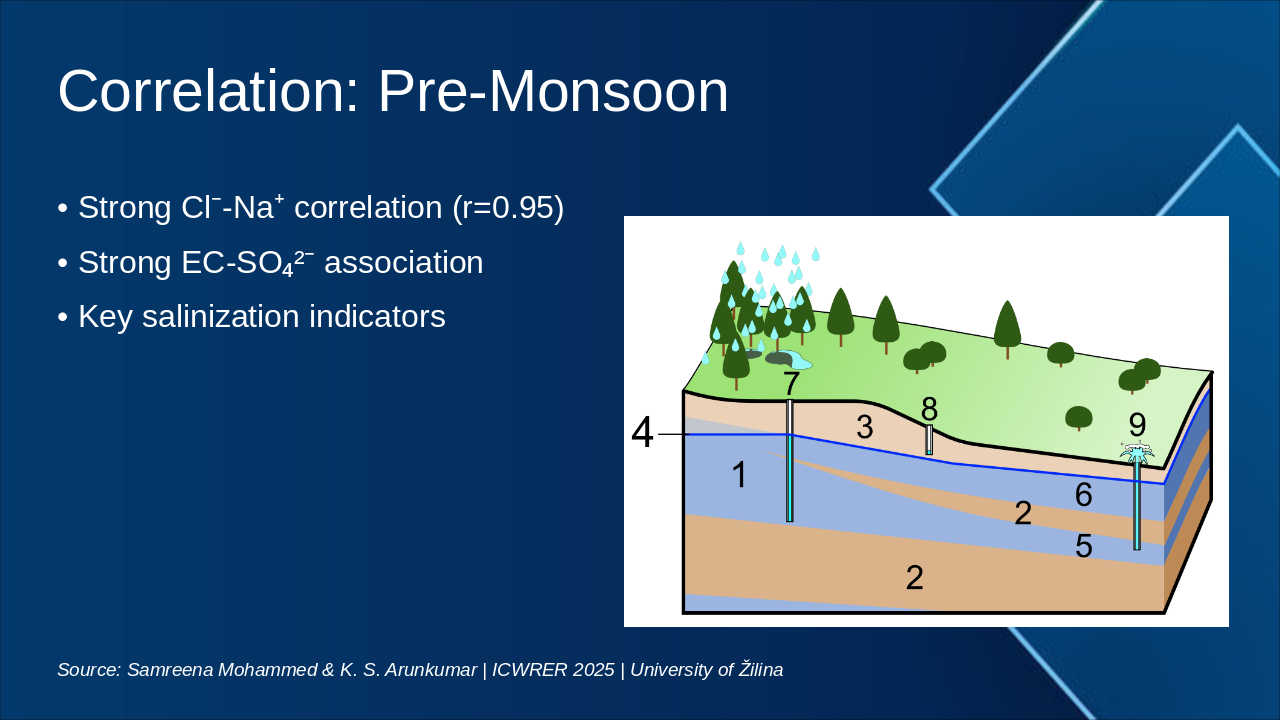
The "Correlation: Pre-Monsoon" slide features an image highlighting key chemical relationships. It shows a strong Cl⁻-Na⁺ correlation (r=0.95), strong EC-SO₄²⁻ association, and labels them as key salinization indicators.

Correlation: Pre-Monsoon

!Image

  • Strong Cl⁻-Na⁺ correlation (r=0.95)
  • Strong EC-SO₄²⁻ association
  • Key salinization indicators

Source: Samreena Mohammed & K. S. Arunkumar | ICWRER 2025 | University of Žilina

Speaker Notes
Heatmap shows strong Cl⁻-Na⁺ (r=0.95) and EC-SO₄²⁻ correlations, indicating salinization likely from seawater intrusion or evaporation concentration in pre-monsoon.
Slide 11 - Correlation: Pre-Monsoon
Slide 12 of 20

Slide 12 - Correlation: Monsoon

The "Correlation: Monsoon" slide features a heatmap showing reduced ion correlations due to rainfall dilution weakening links. Notably, HCO3-Ca displays a strong positive correlation.

Correlation: Monsoon

!Image

  • Reduced correlations observed in monsoon heatmap.
  • Dilution from rainfall weakens ion links.
  • HCO3-Ca shows strong positive correlation.

Source: Wikipedia - Monsoon in India

Speaker Notes
Heatmap: Reduced correlations due to dilution. HCO3-Ca positive.
Slide 12 - Correlation: Monsoon
Slide 13 of 20

Slide 13 - Correlation: Post-Monsoon

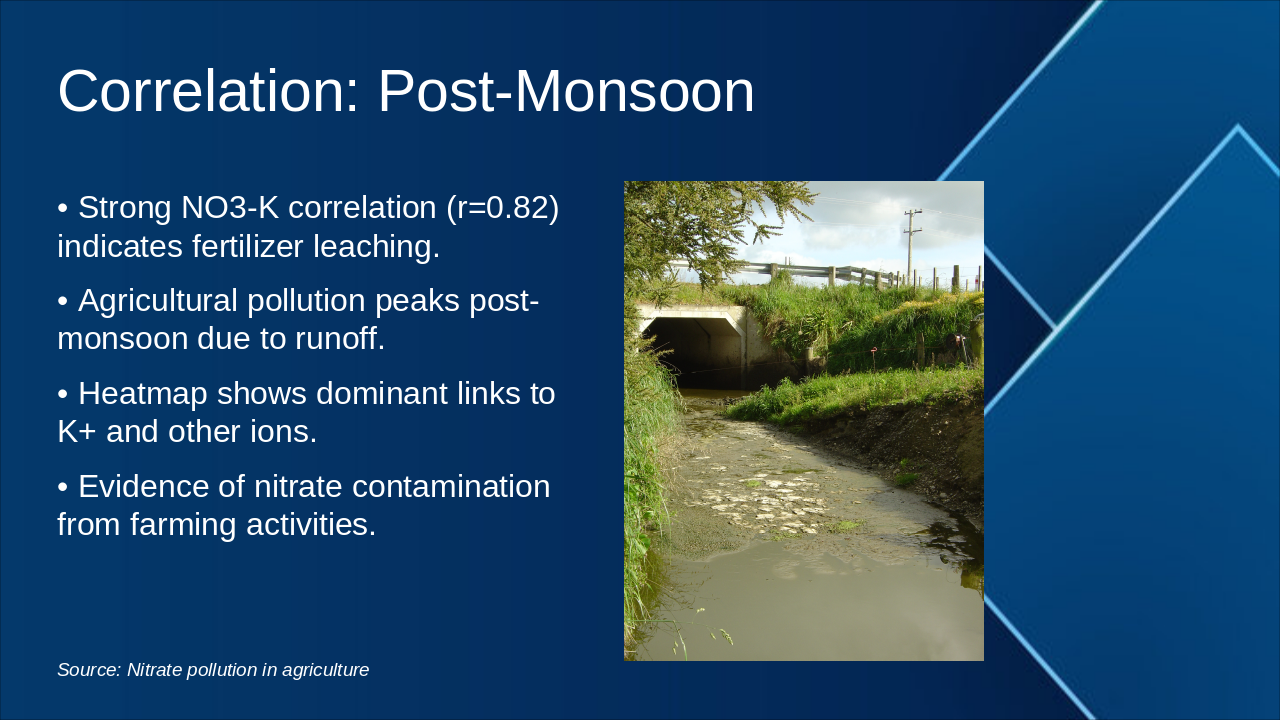
The slide "Correlation: Post-Monsoon" features a strong NO3-K correlation (r=0.82), indicating fertilizer leaching and nitrate contamination from farming. A heatmap shows dominant links to K+ and other ions, with agricultural pollution peaking due to post-monsoon runoff.

Correlation: Post-Monsoon

!Image

  • Strong NO3-K correlation (r=0.82) indicates fertilizer leaching.
  • Agricultural pollution peaks post-monsoon due to runoff.
  • Heatmap shows dominant links to K+ and other ions.
  • Evidence of nitrate contamination from farming activities.

Source: Nitrate pollution in agriculture

Speaker Notes
Highlight the heatmap's NO3-K correlation (r>0.8), strongest post-monsoon link to agricultural fertilizer leaching and pollution.
Slide 13 - Correlation: Post-Monsoon
Slide 14 of 20

Slide 14 - Assessing Groundwater Resources in Central Kerala, India: A Multivariate Statistical Approach

This section header slide introduces Section 08 on Factor Analysis within the presentation on assessing groundwater resources in Central Kerala, India. The subtitle specifies Varimax-Rotated FA for source apportionment.

Assessing Groundwater Resources in Central Kerala, India: A Multivariate Statistical Approach

08

Factor Analysis

Varimax-Rotated FA: Source Apportionment

Source: ICWRER 2025 | University of Žilina

Speaker Notes
Transition to Factor Analysis: Highlight Varimax-rotated results for identifying sources of variation in groundwater quality parameters.
Slide 14 - Assessing Groundwater Resources in Central Kerala, India: A Multivariate Statistical Approach
Slide 15 of 20

Slide 15 - FA: Pre-Monsoon

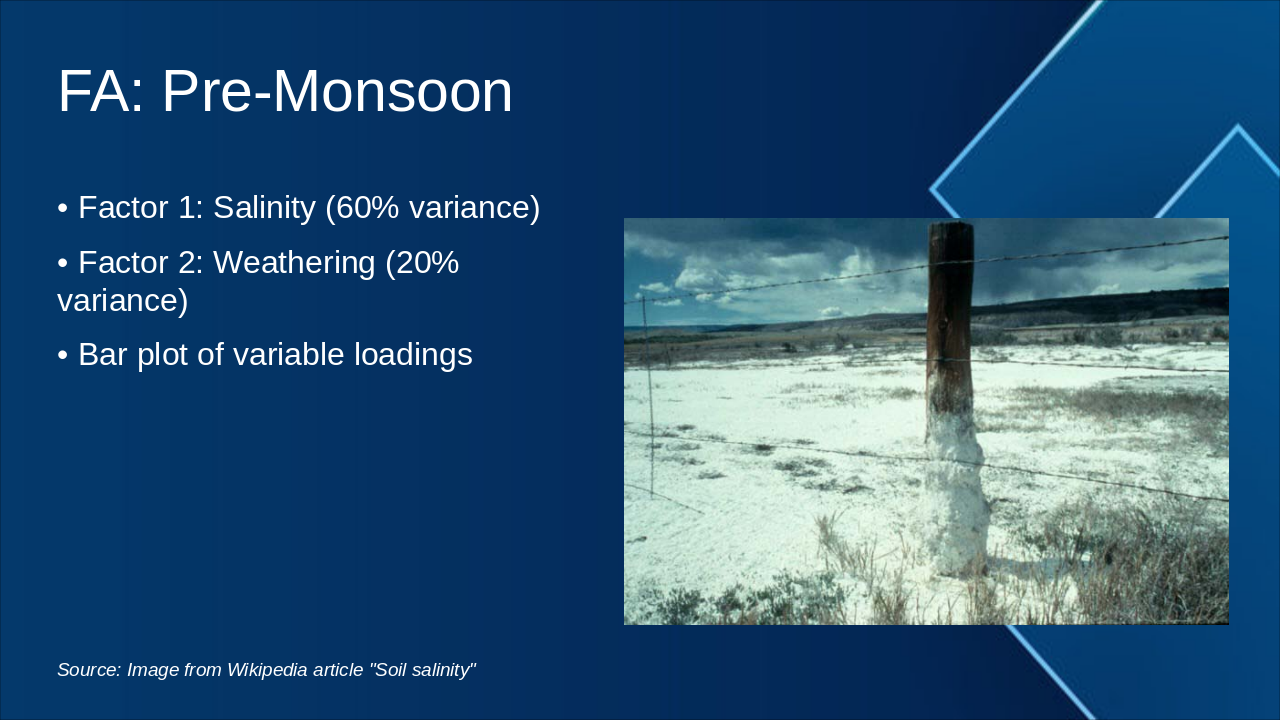
The slide "FA: Pre-Monsoon" highlights Factor Analysis results, with Factor 1 linked to Salinity (60% variance) and Factor 2 to Weathering (20% variance). It features a bar plot of variable loadings.

FA: Pre-Monsoon

!Image

  • Factor 1: Salinity (60% variance)
  • Factor 2: Weathering (20% variance)
  • Bar plot of variable loadings

Source: Image from Wikipedia article "Soil salinity"

Slide 15 - FA: Pre-Monsoon
Slide 16 of 20

Slide 16 - FA: Monsoon

The slide "FA: Monsoon" illustrates key factors from factor analysis in an image format. It highlights Factor 1 as leaching processes (50% variance) and Factor 2 as rain dilution of groundwater ions.

FA: Monsoon

!Image

  • Factor 1: Leaching processes (50% variance)
  • Factor 2: Rain dilution of groundwater ions

Source: ICWRER 2025

Slide 16 - FA: Monsoon
Slide 17 of 20

Slide 17 - FA: Post-Monsoon

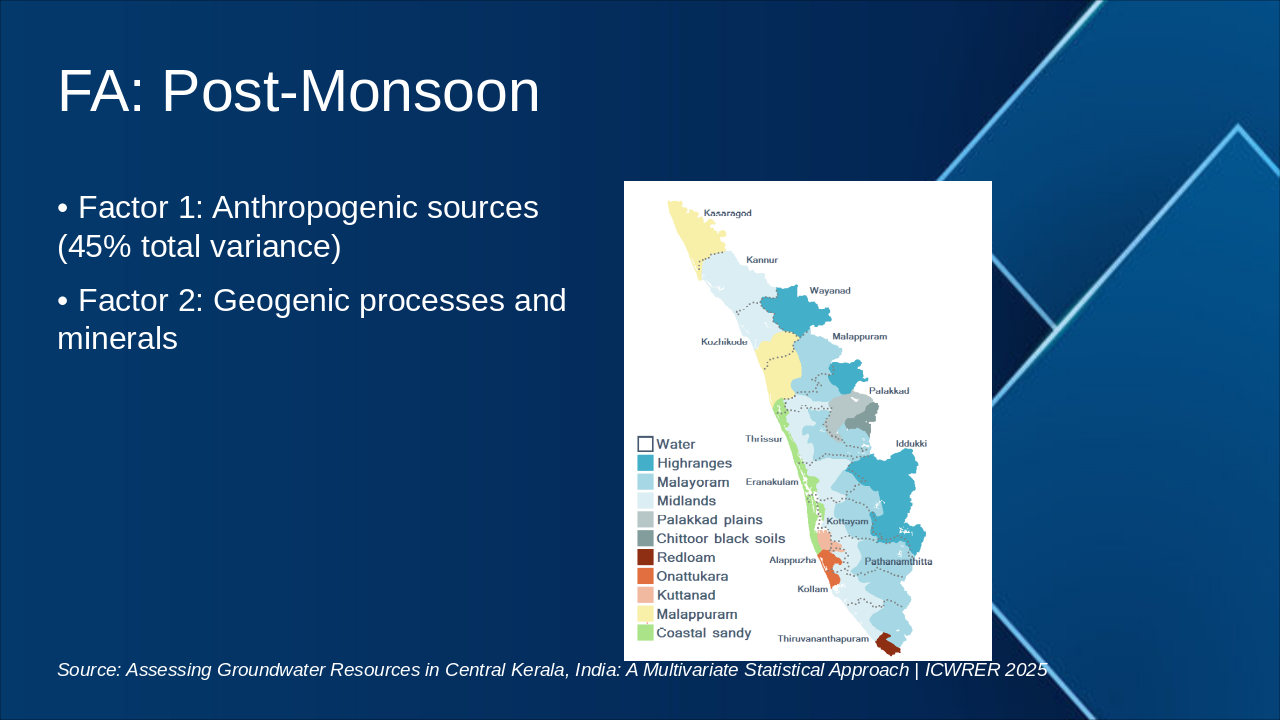
This slide, titled "FA: Post-Monsoon," displays factor analysis results from an image. It highlights Factor 1 as anthropogenic sources (45% total variance) and Factor 2 as geogenic processes and minerals.

FA: Post-Monsoon

!Image

  • Factor 1: Anthropogenic sources (45% total variance)
  • Factor 2: Geogenic processes and minerals

Source: Assessing Groundwater Resources in Central Kerala, India: A Multivariate Statistical Approach | ICWRER 2025

Speaker Notes
Emphasize anthropogenic dominance (45%) in post-monsoon factor analysis; contrast with geogenic Factor 2.
Slide 17 - FA: Post-Monsoon
Slide 18 of 20

Slide 18 - Discussion

PCA/FA analysis reveals seasonal shifts in groundwater quality, with salinity dominating pre-monsoon, while correlations confirm seawater intrusion and agricultural impacts. These findings highlight implications for sustainable groundwater management in Kerala.

Discussion

  • PCA/FA reveal seasonal shifts: salinity dominant pre-monsoon.
  • Correlations confirm seawater intrusion, agricultural impacts.
  • Implications for sustainable groundwater management in Kerala.
Slide 18 - Discussion
Slide 19 of 20

Slide 19 - Conclusion

The slide concludes that a multivariate approach identifies key hydrochemical drivers and recommends prioritizing recharge and pollution control. It proposes future isotope studies, thanks the audience, and invites questions.

Conclusion

• Multivariate approach identifies key hydrochemical drivers

  • Prioritize recharge and pollution control
  • Future: Isotope studies

Thank you for your attention! Questions?

Source: Assessing Groundwater Resources in Central Kerala, India: A Multivariate Statistical Approach | ICWRER 2025

Speaker Notes
Highlight key takeaways, emphasize actions and future research. End with Q&A invite.
Slide 19 - Conclusion
Slide 20 of 20

Slide 20 - Acknowledgements

The Acknowledgements slide thanks the University of Žilina and ICWRER 2025 organizers, funding sources, lab team, and field assistants. It concludes with "Thank you! Q&A".

Acknowledgements

  • • University of Žilina & ICWRER 2025 organizers
  • • Funding from supporting sources
  • • Lab team & field assistants
  • Thank you! Q&A
Slide 20 - Acknowledgements

Discover More Presentations

Explore thousands of AI-generated presentations for inspiration

Browse Presentations
Powered by AI

Create Your Own Presentation

Generate professional presentations in seconds with Karaf's AI. Customize this presentation or start from scratch.

Create New Presentation

Powered by Karaf.ai — AI-Powered Presentation Generator