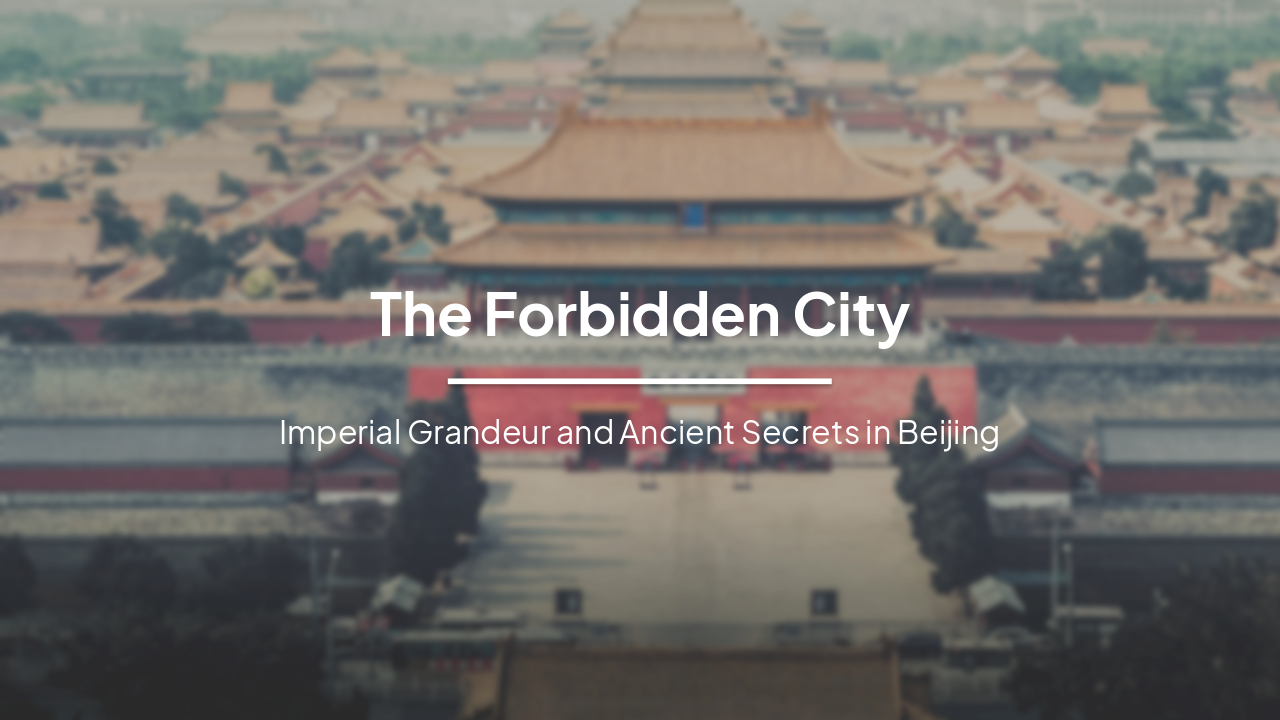
The Forbidden City: Imperial Grandeur and Ancient Secrets
Generated from prompt:
Design style: * Elegant historical / Chinese imperial aesthetic * Colors: red, gold, dark brown, beige * Backgrounds: parchment paper, palace textures, subtle dragon patterns * Fonts: serif / classical style (як “Trajan”, “Cinzel”) * Mood: luxury, ancient, imperial, mysterious ⸻ 🏮 SLIDE 1 — Title Slide (cover) Title: The Forbidden City: Imperial Grandeur and Ancient Secrets in Beijing Design: * Full background: Forbidden City gate or aerial view * Dark overlay + gold text * Minimal, centered composition * Small dragon pattern in corners ⸻ 🏯 SLIDE 2 — Introduction The Forbidden City is one of the most famous historical sites in the world. Located in Beijing, China, it served as the imperial palace for Chinese emperors for nearly 500 years. Design: * Split layout (text + image) * Left: text * Right: photo of palace courtyards * Warm beige background * Thin red borders like traditional Chinese frames ⸻ 📍 SLIDE 3 — Location & History It was built during the Ming Dynasty (1406–1420) and used by both Ming and Qing dynasties. It was home to 24 emperors. Ordinary people were not allowed inside. Design: * Map of Beijing faded in background * Highlight Forbidden City location * Red “stamp” style elements (Chinese seal look) ⸻ 🏛 SLIDE 4 — Architecture The complex has nearly 1,000 buildings and over 8,000 rooms. It is perfectly symmetrical and follows strict traditional Chinese design principles. Design: * Grid layout * Images of roofs, gates, courtyards * Golden lines connecting sections * Slight 3D depth effect ⸻ 🐉 SLIDE 5 — Symbolism Yellow roofs represent imperial power. Dragons symbolize strength and authority. Every detail reflects the emperor as the “Son of Heaven.” Design: * Dark red background * Gold dragon illustrations * Icons: crown, dragon, sun * Elegant centered text blocks ⸻ 👑 SLIDE 6 — Life in the Palace Life inside the Forbidden City was strictly controlled. The emperor, his family, and officials followed daily rituals and ceremonies. Design: * Palace interior paintings or reconstructions * Soft lighting effect * Storytelling layout (like diary style) ⸻ 🔐 SLIDE 7 — Secrets & Mysteries The Forbidden City holds many hidden stories, secret rooms, and political intrigues from Chinese imperial history. Design: * Darker mood (shadow + fog effect) * Slight blur background of corridors * “mysterious” aesthetic, almost cinematic ⸻ 🏁 SLIDE 8 — Conclusion Today, the Forbidden City is a UNESCO World Heritage Site and one of the most visited museums in the world. Design: * Bright, hopeful tone * Wide panoramic image * Gold “thank you” style ending * Clean minimal layout
Explore the Forbidden City in Beijing, the imperial palace for 24 emperors over nearly 500 years. Discover its history, architectural mastery, symbolic designs, daily life, hidden mysteries, and enduring legacy as a UNESCO World Heritage Site.
Slide 2 - Introduction to the Forbidden City
Introduction The Forbidden City is one of the most famous historical sites in the world. Located in the heart of Beijing, China, it served as the majestic imperial palace for Chinese emperors for nearly 500 years.
Palace Grandeur The site stands as a testament to the architectural brilliance and cultural depth of ancient Chinese civilization, preserved through centuries of change.
Slide 3 - Location & History
- Built during the Ming Dynasty (1406–1420).
- Served as the home and seat of power for 24 emperors of the Ming and Qing dynasties.
- Strictly off-limits to ordinary people, earning it the name 'Forbidden City'.
- A site of profound political and social importance throughout imperial history.
Slide 4 - Architectural Mastery
- Complex features nearly 1,000 buildings and over 8,000 rooms.
- Designed with strict adherence to traditional Chinese architectural principles.
- Perfectly symmetrical layout reflecting order and harmony.
- Buildings range from grand halls and gates to delicate inner courtyards.
Slide 5 - Imperial Symbolism
- Yellow-glazed roof tiles: Symbols of exclusive imperial power.
- Dragon motifs: Representations of divine strength and royal authority.
- Design ethos: Reflects the Emperor as the 'Son of Heaven', mediating between heaven and earth.
- Every architectural detail holds specific symbolic meaning.
Slide 6 - Life Behind Closed Doors
- Life was governed by elaborate daily rituals and strict court ceremonies.
- The Palace was a self-contained world for the Emperor, his family, and high-ranking officials.
- Strict hierarchies defined every interaction and movement within the walls.
- A daily cycle of governance, study, and leisure in a secluded environment.
---
Photo by Pixelbuddha Studio on Unsplash
Slide 7 - Secrets and Mysteries
- Centuries of political intrigue and hidden power struggles.
- Numerous secret rooms and restricted areas shielded from the public eye.
- Countless legends of lost treasures and forgotten historical figures.
- The mysterious atmosphere of long, dimly lit corridors and isolated chambers.
Slide 8 - A Lasting Legacy
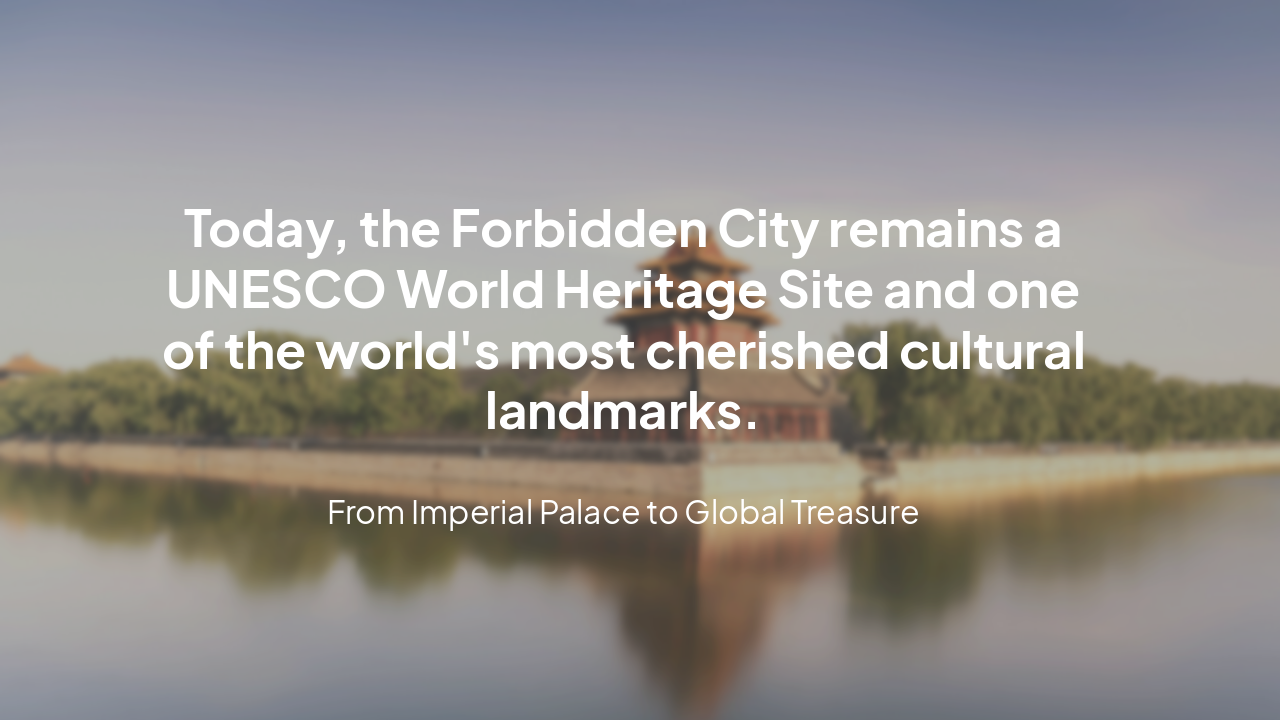
Today, the Forbidden City remains a UNESCO World Heritage Site and one of the world's most cherished cultural landmarks.
From Imperial Palace to Global Treasure
---
Photo by Steven Wei on Unsplash
Discover More Presentations
Explore thousands of AI-generated presentations for inspiration
Create Your Own Presentation
Generate professional presentations in seconds with Karaf's AI. Customize this presentation or start from scratch.