Why Current Suddenly Surges in Circuits

Generated from prompt:

Improve the text styling of an existing presentation titled "Why does current suddenly increase in circuits?" without changing the background, layout, or core content. Enhance wording clarity, consistency, and visual hierarchy. Use cleaner phrasing, better slide titles, concise bullet points, consistent capitalization, and improved flow. Keep all original concepts: Ohm’s law, AC vs DC, inductors, capacitors, frequency, resonance, energy transfer, and applications. Make slides more readable and polished for a student audience.

Explore the reasons behind sudden current increases in electrical circuits: from Ohm’s Law basics and AC/DC differences to reactive components, resonance effects, and practical applications for circuit stability.

April 3, 20267 slides
Slide 1 of 7

Slide 1 - Presentation Title

Why Does Current Suddenly Increase in Circuits?

Understanding Electrical Transients and Circuit Behavior
Slide 1 - Presentation Title
Slide 2 of 7

Slide 2 - Agenda

  • Ohm’s Law and Basics: Fundamentals of current flow and resistance
  • AC vs. DC Circuits: Comparing AC and DC behavior
  • Reactive Components: The role of inductors and capacitors
  • Frequency and Resonance: Frequency and resonance effects for current spikes
  • Applications and Energy Transfer: Practical scenarios and energy transfer
Slide 2 - Agenda
Slide 3 of 7

Slide 3 - Ohm’s Law and Circuit Fundamentals

  • Ohm’s Law (V = I * R) defines the linear relationship between voltage, current, and resistance.
  • Ohmic materials maintain constant resistance under stable operating conditions.
  • Current increases occur when voltage rises or resistance decreases significantly.
  • Transient events often violate steady-state assumptions, leading to rapid current surges.
Slide 3 - Ohm’s Law and Circuit Fundamentals
Slide 4 of 7

Slide 4 - Comparing AC and DC Circuits

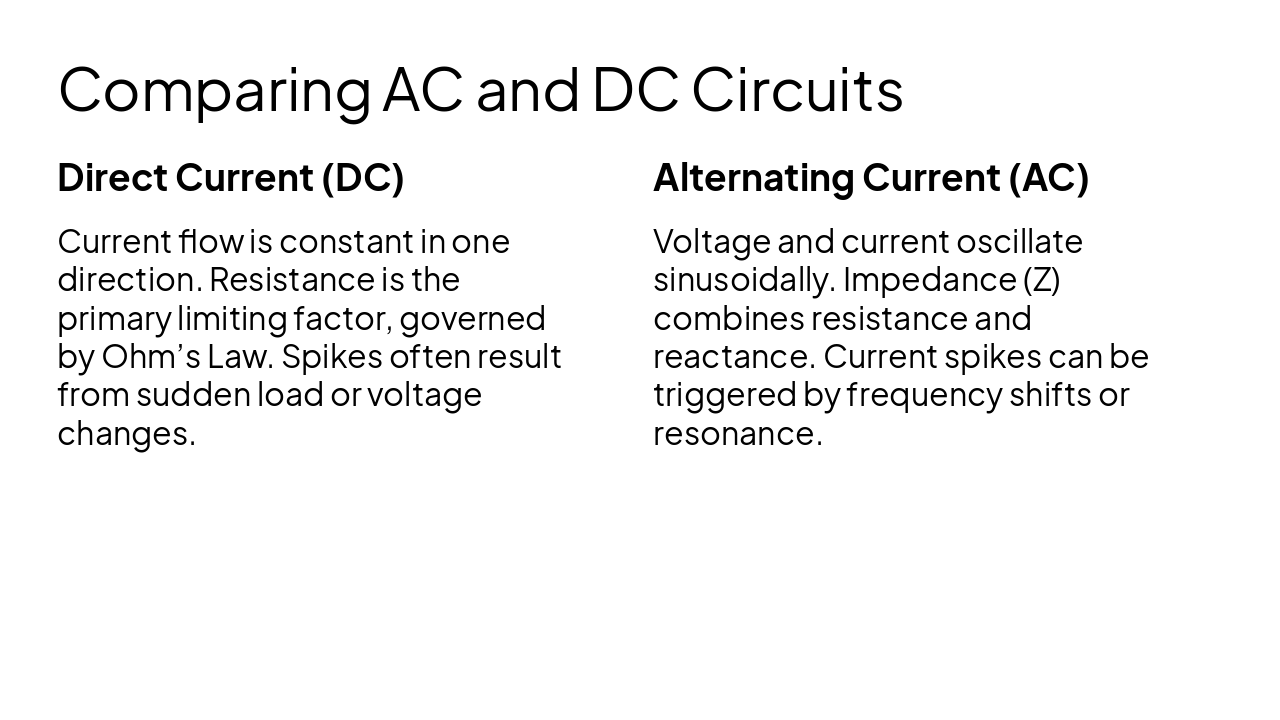
Direct Current (DC) Current flow is constant in one direction. Resistance is the primary limiting factor, governed by Ohm’s Law. Spikes often result from sudden load or voltage changes.

Alternating Current (AC) Voltage and current oscillate sinusoidally. Impedance (Z) combines resistance and reactance. Current spikes can be triggered by frequency shifts or resonance.
Slide 4 - Comparing AC and DC Circuits
Slide 5 of 7

Slide 5 - Role of Reactive Components

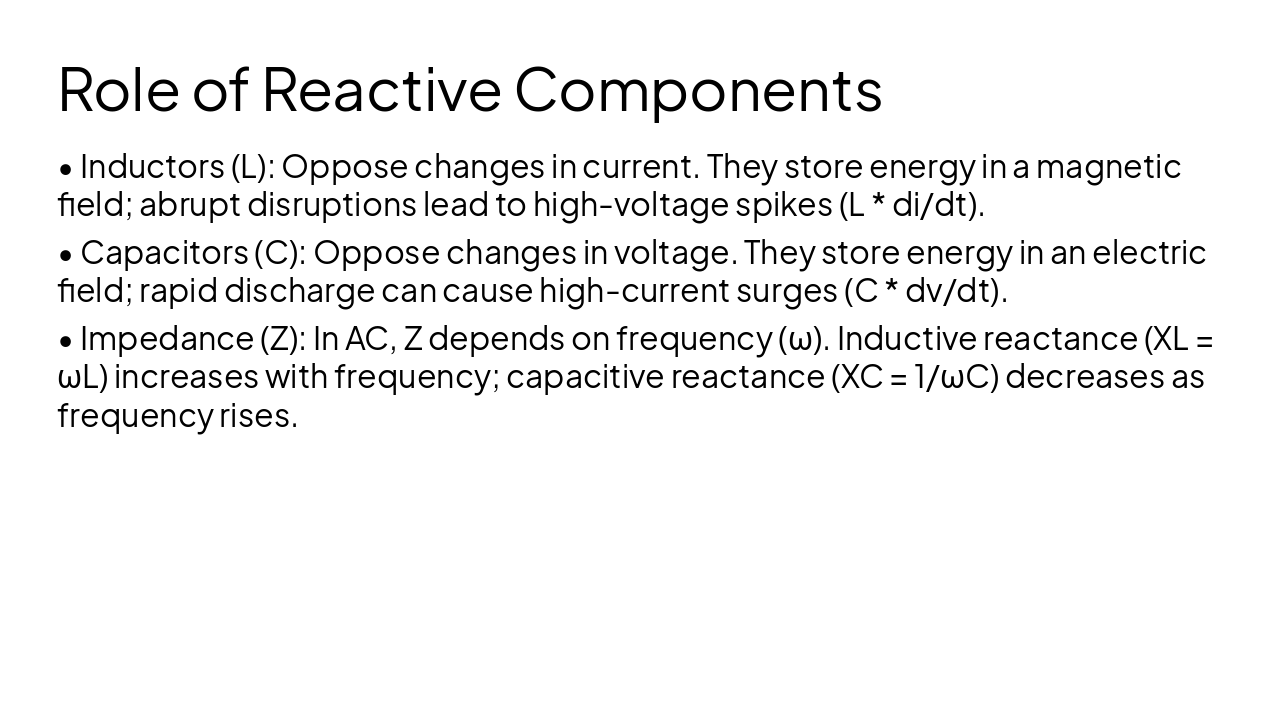
  • Inductors (L): Oppose changes in current. They store energy in a magnetic field; abrupt disruptions lead to high-voltage spikes (L di/dt).
  • Capacitors (C): Oppose changes in voltage. They store energy in an electric field; rapid discharge can cause high-current surges (C dv/dt).
  • Impedance (Z): In AC, Z depends on frequency (ω). Inductive reactance (XL = ωL) increases with frequency; capacitive reactance (XC = 1/ωC) decreases as frequency rises.
Slide 5 - Role of Reactive Components
Slide 6 of 7

Slide 6 - Frequency and Resonance Effects

  • Resonance occurs when inductive reactance equals capacitive reactance (XL = XC).
  • Frequency Dependency: At resonance, circuit impedance is minimized to simple ohmic resistance, which can lead to dangerously high current spikes.
  • Energy Transfer: Efficient energy exchange happens between the magnetic and electric fields at the resonant frequency.
  • Applications: Essential for tuning, filtering, and power distribution systems, but risky in transient states.
Slide 6 - Frequency and Resonance Effects
Slide 7 of 7

Slide 7 - Summary and Conclusion

Current spikes result from transient shifts, reactive component energy discharge, or resonant impedance drops. Managing these effectively is crucial for circuit stability.

Key Takeaways and Final Summary
Slide 7 - Summary and Conclusion

Discover More Presentations

Explore thousands of AI-generated presentations for inspiration

Browse Presentations
Powered by AI

Create Your Own Presentation

Generate professional presentations in seconds with Karaf's AI. Customize this presentation or start from scratch.

Create New Presentation

Powered by Karaf.ai — AI-Powered Presentation Generator