AgriVision AI: Smart Farming Revolution

Generated from prompt:

Create an 8-slide presentation titled 'AgriVision AI – FYP Defense' with a greenish plant-themed background. The layout should be: 1. Title Slide – 'AgriVision AI: Smart Agriculture System (AI + IoT + Drone Imaging)'. 2. Problem Background – summarize traditional farming issues (no real-time monitoring, manual delays, inefficiency). 3. Proposed Solution – outline integration of AI-based crop analysis, IoT sensors, and drone imaging. 4. Target Crops & Literature Review – include crops (Corn, Rice, Potato, Wheat, Sugarcane) and research focus (AI, drones, IoT in agriculture). 5. Related Work & Comparative Analysis – summarize CNN accuracy, poor integration, lack of combined systems. 6. Challenges & Methodology – mention scalability, cost, unified platforms, plus data collection and AI analysis steps. 7. System Architecture – describe buyer/service model, centralized backend, lightweight database. 8. Conclusion – highlight AgriVision AI’s improvements in scalability, usability, and precision agriculture.

AgriVision AI integrates AI crop analysis, IoT sensors, and drone imaging to solve traditional farming inefficiencies. Targets key crops like corn & rice, offering scalable, precise agriculture via un

January 1, 20268 slides
Slide 1 of 8

Slide 1 - AgriVision AI: Smart Agriculture System (AI + IoT + Drone Imaging)

The slide introduces AgriVision AI, a smart agriculture system integrating AI, IoT, and drone imaging. Its subtitle highlights innovative precision farming powered by AI, IoT sensors, and drone imaging.

AgriVision AI

Smart Agriculture System (AI + IoT + Drone Imaging)

Innovative Precision Farming with AI, IoT Sensors & Drone Imaging

Source: AgriVision AI – FYP Defense

Speaker Notes
Innovative integration of AI, IoT sensors, and drone imaging for precision farming. Greenish plant-themed background.
Slide 1 - AgriVision AI: Smart Agriculture System (AI + IoT + Drone Imaging)
Slide 2 of 8

Slide 2 - Problem Background

Traditional farming faces challenges like lack of real-time crop monitoring, which prevents timely interventions, and manual inspections that cause delays and errors. Additionally, resource inefficiency leads to waste, while pest/disease outbreaks and unpredictable weather increase yield losses and risks.

Problem Background

  • No real-time crop monitoring hinders timely interventions
  • Manual inspections cause significant delays and errors
  • Resource inefficiency leads to overuse and waste
  • Pest and disease outbreaks result in yield losses
  • Unpredictable weather impacts exacerbate farming risks

Source: Traditional farming challenges

Speaker Notes
Traditional farming faces significant hurdles due to lack of technology, leading to inefficiencies and losses.
Slide 2 - Problem Background
Slide 3 of 8

Slide 3 - Proposed Solution

The proposed solution leverages seamless AI-powered analysis of drone imagery, IoT sensors for real-time soil and moisture data, and instant alerts for timely farming interventions. It features automated decision-making to optimize resource usage and an integrated system that enhances overall farm efficiency.

Proposed Solution

  • Seamless AI-powered crop analysis from drone imagery
  • IoT sensors for real-time soil and moisture data
  • Instant alerts for timely farming interventions
  • Automated decision-making optimizes resource usage
  • Integrated system enhances overall farm efficiency

Source: AgriVision AI FYP Defense

Slide 3 - Proposed Solution
Slide 4 of 8

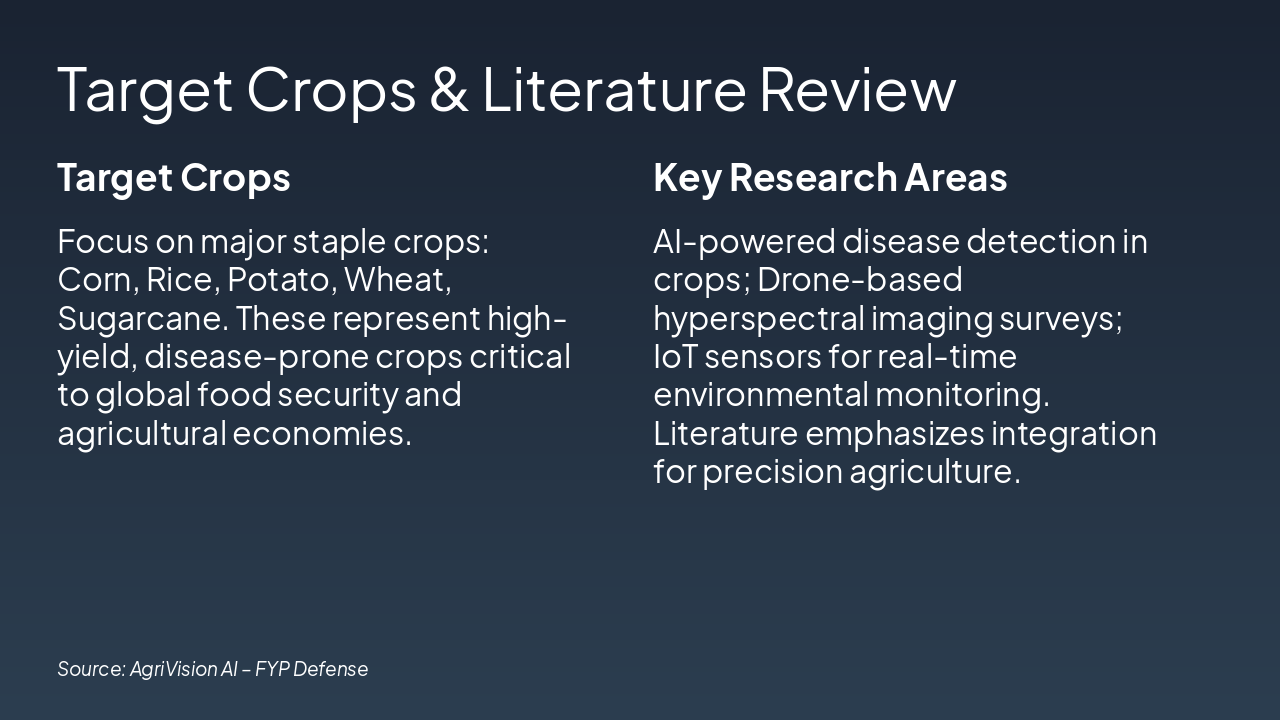
Slide 4 - Target Crops & Literature Review

The slide focuses on target staple crops—corn, rice, potato, wheat, and sugarcane—which are high-yield and disease-prone, vital for global food security and agricultural economies. It highlights key research areas like AI-powered disease detection, drone-based hyperspectral imaging, and IoT sensors for real-time monitoring, emphasizing their integration for precision agriculture.

Target Crops & Literature Review

Target CropsKey Research Areas
Focus on major staple crops: Corn, Rice, Potato, Wheat, Sugarcane. These represent high-yield, disease-prone crops critical to global food security and agricultural economies.AI-powered disease detection in crops; Drone-based hyperspectral imaging surveys; IoT sensors for real-time environmental monitoring. Literature emphasizes integration for precision agriculture.

Source: AgriVision AI – FYP Defense

Slide 4 - Target Crops & Literature Review
Slide 5 of 8

Slide 5 - Related Work & Comparative Analysis

The slide compares various models and systems in a table, showing existing CNN models (85-92% accuracy, poor AI-IoT integration, no drone+IoT unification), traditional IoT sensors (N/A accuracy, limited integration, no unification), drone imaging alone (80-90% accuracy, no integration, partial unification), and AgriVision AI (95%+ accuracy, excellent integration, full unification). AgriVision AI stands out as superior across all metrics in this related work analysis.

Related Work & Comparative Analysis

Model/SystemAccuracyAI-IoT IntegrationDrone+IoT Unified
Existing CNN Models85-92%PoorNo
Traditional IoT SensorsN/ALimitedNo
Drone Imaging Alone80-90%NonePartial
AgriVision AI95%+ExcellentYes

Source: AgriVision AI – FYP Defense

Slide 5 - Related Work & Comparative Analysis
Slide 6 of 8

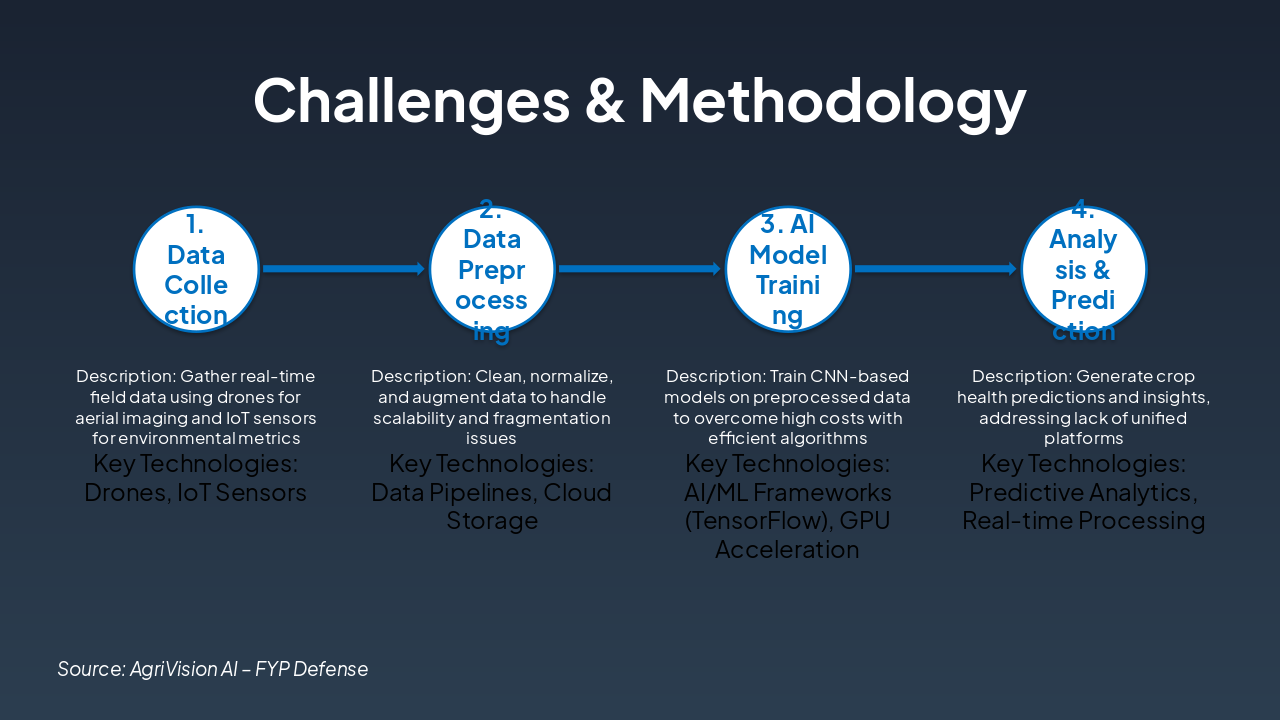
Slide 6 - Challenges & Methodology

The slide outlines a four-phase workflow to address challenges in agricultural data analysis: Phase 1 collects real-time data via drones and IoT sensors; Phase 2 preprocesses it using data pipelines and cloud storage. Phases 3 and 4 involve training CNN-based AI models with TensorFlow and GPU acceleration, followed by predictive analytics for crop health insights.

Challenges & Methodology

Source: AgriVision AI – FYP Defense

Slide 6 - Challenges & Methodology
Slide 7 of 8

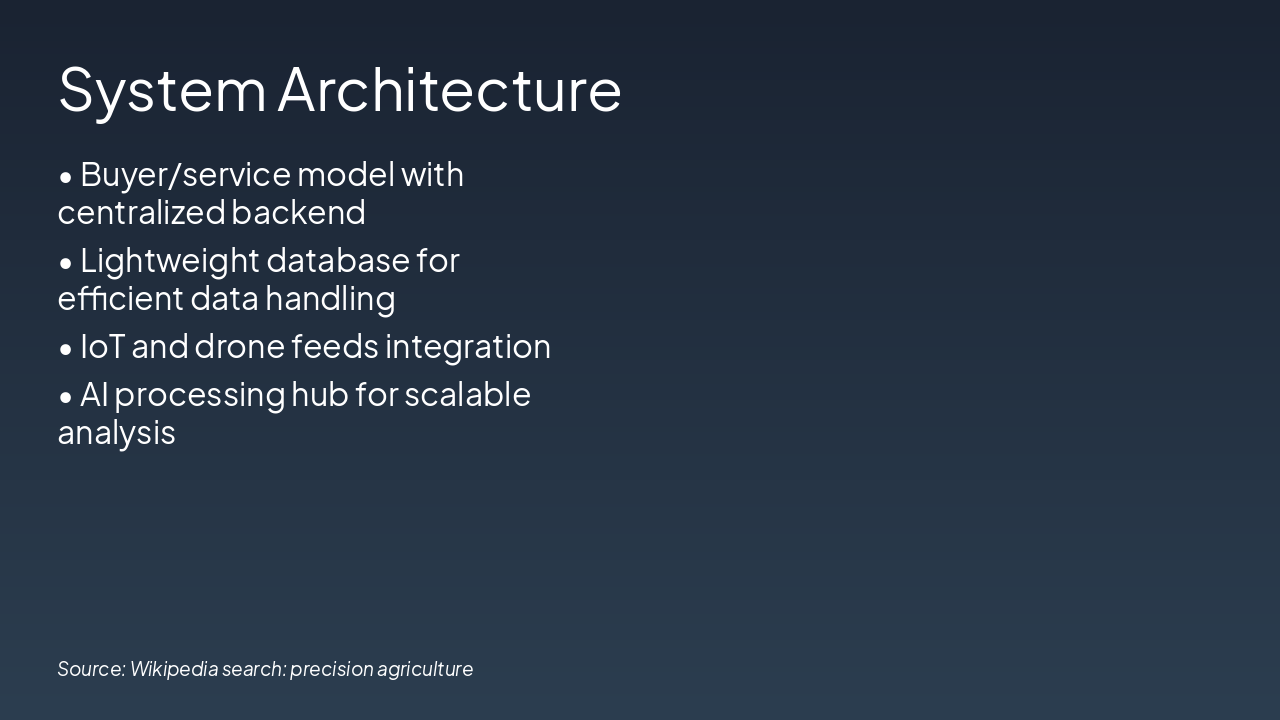
Slide 7 - System Architecture

The slide outlines a system architecture featuring a buyer/service model with a centralized backend. It highlights a lightweight database for efficient data handling, integration of IoT and drone feeds, and an AI processing hub for scalable analysis.

System Architecture

  • Buyer/service model with centralized backend
  • Lightweight database for efficient data handling
  • IoT and drone feeds integration
  • AI processing hub for scalable analysis

Source: Wikipedia search: precision agriculture

Slide 7 - System Architecture
Slide 8 of 8

Slide 8 - Conclusion

AgriVision AI provides superior scalability, user-friendly interface, and precision agriculture benefits, including 20-30% yield boosts, real-time insights, and cost savings. It revolutionizes farming with AI excellence, empowering sustainable farming—contact us today to transform your agriculture.

Conclusion

AgriVision AI delivers superior scalability, user-friendly interface, and precision agriculture gains:

  • 20-30% yield boost
  • Real-time insights
  • Cost savings

Closing: Revolutionizing farming with AI excellence.

CTA: Contact us to transform your agriculture today!

Empowering Sustainable Farming

Source: AgriVision AI – FYP Defense

Speaker Notes
Summarize key benefits: scalability, user-friendly interface, 20-30% yield boost, real-time insights, cost savings. End with closing message and CTA.
Slide 8 - Conclusion

Discover More Presentations

Explore thousands of AI-generated presentations for inspiration

Browse Presentations
Powered by AI

Create Your Own Presentation

Generate professional presentations in seconds with Karaf's AI. Customize this presentation or start from scratch.

Create New Presentation

Powered by Karaf.ai — AI-Powered Presentation Generator