Privatisation: Public to Private Shift (38 chars)

Generated from prompt:

Make a presentation about privatisation

Defines privatisation as transferring public assets to private hands. Covers history (timeline, pre-20th vs. modern), key examples via table, and takeaways: drives efficiency but sparks equity debates

December 11, 20258 slides
Slide 1 of 8

Slide 1 - Privatisation: From Public to Private

This title slide is named "Privatisation: From Public to Private." Its subtitle introduces an exploration of the concept, history, and examples of privatisation.

Privatisation: From Public to Private

Exploring the concept, history, and examples of privatisation.

Slide 1 - Privatisation: From Public to Private
Slide 2 of 8

Slide 2 - Presentation Agenda

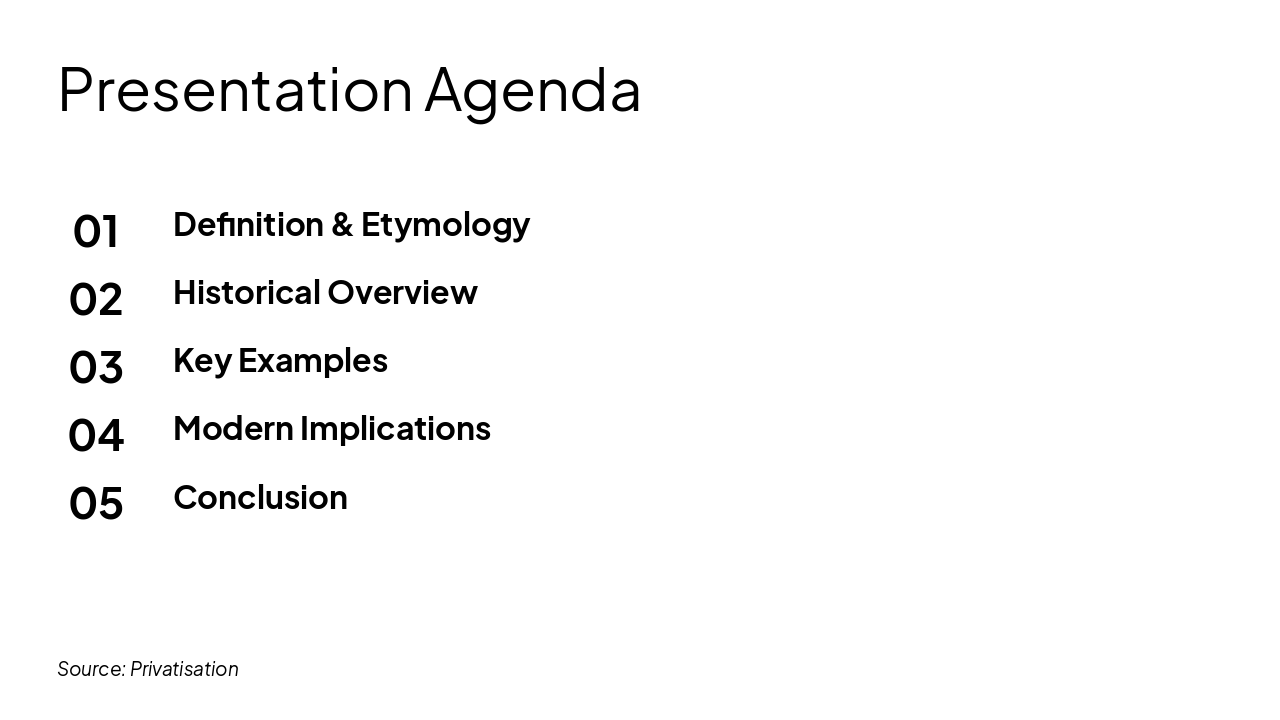
This slide presents the agenda for the presentation. It covers Definition & Etymology, Historical Overview, Key Examples, Modern Implications, and Conclusion.

Presentation Agenda

  1. Definition & Etymology
  2. Historical Overview
  3. Key Examples
  4. Modern Implications
  5. Conclusion

Source: Privatisation

Slide 2 - Presentation Agenda
Slide 3 of 8

Slide 3 - What is Privatisation?

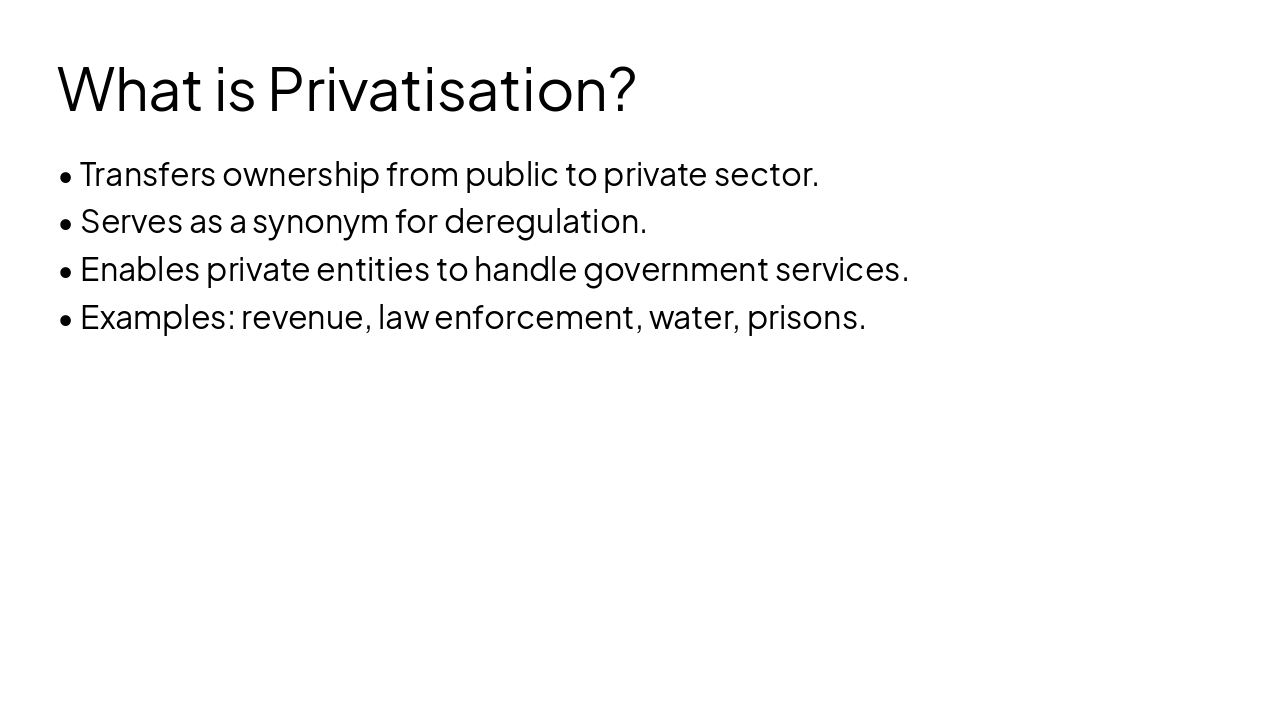
Privatisation transfers ownership of assets from the public to the private sector and serves as a synonym for deregulation. It enables private entities to handle government services, such as revenue collection, law enforcement, water supply, and prisons.

What is Privatisation?

  • Transfers ownership from public to private sector.
  • Serves as a synonym for deregulation.
  • Enables private entities to handle government services.
  • Examples: revenue, law enforcement, water, prisons.
Slide 3 - What is Privatisation?
Slide 4 of 8

Slide 4 - History of Privatisation

This slide serves as a section header titled "History of Privatisation." Its subtitle, "From ancient roots to modern reforms," previews the topic's historical timeline.

History of Privatisation

History of Privatisation

From ancient roots to modern reforms

Slide 4 - History of Privatisation
Slide 5 of 8

Slide 5 - Historical Timeline

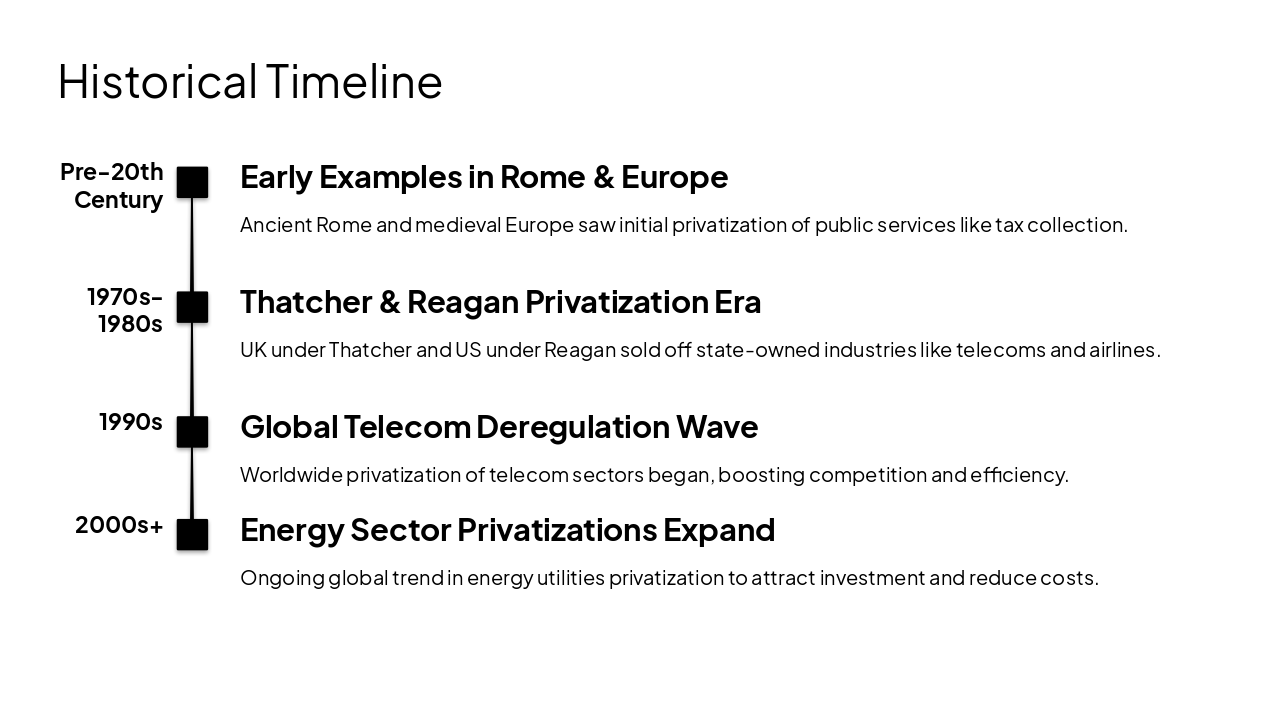
This historical timeline outlines privatization's evolution, starting with early examples in ancient Rome and medieval Europe for services like tax collection. It progresses through the 1970s-1980s Thatcher-Reagan era privatizing telecoms and airlines, 1990s global telecom deregulation, and ongoing 2000s+ energy sector expansions for investment and efficiency.

Historical Timeline

Pre-20th Century: Early Examples in Rome & Europe Ancient Rome and medieval Europe saw initial privatization of public services like tax collection. 1970s-1980s: Thatcher & Reagan Privatization Era UK under Thatcher and US under Reagan sold off state-owned industries like telecoms and airlines. 1990s: Global Telecom Deregulation Wave Worldwide privatization of telecom sectors began, boosting competition and efficiency. 2000s+: Energy Sector Privatizations Expand Ongoing global trend in energy utilities privatization to attract investment and reduce costs.

Slide 5 - Historical Timeline
Slide 6 of 8

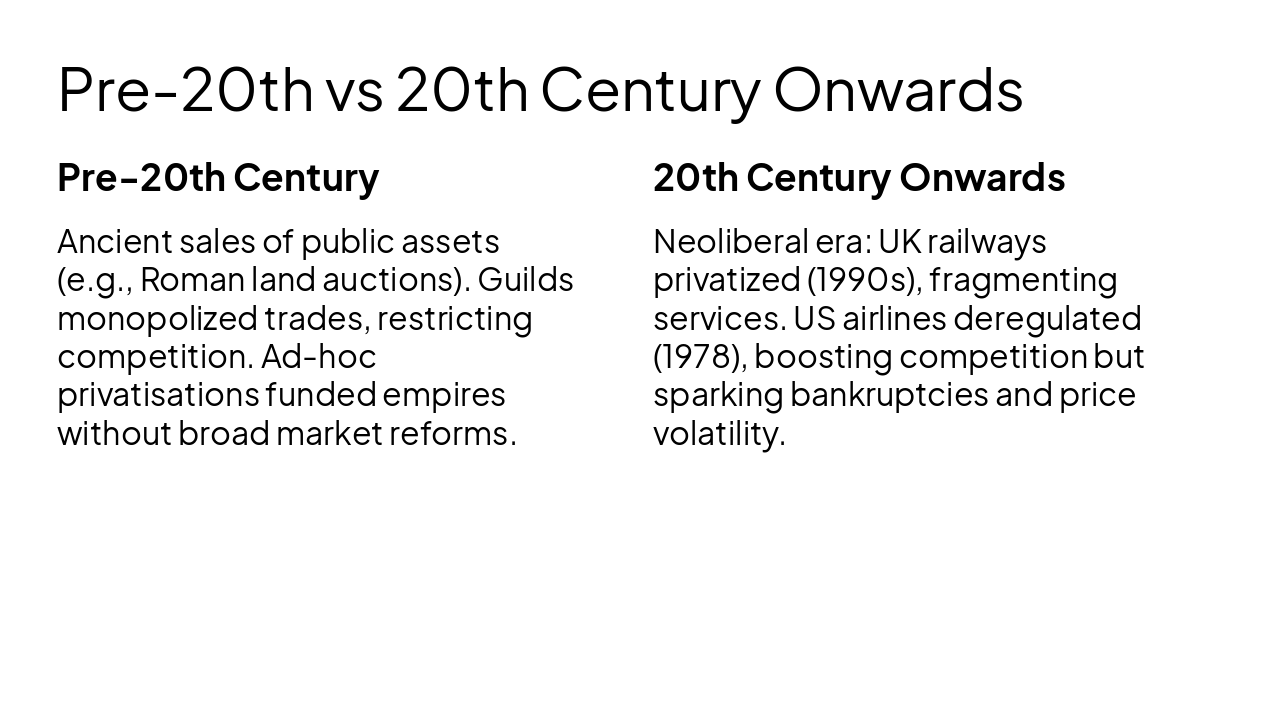
Slide 6 - Pre-20th vs 20th Century Onwards

Pre-20th century privatization involved ancient sales like Roman land auctions, guild monopolies restricting competition, and ad-hoc asset sales funding empires without market reforms. From the 20th century onward, neoliberal examples include 1990s UK railway privatization fragmenting services and 1978 US airline deregulation boosting competition but causing bankruptcies and price volatility.

Pre-20th vs 20th Century Onwards

Pre-20th Century20th Century Onwards
Ancient sales of public assets (e.g., Roman land auctions). Guilds monopolized trades, restricting competition. Ad-hoc privatisations funded empires without broad market reforms.Neoliberal era: UK railways privatized (1990s), fragmenting services. US airlines deregulated (1978), boosting competition but sparking bankruptcies and price volatility.
Slide 6 - Pre-20th vs 20th Century Onwards
Slide 7 of 8

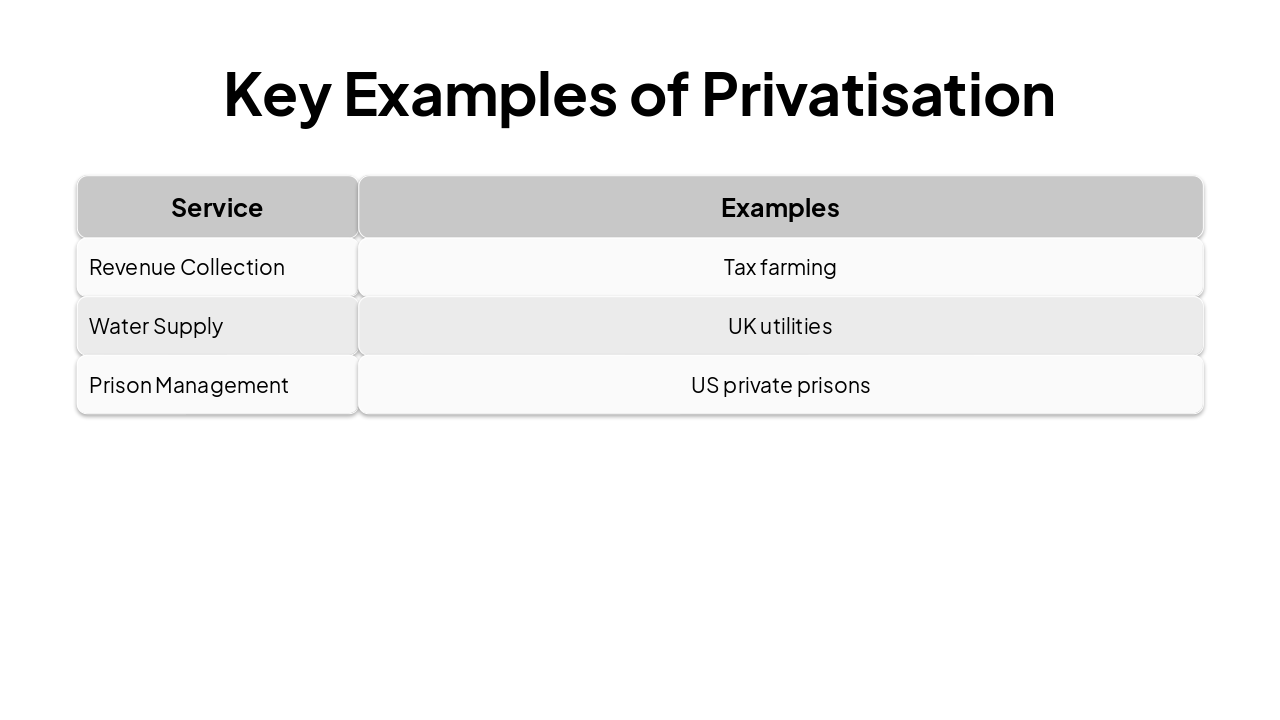
Slide 7 - Key Examples of Privatisation

The slide "Key Examples of Privatisation" features a table listing services alongside specific privatization cases. It covers revenue collection via tax farming, water supply through UK utilities, and prison management with US private prisons.

Key Examples of Privatisation

{ "headers": [ "Service", "Examples" ], "rows": [ [ "Revenue Collection", "Tax farming" ], [ "Water Supply", "UK utilities" ], [ "Prison Management", "US private prisons" ] ] }

Slide 7 - Key Examples of Privatisation
Slide 8 of 8

Slide 8 - Key Takeaways

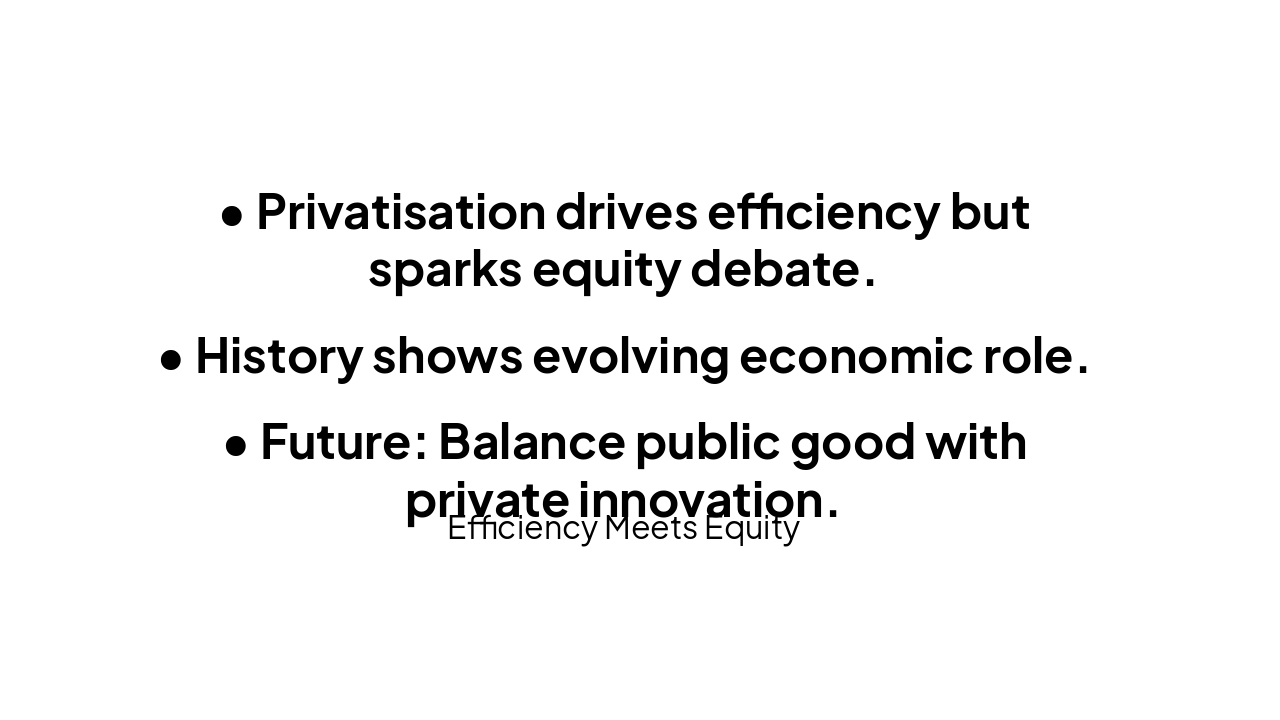
Privatization boosts efficiency but ignites equity debates, with history revealing its evolving economic role. The future calls for balancing public good with private innovation, under the subtitle "Efficiency Meets Equity."

Key Takeaways

• Privatisation drives efficiency but sparks equity debate.

  • History shows evolving economic role.
  • Future: Balance public good with private innovation.

Efficiency Meets Equity

Speaker Notes
Closing: Balance efficiency, equity, innovation. CTA: Reflect on privatisation strategies for your context.
Slide 8 - Key Takeaways
Powered by AI

Create Your Own Presentation

Generate professional presentations in seconds with Karaf's AI. Customize this presentation or start from scratch.

Create New Presentation

Powered by Karaf.ai — AI-Powered Presentation Generator