Gaps in Pakistan's Water & Climate Policies

Generated from prompt:

Analysis of Water Apportionment Accord, Pakistan's Water & Climate Policies: 1. Water Apportionment Accord 1991 (WAA 1991): The rigid water-sharing formula doesn’t account for climate change, reduced flows, or groundwater. It lacks provisions for regulating excess flood flows or groundwater depletion. Hill-torrent potential (8 MAF) is unaddressed in provincial allocations. 2. National Water Policy 2018 (NWP 2018): The policy suffers from unclear federal-provincial roles, overemphasis on infrastructure, and neglect of water efficiency. There’s no strategy for the Water-Food-Energy Nexus or alignment with SDGs. Water theft, pricing, and metering are unaddressed. 3. National Climate Change Policy 2021 (NCCP 2021): Lacks clear priorities, integration with water policy, and actionable plans. No financial mechanisms or effective local governance for climate resilience. 4. Cross Domain Impact: No accountability mechanism for provincial non-compliance, data manipulation, or over-withdrawal. Weak governance linkages between climate, water, and energy. Limited enforcement authority within IRSA. No framework for water-food-energy nexus.

This presentation critiques Pakistan's key policies: the 1991 Water Apportionment Accord's failure to address climate change and groundwater; the 2018 National Water Policy's unclear roles and infrast

November 27, 202511 slides
Slide 1 of 11

Slide 1 - Analysis of Pakistan's Water and Climate Policies

The slide, titled "Analysis of Pakistan's Water and Climate Policies," presents an overview of critical issues within these key policies. It highlights their cross-domain impacts, emphasizing interconnected challenges in water management and climate adaptation.

Analysis of Pakistan's Water and Climate Policies

Overview of Critical Issues in Key Policies and Cross-Domain Impacts
Slide 1 - Analysis of Pakistan's Water and Climate Policies
Slide 2 of 11

Slide 2 - Presentation Agenda

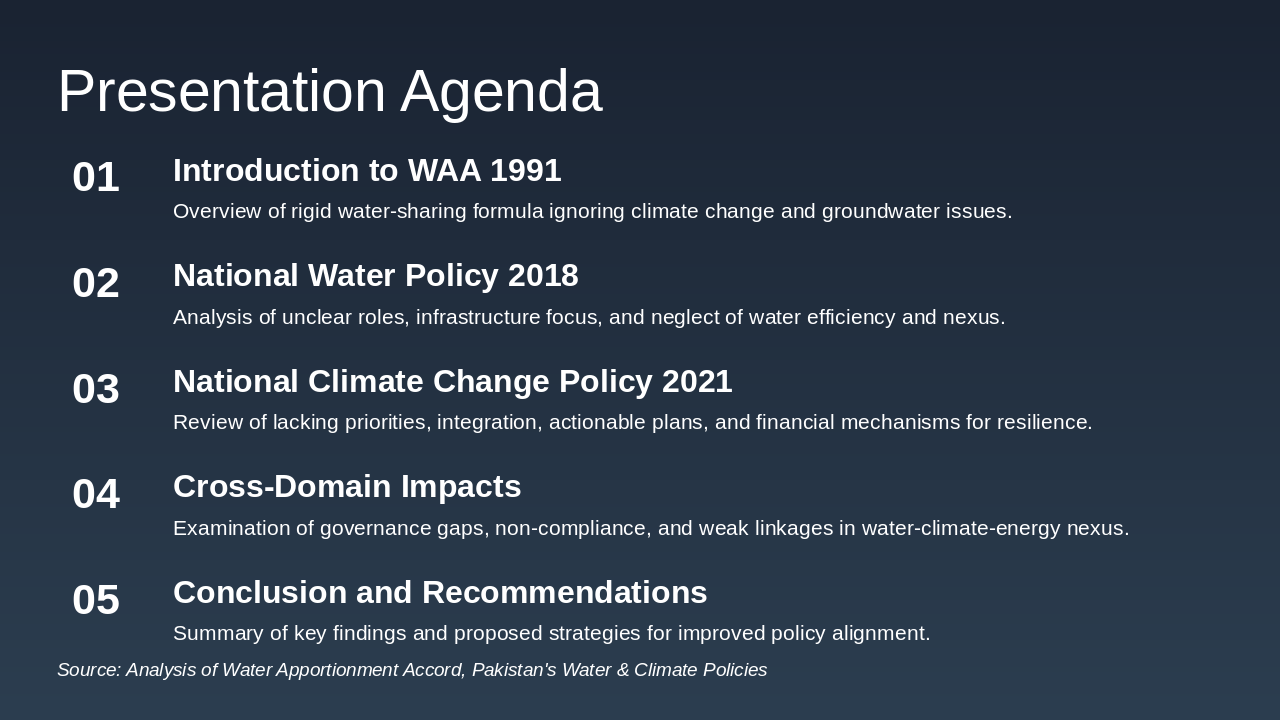
The presentation agenda outlines key topics on water and climate policies, starting with an introduction to the rigid WAA 1991 framework that overlooks climate change and groundwater. It proceeds to analyze the National Water Policy 2018's shortcomings in roles and efficiency, reviews gaps in the National Climate Change Policy 2021 for resilience, examines cross-domain impacts on governance and the water-climate-energy nexus, and ends with conclusions and recommendations for better alignment.

Presentation Agenda

  1. Introduction to WAA 1991
  2. Overview of rigid water-sharing formula ignoring climate change and groundwater issues.

  3. National Water Policy 2018
  4. Analysis of unclear roles, infrastructure focus, and neglect of water efficiency and nexus.

  5. National Climate Change Policy 2021
  6. Review of lacking priorities, integration, actionable plans, and financial mechanisms for resilience.

  7. Cross-Domain Impacts
  8. Examination of governance gaps, non-compliance, and weak linkages in water-climate-energy nexus.

  9. Conclusion and Recommendations

Summary of key findings and proposed strategies for improved policy alignment. Source: Analysis of Water Apportionment Accord, Pakistan's Water & Climate Policies

Slide 2 - Presentation Agenda
Slide 3 of 11

Slide 3 - Water Apportionment Accord 1991 (WAA 1991)

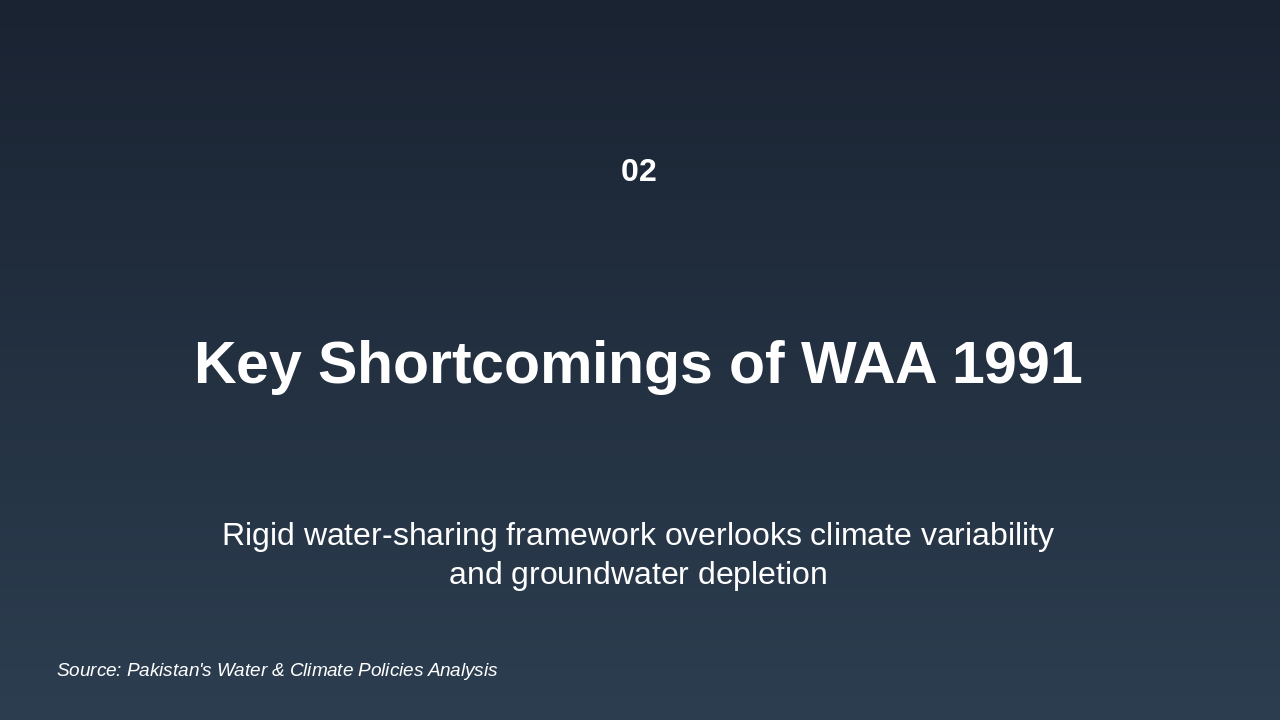
The slide introduces Section 02 of the presentation on the Water Apportionment Accord 1991 (WAA 1991), focusing on its key shortcomings. It highlights the accord's rigid water-sharing framework, which fails to account for climate variability and groundwater depletion.

Water Apportionment Accord 1991 (WAA 1991)

02

Key Shortcomings of WAA 1991

Rigid water-sharing framework overlooks climate variability and groundwater depletion

Source: Pakistan's Water & Climate Policies Analysis

Speaker Notes
Key shortcomings: Rigid sharing ignores climate change, reduced flows, groundwater; lacks flood/groundwater provisions; unaddressed hill-torrent potential (8 MAF).
Slide 3 - Water Apportionment Accord 1991 (WAA 1991)
Slide 4 of 11

Slide 4 - Issues with WAA 1991

The Water Apportionment Accord (WAA) of 1991 overlooks critical environmental factors, including climate change, reduced water flows, and groundwater dynamics. It also lacks mechanisms for flood regulation and depletion control, while failing to incorporate the untapped potential of hill-torrents, estimated at 8 million acre-feet, into its allocations.

Issues with WAA 1991

  • Ignores climate change, reduced flows, and groundwater dynamics.
  • Lacks provisions for flood regulation and depletion control.
  • Fails to address hill-torrent potential (8 MAF) in allocations.

Source: Analysis of Water Apportionment Accord, Pakistan's Water & Climate Policies

Slide 4 - Issues with WAA 1991
Slide 5 of 11

Slide 5 - National Water Policy 2018 (NWP 2018)

The slide introduces the section on "NWP 2018 Implementation Challenges" under the National Water Policy 2018. It highlights key issues including unclear roles, a bias toward infrastructure development, and neglected strategies for water efficiency.

National Water Policy 2018 (NWP 2018)

NWP 2018 Implementation Challenges

Unclear roles, infrastructure bias, and neglected water efficiency strategies

Speaker Notes
Challenges in policy implementation and focus areas. Analysis includes Water Apportionment Accord 1991 (rigid formula ignores climate change, groundwater); NWP 2018 (unclear roles, infrastructure focus, neglects efficiency, nexus, SDGs, theft/pricing); NCCP 2021 (lacks priorities, integration, finance, governance); Cross-domain impacts (no accountability, weak linkages, limited enforcement).
Slide 5 - National Water Policy 2018 (NWP 2018)
Slide 6 of 11

Slide 6 - Shortcomings of NWP 2018

The NWP 2018 slide highlights key shortcomings, including unclear federal-provincial roles, an overemphasis on infrastructure at the expense of efficiency measures, and a failure to integrate the Water-Food-Energy Nexus. It also notes a lack of alignment with Sustainable Development Goals and unaddressed challenges like water theft, pricing, and metering.

Shortcomings of NWP 2018

  • Unclear federal-provincial roles and responsibilities
  • Overemphasis on infrastructure over efficiency measures
  • Neglects Water-Food-Energy Nexus integration
  • Lacks alignment with Sustainable Development Goals
  • Unaddressed issues: water theft, pricing, metering
Slide 6 - Shortcomings of NWP 2018
Slide 7 of 11

Slide 7 - National Climate Change Policy 2021 (NCCP 2021)

The slide serves as a section header for "Gaps in NCCP 2021 Integration" within the National Climate Change Policy 2021 framework, marking it as section 03. It highlights key shortcomings, including the absence of defined priorities, alignment with water policies, actionable implementation plans, and mechanisms for building resilience.

National Climate Change Policy 2021 (NCCP 2021)

03

Gaps in NCCP 2021 Integration

Lacks priorities, water policy alignment, actionable plans, and resilience mechanisms

Source: Pakistan's Water & Climate Policies Analysis

Speaker Notes
Gaps in integration and actionability: Lacks clear priorities, integration with water policy, actionable plans, financial mechanisms, and local governance for climate resilience. Context includes analysis of WAA 1991, NWP 2018, and cross-domain impacts.
Slide 7 - National Climate Change Policy 2021 (NCCP 2021)
Slide 8 of 11

Slide 8 - Limitations of NCCP 2021

The NCCP 2021 slide highlights key limitations, including a lack of clear priorities for climate action and insufficient integration with national water policy. It also points out the absence of actionable implementation plans, dedicated financial mechanisms for resilience, and effective local governance for adaptation.

Limitations of NCCP 2021

  • Lacks clear priorities for climate action initiatives.
  • Insufficient integration with national water policy.
  • Absence of actionable and detailed implementation plans.
  • No dedicated financial mechanisms for resilience building.
  • Ineffective local governance for climate adaptation.

Source: Analysis of Water Apportionment Accord, Pakistan's Water & Climate Policies

Slide 8 - Limitations of NCCP 2021
Slide 9 of 11

Slide 9 - Cross-Domain Impacts

The slide titled "Cross-Domain Impacts" serves as a section header in the presentation. It features a subtitle highlighting broader governance and enforcement challenges within Pakistan's water and climate policies.

Cross-Domain Impacts

Cross-Domain Impacts

Broader governance and enforcement challenges in Pakistan's water and climate policies.

Source: Analysis of Pakistan's Water Apportionment Accord, Water & Climate Policies

Speaker Notes
Broader governance and enforcement challenges. Context: Analysis of Water Apportionment Accord, Pakistan's Water & Climate Policies: 1. Water Apportionment Accord 1991 (WAA 1991): The rigid water-sharing formula doesn’t account for climate change, reduced flows, or groundwater. It lacks provisions for regulating excess flood flows or groundwater depletion. Hill-torrent potential (8 MAF) is unaddressed in provincial allocations. 2. National Water Policy 2018 (NWP 2018): The policy suffers from unclear federal-provincial roles, overemphasis on infrastructure, and neglect of water efficiency. There’s no strategy for the Water-Food-Energy Nexus or alignment with SDGs. Water theft, pricing, and metering are unaddressed. 3. National Climate Change Policy 2021 (NCCP 2021): Lacks clear priorities, integration with water policy, and actionable plans. No financial mechanisms or effective local governance for climate resilience. 4. Cross Domain Impact: No accountability mechanism for provincial non-compliance, data manipulation, or over-withdrawal. Weak governance linkages between climate, water, and energy. Limited enforcement authority within IRSA. No framework for water-food-energy nexus.
Slide 9 - Cross-Domain Impacts
Slide 10 of 11

Slide 10 - Key Cross-Domain Issues

The slide highlights key cross-domain issues in water management, starting with accountability and compliance gaps under the Water Apportionment Accord, where the lack of mechanisms for provincial non-compliance, data manipulation, or over-withdrawal leads to inequities, unsustainable groundwater use, and exacerbated water scarcity from unaddressed flood flows amid climate variability. It also addresses integration and enforcement deficiencies, including weak linkages between climate, water, and energy sectors, limited authority for IRSA enforcement, and the absence of a Water-Food-Energy Nexus framework in policies like NWP 2018 and NCCP 2021, which undermine coordination and alignment with SDGs.

Key Cross-Domain Issues

Accountability and Compliance GapsIntegration and Enforcement Deficiencies
No accountability mechanisms for provincial non-compliance, data manipulation, or over-withdrawal under the Water Apportionment Accord. This fosters inequities, unsustainable groundwater use, and unaddressed flood flows, exacerbating water scarcity amid climate variability.Weak governance linkages between climate, water, and energy sectors. Limited IRSA enforcement authority and absence of a Water-Food-Energy Nexus framework in policies like NWP 2018 and NCCP 2021 hinder cross-domain coordination and SDG alignment.

Source: Analysis of Water Apportionment Accord, Pakistan's Water & Climate Policies

Slide 10 - Key Cross-Domain Issues
Slide 11 of 11

Slide 11 - Conclusion

The conclusion slide emphasizes the urgent need for policy reforms in Pakistan to tackle climate variability, governance challenges, and integrated nexus approaches for sustainable water management. It calls for immediate action under the subtitle "Reform Now for a Resilient Future."

Conclusion

Urgent need for policy reforms addressing climate variability, governance, and integrated nexus approaches to ensure sustainable water management in Pakistan.

Reform Now for a Resilient Future

Source: Analysis of Water Apportionment Accord, Pakistan's Water & Climate Policies

Speaker Notes
Closing message: Reform policies for sustainable water. Call-to-action: Urge stakeholders to integrate nexus approaches and enforce governance for climate-resilient water management in Pakistan. Key issues: Rigid WAA 1991 ignores climate variability; NWP 2018 lacks efficiency and nexus strategy; NCCP 2021 misses actionable integration; overall weak accountability and enforcement.
Slide 11 - Conclusion

Discover More Presentations

Explore thousands of AI-generated presentations for inspiration

Browse Presentations
Powered by AI

Create Your Own Presentation

Generate professional presentations in seconds with Karaf's AI. Customize this presentation or start from scratch.

Create New Presentation

Powered by Karaf.ai — AI-Powered Presentation Generator