HVAC Air Distribution System Design Essentials (45 chars)

Generated from prompt:

Make a presentation aboPerfect 👍 Here’s your PowerPoint outline version of your class report on “Member 6 – Air Distribution System Design.” This includes slide titles, bullet points, and short speaker notes that you can use during your presentation. ⸻ 🟦 SLIDE 1: Title Slide Title: Member 6 – Air Distribution System Design Subtitle: Duct Design • Airflow Measurement • Fans/Blowers • Diffusers and Grilles Presented by: [Your Name] Course/Subject: [Insert course name] Speaker Note: “Good day everyone. I’ll be presenting about Air Distribution System Design, which is a key part of an HVAC system. We’ll look at how air is delivered throughout a building through proper duct design, airflow measurement, fan selection, and diffusers or grilles.” ⸻ 🟦 SLIDE 2: Introduction Content: • Air distribution systems deliver conditioned air (heated or cooled). • They maintain indoor comfort and air quality. • Key elements: 1. Duct Design 2. Airflow Measurement 3. Fans/Blowers 4. Diffusers and Grilles Speaker Note: “An air distribution system ensures that every part of a building receives the right amount of air for comfort and ventilation. Each component must work efficiently for the system to function properly.” ⸻ 🟦 SLIDE 3: Duct Design (Overview) Content: • Ducts are air pathways in HVAC systems. • Good design ensures efficient airflow and energy savings. • Main factors: • Materials • Layout • Sizing Speaker Note: “The duct system is like the arteries of an HVAC setup—it moves air from the air handler to different areas. Poor duct design can lead to air loss, noise, and uneven temperature.” ⸻ 🟦 SLIDE 4: Duct Materials Content: • Galvanized Steel – durable, common in commercial buildings • Aluminum – lightweight, corrosion-resistant • Flexible Ducts – easy to install, for tight spaces • Fiberglass Duct Board – good insulation, not for humid areas Speaker Note: “The choice of material depends on the project type. For example, flexible ducts are easier to install in residential homes, while galvanized steel is preferred in large commercial systems.” ⸻ 🟦 SLIDE 5: Duct Layout Content: • Proper layout = efficient air distribution • Common systems: • Trunk and Branch – main duct with smaller branches • Radial System – ducts radiate from central plenum • Perimeter Loop – used in large buildings Speaker Note: “The goal of a good layout is to minimize pressure loss and make sure all zones get equal air distribution.” ⸻ 🟦 SLIDE 6: Duct Sizing Content: • Ducts too small → noise, pressure loss • Ducts too large → wasted materials, uneven airflow • Common sizing methods: • Equal Friction • Static Regain • Velocity Reduction Speaker Note: “Engineers use different sizing methods depending on the building’s needs. Proper sizing ensures efficiency and comfort.” ⸻ 🟦 SLIDE 7: Airflow Measurement Content: • Ensures correct air delivery to each zone • Measured in CFM (Cubic Feet per Minute) • Tools used: • Anemometer – air velocity • Pitot Tube – pressure difference • Flow Hood – air volume at diffusers Speaker Note: “Airflow measurement is essential for system balancing. It helps identify leaks, blockages, or areas with poor air distribution.” ⸻ 🟦 SLIDE 8: Types of Fans and Blowers Content: Fans and blowers provide the pressure to move air. Types: • Axial Fans – parallel airflow, high volume, low pressure • Centrifugal Fans – perpendicular airflow, higher pressure • Blowers – high-pressure air movement for industrial use Speaker Note: “Fans and blowers are the heart of the system. Choosing the right type ensures that air moves efficiently through long ducts or large spaces.” ⸻ 🟦 SLIDE 9: Diffusers and Grilles Content: • Final components that deliver air into the room • Diffusers: Spread air evenly, reduce drafts • Grilles: Simple covers for air passage • Registers: Grilles with adjustable dampers Speaker Note: “These parts affect both comfort and appearance. Proper selection ensures quiet and even airflow inside the room.” ⸻ 🟦 SLIDE 10: Summary / Conclusion Content: ✔ Duct Design – ensures efficient air movement ✔ Airflow Measurement – verifies correct air delivery ✔ Fans/Blowers – supply the needed air pressure ✔ Diffusers/Grilles – control air direction and comfort Speaker Note: “In summary, air distribution system design is about achieving balance—ensuring that air moves smoothly, efficiently, and quietly through every part of a building.” ⸻ 🟦 SLIDE 11: References (Optional) Content: • HVAC Design Fundamentals, ASHRAE Handbook • Modern Air Conditioning Engineering, McQuiston & Parker • HVAC System Design Manual, SMACNA Speaker Note: “These are standard references used by engineers and designers in HVAC design and

Overview of air distribution in HVAC: duct design (materials, layout, sizing), airflow measurement (CFM tools), fans/blowers types, and diffusers/grilles for efficient, comfortable air delivery. (162

December 12, 202511 slides
Slide 1 of 11

Slide 1 - Member 6 – Air Distribution System Design

This title slide introduces Member 6 on Air Distribution System Design, highlighting key topics like Duct Design, Airflow Measurement, Fans/Blowers, and Diffusers and Grilles. It includes a subtitle crediting [Your Name] as presenter for the course [Insert course name].

Duct Design • Airflow Measurement • Fans/Blowers • Diffusers and Grilles

Presented by: [Your Name] | Course: [Insert course name]

Source: HVAC Presentation Outline

Speaker Notes
Good day everyone. I’ll be presenting about Air Distribution System Design, which is a key part of an HVAC system. We’ll look at how air is delivered throughout a building through proper duct design, airflow measurement, fan selection, and diffusers or grilles.
Slide 1 - Member 6 – Air Distribution System Design
Slide 2 of 11

Slide 2 - Introduction

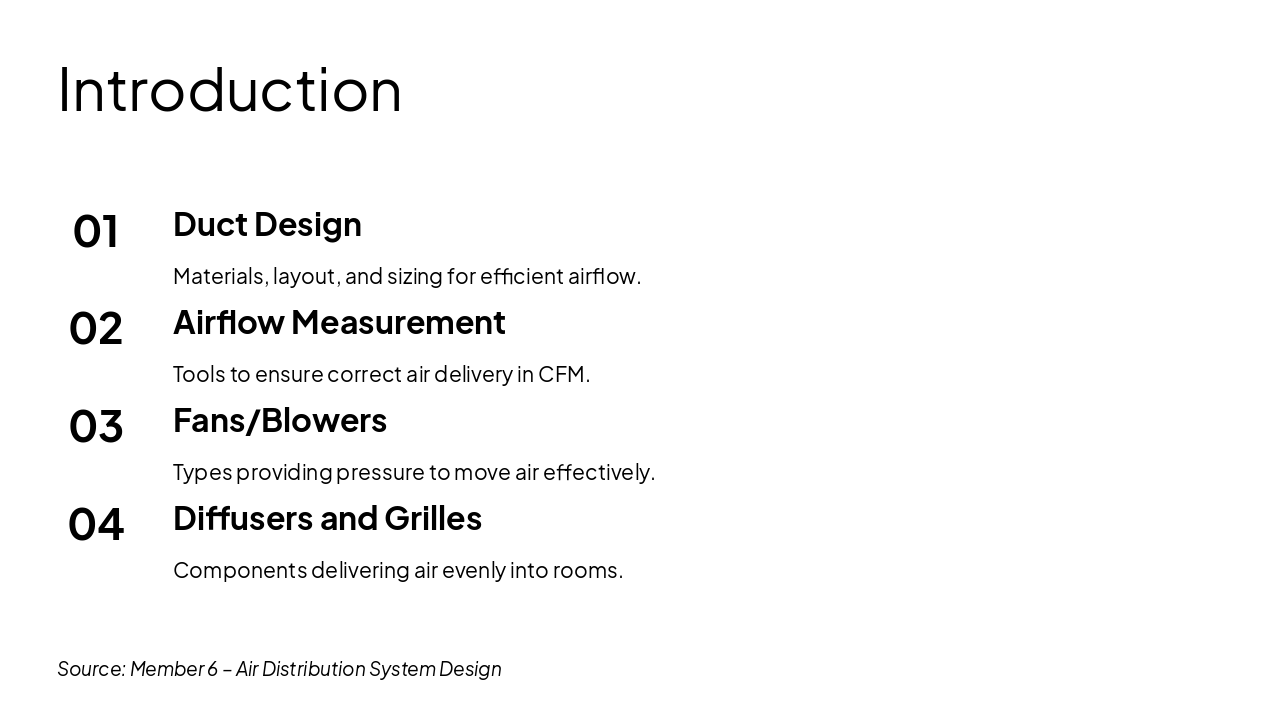
This agenda slide, titled "Introduction," outlines the key topics for the session. It covers duct design for efficient airflow, airflow measurement in CFM, fans/blowers for effective air movement, and diffusers/grilles for even room air delivery.

Introduction

  1. Duct Design
  2. Materials, layout, and sizing for efficient airflow.

  3. Airflow Measurement
  4. Tools to ensure correct air delivery in CFM.

  5. Fans/Blowers
  6. Types providing pressure to move air effectively.

  7. Diffusers and Grilles

Components delivering air evenly into rooms. Source: Member 6 – Air Distribution System Design

Speaker Notes
An air distribution system ensures that every part of a building receives the right amount of air for comfort and ventilation. Each component must work efficiently for the system to function properly.
Slide 2 - Introduction
Slide 3 of 11

Slide 3 - Mastering Duct Design

Slide 3 - Mastering Duct Design
Slide 4 of 11

Slide 4 - Duct Materials

This slide lists common duct materials: galvanized steel for durability in commercial buildings, lightweight and corrosion-resistant aluminum, easy-to-install flexible ducts for tight spaces, and insulated fiberglass duct board to avoid humid areas. Each material highlights key advantages and suitable applications for HVAC systems.

Duct Materials

  • Galvanized Steel: durable, common in commercial buildings.
  • Aluminum: lightweight, corrosion-resistant.
  • Flexible Ducts: easy to install, ideal for tight spaces.
  • Fiberglass Duct Board: insulated, avoid humid areas.

Source: Member 6 – Air Distribution System Design

Speaker Notes
The choice of material depends on the project type. For example, flexible ducts are easier to install in residential homes, while galvanized steel is preferred in large commercial systems.
Slide 4 - Duct Materials
Slide 5 of 11

Slide 5 - Duct Layout

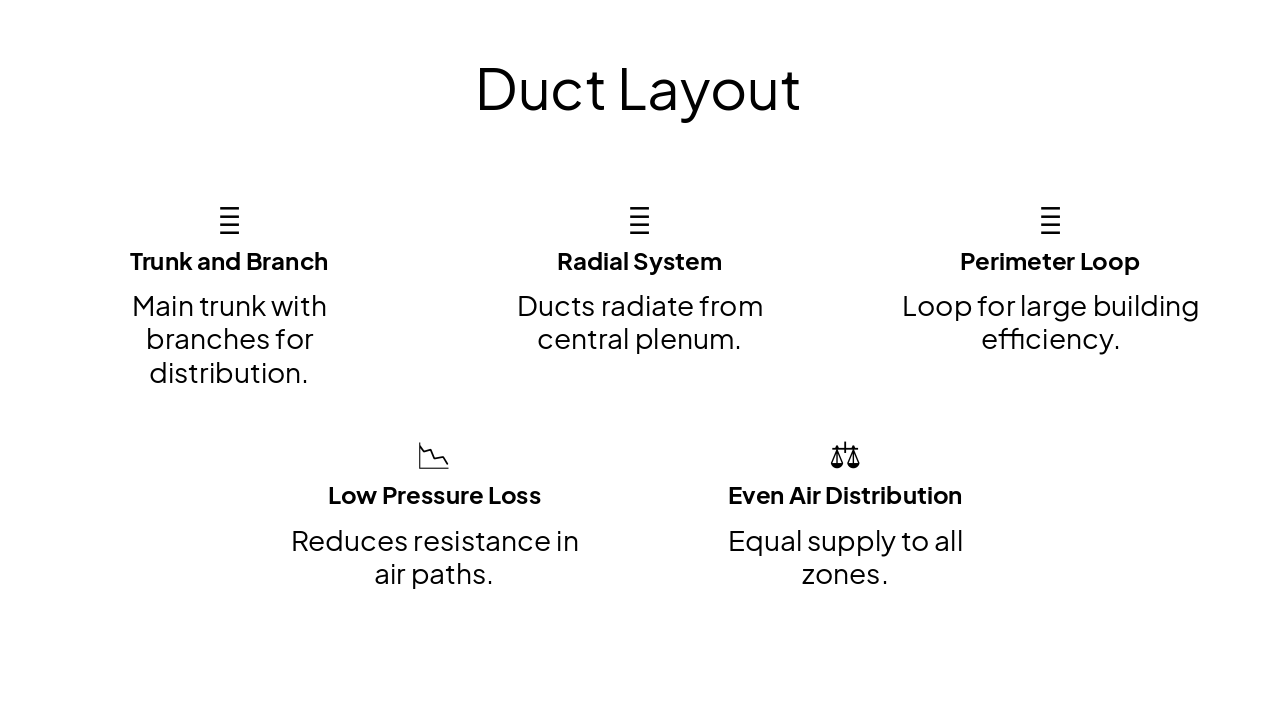
The Duct Layout slide features three main configurations: Trunk and Branch for distribution, Radial System from a central plenum, and Perimeter Loop for large-building efficiency. It also emphasizes benefits like low pressure loss and even air distribution to all zones.

Duct Layout

{ "features": [ { "icon": "🌳", "heading": "Trunk and Branch", "description": "Main trunk with branches for distribution." }, { "icon": "🌐", "heading": "Radial System", "description": "Ducts radiate from central plenum." }, { "icon": "🔄", "heading": "Perimeter Loop", "description": "Loop for large building efficiency." }, { "icon": "📉", "heading": "Low Pressure Loss", "description": "Reduces resistance in air paths." }, { "icon": "⚖️", "heading": "Even Air Distribution", "description": "Equal supply to all zones." } ] }

Speaker Notes
The goal of a good layout is to minimize pressure loss and make sure all zones get equal air distribution.
Slide 5 - Duct Layout
Slide 6 of 11

Slide 6 - Duct Sizing

The Duct Sizing slide warns that undersized ducts cause noise and pressure loss, while oversized ducts lead to waste and uneven flow. It outlines three sizing methods: Equal Friction, Static Regain, and Velocity Reduction.

Duct Sizing

  • Undersized ducts: noise, pressure loss
  • Oversized ducts: waste, uneven flow
  • Equal Friction method
  • Static Regain method
  • Velocity Reduction method
Slide 6 - Duct Sizing
Slide 7 of 11

Slide 7 - Airflow Measurement

Airflow measurement ensures accurate zone delivery in CFM, balances systems, and detects issues. Tools include anemometer for air velocity, pitot tube for pressure, and flow hood for volume.

Airflow Measurement

  • Ensures accurate zone delivery in CFM
  • Anemometer measures air velocity
  • Pitot tube measures pressure
  • Flow hood measures volume
  • Balances system and detects issues

Source: Member 6 – Air Distribution System Design

Speaker Notes
Airflow measurement is essential for system balancing. It helps identify leaks, blockages, or areas with poor air distribution.
Slide 7 - Airflow Measurement
Slide 8 of 11

Slide 8 - Fans and Blowers

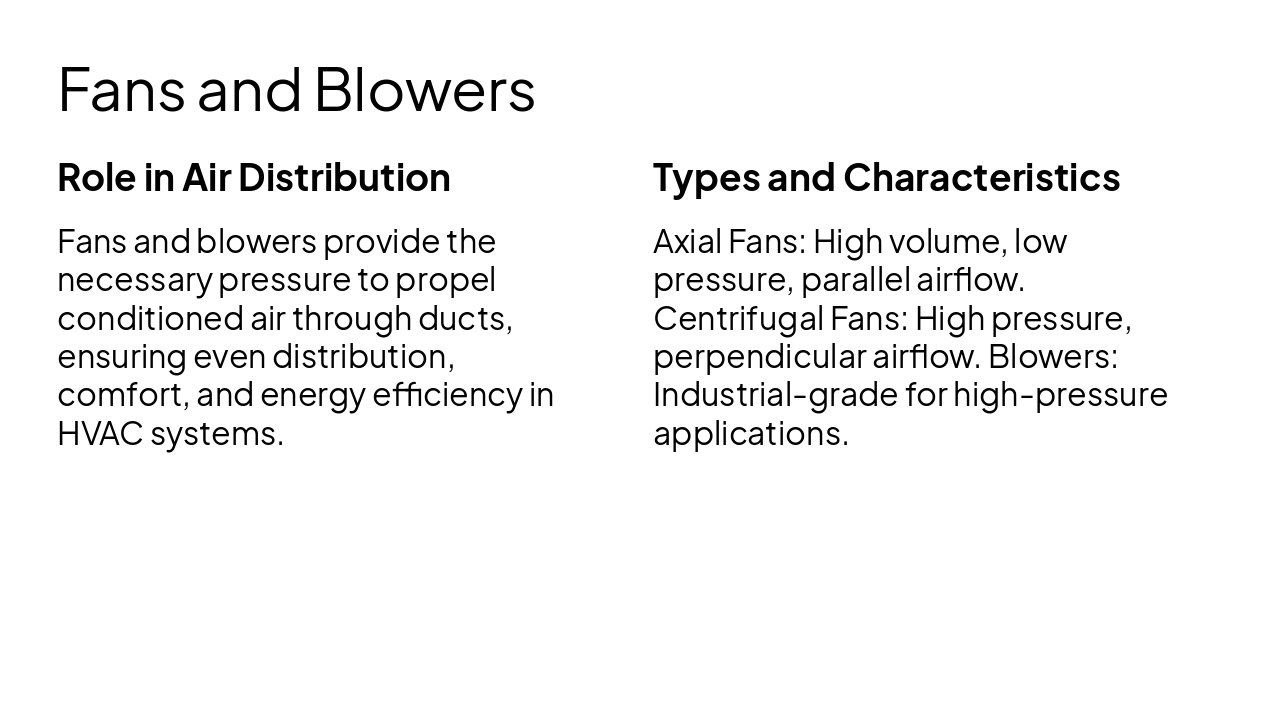
Fans and blowers supply pressure to propel conditioned air through ducts in HVAC systems, ensuring even distribution, comfort, and energy efficiency. Key types include axial fans (high volume, low pressure, parallel airflow), centrifugal fans (high pressure, perpendicular airflow), and industrial blowers for high-pressure applications.

Fans and Blowers

Role in Air DistributionTypes and Characteristics
Fans and blowers provide the necessary pressure to propel conditioned air through ducts, ensuring even distribution, comfort, and energy efficiency in HVAC systems.Axial Fans: High volume, low pressure, parallel airflow. Centrifugal Fans: High pressure, perpendicular airflow. Blowers: Industrial-grade for high-pressure applications.
Speaker Notes
Fans and blowers are the heart of the system. Choosing the right type ensures that air moves efficiently through long ducts or large spaces.
Slide 8 - Fans and Blowers
Slide 9 of 11

Slide 9 - Diffusers and Grilles

Diffusers and grilles deliver conditioned air into rooms. Diffusers ensure even spread without drafts, grilles serve as simple protective covers, and registers add adjustable dampers to grilles.

Diffusers and Grilles

  • Deliver conditioned air into rooms
  • Diffusers: even spread, no drafts
  • Grilles: simple protective covers
  • Registers: grilles with adjustable dampers

Source: Air Distribution System Design

Speaker Notes
These parts affect both comfort and appearance. Proper selection ensures quiet and even airflow inside the room.
Slide 9 - Diffusers and Grilles
Slide 10 of 11

Slide 10 - Summary

The conclusion slide summarizes key HVAC principles with checkmarks: efficient duct design for movement, airflow verification for delivery, fans/blowers for pressure, and diffusers/grilles for direction and comfort. It stresses that balanced design ensures comfort and urges immediate implementation of these principles.

Summary

✔ Duct Design: efficient movement ✔ Airflow: verifies delivery ✔ Fans/Blowers: pressure ✔ Diffusers/Grilles: direction, comfort

Balanced design ensures comfort. Implement these principles today.

Source: Air Distribution System Design

Speaker Notes
In summary, air distribution system design is about achieving balance—ensuring that air moves smoothly, efficiently, and quietly through every part of a building.
Slide 10 - Summary
Slide 11 of 11

Slide 11 - References

This slide, titled "References," lists key resources for HVAC design and engineering. It includes "HVAC Design Fundamentals" by ASHRAE, "Modern Air Conditioning Engineering" by McQuiston & Parker, and "HVAC System Design Manual" by SMACNA.

References

  • HVAC Design Fundamentals, ASHRAE.
  • Modern Air Conditioning Engineering, McQuiston & Parker.
  • HVAC System Design Manual, SMACNA.
Speaker Notes
These are standard references used by engineers and designers in HVAC design.
Slide 11 - References
Powered by AI

Create Your Own Presentation

Generate professional presentations in seconds with Karaf's AI. Customize this presentation or start from scratch.

Create New Presentation

Powered by Karaf.ai — AI-Powered Presentation Generator