Robotics Portfolio: Automation Meets Creativity (42 chars)

Generated from prompt:

로봇공학 석사용 면접 포트폴리오 30페이지 구성. 블루 계열의 테크 감성 스타일로 디자인. 1~3. INTRO 1. 표지 — 이름, 전공, 한 줄 슬로건 (“Automation Meets Creativity”) 2. 소개 — 학력, 관심 연구 분야, 비전 3. 포트폴리오 개요 — 전체 목차 및 핵심 주제 요약 4~7. ACADEMIC BACKGROUND 4. 학부 전공 과정 — 주요 수강 과목 및 프로젝트 5. 로봇공학 기초역량 — ROS, 제어, 센서, AI, Vision 등 6. 기술 스택 다이어그램 — Python, C++, PLC, SolidWorks 등 시각화 7. 연구 관심 분야 — 지능형 자동화, 협동로봇, AI 제어 8~13. AUTOMATION PROJECTS (학부시절 과제 중심) 8. 프로젝트 개요 (“Smart Automation for Efficiency”) 9. 문제 정의 & 목표 10. 시스템 아키텍처 / 설계도 11. 제어 알고리즘 / 코드 일부 시각화 12. 결과 및 개선점 13. 실험 영상 캡처 & 데이터 그래프 14~19. 삼성중공업 DT 인재교육 14. 교육 개요 및 목적 15. DT 교육 커리큘럼 요약 — 데이터 분석, IoT, 디지털 트윈 등 16. 팀 프로젝트 주제 및 역할 17. 사용 기술 및 툴 (Python, TensorFlow, OPC-UA 등) 18. 성과 및 배운 점 19. 피드백 & 수료 인증 이미지 20~26. 삼성중공업 자동화 프로젝트 20. 프로젝트 개요 (“Shipyard Automation System”) 21. 현장 분석 & 문제 정의 22. 제안한 솔루션 개요 23. 로봇 제어 시스템 구성도 24. 데이터 흐름 & 자동화 알고리즘 25. 결과 및 성과지표 26. 향후 개선 방향 27~30. CLOSING & VISION 27. 기술적 성장 요약 — Timeline 그래프 28. 진로 방향 / 연구 목표 29. 감사의 글 / Mentor 언급 30. Contact & QR Portfolio Link

35-slide portfolio for robotics master's interview showcasing academic background (ROS, AI, control), undergrad automation projects, Samsung Heavy Industries DT training & shipyard automation system,

December 13, 202535 slides
Slide 1 of 35

Slide 1 - 포트폴리오 표지

This is a portfolio cover title slide titled "포트폴리오 표지." It displays the main text "Automation Meets Creativity" with a subtitle showing a name and "로봇공학 전공" for robotics major.

Automation Meets Creativity

[이름] 로봇공학 전공

Slide 1 - 포트폴리오 표지
Slide 2 of 35

Slide 2 - 소개

The slide, titled "소개" (Introduction), states the presenter's bachelor's degree in robotics from university. It highlights their interest in intelligent robots and AI control research, plus a vision to lead future industries through automation innovation.

소개

  • [대학] 로봇공학 학사 졸업
  • 지능형 로봇 및 AI 제어 연구 관심
  • 자동화 혁신으로 미래 산업 선도 비전
Slide 2 - 소개
Slide 3 of 35

Slide 3 - 포트폴리오 개요

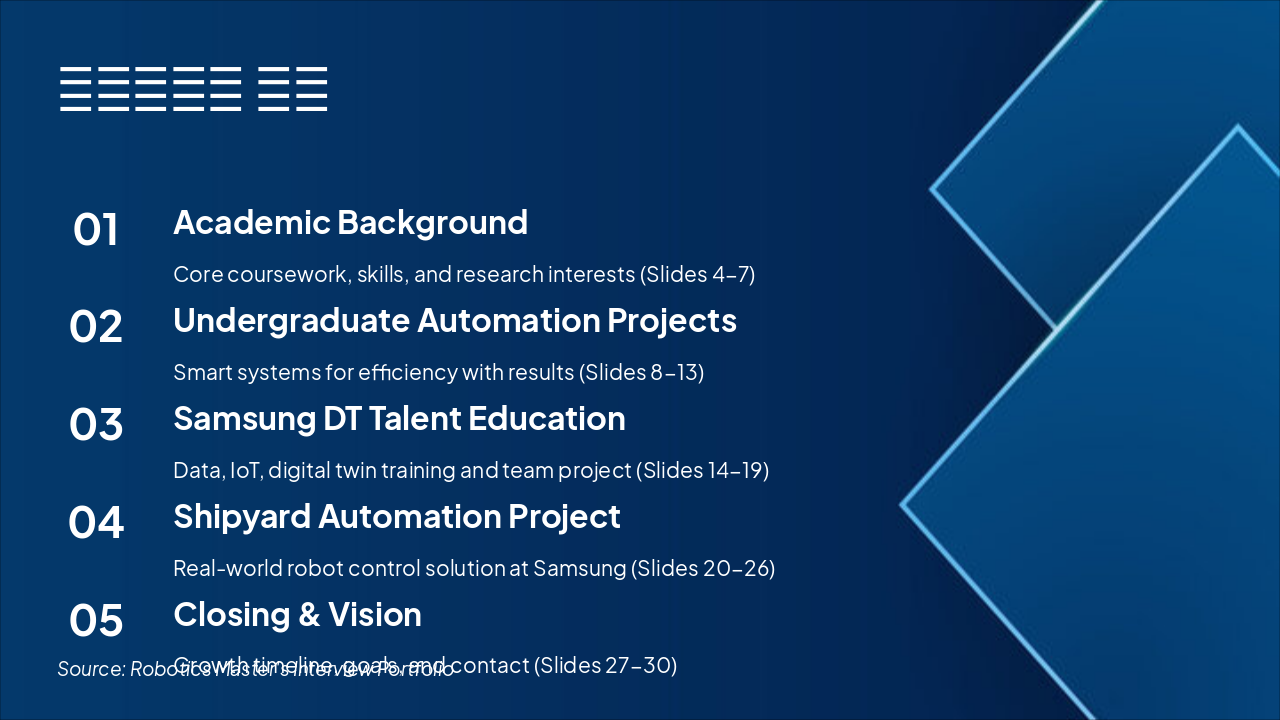
This Portfolio Overview agenda slide outlines the presentation structure across key sections. It covers academic background (Slides 4-7), undergraduate automation projects (8-13), Samsung DT Talent Education (14-19), shipyard automation project (20-26), and closing vision (27-30).

포트폴리오 개요

  1. Academic Background
  2. Core coursework, skills, and research interests (Slides 4-7)

  3. Undergraduate Automation Projects
  4. Smart systems for efficiency with results (Slides 8-13)

  5. Samsung DT Talent Education
  6. Data, IoT, digital twin training and team project (Slides 14-19)

  7. Shipyard Automation Project
  8. Real-world robot control solution at Samsung (Slides 20-26)

  9. Closing & Vision

Growth timeline, goals, and contact (Slides 27-30) Source: Robotics Master's Interview Portfolio

Speaker Notes
Summarize academics, projects, and practical experience across 30 slides.
Slide 3 - 포트폴리오 개요
Slide 4 of 35

Slide 4 - ACADEMIC BACKGROUND

This slide serves as the section header for "ACADEMIC BACKGROUND" (section 04). Its subtitle outlines coverage from undergraduate major courses to research interests.

ACADEMIC BACKGROUND

04

ACADEMIC BACKGROUND

From undergraduate major courses to research interests

Slide 4 - ACADEMIC BACKGROUND
Slide 5 of 35

Slide 5 - 학부 전공 과정

This slide, titled "Undergraduate Major Courses," lists key robotics classes. It covers robot dynamics and kinematics basics, PID control and stabilization, machine vision for image processing, mobile robot navigation projects, and IMU-LiDAR sensor fusion.

학부 전공 과정

  • 로봇학개론: 로봇 동역학 및 키네마틱스 기초 학습
  • 제어공학: PID 제어와 시스템 안정화 이론 습득
  • 머신비전: 이미지 처리 및 객체 인식 기술
  • 모바일 로봇 네비게이션: 경로 계획 프로젝트 구현
  • 센서 융합: IMU·LiDAR 데이터 통합 프로젝트
Slide 5 - 학부 전공 과정
Slide 6 of 35

Slide 6 - 로봇공학 기초역량

This slide, titled "로봇공학 기초역량" (Robotics Basic Competencies), presents a feature grid of four core robotics skills. It covers ROS mastery for scalable apps, PID & MPC control for dynamics, LiDAR-IMU fusion for localization, and CNN-YOLO for real-time vision.

로봇공학 기초역량

{ "features": [ { "icon": "🤖", "heading": "ROS Mastery", "description": "Proficient in Robot Operating System for developing scalable robot applications." }, { "icon": "⚙️", "heading": "PID & MPC Control", "description": "Implemented PID controllers and Model Predictive Control for precise robot dynamics." }, { "icon": "📡", "heading": "LiDAR & IMU Sensors", "description": "Expert in fusing LiDAR and IMU data for accurate localization and mapping." }, { "icon": "🧠", "heading": "CNN & YOLO Vision", "description": "Built CNN models and YOLO detectors for real-time object recognition in robotics." } ] }

Slide 6 - 로봇공학 기초역량
Slide 7 of 35

Slide 7 - 기술 스택 다이어그램

The slide is a technology stack diagram outlining four layers: High-Level Logic (Python with ROS2/Gazebo), Real-Time Processing (C++ with ROS2 bridges), Industrial Control (PLC with OPC-UA/EtherCAT), and Mechanical Design (SolidWorks with ROS2 simulation). Each layer specifies key functions and integrations for a robotics or automation workflow.

기술 스택 다이어그램

{ "headers": [ "Layer", "Technology", "Key Functions", "Integration" ], "rows": [ [ "High-Level Logic", "Python", "ROS2 Nodes, AI/ML Scripting", "ROS2, Gazebo" ], [ "Real-Time Processing", "C++", "Performance Optimization, Drivers", "ROS2 Bridges" ], [ "Industrial Control", "PLC", "Hardware I/O, Safety Control", "OPC-UA, EtherCAT" ], [ "Mechanical Design", "SolidWorks", "CAD Modeling, URDF Export", "ROS2 Simulation" ] ] }

Speaker Notes
Python → C++ → PLC → SolidWorks 통합: ROS2, Gazebo 시뮬레이션
Slide 7 - 기술 스택 다이어그램
Slide 8 of 35

Slide 8 - 연구 관심 분야

This slide lists research interests under the title "연구 관심 분야" (Research Interests). It highlights intelligent automation for maximizing production efficiency and smart manufacturing, collaborative robots (cobots) for safe human-robot collaboration, and AI-based control systems for adaptive robot motion optimization.

연구 관심 분야

  • 지능형 자동화: 생산 효율성 극대화 및 스마트 제조
  • 협동로봇(Cobots): 인간-로봇 안전 협업 기술 개발
  • AI 기반 제어 시스템: 적응형 로봇 동작 최적화
Slide 8 - 연구 관심 분야
Slide 9 of 35

Slide 9 - AUTOMATION PROJECTS

This slide serves as the section header for Section 08 titled "AUTOMATION PROJECTS." It includes the subtitle "Undergraduate Smart Automation Projects for Enhanced Efficiency."

08

AUTOMATION PROJECTS

Undergraduate Smart Automation Projects for Enhanced Efficiency

Slide 9 - AUTOMATION PROJECTS
Slide 10 of 35

Slide 10 - 프로젝트 개요

This title slide, named "프로젝트 개요" (Project Overview), features the main text "Smart Automation for Efficiency." The subtitle reads "효율적 자동화 시스템 개발," meaning "Development of an Efficient Automation System."

Smart Automation for Efficiency

효율적 자동화 시스템 개발

Source: Smart Automation for Efficiency Portfolio

Slide 10 - 프로젝트 개요
Slide 11 of 35

Slide 11 - 문제 정의 & 목표

The slide highlights problems like high manual labor dependency reducing production efficiency, frequent human errors, and safety risks from repetitive tasks. It sets goals for 30% efficiency gains through automation, error minimization, work standardization, and cost savings via process optimization.

문제 정의 & 목표

  • 수작업 의존도 높아 생산 효율 저하
  • 반복 작업으로 인간 오류 빈발 및 안전 위험
  • 자동화 도입으로 30% 효율 향상 목표
  • 오류 최소화 및 작업 표준화 달성
  • 프로세스 최적화로 비용 절감 기대
Slide 11 - 문제 정의 & 목표
Slide 12 of 35

Slide 12 - 시스템 아키텍처 / 설계도

This slide outlines a ROS-based system architecture workflow across four phases: Sensor Input (Camera, LiDAR, IMU publishing to /sensordata), Perception & Planning (processing to /plannedpath), Control (to /controlcmd), and Actuator Output (to hardware). Each phase lists key components, data flows via ROS topics, and associated nodes like sensorpublishernode and controlnode.

시스템 아키텍처 / 설계도

{ "headers": [ "Phase", "Key Components", "Data Flow", "ROS Nodes" ], "rows": [ [ "Sensor Input", "Camera, LiDAR, IMU", "Raw Signals → /sensordata", "sensorpublishernode" ], [ "Perception & Planning", "Computer Vision, Path Planner", "/sensordata → /plannedpath", "perceptionnode, plannernode" ], [ "Control", "PID Controller, Motion Control", "/plannedpath → /controlcmd", "controlnode" ], [ "Actuator Output", "Motors, Grippers, Servos", "/controlcmd → Hardware Execution", "actuatordriver_node" ] ] }

Source: ROS Node-based Robot Control Architecture

Speaker Notes
센서 입력부터 액추에이터 출력까지의 데이터 흐름을 설명하세요. ROS 노드의 모듈러 설계가 로봇 제어의 유연성과 확장성을 어떻게 제공하는지 강조.

Slide 12 - 시스템 아키텍처 / 설계도
Slide 13 of 35

Slide 13 - 제어 알고리즘 / 코드 시각화

The slide visualizes a Python PID control algorithm with Kp, Ki, and Kd tuning parameters. It features a control loop flowchart (error → PID → actuator), real-time robot simulation stability, and code snippets emphasizing error accumulation and derivative calculations.

제어 알고리즘 / 코드 시각화

!Image

  • Python PID implementation with Kp, Ki, Kd tuning
  • Control loop flowchart: error → PID → actuator
  • Real-time stability achieved in robot simulation
  • Snippet highlights error accumulation and derivative

Source: Wikipedia PID Controller & Custom Python Snippet

Speaker Notes
PID 제어 코드 스니펫 및 플로우차트 Python 구현 예시
Slide 13 - 제어 알고리즘 / 코드 시각화
Slide 14 of 35

Slide 14 - 결과 및 개선점

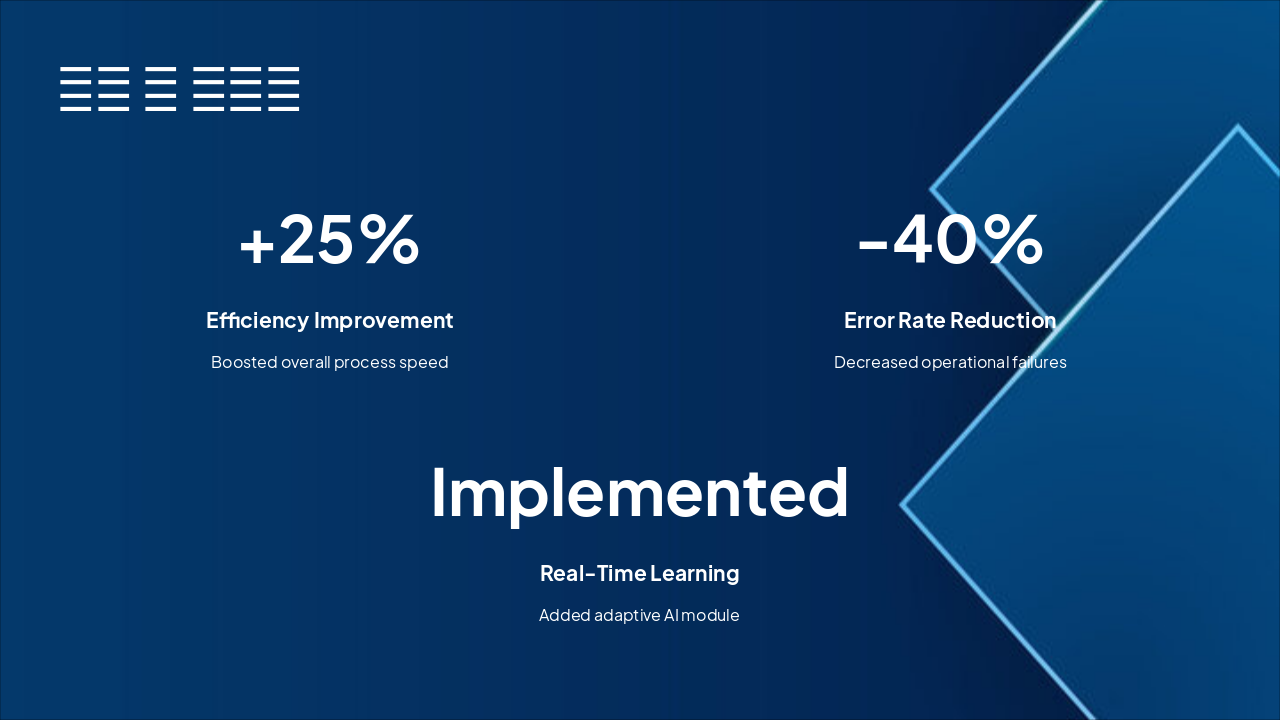
The slide "결과 및 개선점" showcases key stats: a +25% efficiency improvement boosting process speed and a -40% error rate reduction decreasing operational failures. It also highlights the implementation of real-time learning via an adaptive AI module.

결과 및 개선점

  • +25%: Efficiency Improvement
  • Boosted overall process speed

  • -40%: Error Rate Reduction
  • Decreased operational failures

  • Implemented: Real-Time Learning
  • Added adaptive AI module

Slide 14 - 결과 및 개선점
Slide 15 of 35

Slide 15 - 실험 영상 캡처 & 데이터 그래프

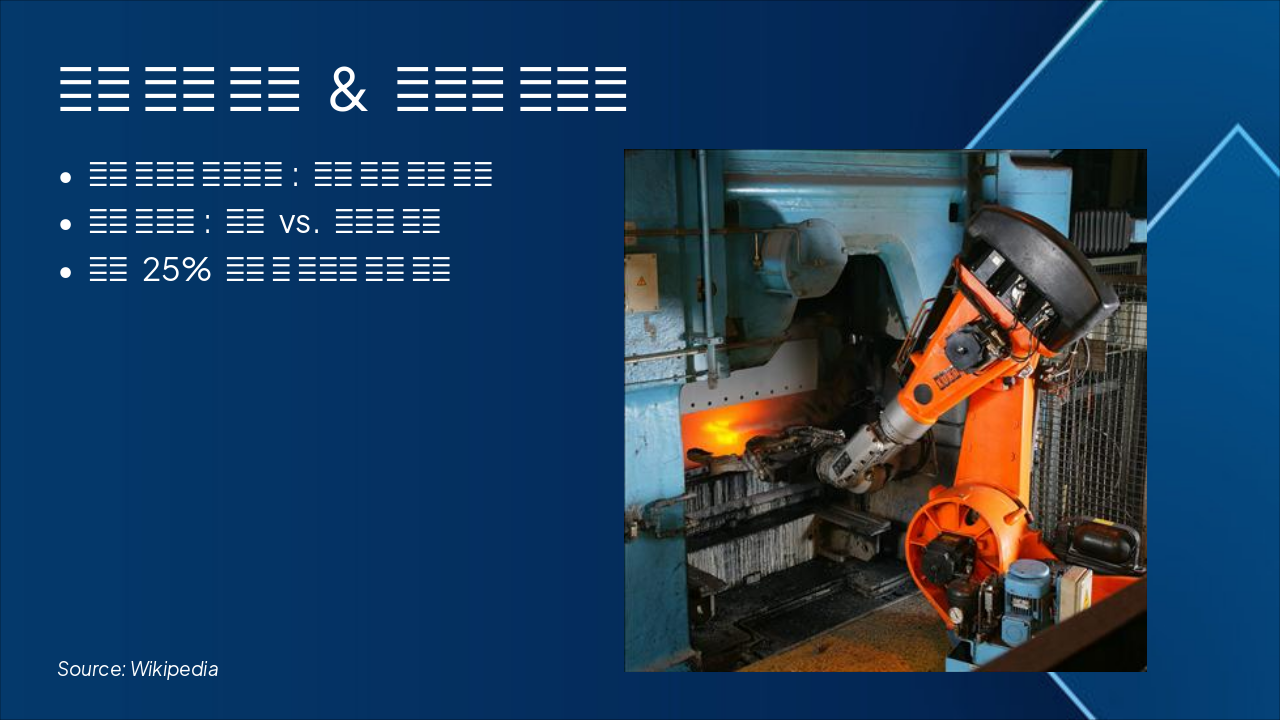
The slide shows screenshots from experiment videos capturing key robot motion scenes. It includes a performance graph of time versus efficiency trends, demonstrating a 25% efficiency improvement and shortened cycle time.

실험 영상 캡처 & 데이터 그래프

!Image

  • 실험 동영상 스크린샷: 로봇 동작 주요 장면
  • 성능 그래프: 시간 vs. 효율성 추이
  • 효율 25% 향상 및 사이클 타임 단축

Source: Wikipedia

Speaker Notes
Highlight experiment visuals and performance data for robotics automation project.
Slide 15 - 실험 영상 캡처 & 데이터 그래프
Slide 16 of 35

Slide 16 - Samsung Heavy Industries DT Talent Education

This slide serves as the section header for Section 14, titled "Samsung Heavy Industries DT Talent Education." The subtitle describes participation experiences and major achievements in Digital Transformation (DT) education programs.

Samsung Heavy Industries DT Talent Education

14

삼성중공업 DT 인재교육

디지털 트랜스포메이션(DT) 교육 프로그램 참여 경험 및 주요 성과

Source: 로봇공학 석사용 면접 포트폴리오

Speaker Notes
디지털 트랜스포메이션 교육 경험 강조
Slide 16 - Samsung Heavy Industries DT Talent Education
Slide 17 of 35

Slide 17 - 교육 개요 및 목적

This slide, titled "Education Overview and Purpose," specifies the training period as [기간]. It aims to strengthen shipyard DT capabilities while targeting the fostering of future talents.

교육 개요 및 목적

  • 교육 기간: [기간]
  • 교육 목적: 조선소 DT 역량 강화
  • 교육 대상: 미래 인재 양성
Slide 17 - 교육 개요 및 목적
Slide 18 of 35

Slide 18 - DT 교육 커리큘럼 요약

The slide summarizes the DT education curriculum in a table covering three fields: Data Analysis, IoT, and Digital Twin. It lists key contents—data processing/visualization (Python, Pandas, Matplotlib), sensor connection/data collection (AWS IoT, OPC-UA), and virtual modeling/simulation (Unity, 3D Rendering)—alongside relevant technologies/tools.

DT 교육 커리큘럼 요약

{ "headers": [ "분야", "주요 내용", "기술/도구" ], "rows": [ [ "데이터 분석", "데이터 처리 및 시각화", "Python, Pandas, Matplotlib" ], [ "IoT", "센서 연결 및 데이터 수집", "AWS IoT, OPC-UA" ], [ "디지털 트윈", "가상 모델링 및 시뮬레이션", "Unity, 3D Rendering" ] ] }

Source: 삼성중공업 DT 인재교육

Slide 18 - DT 교육 커리큘럼 요약
Slide 19 of 35

Slide 19 - 팀 프로젝트 주제 및 역할

The slide outlines the team project on a Ship Production IoT Monitoring System, with the presenter's role as Algorithm Development Team Leader. Key responsibilities include designing real-time data analysis algorithms, leading IoT data integration and optimization, and aiming to improve production efficiency and quality.

팀 프로젝트 주제 및 역할

  • 프로젝트 주제: 선박 생산 IoT 모니터링 시스템
  • 역할: 알고리즘 개발 팀 리더
  • 주요 책임: 실시간 데이터 분석 알고리즘 설계
  • 팀 협업: IoT 데이터 통합 및 최적화 주도
  • 목표: 생산 효율성 및 품질 향상

Source: 삼성중공업 DT 인재교육

Speaker Notes
삼성중공업 DT 교육 팀 프로젝트 소개. 주제는 선박 생산 IoT 모니터링, 알고리즘 개발 리더 역할 강조. 다음 슬라이드 기술 연결.
Slide 19 - 팀 프로젝트 주제 및 역할
Slide 20 of 35

Slide 20 - 사용 기술 및 툴

This slide, titled "사용 기술 및 툴" (Technologies and Tools Used), features a grid highlighting four key technologies: Python for automation scripts and data analysis, TensorFlow for machine learning models and AI control systems, OPC-UA for real-time industrial data exchange, and MQTT for efficient IoT pub/sub messaging. Each entry includes an icon and a concise description of its primary application.

사용 기술 및 툴

{ "features": [ { "icon": "🐍", "heading": "Python 프로그래밍", "description": "자동화 스크립트, 데이터 처리 및 분석 구현에 핵심 활용." }, { "icon": "🧠", "heading": "TensorFlow 프레임워크", "description": "기계학습 모델 개발과 AI 기반 제어 시스템 적용." }, { "icon": "🔌", "heading": "OPC-UA 통신", "description": "산업 설비 간 실시간 데이터 교환 및 통합 표준." }, { "icon": "📡", "heading": "MQTT 프로토콜", "description": "경량 IoT 메시징을 위한 효율적인 pub/sub 통신." } ] }

Source: 삼성중공업 DT 인재교육

Slide 20 - 사용 기술 및 툴
Slide 21 of 35

Slide 21 - 성과 및 배운 점

The slide highlights key achievements, including the successful completion of the Shipyard DT prototype, strengthened multidisciplinary team collaboration, adherence to data ethics principles, and a 20% efficiency gain via simulation. It also notes lessons learned, such as insights into scalable automation solutions.

성과 및 배운 점

  • 프로토타입 완성: Shipyard DT 시스템 성공 구축
  • 산업 협업: 다학제 팀 프로젝트 경험 강화
  • 데이터 윤리: 실무 적용 원칙 학습 및 준수
  • 성과 지표: 시뮬레이션 통해 효율성 20% 향상
  • 배운 점: 확장 가능한 자동화 솔루션 인사이트 획득
Slide 21 - 성과 및 배운 점
Slide 22 of 35

Slide 22 - 피드백 & 수료 인증

The slide "Feedback & Completion Certification" highlights positive instructor feedback on project innovativeness and excellent completion of all Digital Twin training modules. It also features the official Samsung Heavy Industries DT Talent Education certificate and recognition of robot automation skills.

피드백 & 수료 인증

!Image

  • 강사로부터 프로젝트 혁신성에 대한 긍정 피드백 수령
  • 디지털 트윈 교육 과정 모든 모듈 우수 성적 완료
  • 삼성중공업 DT 인재교육 수료증 공식 발급
  • 로봇 자동화 기술 역량 공식 인정

Source: Professional certification

Speaker Notes
Showcases instructor feedback and official completion certificate from Samsung DT training.
Slide 22 - 피드백 & 수료 인증
Slide 23 of 35

Slide 23 - 삼성중공업 자동화 프로젝트

This section header slide, titled "Samsung Heavy Industries Automation Project," marks Section 22. It presents the "Overview of Proposed Solution" with a subtitle on intelligent automation solutions to optimize shipyard welding and assembly processes.

삼성중공업 자동화 프로젝트

22

제안한 솔루션 개요

Intelligent automation solutions to optimize shipyard welding and assembly processes

Source: Shipyard 실무 프로젝트

Speaker Notes
Highlight the key proposed solutions for shipyard automation, emphasizing robotics and AI integration.
Slide 23 - 삼성중공업 자동화 프로젝트
Slide 24 of 35

Slide 24 - 프로젝트 개요

This title slide, labeled "프로젝트 개요" (Project Overview), presents the main title "Shipyard Automation System." The subtitle in Korean reads "조선소 자동화 솔루션," highlighting a shipyard automation solution.

Shipyard Automation System

조선소 자동화 솔루션

Source: Shipyard Automation System 조선소 자동화 솔루션

Slide 24 - 프로젝트 개요
Slide 25 of 35

Slide 25 - 현장 분석 & 문제 정의

The slide analyzes on-site block movement, dominated by manual handling of heavy objects. It highlights problems like high accident risks (falls, collisions), low efficiency and productivity, worker fatigue from repetitive labor, and challenging conditions such as narrow spaces and poor visibility.

현장 분석 & 문제 정의

  • 블록 이동: 수작업 중심, 중량물 취급
  • 안전 문제: 사고 위험(낙하, 충돌) 높음
  • 효율 저하: 생산성 낮음, 작업 시간 과다
  • 작업자 피로: 반복 노동으로 인한 건강 이슈
  • 현장 환경: 협소 공간, 가시성 부족
Slide 25 - 현장 분석 & 문제 정의
Slide 26 of 35

Slide 26 - 제안한 솔루션 개요

The slide outlines the proposed solution introducing AGV robots for automated material transport. It highlights AI-based path optimization, real-time obstacle avoidance, seamless PLC integration, and scalable fleet management.

제안한 솔루션 개요

  • AGV 로봇 도입으로 자재 운송 자동화
  • AI 기반 경로 최적화로 이동 시간 단축
  • 실시간 장애물 회피 및 안전 기능 강화
  • 기존 PLC 시스템과 원활한 연동
  • 확장 가능한 로봇 플릿 관리 지원
Slide 26 - 제안한 솔루션 개요
Slide 27 of 35

Slide 27 - 로봇 제어 시스템 구성도

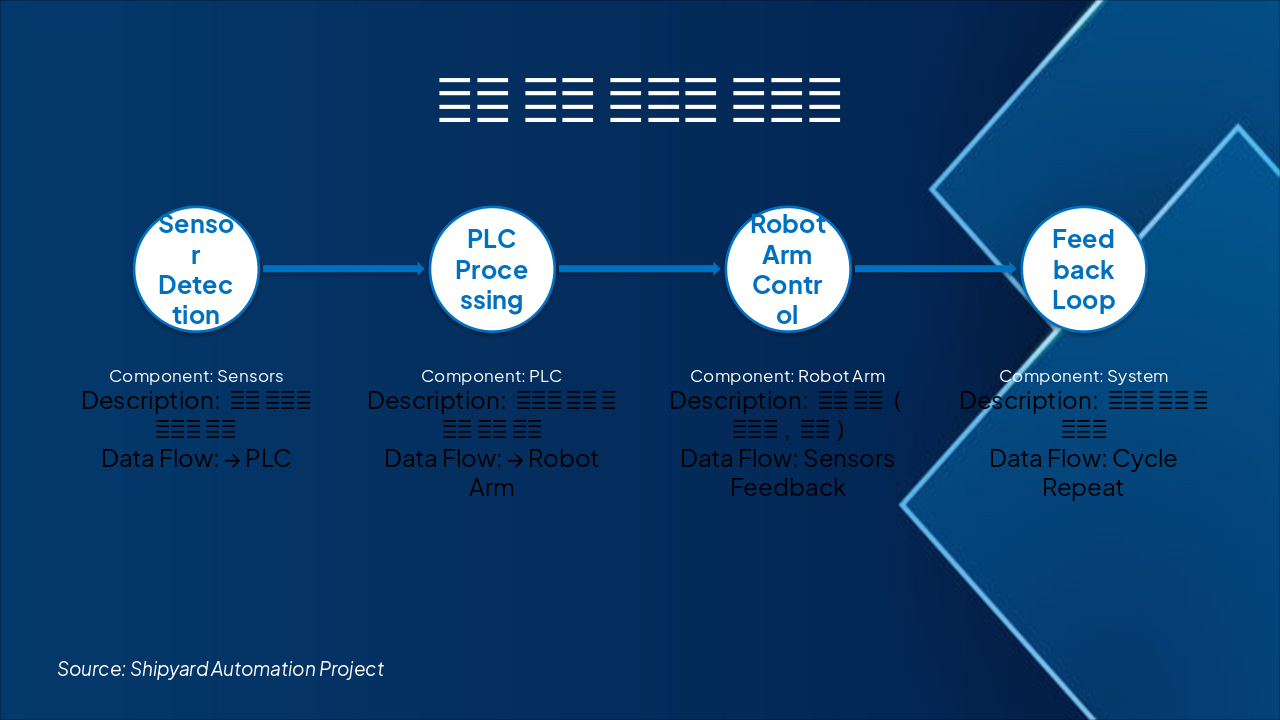
The slide outlines a robot control system workflow: sensors collect real-time environmental data and send it to the PLC for analysis and command generation, which directs the robot arm to execute tasks like movement and manipulation. A feedback loop from the robot arm to sensors enables real-time adjustments, optimization, and cycle repetition.

로봇 제어 시스템 구성도

{ "headers": [ "Step", "Component", "Description", "Data Flow" ], "rows": [ [ "Sensor Detection", "Sensors", "환경 데이터 실시간 수집", "→ PLC" ], [ "PLC Processing", "PLC", "데이터 분석 및 제어 명령 생성", "→ Robot Arm" ], [ "Robot Arm Control", "Robot Arm", "작업 실행 (움직임, 조작)", "Sensors Feedback" ], [ "Feedback Loop", "System", "실시간 조정 및 최적화", "Cycle Repeat" ] ] }

Source: Shipyard Automation Project

Speaker Notes
센서에서 로봇 팔까지의 실시간 제어 흐름 강조. 피드백 루프로 정밀 제어 구현.
Slide 27 - 로봇 제어 시스템 구성도
Slide 28 of 35

Slide 28 - 데이터 흐름 & 자동화 알고리즘

The workflow depicts shipyard data flow starting with real-time IoT sensor acquisition via OPC-UA and MQTT, followed by secure cloud storage using AWS IoT Core and Kafka. It then executes AI/ML automation with Python and TensorFlow for control decisions, ending with command dispatch to robots and PLCs via OPC-UA and REST APIs.

데이터 흐름 & 자동화 알고리즘

{ "headers": [ "Stage", "Description", "Technologies", "Output" ], "rows": [ [ "IoT Data Acquisition", "Real-time data collection from shipyard sensors and equipment", "IoT Sensors, OPC-UA, MQTT", "Raw Data Stream" ], [ "Cloud Ingestion & Storage", "Secure upload and storage of data in cloud platform", "AWS IoT Core, Kafka", "Processed Data in Cloud" ], [ "Automation Algorithm Execution", "AI/ML analysis for decision-making and optimization", "Python, TensorFlow, Custom Algorithms", "Control Decisions" ], [ "Command Dispatch", "Issuance of control signals to robots and PLCs", "OPC-UA, REST APIs", "Executed Control Commands" ] ] }

Source: IoT 데이터 → 클라우드 → 제어 명령

Speaker Notes
로봇공학 석사용 면접 포트폴리오: 삼성중공업 자동화 프로젝트의 데이터 흐름과 자동화 알고리즘을 시각화. IoT 센서에서 수집된 데이터를 클라우드로 전송해 AI 기반 분석 후 제어 명령을 발행하는 프로세스.
Slide 28 - 데이터 흐름 & 자동화 알고리즘
Slide 29 of 35

Slide 29 - 결과 및 성과지표

The slide showcases key results with a 35% productivity increase, 99.5% system uptime, and 28% cost savings. It also reports zero safety incidents throughout the project.

결과 및 성과지표

  • +35%: Productivity Increase
  • Overall efficiency boosted by 35%

  • 0: Safety Incidents
  • Zero accidents throughout project

  • 99.5%: System Uptime
  • Achieved near-perfect operational reliability

  • 28%: Cost Savings

Reduced operational expenses significantly Source: Samsung Heavy Industries Shipyard Automation Project

Slide 29 - 결과 및 성과지표
Slide 30 of 35

Slide 30 - 향후 개선 방향

Future improvements include 5G integration for real-time low-latency communication and multi-robot collaboration systems. Further enhancements involve AI predictive maintenance, edge computing for data optimization, and digital twin expansion for advanced simulations.

향후 개선 방향

  • 5G 연동으로 실시간 저지연 통신 강화
  • 멀티 로봇 협업 시스템 개발 및 통합
  • AI 기반 예측 유지보수 기능 추가
  • 엣지 컴퓨팅 도입으로 데이터 처리 최적화
  • 디지털 트윈 확장을 통한 시뮬레이션 향상
Slide 30 - 향후 개선 방향
Slide 31 of 35

Slide 31 - CLOSING & VISION

This section header slide is titled "Closing & Vision" and spans sections 27-30. Its subtitle highlights wrapping up achievements and envisioning the future in robotics.

CLOSING & VISION

27-30

Closing & Vision

Wrapping up achievements and envisioning the future in robotics

Source: 로봇공학 석사용 면접 포트폴리오

Slide 31 - CLOSING & VISION
Slide 32 of 35

Slide 32 - 기술적 성장 요약

This timeline summarizes technical growth from 2020-2024, starting with undergraduate ROS foundation in robotics skills (2020-2022) and Samsung DT training in IoT, data analysis, and digital twins (2023 Q1-Q2). It progresses to PLC programming for shipyard automation (2023 Q3) and full PLC-based system deployment for industrial robotics efficiency (2024).

기술적 성장 요약

2020-2022: Undergraduate ROS Foundation Developed core robotics skills with ROS, control, sensors, and vision systems. 2023 Q1-Q2: DT Talent Education Program Completed Samsung DT training in IoT, data analysis, and digital twins. 2023 Q3: PLC Practical Training Start Transitioned to real-world PLC programming for shipyard automation. 2024: Full Automation Integration Deployed PLC-based systems enhancing efficiency in industrial robotics.

Slide 32 - 기술적 성장 요약
Slide 33 of 35

Slide 33 - 진로 방향 / 연구 목표

The slide outlines a master's focus on collaborative robot AI research, aiming to become an industrial innovation leader. Key goals include developing human-robot collaboration tech, commercializing intelligent automation systems, and advancing Industry 4.0 in shipbuilding.

진로 방향 / 연구 목표

  • 석사 과정: 협동로봇 AI 연구 집중
  • 목표: 산업 혁신 리더 되기
  • 인간-로봇 협업 기술 개발
  • 지능형 자동화 시스템 상용화
  • 조선업 Industry 4.0 선도 기여

Source: 로봇공학 석사용 면접 포트폴리오

Speaker Notes
미래 진로와 연구 목표를 간결히 요약하여 열정 전달
Slide 33 - 진로 방향 / 연구 목표
Slide 34 of 35

Slide 34 - 감사의 글

This slide, titled "감사의 글" (Words of Gratitude), features a quote thanking a mentor for valuable advice and dedicated guidance that illuminated the author's robotics research journey. The quote, from [이름], a robotics master's applicant who completed Samsung Heavy Industries DT Talent Education, notes that this portfolio is part of that mentorship's fruit.

감사의 글

> 멘토님의 지도에 감사드립니다. 귀중한 조언과 헌신적인 지도로 로봇공학 연구 여정을 밝혀주신 멘토님께 깊은 감사의 마음을 전합니다. 이 포트폴리오가 그 열매의 일부입니다.

— [이름], 로봇공학 석사 과정 지원자 (삼성중공업 DT 인재교육 수료)

Source: 로봇공학 석사 면접 포트폴리오

Speaker Notes
멘토님의 지도에 대한 감사 표현. 블루 계열 테크 감성.
Slide 34 - 감사의 글
Slide 35 of 35

Slide 35 - Contact & QR

This title slide is named "Contact & QR." It features contact details including an email, LinkedIn link, and a QR code for portfolio download.

Contact & QR

Email: [이메일] | LinkedIn: [링크] | QR: 포트폴리오 다운로드

Source: 로봇공학 석사용 면접 포트폴리오

Slide 35 - Contact & QR

Discover More Presentations

Explore thousands of AI-generated presentations for inspiration

Browse Presentations
Powered by AI

Create Your Own Presentation

Generate professional presentations in seconds with Karaf's AI. Customize this presentation or start from scratch.

Create New Presentation

Powered by Karaf.ai — AI-Powered Presentation Generator