AI History: Turing to Transformers (32 chars)

Generated from prompt:

make a presentation about the history of artificial intelligence

Traces AI from 1940s pioneers (Turing, Wiener), 1956 birth, 1970s-90s winters, 2000s ML resurgence, 2010s deep learning (AlexNet, Transformers), to ethical future. (168 chars)

December 7, 202512 slides
Slide 1 of 12

Slide 1 - The History of Artificial Intelligence

This is a title slide titled "The History of Artificial Intelligence." Its subtitle describes exploring AI's evolution from early concepts to today's transformative technologies.

The History of Artificial Intelligence

Exploring the evolution of AI from early concepts to today's transformative technologies.

Slide 1 - The History of Artificial Intelligence
Slide 2 of 12

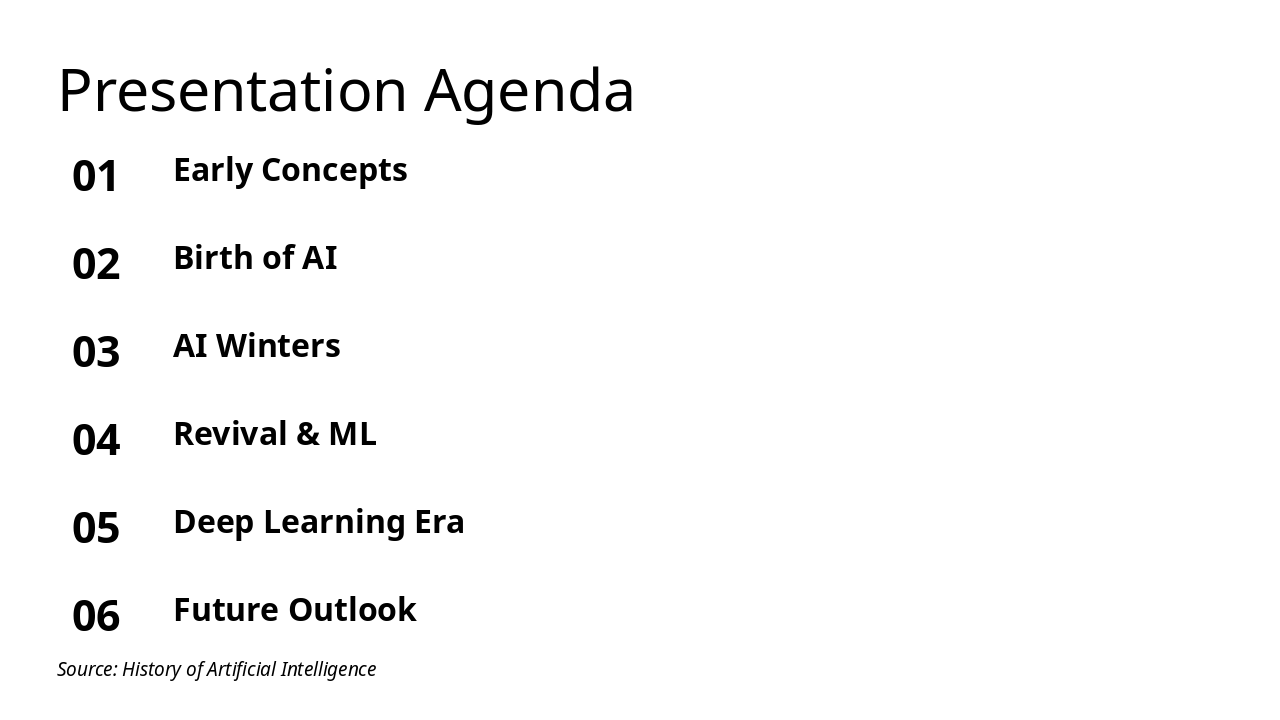
Slide 2 - Presentation Agenda

This agenda slide outlines a presentation on AI's evolution. It covers early concepts, the birth of AI, AI winters, revival with ML, the deep learning era, and future outlook.

Presentation Agenda

  1. Early Concepts
  2. Birth of AI
  3. AI Winters
  4. Revival & ML
  5. Deep Learning Era
  6. Future Outlook

Source: History of Artificial Intelligence

Slide 2 - Presentation Agenda
Slide 3 of 12

Slide 3 - Early Concepts (1940s-1950s)

This section header slide introduces Section 02, titled "Early Concepts (1940s-1950s)." Its subtitle describes foundational ideas in computation and intelligence.

02

Early Concepts (1940s-1950s)

Foundational ideas in computation and intelligence.

Slide 3 - Early Concepts (1940s-1950s)
Slide 4 of 12

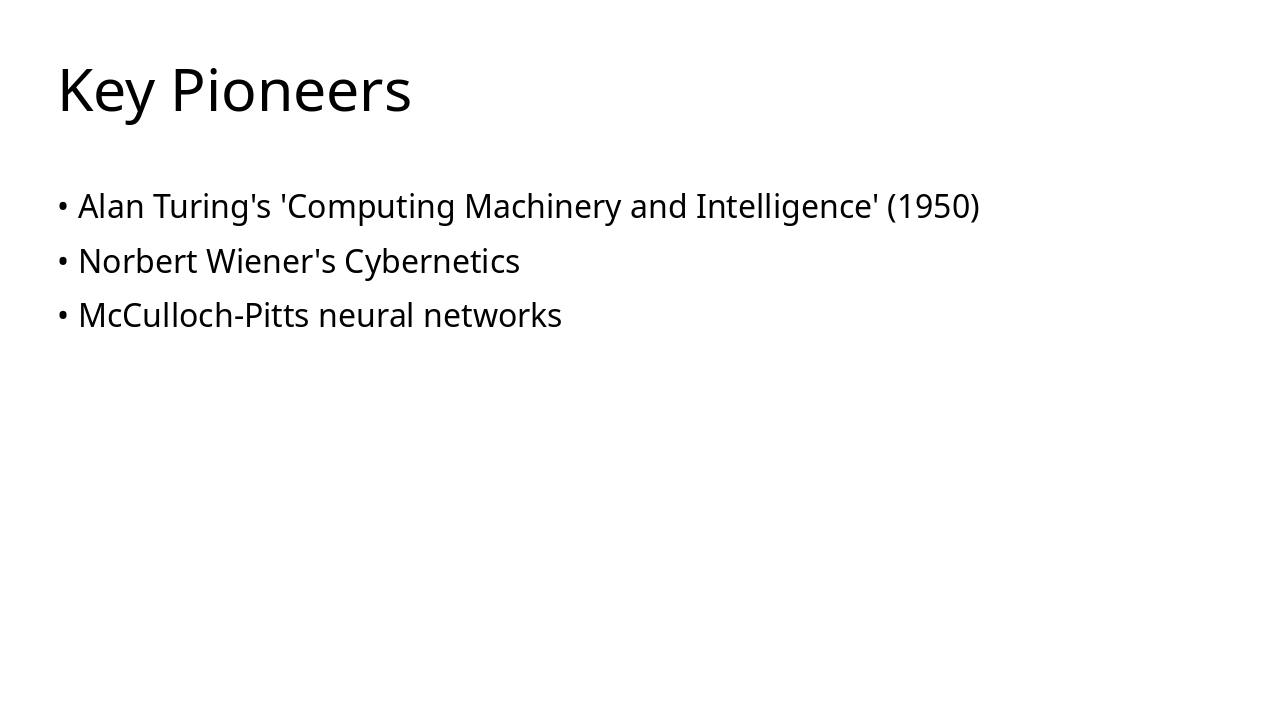
Slide 4 - Key Pioneers

The "Key Pioneers" slide highlights foundational AI contributions. It lists Alan Turing's 1950 paper "Computing Machinery and Intelligence," Norbert Wiener's Cybernetics, and McCulloch-Pitts neural networks.

Key Pioneers

  • Alan Turing's 'Computing Machinery and Intelligence' (1950)
  • Norbert Wiener's Cybernetics
  • McCulloch-Pitts neural networks
Slide 4 - Key Pioneers
Slide 5 of 12

Slide 5 - Turing's Famous Question

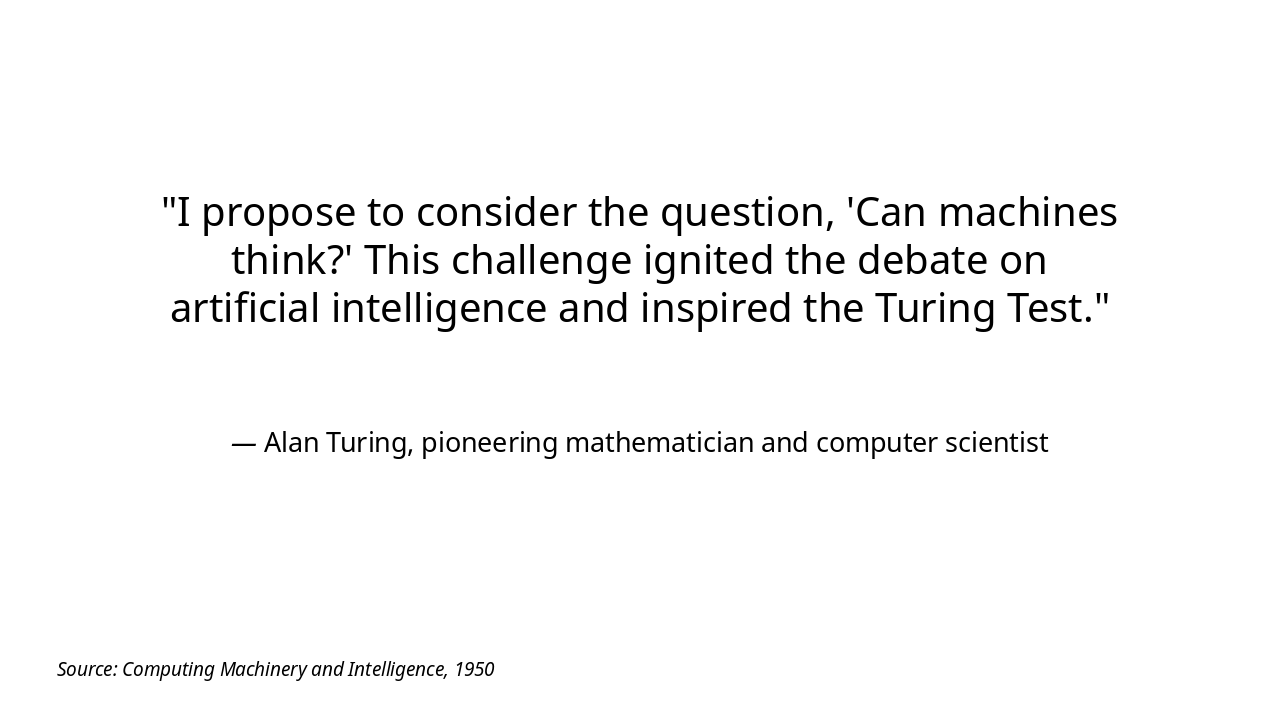
The slide, titled "Turing's Famous Question," presents a quote from Alan Turing proposing: "Can machines think?" This question ignited AI debates and inspired the Turing Test, crediting Turing as a pioneering mathematician and computer scientist.

Turing's Famous Question

> I propose to consider the question, 'Can machines think?' This challenge ignited the debate on artificial intelligence and inspired the Turing Test.

— Alan Turing, pioneering mathematician and computer scientist

Source: Computing Machinery and Intelligence, 1950

Speaker Notes
"Can machines think?" - Alan Turing, laying groundwork for AI debate and Turing Test. Context: make a presentation about the history of artificial intelligence
Slide 5 - Turing's Famous Question
Slide 6 of 12

Slide 6 - Birth of AI (1956)

In 1956, the Dartmouth Conference coined the term "Artificial Intelligence" and Newell and Simon developed the first AI program, Logic Theorist. The next years brought Frank Rosenblatt's Perceptron neural network in 1957 and initial US government funding for AI research in 1958.

Birth of AI (1956)

1956: Dartmouth Conference Convened John McCarthy organizes workshop; coins term 'Artificial Intelligence' for machine intelligence simulation. 1956: Logic Theorist Developed Newell and Simon create first AI program, proving theorems in Principia Mathematica automatically. 1957: Perceptron Introduced Frank Rosenblatt invents Perceptron, pioneering single-layer neural network for pattern recognition. 1958: Early AI Funding Begins US government invests in AI research post-Dartmouth, fueling perceptron and logic advancements.

Source: History of Artificial Intelligence

Slide 6 - Birth of AI (1956)
Slide 7 of 12

Slide 7 - AI Winters (1970s-1990s)

This section header slide, numbered 06, is titled "AI Winters (1970s-1990s)." It defines these as periods of reduced funding caused by overhyped expectations.

AI Winters (1970s-1990s)

06

AI Winters (1970s-1990s)

Periods of reduced funding due to overhyped expectations.

Speaker Notes
Periods of reduced funding due to overhyped expectations. Context: Presentation on the history of artificial intelligence.
Slide 7 - AI Winters (1970s-1990s)
Slide 8 of 12

Slide 8 - First & Second Winters

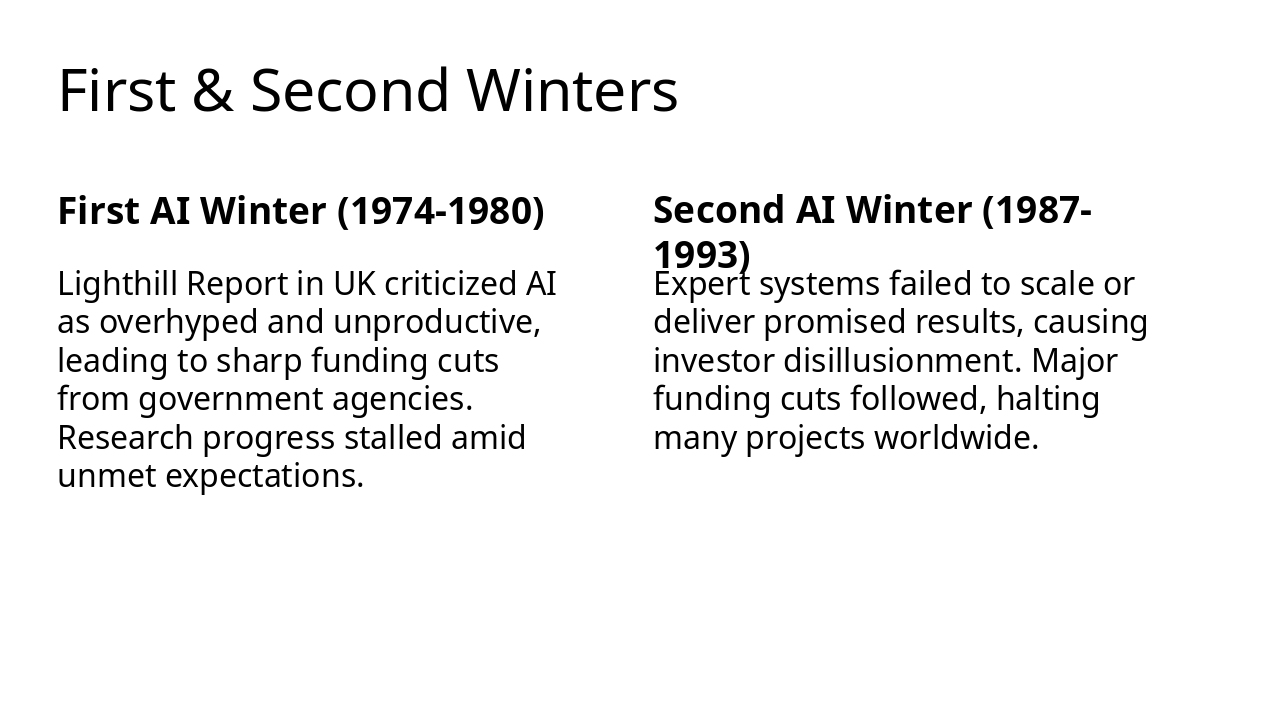
The slide outlines the First AI Winter (1974-1980), sparked by the Lighthill Report's criticism of AI as overhyped, which caused sharp government funding cuts and stalled research. It also covers the Second AI Winter (1987-1993), driven by expert systems' failure to scale, leading to investor disillusionment and major global funding reductions.

First & Second Winters

First AI Winter (1974-1980)Second AI Winter (1987-1993)
Lighthill Report in UK criticized AI as overhyped and unproductive, leading to sharp funding cuts from government agencies. Research progress stalled amid unmet expectations.Expert systems failed to scale or deliver promised results, causing investor disillusionment. Major funding cuts followed, halting many projects worldwide.
Slide 8 - First & Second Winters
Slide 9 of 12

Slide 9 - Key Milestones Stats

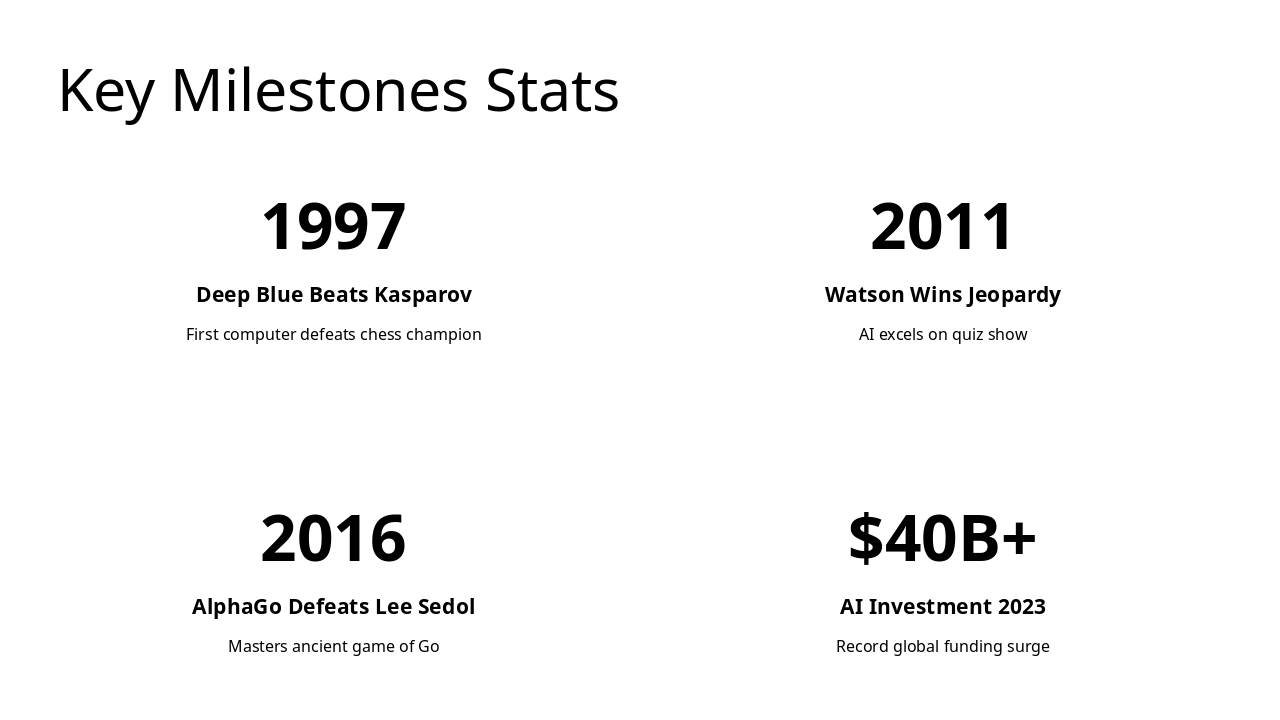
The "Key Milestones Stats" slide highlights major AI achievements: Deep Blue defeating chess champion Kasparov in 1997, Watson winning Jeopardy in 2011, and AlphaGo beating Lee Sedol at Go in 2016. It also notes a record surge of $40B+ in global AI investments in 2023.

Key Milestones Stats

  • 1997: Deep Blue Beats Kasparov
  • First computer defeats chess champion

  • 2011: Watson Wins Jeopardy
  • AI excels on quiz show

  • 2016: AlphaGo Defeats Lee Sedol
  • Masters ancient game of Go

  • $40B+: AI Investment 2023
  • Record global funding surge

Slide 9 - Key Milestones Stats
Slide 10 of 12

Slide 10 - Rise of Machine Learning

The slide "Rise of Machine Learning" features an image highlighting the resurgence of neural networks in the 2000s. It covers the shift from rule-based to data-driven AI, fueled by big data and computing power, leading to deep learning advancements.

Rise of Machine Learning

!Image

  • Neural networks resurged in the 2000s
  • Shift from rule-based to data-driven AI
  • Fueled by big data and computing power
  • Leading to deep learning advancements

Source: Wikipedia

Speaker Notes
Visual: Neural network evolution. Shift from rule-based to data-driven AI in 2000s.
Slide 10 - Rise of Machine Learning
Slide 11 of 12

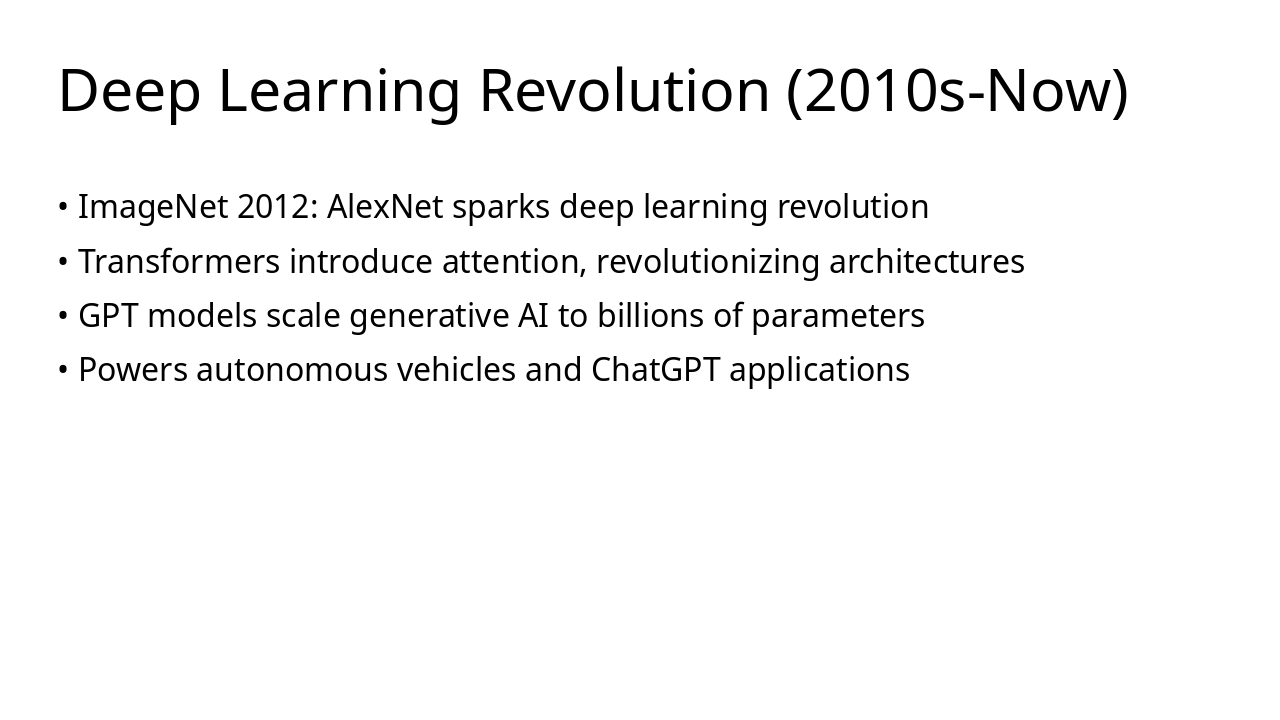
Slide 11 - Deep Learning Revolution (2010s-Now)

The Deep Learning Revolution, from the 2010s to now, ignited with AlexNet's ImageNet win in 2012 and was transformed by attention mechanisms in Transformers. GPT models then scaled generative AI to billions of parameters, enabling applications like autonomous vehicles and ChatGPT.

Deep Learning Revolution (2010s-Now)

  • ImageNet 2012: AlexNet sparks deep learning revolution
  • Transformers introduce attention, revolutionizing architectures
  • GPT models scale generative AI to billions of parameters
  • Powers autonomous vehicles and ChatGPT applications
Slide 11 - Deep Learning Revolution (2010s-Now)
Slide 12 of 12

Slide 12 - The Future of AI

The conclusion slide, titled "The Future of AI," highlights that AI's path forward involves integration, innovation, and ethical advancement. It calls on viewers to remain engaged in shaping responsible AI development.

The Future of AI

AI's Future: Integrate, Innovate, Ethically Advance.

Stay engaged in shaping responsible AI development.

Source: Wikipedia

Speaker Notes
Summarize AI's evolution towards integrating reasoning, learning, perception, while highlighting ethical challenges. Align with Wikipedia's focus on goals like problem-solving and decision-making in the history of AI presentation.
Slide 12 - The Future of AI
Powered by AI

Create Your Own Presentation

Generate professional presentations in seconds with Karaf's AI. Customize this presentation or start from scratch.

Create New Presentation

Powered by Karaf.ai — AI-Powered Presentation Generator