Erosion & Tundra: Earth's Sculptors

Generated from prompt:

Make a presentation about 10-15 slide presentation - choose one process shaping the Earth's surface and one type of vegetation and present it in the form of a short description and photos.

Explore erosion's powerful role in carving Earth's surface, from river canyons to rock exposure, alongside resilient tundra vegetation thriving in Arctic permafrost with mosses and dwarf shrubs. (148

January 18, 20268 slides
Slide 1 of 8

Slide 1 - Erosion and Tundra Vegetation

This title slide is titled "Erosion and Tundra Vegetation." Its subtitle, "Exploring Surface Shaping and Unique Arctic Flora," introduces the topic of erosion's impact on tundra landscapes and the distinctive plant life in Arctic regions.

Erosion and Tundra Vegetation

Exploring Surface Shaping and Unique Arctic Flora

Slide 1 - Erosion and Tundra Vegetation
Slide 2 of 8

Slide 2 - Presentation Overview

This agenda slide titled "Presentation Overview" outlines the key sections of the presentation. It includes: Introduction to Erosion, Erosion Mechanisms & Impacts, Tundra Features & Adaptations, and Comparisons & Conclusion.

Presentation Overview

  1. Introduction to Erosion
  2. Erosion Mechanisms & Impacts
  3. Tundra Features & Adaptations
  4. Comparisons & Conclusion

Source: Erosion in Tundra Environments

Speaker Notes
Outline the key sections of the 10-15 slide presentation on erosion processes shaping Earth's surface and tundra vegetation.
Slide 2 - Presentation Overview
Slide 3 of 8

Slide 3 - Part 1: Erosion - Shaping Earth's Surface

This section header slide introduces Part 1: Erosion, labeled as section 01. It highlights how erosion sculpts Earth's landscapes through the forces of wind, water, ice, and gravity.

Part 1: Erosion - Shaping Earth's Surface

01

Part 1: Erosion

Sculpts landscapes through wind, water, ice, and gravity

Speaker Notes
Erosion sculpts landscapes through wind, water, ice, and gravity. Discover how it transforms our planet.
Slide 3 - Part 1: Erosion - Shaping Earth's Surface
Slide 4 of 8

Slide 4 - What is Erosion?

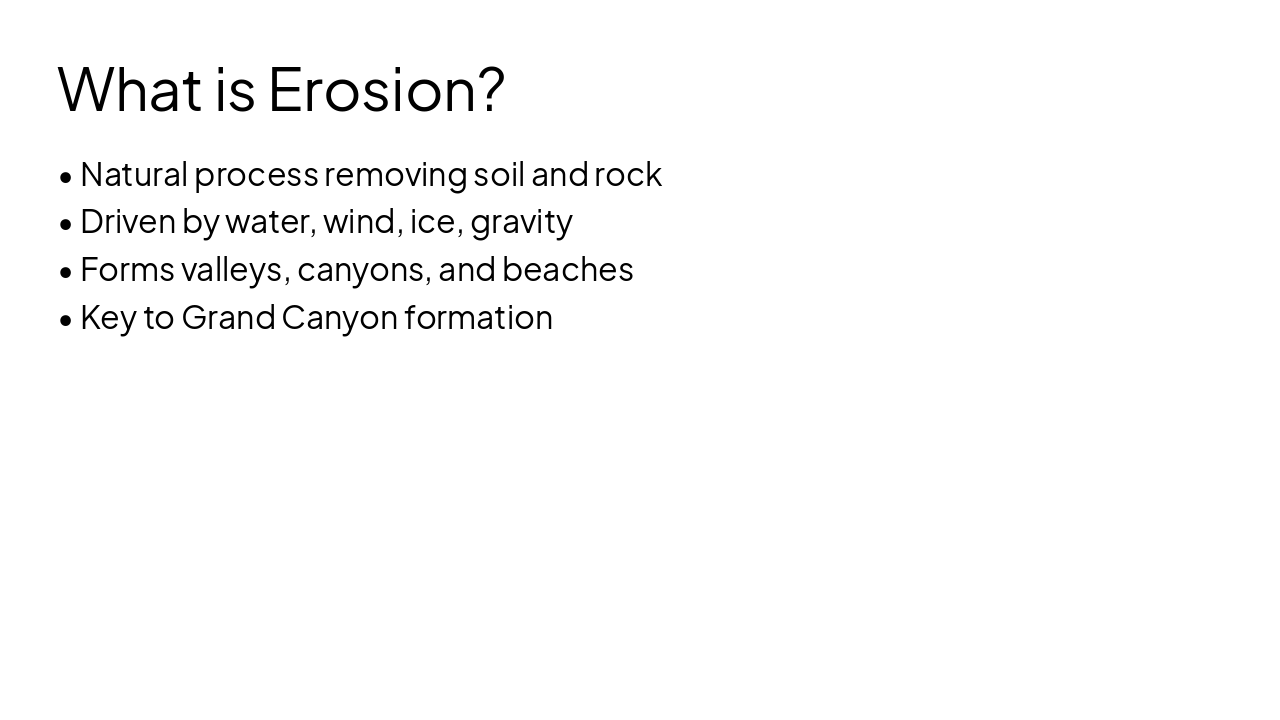
Erosion is a natural process that removes soil and rock, driven by water, wind, ice, and gravity. It shapes landscapes by forming valleys, canyons, and beaches, and played a key role in creating the Grand Canyon.

What is Erosion?

  • Natural process removing soil and rock
  • Driven by water, wind, ice, gravity
  • Forms valleys, canyons, and beaches
  • Key to Grand Canyon formation
Speaker Notes
Erosion is a key process shaping Earth's surface, like the Grand Canyon. Agents include water, wind, ice, and gravity. Pairs with desert vegetation adaptation.
Slide 4 - What is Erosion?
Slide 5 of 8

Slide 5 - Erosion in Action

The slide "Erosion in Action" showcases the Colorado River carving a vast canyon over millions of years, exposing dramatic ancient rock layers. It highlights erosion's immense power and ongoing role in dramatically shaping Earth's surface.

Erosion in Action

!Image

  • Colorado River carved canyon over millions of years
  • Exposes dramatic rock layers from ancient times
  • Vast scale demonstrates erosion's immense power
  • Ongoing process shapes Earth's surface dramatically

Source: Grand Canyon, Wikipedia

Speaker Notes
Photo: Grand Canyon carved by Colorado River over millions of years. Shows dramatic layers and vast scale.
Slide 5 - Erosion in Action
Slide 6 of 8

Slide 6 - Erosion Facts

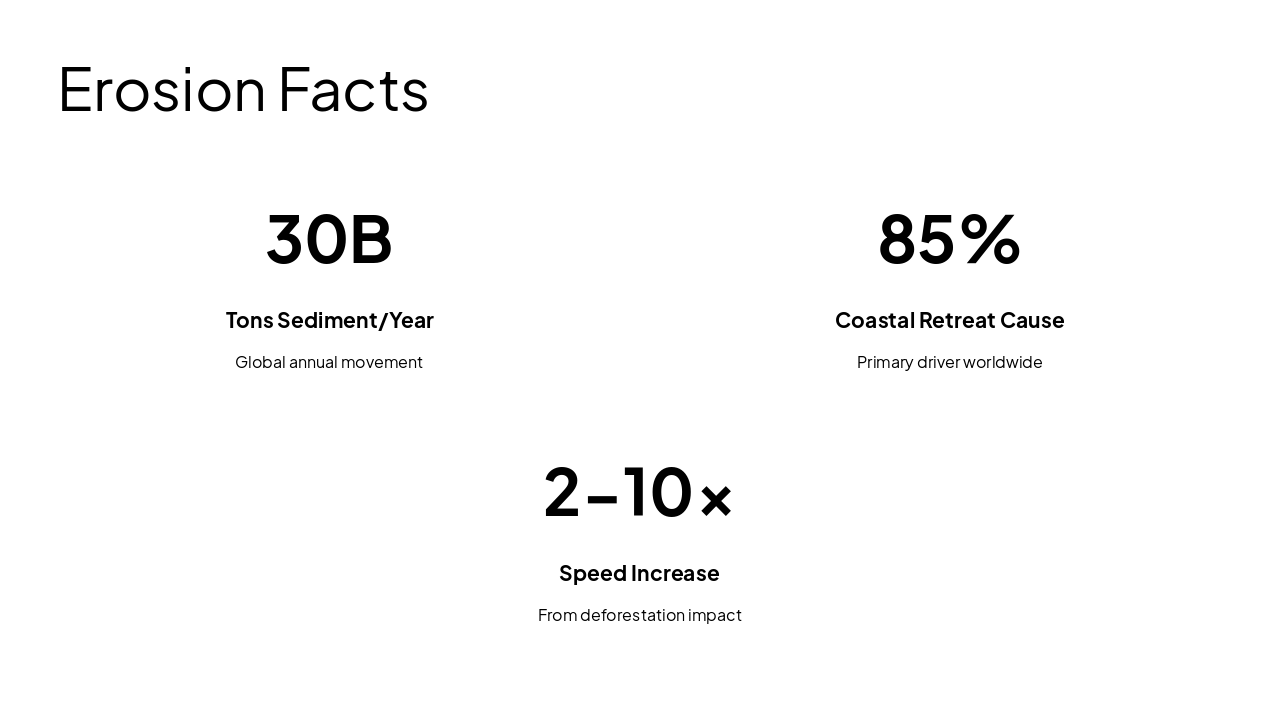
Globally, 30 billion tons of sediment move annually due to erosion, which drives 85% of coastal retreat worldwide. Deforestation accelerates erosion speeds by 2-10 times.

Erosion Facts

  • 30B: Tons Sediment/Year
  • Global annual movement

  • 85%: Coastal Retreat Cause
  • Primary driver worldwide

  • 2-10x: Speed Increase
  • From deforestation impact

Speaker Notes
Highlight the massive scale of erosion and its acceleration by human activity like deforestation.
Slide 6 - Erosion Facts
Slide 7 of 8

Slide 7 - Part 2: Tundra Vegetation

This section header slide introduces Part 2: Tundra Vegetation, labeled as section 02. It describes the tundra as a cold biome featuring low shrubs, mosses, and lichens adapted to permafrost and short summers.

Part 2: Tundra Vegetation

02

Part 2: Tundra Vegetation

Cold biome with low shrubs, mosses, lichens adapted to permafrost and short summers.

Speaker Notes
Tundra: Cold biome with low shrubs, mosses, lichens adapted to permafrost and short summers.
Slide 7 - Part 2: Tundra Vegetation
Slide 8 of 8

Slide 8 - Tundra Landscapes

The tundra landscape slide showcases vast Arctic expanses featuring permafrost polygons. It highlights colorful mosses and dwarf willow shrubs illuminated by vibrant northern lights.

Tundra Landscapes

!Image

  • Vast Arctic expanses with permafrost polygons
  • Colorful mosses and dwarf willow shrubs
  • Illuminated by vibrant northern lights

Source: Wikipedia: Arctic tundra

Speaker Notes
Photo: Vast Arctic tundra with colorful mosses, dwarf willows, and permafrost polygons under northern lights.
Slide 8 - Tundra Landscapes

Discover More Presentations

Explore thousands of AI-generated presentations for inspiration

Browse Presentations
Powered by AI

Create Your Own Presentation

Generate professional presentations in seconds with Karaf's AI. Customize this presentation or start from scratch.

Create New Presentation

Powered by Karaf.ai — AI-Powered Presentation Generator