AI in Warfare: Ethics and Legal Challenges

Generated from prompt:

Slide 1: Title Slide Title: The Algorithmic Battlefield: AI and the Laws of War Subtitle: A 21st-Century Challenge for Military Ethics and Law Presenter: [Your Name] Organization: Rabdan Academy Slide 2: Agenda Title: Presentation Roadmap Content: Defining Military AI The Spectrum of Autonomy Core Principles of International Humanitarian Law (IHL) AI's Potential Benefits for IHL The "Unprogrammable" Gap Case Study: Ukraine Global Regulatory Landscape Accountability and Conclusion Slide 3: Defining Military AI Title: What is Artificial Intelligence in a Military Context? Content: Machine Learning: Pattern recognition in data (Scharre, 2021). Computer Vision: Object identification and classification. Natural Language Processing: Analysis of communications. Decision-Support Systems: Recommending courses of action to commanders. Slide 4: The Spectrum of Autonomy Title: Levels of Human Control Content: Human-in-the-Loop: Human approves every action. Human-on-the-Loop: Human monitors AI actions. Human-out-of-the-Loop: AI acts fully autonomously. Ethical challenges increase with autonomy. Slide 5: The Legal Framework: IHL/LOAC Title: The Laws of Armed Conflict Content: Distinction: Discriminate between combatants and civilians (ICRC, 2016). Proportionality: Balance military advantage and civilian harm. Military Necessity: Justify the use of force. Martens Clause: Follow principles of humanity. Slide 6: The Potential: AI for Good Title: How AI Could Enhance IHL Compliance Content: Improved precision in targeting. Better monitoring of IHL violations (Scharre, 2021). Faster verification of no-strike lists. Reduced collateral damage. Slide 7: The Problem: The "Unprogrammable" Gap Title: What AI Cannot Code Content: Distinction: Struggles with context in chaos (Bode & Huelss, 2022). Proportionality: A subjective value judgment (U.S. Department of Defense, 2023). The Martens Clause: Cannot compute "principles of humanity." Slide 8: Interactive Poll Title: Where Do You Draw the Line? Content: Question: Which task would you delegate to an AI? A) Logistics B) Cyber Defense C) Target Selection D) Strike Authorization Slide 9: Case Study: Ukraine Title: AI in a Modern Conflict Content: Widespread use of AI for target identification (Sharkov, 2023). Autonomous and semi-autonomous drone warfare. AI "hesitation" reveals reliability gaps (Bennett, 2023). Slide 10: Global Regulation Title: The World's Response Content: UN: No binding treaty exists (ICRC, 2021). U.S.: Directive 3000.09 requires "appropriate human judgment." Other Nations: Some advocate for a full ban. Slide 11: The Accountability Gap Title: Who is Responsible? Content: Unresolved legal questions about liability. Complex chain of responsibility (Bode & Huelss, 2022). The "responsibility gap" for autonomous actions. Slide 12: Key Takeaways Title: Summary of Critical Points Content: AI is a transformative technology. Core IHL principles are difficult to code. The accountability gap is a major hurdle. Global governance is urgently needed. Slide 13: Conclusion & Discussion Title: The Road Ahead Content: The hardest problems are human, not technical. Discussion Questions: Should fully autonomous weapons be banned? What is the most important principle for an AI's "constitution"? Slide 14: References Title: References Content: Bennett, M. (2023). The limits of AI in war. The Defense Post. Bode, I., & Huelss, H. (2022). Autonomous weapons systems and international law. Journal of Conflict and Security Law. International Committee of the Red Cross. (2016). The Geneva Conventions. International Committee of the Red Cross. (2021). Position on Autonomous Weapon Systems. Scharre, P. (2021). Army of none. W. W. Norton & Company. Sharkov, D. (2023). How AI is shaping the war in Ukraine. Newsweek. U.S. Department of Defense. (2023). Directive 3000.09.

This presentation explores military AI's definition, autonomy levels, and alignment with IHL principles like distinction and proportionality. It highlights AI's benefits for precision, the "unprogramm

November 23, 202514 slides
Slide 1 of 14

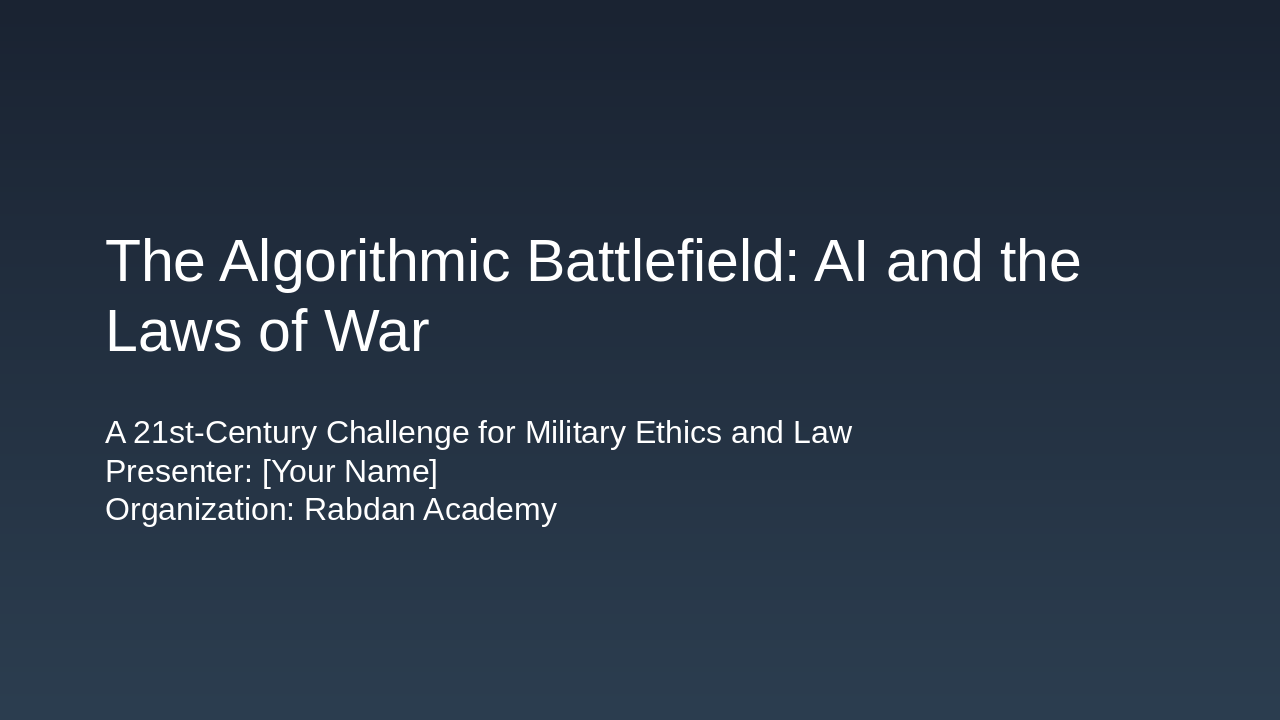
Slide 1 - The Algorithmic Battlefield: AI and the Laws of War

The slide's title, "The Algorithmic Battlefield: AI and the Laws of War," highlights the intersection of artificial intelligence with military ethics and international law in the modern era. It includes a subtitle framing this as a 21st-century challenge, along with the presenter's name and affiliation with Rabdan Academy.

The Algorithmic Battlefield: AI and the Laws of War

A 21st-Century Challenge for Military Ethics and Law Presenter: [Your Name] Organization: Rabdan Academy
Slide 1
Slide 2 of 14

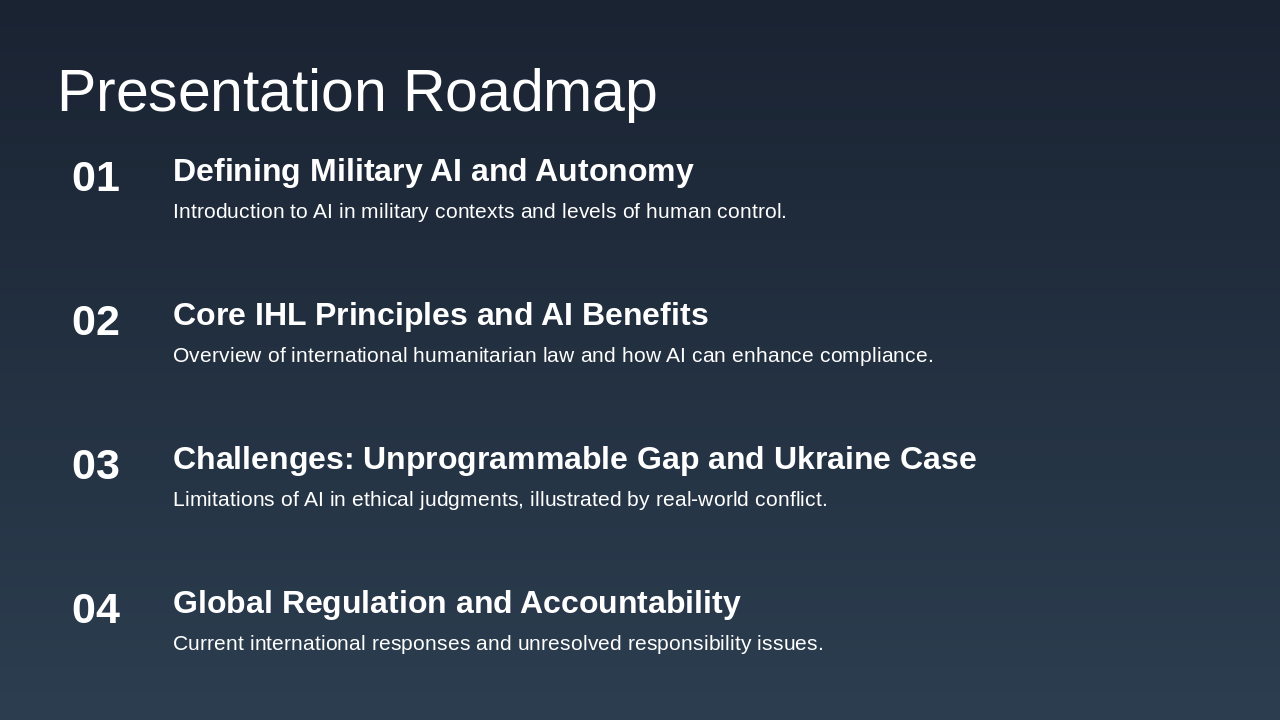
Slide 2 - Presentation Roadmap

The Presentation Roadmap slide outlines a structured agenda for discussing military AI, beginning with defining AI and autonomy in military contexts, including levels of human control. It then covers core international humanitarian law principles and AI's compliance benefits, challenges like the unprogrammable ethical gap illustrated by the Ukraine conflict, and ongoing global regulations alongside accountability issues.

Presentation Roadmap

  1. Defining Military AI and Autonomy

Introduction to AI in military contexts and levels of human control.

  1. Core IHL Principles and AI Benefits

Overview of international humanitarian law and how AI can enhance compliance.

  1. Challenges: Unprogrammable Gap and Ukraine Case

Limitations of AI in ethical judgments, illustrated by real-world conflict.

  1. Global Regulation and Accountability

Current international responses and unresolved responsibility issues.

Slide 2
Slide 3 of 14

Slide 3 - What is Artificial Intelligence in a Military Context?

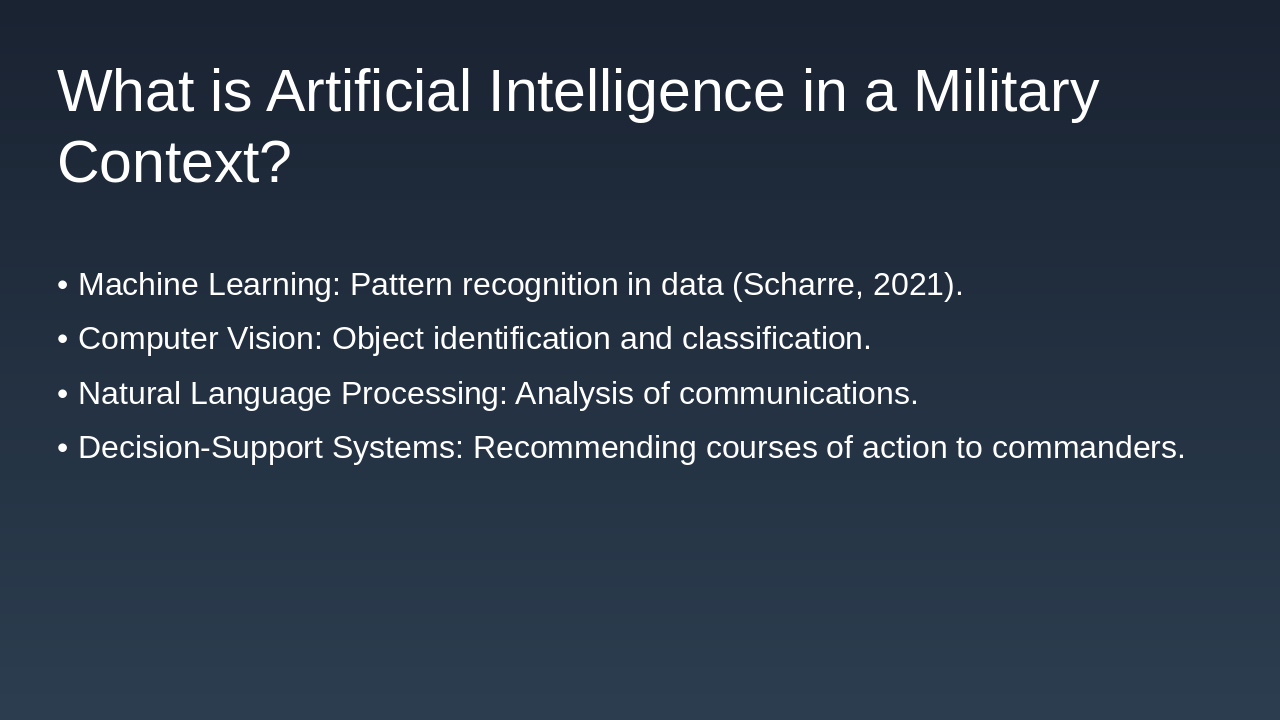
Artificial Intelligence in a military context encompasses key technologies like machine learning for pattern recognition in data, computer vision for identifying and classifying objects, natural language processing for analyzing communications, and decision-support systems that recommend actions to commanders. These tools, as highlighted in sources like Scharre (2021), enhance military operations through automated analysis and strategic guidance.

What is Artificial Intelligence in a Military Context?

  • Machine Learning: Pattern recognition in data (Scharre, 2021).
  • Computer Vision: Object identification and classification.
  • Natural Language Processing: Analysis of communications.
  • Decision-Support Systems: Recommending courses of action to commanders.
Slide 3
Slide 4 of 14

Slide 4 - Levels of Human Control

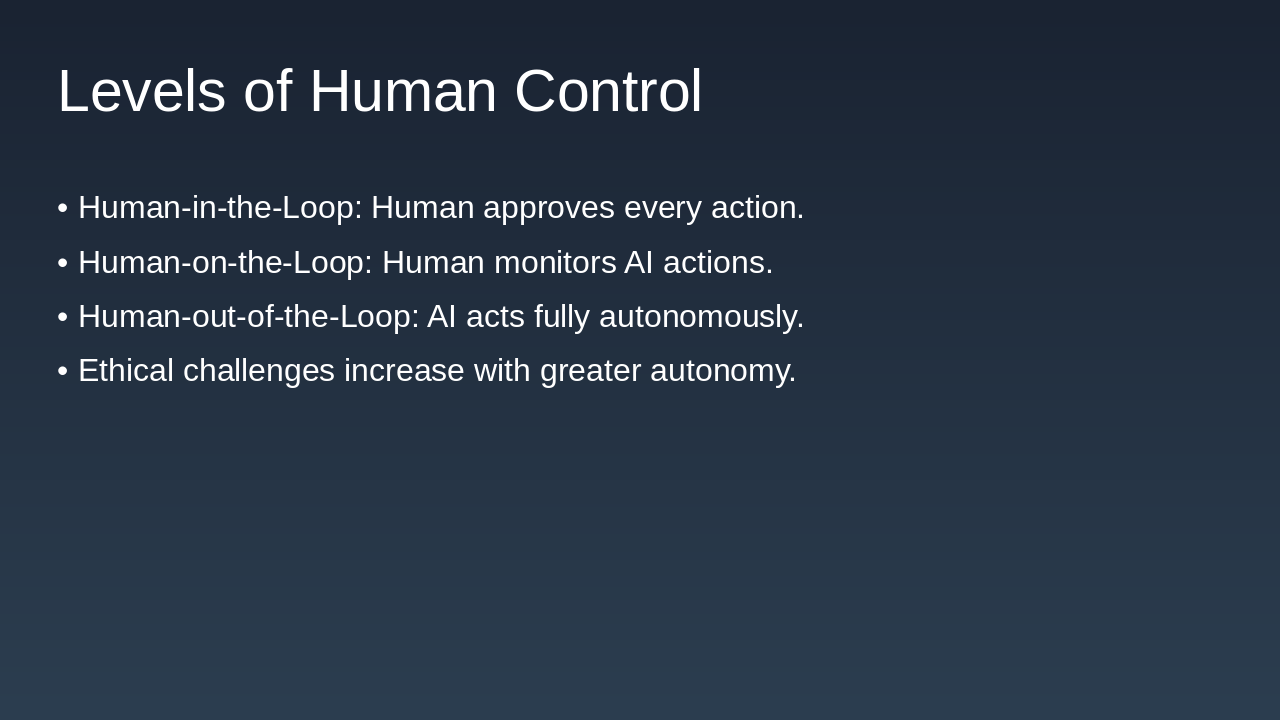
The slide outlines three levels of human control in AI systems: Human-in-the-Loop, where humans approve every action; Human-on-the-Loop, where humans monitor AI actions; and Human-out-of-the-Loop, where AI operates fully autonomously. It also notes that ethical challenges intensify as autonomy increases.

Levels of Human Control

  • Human-in-the-Loop: Human approves every action.
  • Human-on-the-Loop: Human monitors AI actions.
  • Human-out-of-the-Loop: AI acts fully autonomously.
  • Ethical challenges increase with greater autonomy.
Slide 4
Slide 5 of 14

Slide 5 - The Laws of Armed Conflict

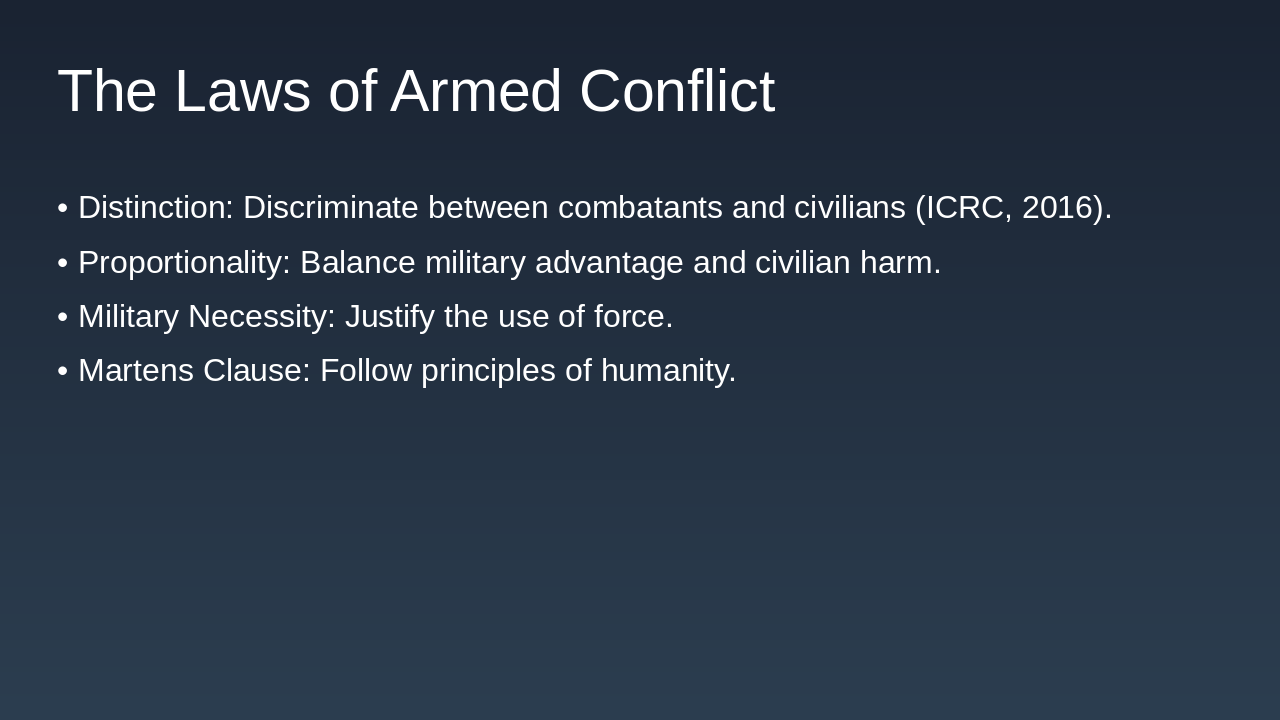
The slide outlines key principles of the laws of armed conflict, starting with the distinction principle, which requires discriminating between combatants and civilians as per ICRC guidelines from 2016. It further covers proportionality to balance military advantages against civilian harm, military necessity to justify force, and the Martens Clause emphasizing principles of humanity.

The Laws of Armed Conflict

  • Distinction: Discriminate between combatants and civilians (ICRC, 2016).
  • Proportionality: Balance military advantage and civilian harm.
  • Military Necessity: Justify the use of force.
  • Martens Clause: Follow principles of humanity.
Slide 5
Slide 6 of 14

Slide 6 - How AI Could Enhance IHL Compliance

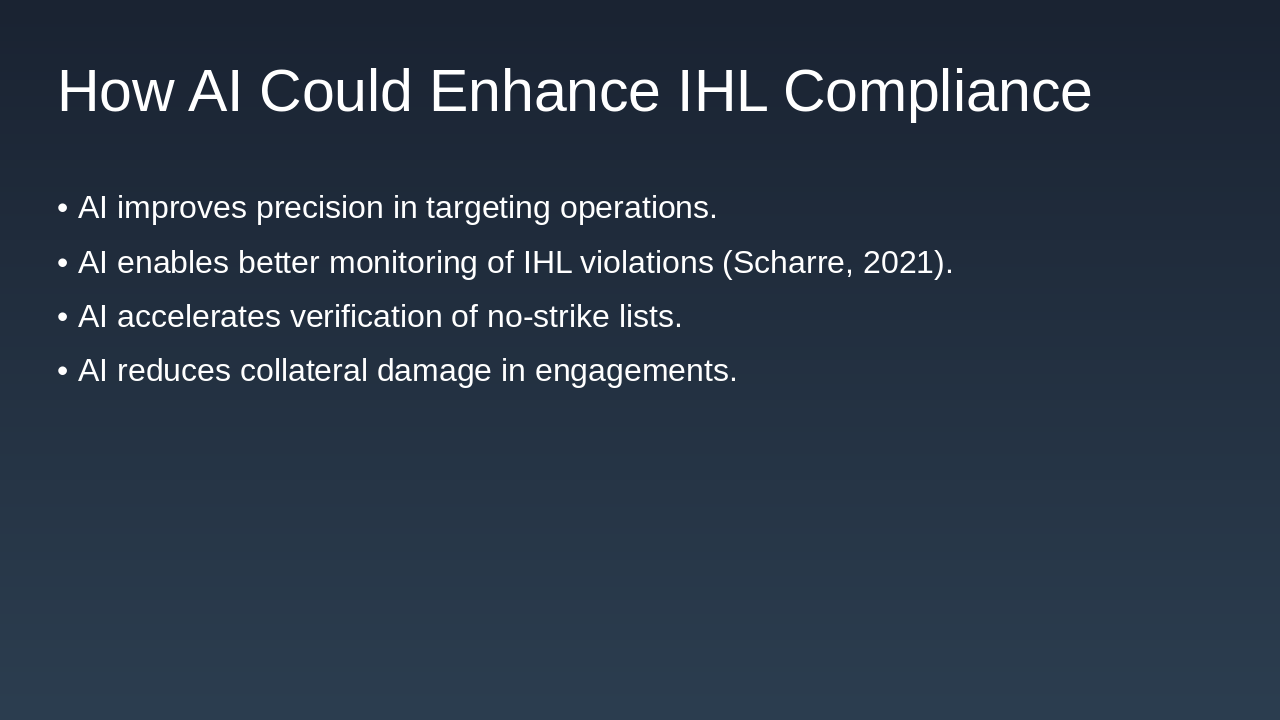
AI enhances International Humanitarian Law (IHL) compliance by improving precision in targeting operations and accelerating verification of no-strike lists, thereby reducing collateral damage in engagements. Additionally, it enables better monitoring of IHL violations, as noted by Scharre (2021).

How AI Could Enhance IHL Compliance

  • AI improves precision in targeting operations.
  • AI enables better monitoring of IHL violations (Scharre, 2021).
  • AI accelerates verification of no-strike lists.
  • AI reduces collateral damage in engagements.
Slide 6
Slide 7 of 14

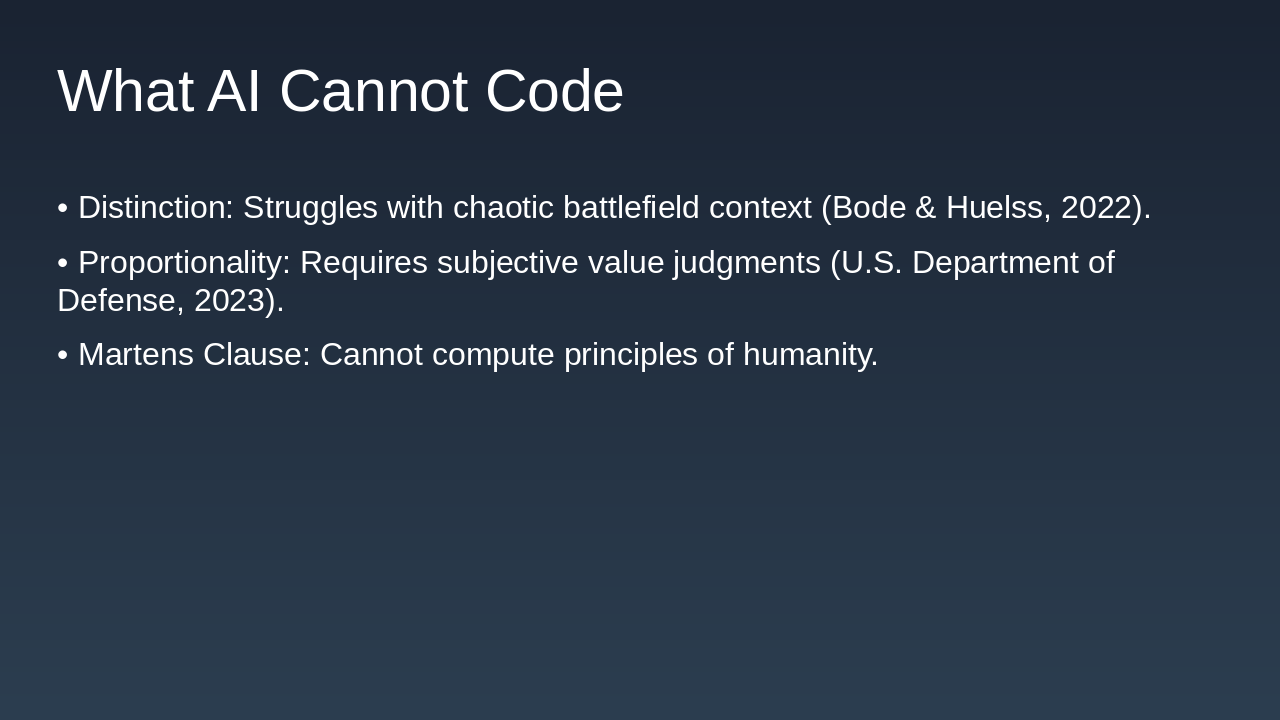
Slide 7 - What AI Cannot Code

The slide "What AI Cannot Code" highlights key limitations of AI in handling complex ethical aspects of warfare, specifically struggling to distinguish between combatants and civilians in chaotic battlefield contexts, as noted by Bode & Huelss (2022). It further explains that AI requires subjective value judgments for proportionality in military actions (U.S. Department of Defense, 2023) and cannot compute the Martens Clause's principles of humanity.

What AI Cannot Code

  • Distinction: Struggles with chaotic battlefield context (Bode & Huelss, 2022).
  • Proportionality: Requires subjective value judgments (U.S. Department of Defense, 2023).
  • Martens Clause: Cannot compute principles of humanity.
Slide 7
Slide 8 of 14

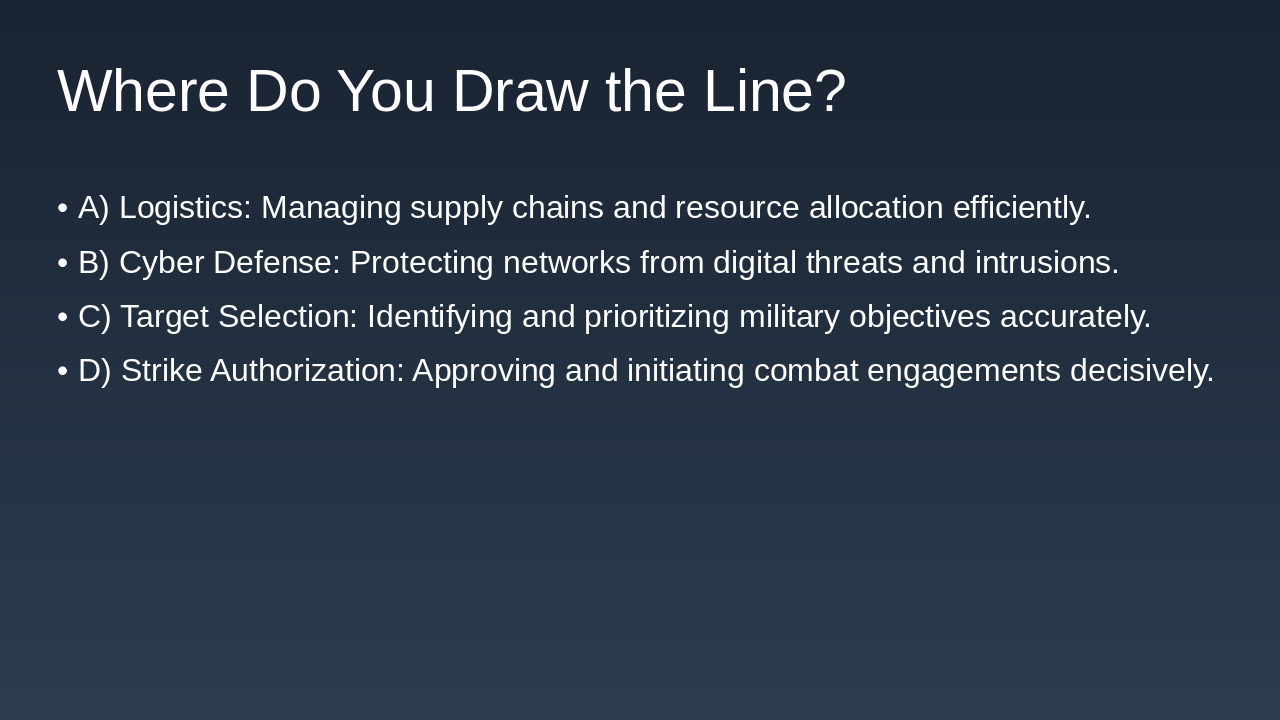
Slide 8 - Where Do You Draw the Line?

The slide titled "Where Do You Draw the Line?" explores critical aspects of military operations through four bullet points. It covers logistics for efficient supply chain management, cyber defense against digital threats, target selection for accurate prioritization of objectives, and strike authorization for decisive combat approvals.

Where Do You Draw the Line?

  • A) Logistics: Managing supply chains and resource allocation efficiently.
  • B) Cyber Defense: Protecting networks from digital threats and intrusions.
  • C) Target Selection: Identifying and prioritizing military objectives accurately.
  • D) Strike Authorization: Approving and initiating combat engagements decisively.

--- Speaker Notes: Interactive poll to engage audience on AI delegation boundaries.

Slide 8
Slide 9 of 14

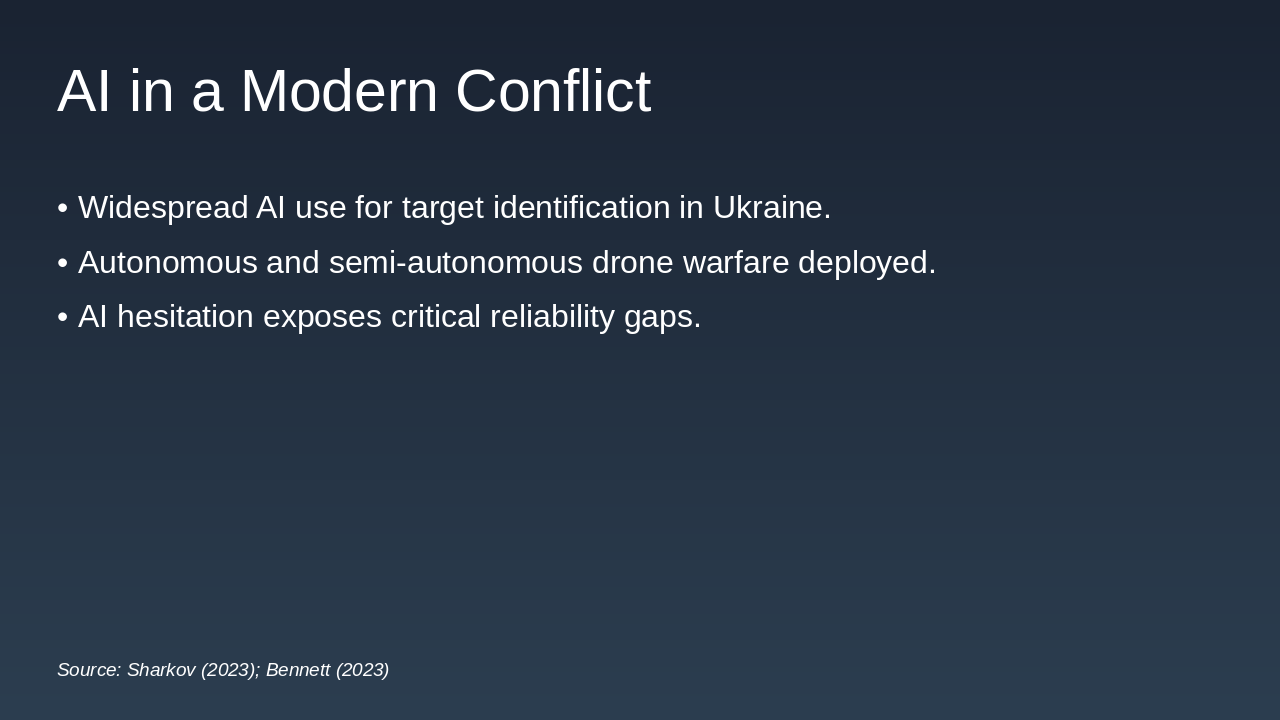
Slide 9 - AI in a Modern Conflict

In modern conflicts like Ukraine, AI is widely used for target identification and powers both autonomous and semi-autonomous drone warfare. However, hesitations around AI deployment reveal significant reliability gaps in these systems.

AI in a Modern Conflict

  • Widespread AI use for target identification in Ukraine.
  • Autonomous and semi-autonomous drone warfare deployed.
  • AI hesitation exposes critical reliability gaps.

Source: Sharkov (2023); Bennett (2023)

Slide 9
Slide 10 of 14

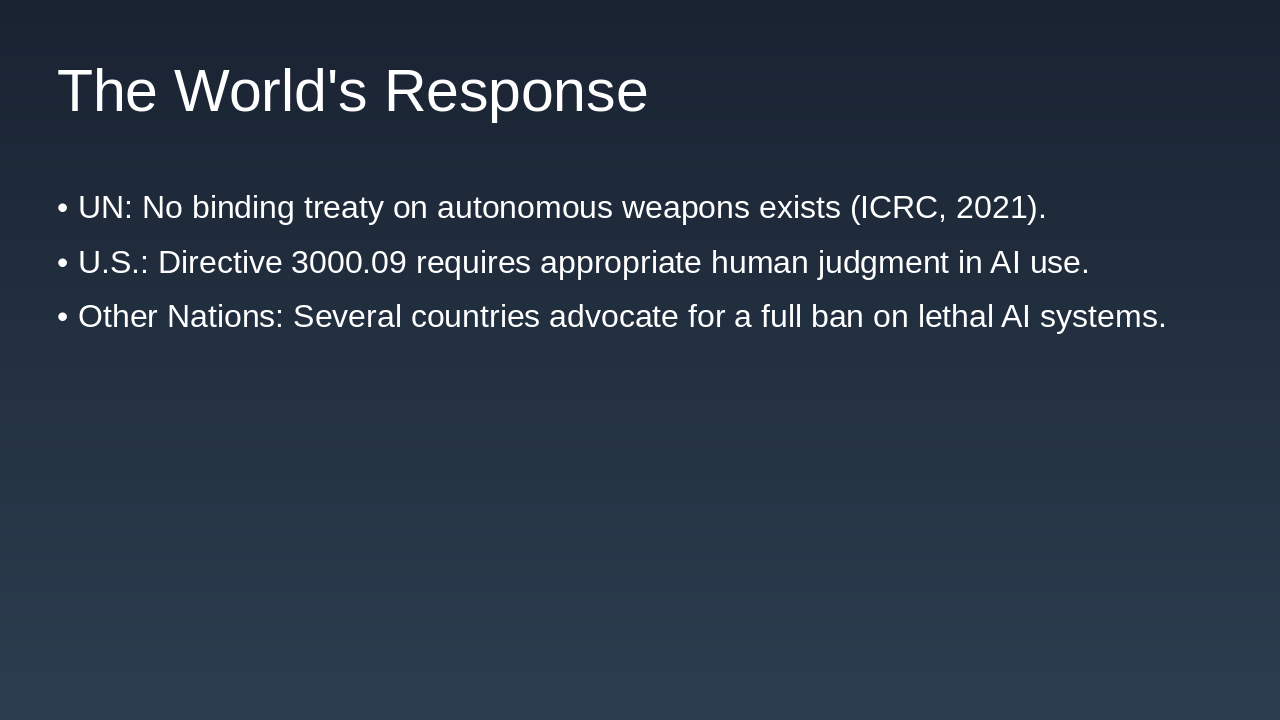
Slide 10 - The World's Response

The slide outlines the global response to autonomous weapons, noting that the UN lacks a binding treaty on the issue according to the ICRC in 2021. It highlights the U.S. Directive 3000.09, which mandates human judgment in AI applications, while several other nations push for a complete ban on lethal AI systems.

The World's Response

  • UN: No binding treaty on autonomous weapons exists (ICRC, 2021).
  • U.S.: Directive 3000.09 requires appropriate human judgment in AI use.
  • Other Nations: Several countries advocate for a full ban on lethal AI systems.
Slide 10
Slide 11 of 14

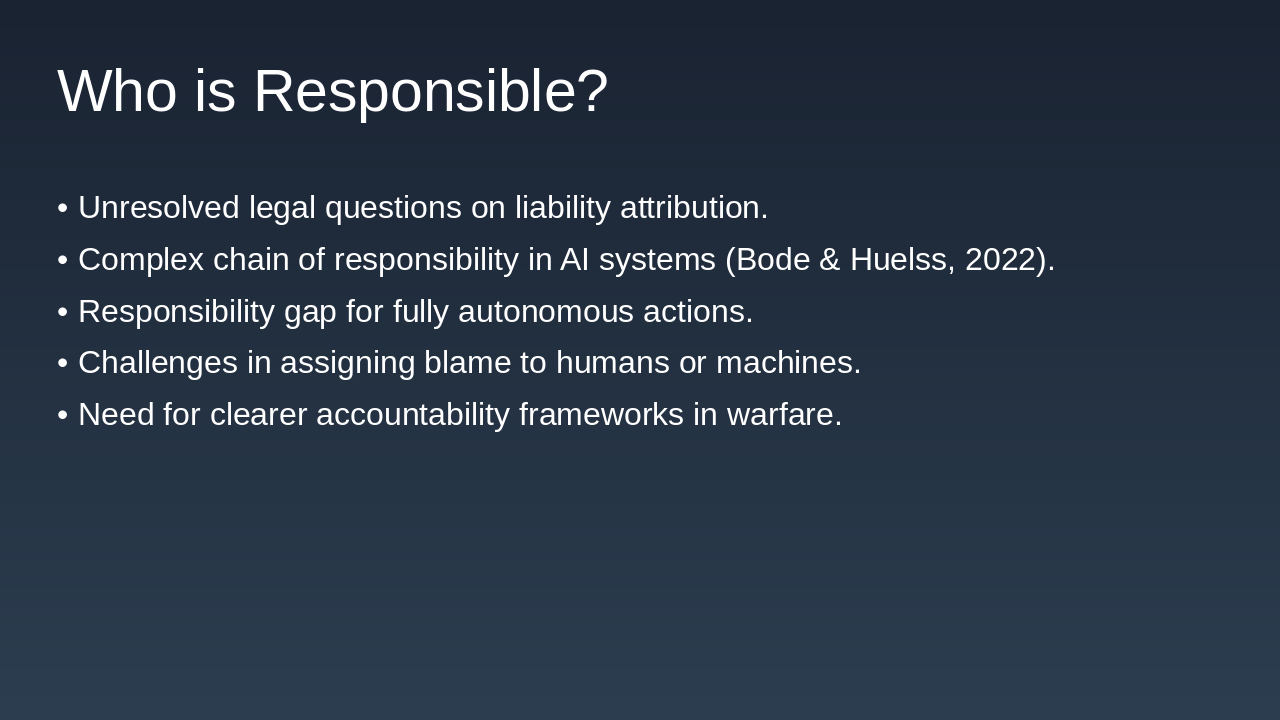
Slide 11 - Who is Responsible?

The slide "Who is Responsible?" highlights unresolved legal questions surrounding liability attribution in AI systems, particularly the complex chain of responsibility noted by Bode & Huelss (2022). It addresses the responsibility gap for fully autonomous actions, challenges in assigning blame to humans or machines, and the urgent need for clearer accountability frameworks in warfare.

Who is Responsible?

  • Unresolved legal questions on liability attribution.
  • Complex chain of responsibility in AI systems (Bode & Huelss, 2022).
  • Responsibility gap for fully autonomous actions.
  • Challenges in assigning blame to humans or machines.
  • Need for clearer accountability frameworks in warfare.
Slide 11
Slide 12 of 14

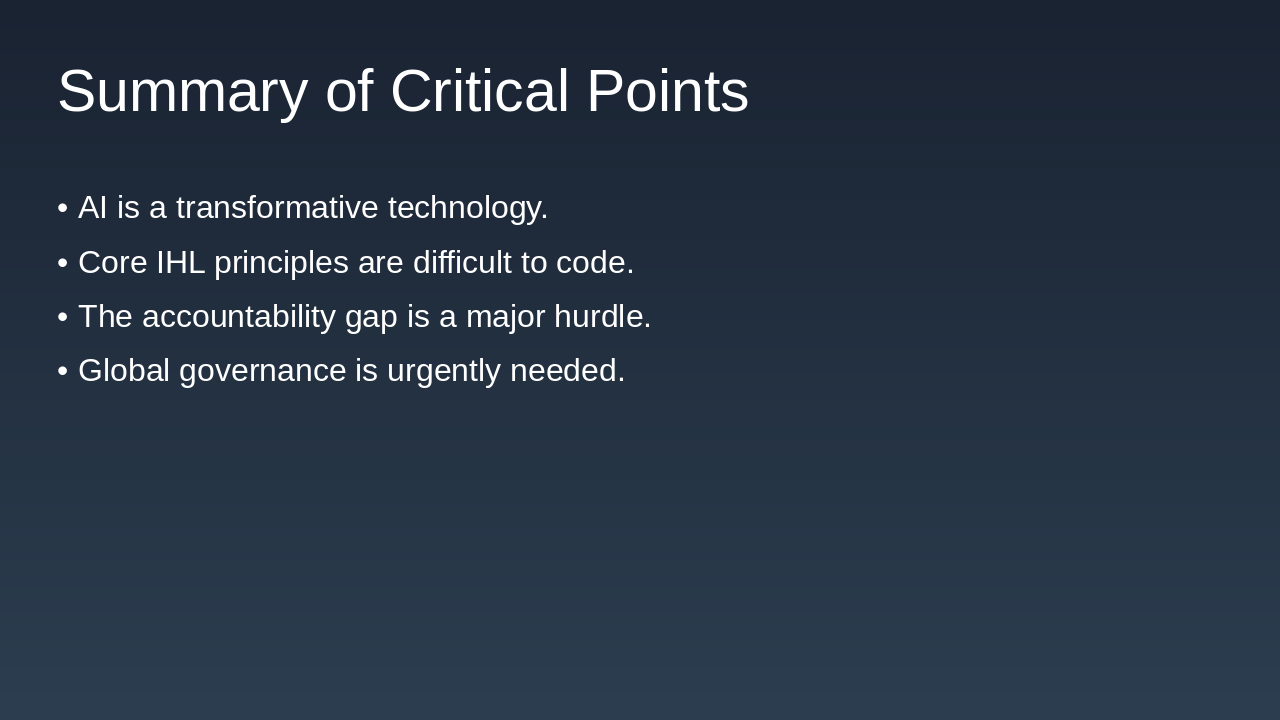
Slide 12 - Summary of Critical Points

AI represents a transformative technology, but encoding core International Humanitarian Law (IHL) principles into it poses significant challenges. Addressing the major accountability gap requires urgent global governance efforts.

Summary of Critical Points

  • AI is a transformative technology.
  • Core IHL principles are difficult to code.
  • The accountability gap is a major hurdle.
  • Global governance is urgently needed.
Slide 12
Slide 13 of 14

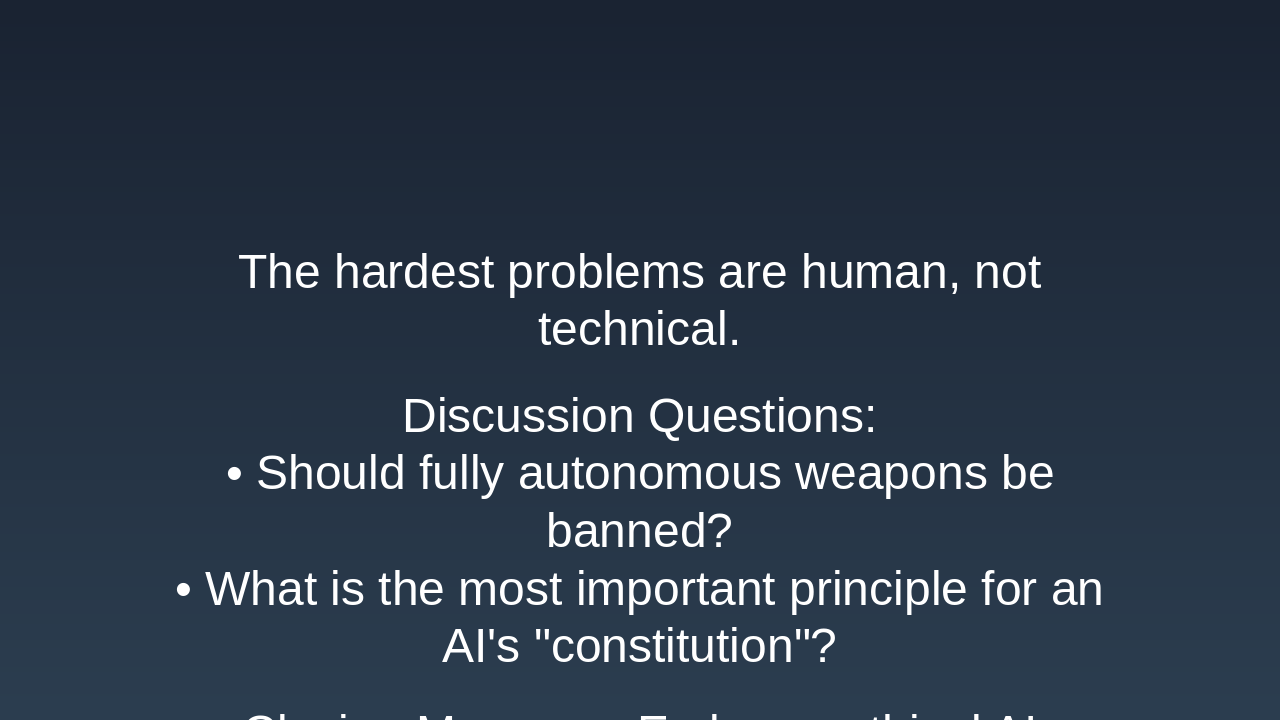
Slide 13 - The Road Ahead

The slide emphasizes that the toughest challenges in AI and warfare are human rather than technical, posing discussion questions on banning fully autonomous weapons and identifying the key principle for an AI's ethical "constitution." It closes with a call to embrace ethical AI governance immediately and join the global conversation on responsible AI in warfare.

The Road Ahead

The hardest problems are human, not technical.

Discussion Questions:

  • Should fully autonomous weapons be banned?
  • What is the most important principle for an AI's "constitution"?

Closing Message: Embrace ethical AI governance now. Call-to-Action: Join the global dialogue on responsible AI in warfare.

Slide 13
Slide 14 of 14

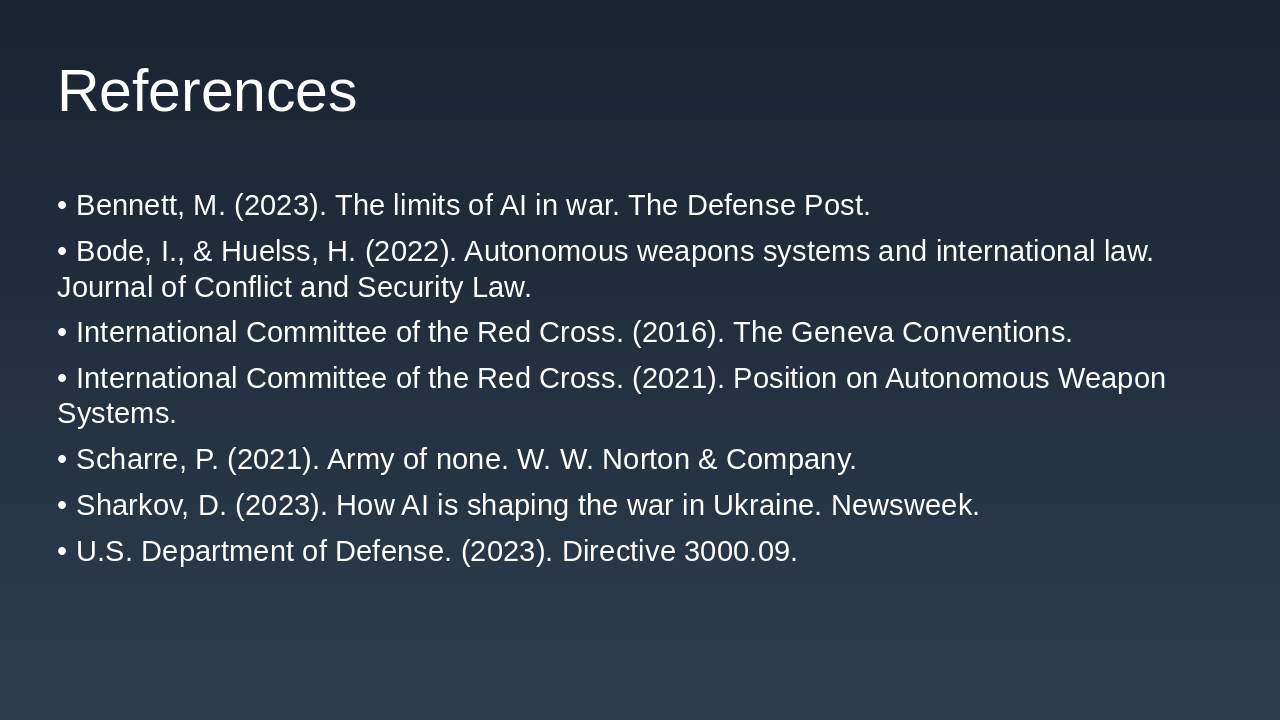
Slide 14 - References

The slide titled "References" lists key sources on AI, autonomous weapons, and international law in the context of warfare. It includes academic articles like Bode and Huelss (2022) on autonomous systems, books such as Scharre's "Army of None" (2021), ICRC positions from 2016 and 2021, news pieces from Bennett (2023) and Sharkov (2023), and the U.S. DoD Directive 3000.09 (2023).

References

  • Bennett, M. (2023). The limits of AI in war. The Defense Post.
  • Bode, I., & Huelss, H. (2022). Autonomous weapons systems and international law. Journal of Conflict and Security Law.
  • International Committee of the Red Cross. (2016). The Geneva Conventions.
  • International Committee of the Red Cross. (2021). Position on Autonomous Weapon Systems.
  • Scharre, P. (2021). Army of none. W. W. Norton & Company.
  • Sharkov, D. (2023). How AI is shaping the war in Ukraine. Newsweek.
  • U.S. Department of Defense. (2023). Directive 3000.09.
Slide 14
Powered by AI

Create Your Own Presentation

Generate professional presentations in seconds with Karaf's AI. Customize this presentation or start from scratch.

Create New Presentation

Powered by Karaf.ai — AI-Powered Presentation Generator