Ecuador: A Land of Wonders

Generated from prompt:

-Capital- -Population- -Flag- -Historical Cities- -Season -Money/currency- -Geographical Location- South America -Language spoken- -Sport- -Famous people- -Well known painters- -Especies en peligro de extinción -Comida tipica -Gente famosa -Las Isla Galápagos -Diferentes formas de proteger la naturaleza -Explique acerca de El oso de anteojos y La tortuga gigante. -¿Cuáles son algunos estilos populares de música en Ecuador? - Porque es importante proteger la selva? -Who are Otavalos and what are they known for? -What is the world’s highest active volcano in Ecuador. Answer all these questions make a slide for each one and provide a image for each slide

This presentation offers a comprehensive exploration of Ecuador, highlighting its diverse geography, rich culture, historical cities, and unique biodiversity. It covers essential facts, famous individuals, traditional cuisine, music, and significant natural landmarks like the Galapagos Islands and Cotopaxi volcano, alongside conservation efforts for its invaluable ecosystems.

May 15, 202620 slides
Slide 1 of 20

Slide 1 - Ecuador: A Land of Wonders

Ecuador: A Land of Wonders

Exploring the Heart of South America

---

Photo by simon on Unsplash
Slide 1 - Ecuador: A Land of Wonders
Slide 2 of 20

Slide 2 - Essential Facts

Essential Facts

Capital, Population, Geography, Language & Currency

---

Photo by Isabela Kronemberger on Unsplash
Slide 2 - Essential Facts
Slide 3 of 20

Slide 3 - Capital City: Quito

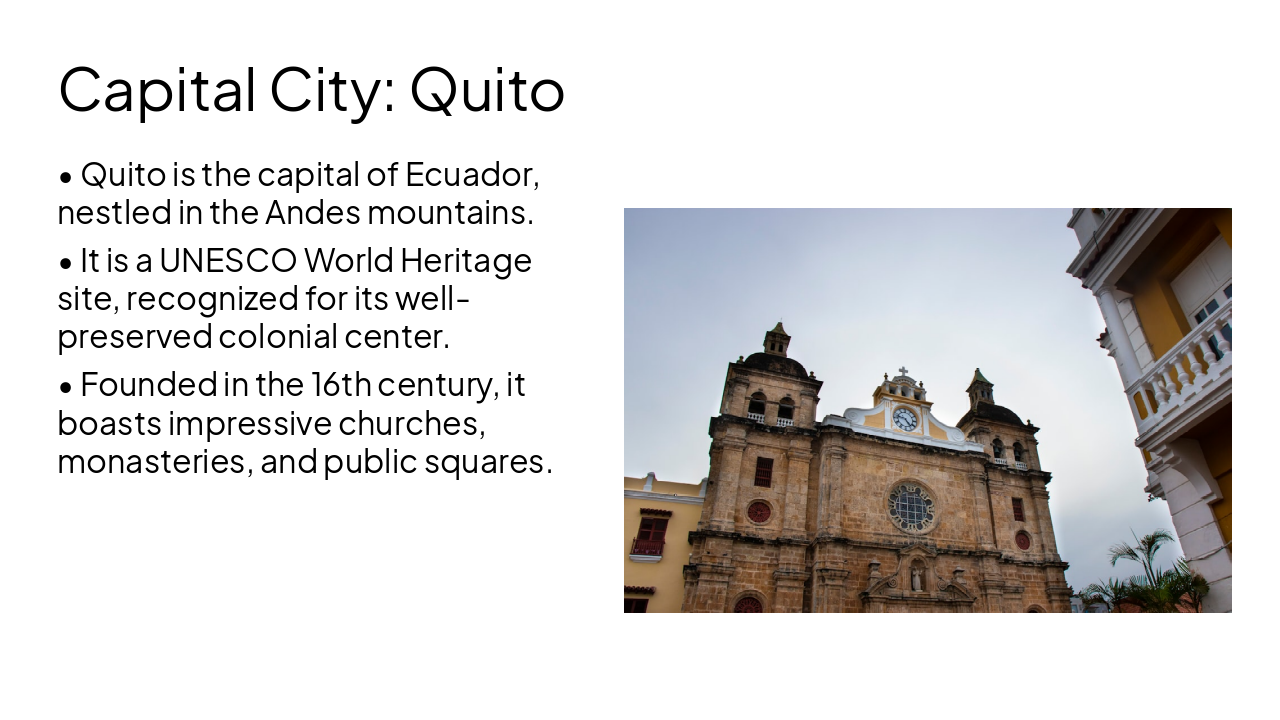
  • Quito is the capital of Ecuador, nestled in the Andes mountains.
  • It is a UNESCO World Heritage site, recognized for its well-preserved colonial center.
  • Founded in the 16th century, it boasts impressive churches, monasteries, and public squares.

---

Photo by Evy Prentice on Unsplash
Slide 3 - Capital City: Quito
Slide 4 of 20

Slide 4 - Population & Flag

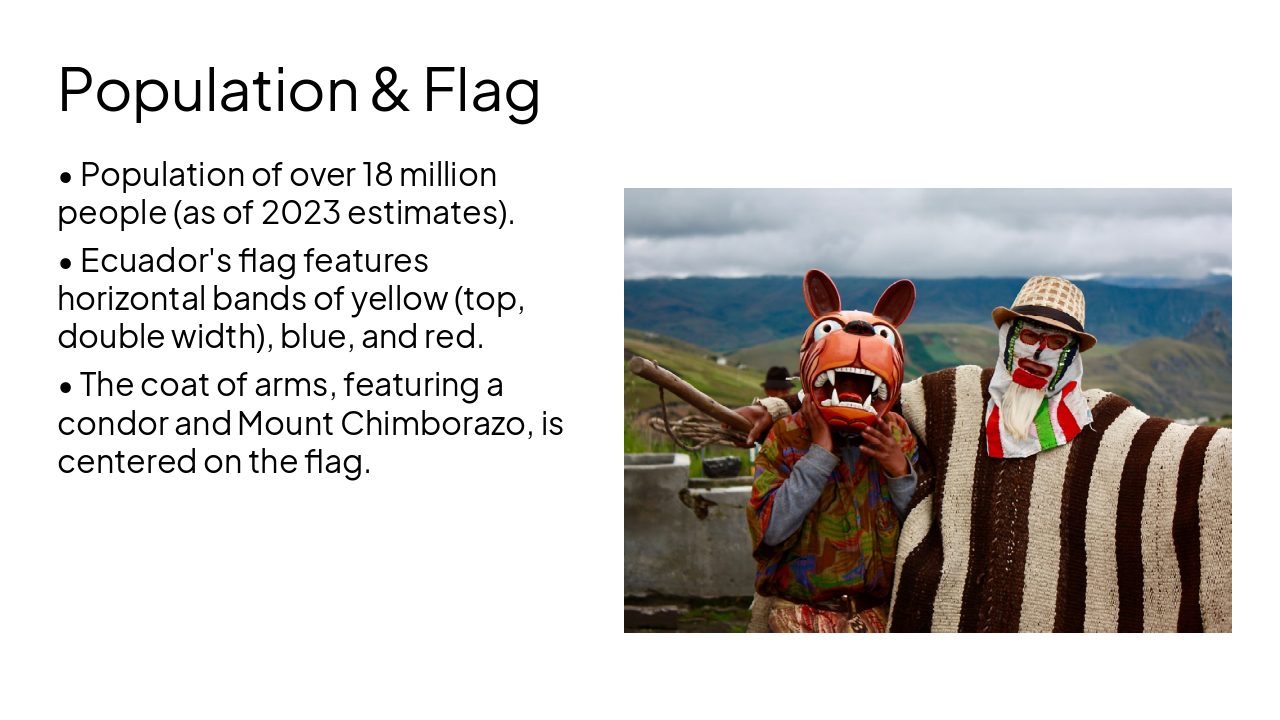
  • Population of over 18 million people (as of 2023 estimates).
  • Ecuador's flag features horizontal bands of yellow (top, double width), blue, and red.
  • The coat of arms, featuring a condor and Mount Chimborazo, is centered on the flag.

---

Photo by Azzedine Rouichi on Unsplash
Slide 4 - Population & Flag
Slide 5 of 20

Slide 5 - Geographical Location

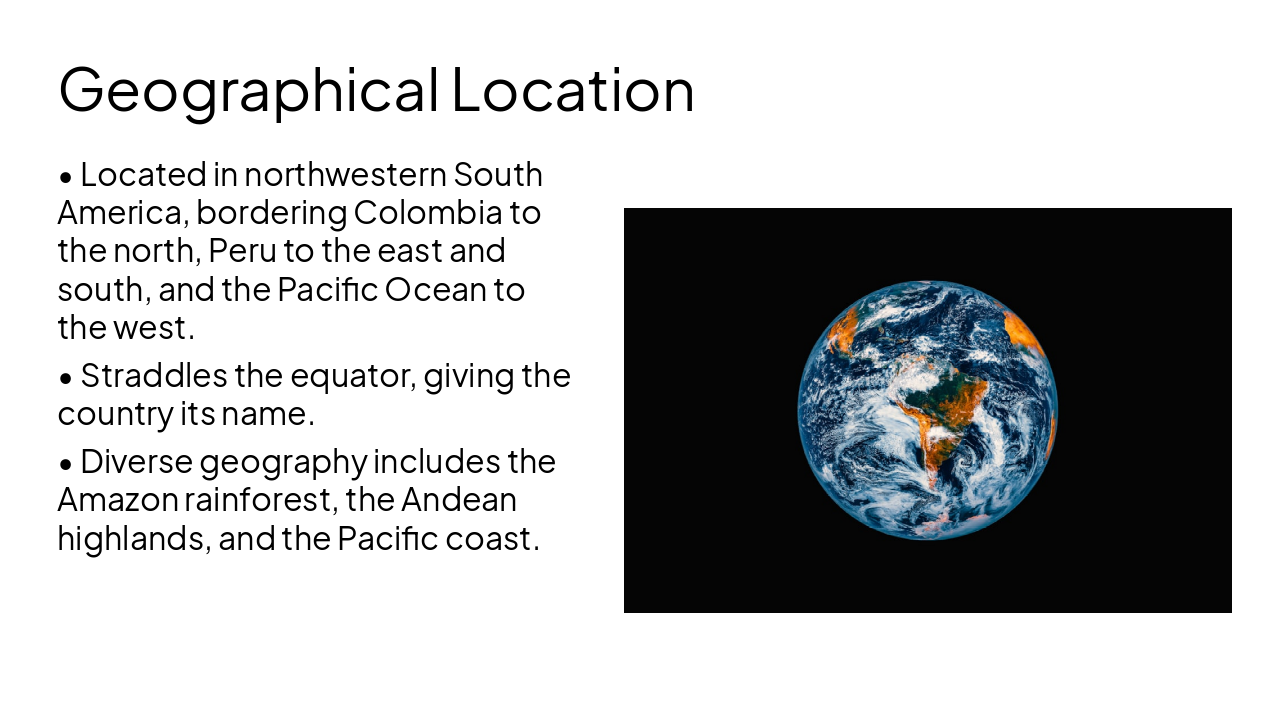
  • Located in northwestern South America, bordering Colombia to the north, Peru to the east and south, and the Pacific Ocean to the west.
  • Straddles the equator, giving the country its name.
  • Diverse geography includes the Amazon rainforest, the Andean highlands, and the Pacific coast.

---

Photo by ostudio on Unsplash

Slide 5 - Geographical Location
Slide 6 of 20

Slide 6 - Historical Cities

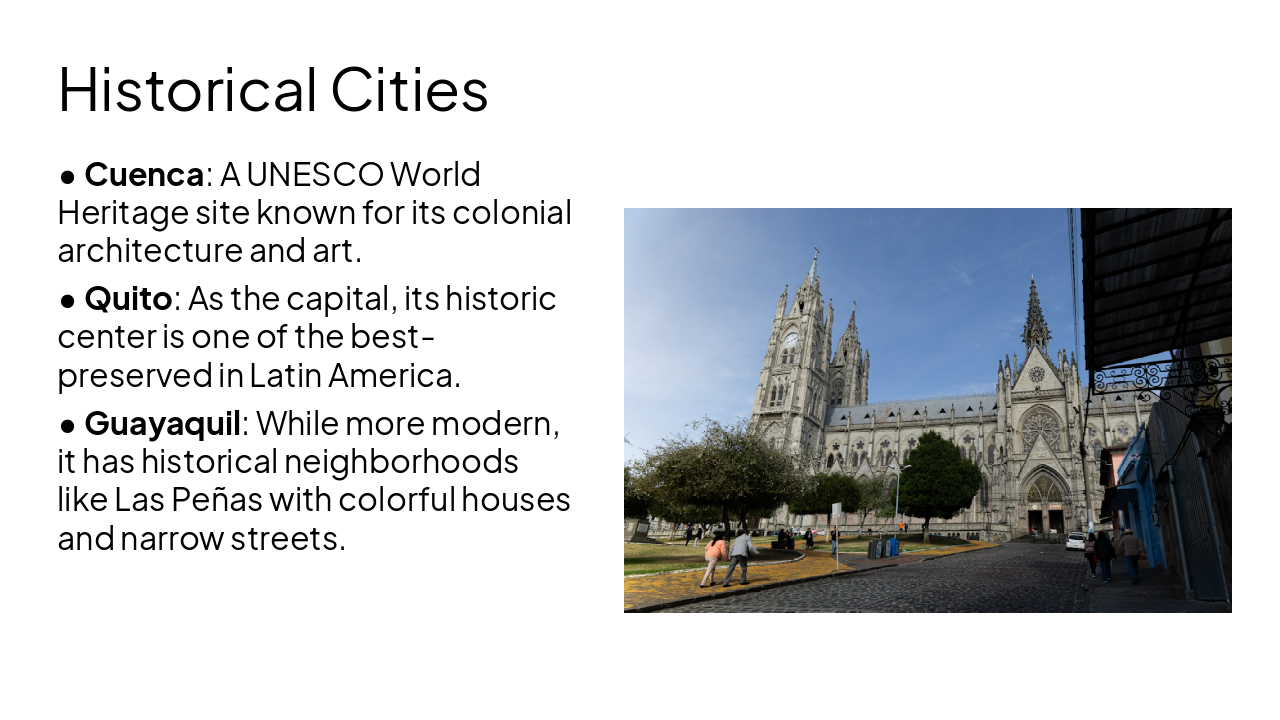
  • Cuenca: A UNESCO World Heritage site known for its colonial architecture and art.
  • Quito: As the capital, its historic center is one of the best-preserved in Latin America.
  • Guayaquil: While more modern, it has historical neighborhoods like Las Peñas with colorful houses and narrow streets.

---

Photo by Rafael Jimenez on Unsplash
Slide 6 - Historical Cities
Slide 7 of 20

Slide 7 - Seasons & Climate

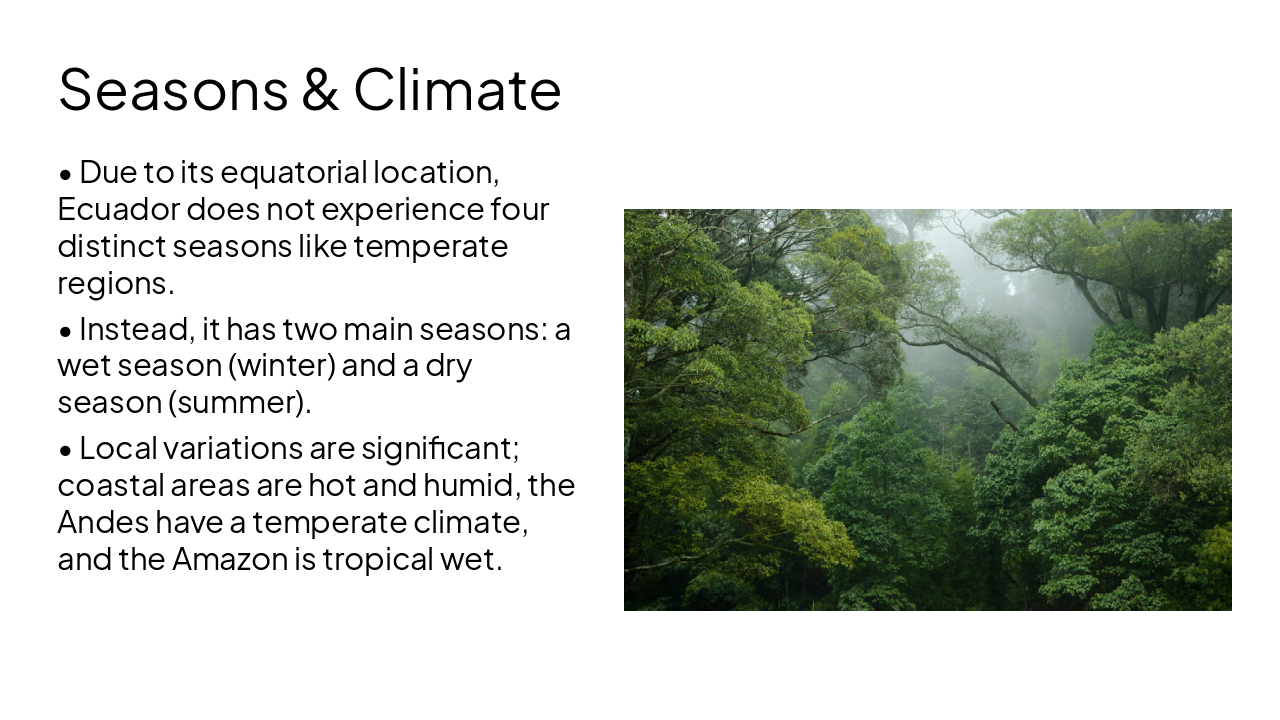
  • Due to its equatorial location, Ecuador does not experience four distinct seasons like temperate regions.
  • Instead, it has two main seasons: a wet season (winter) and a dry season (summer).
  • Local variations are significant; coastal areas are hot and humid, the Andes have a temperate climate, and the Amazon is tropical wet.

---

Photo by Lingchor on Unsplash

Slide 7 - Seasons & Climate
Slide 8 of 20

Slide 8 - Currency & Languages

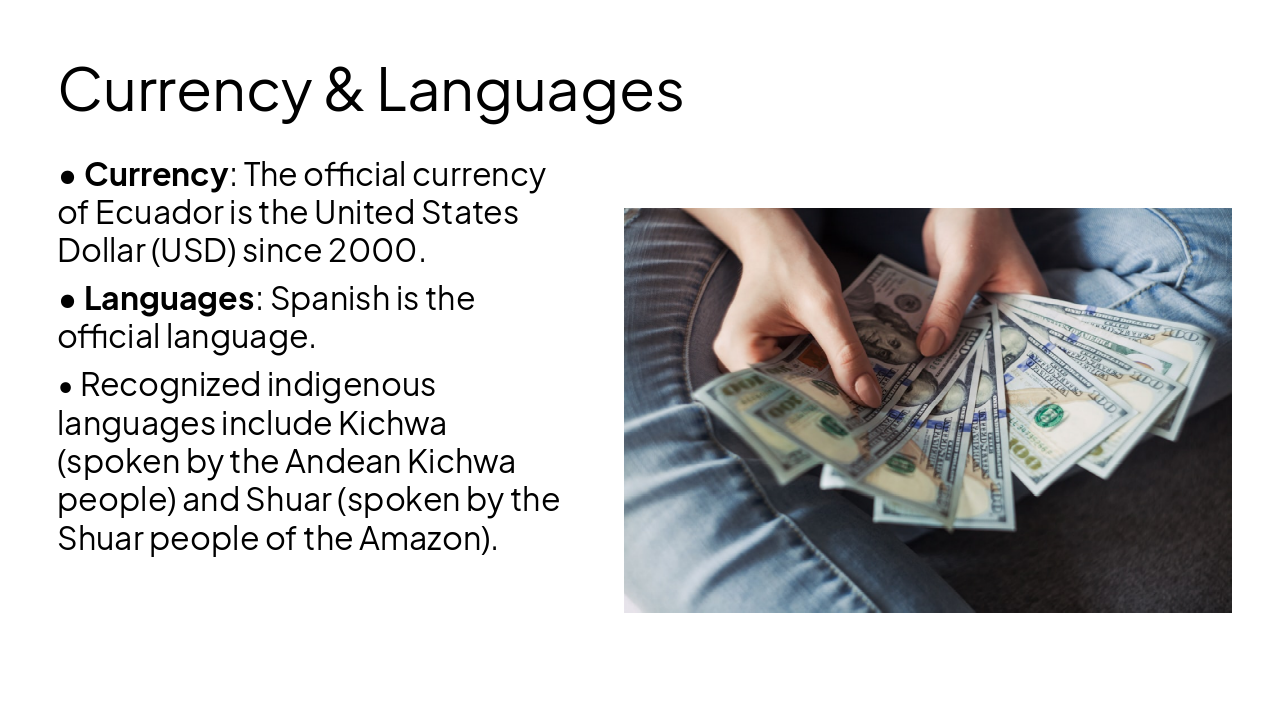
  • Currency: The official currency of Ecuador is the United States Dollar (USD) since 2000.
  • Languages: Spanish is the official language.
  • Recognized indigenous languages include Kichwa (spoken by the Andean Kichwa people) and Shuar (spoken by the Shuar people of the Amazon).

---

Photo by Alexander Mils on Unsplash
Slide 8 - Currency & Languages
Slide 9 of 20

Slide 9 - National Sport: Football

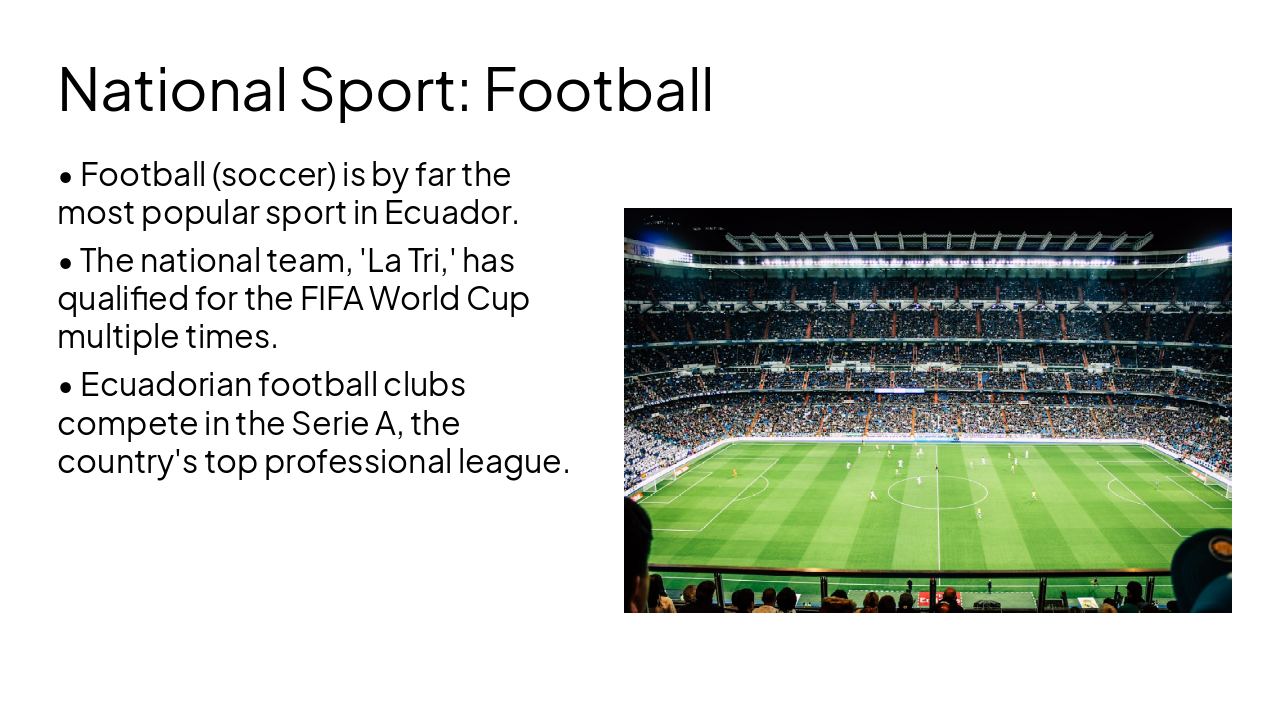
  • Football (soccer) is by far the most popular sport in Ecuador.
  • The national team, 'La Tri,' has qualified for the FIFA World Cup multiple times.
  • Ecuadorian football clubs compete in the Serie A, the country's top professional league.

---

Photo by Vienna Reyes on Unsplash
Slide 9 - National Sport: Football
Slide 10 of 20

Slide 10 - Famous Ecuadorians: People & Art

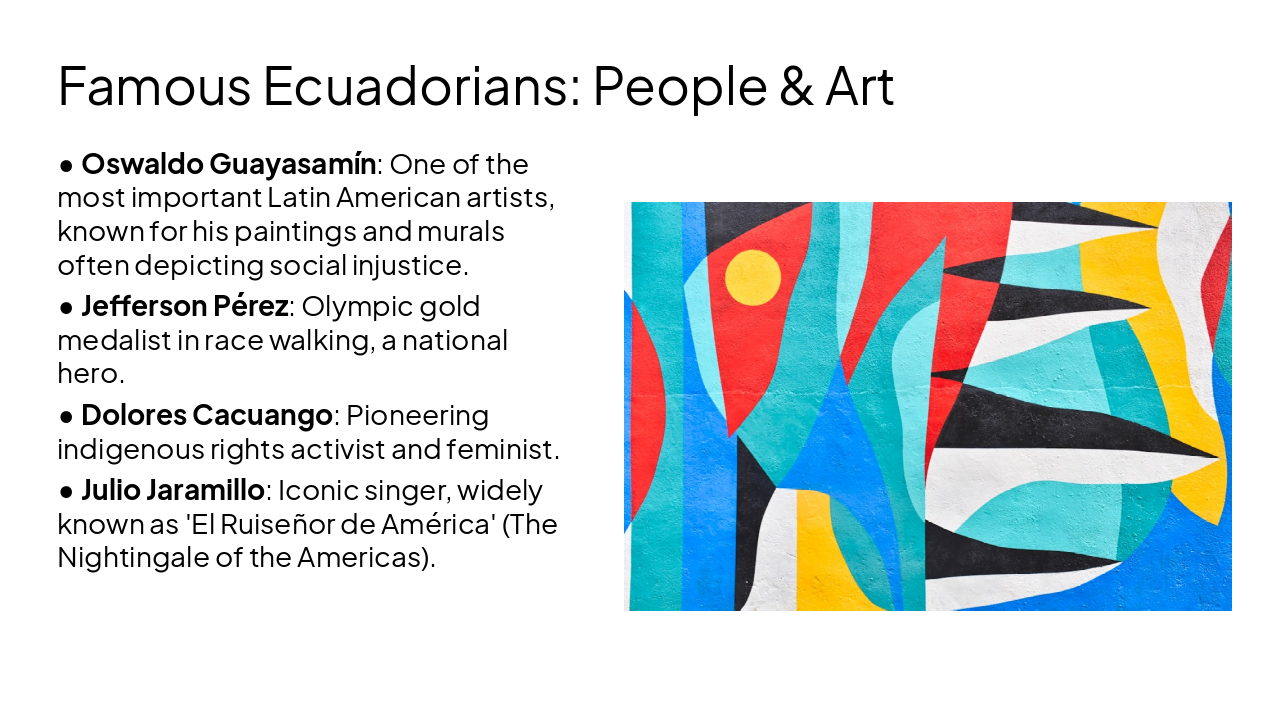
  • Oswaldo Guayasamín: One of the most important Latin American artists, known for his paintings and murals often depicting social injustice.
  • Jefferson Pérez: Olympic gold medalist in race walking, a national hero.
  • Dolores Cacuango: Pioneering indigenous rights activist and feminist.
  • Julio Jaramillo: Iconic singer, widely known as 'El Ruiseñor de América' (The Nightingale of the Americas).

---

Photo by Robert Keane on Unsplash
Slide 10 - Famous Ecuadorians: People & Art
Slide 11 of 20

Slide 11 - Endangered Species in Ecuador

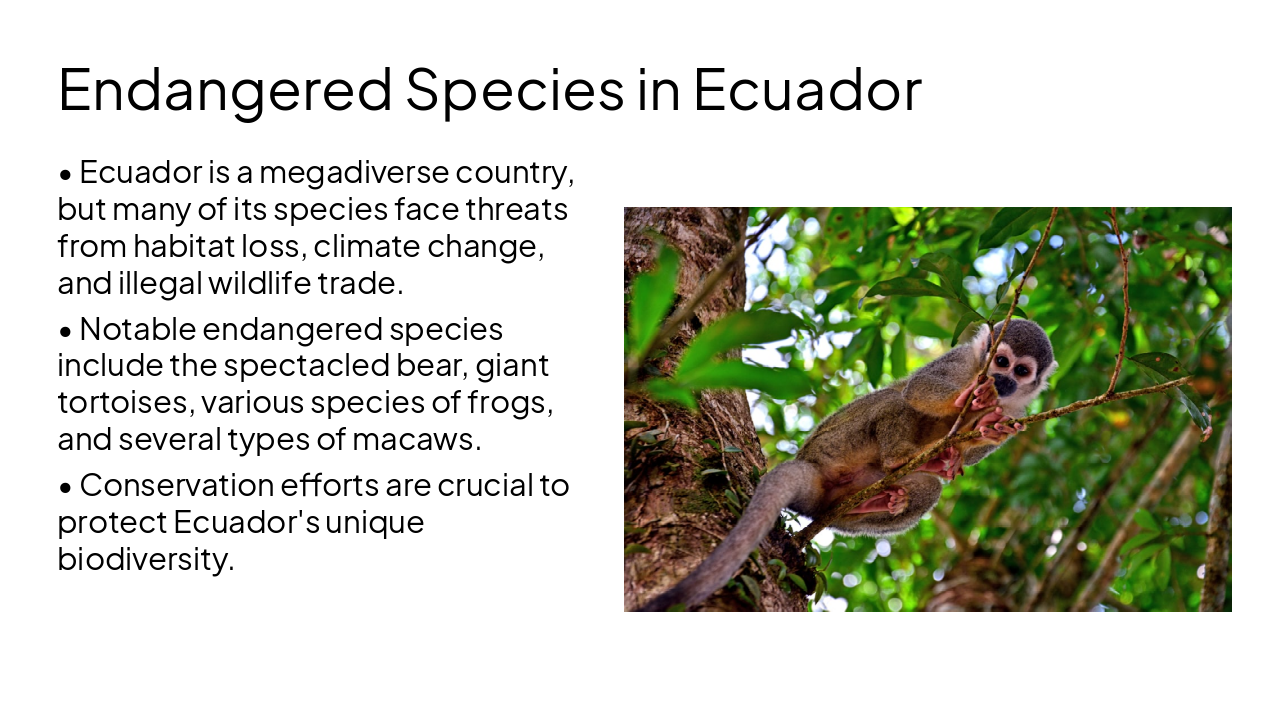
  • Ecuador is a megadiverse country, but many of its species face threats from habitat loss, climate change, and illegal wildlife trade.
  • Notable endangered species include the spectacled bear, giant tortoises, various species of frogs, and several types of macaws.
  • Conservation efforts are crucial to protect Ecuador's unique biodiversity.

---

Photo by Andres Medina on Unsplash
Slide 11 - Endangered Species in Ecuador
Slide 12 of 20

Slide 12 - El Oso de Anteojos (Spectacled Bear)

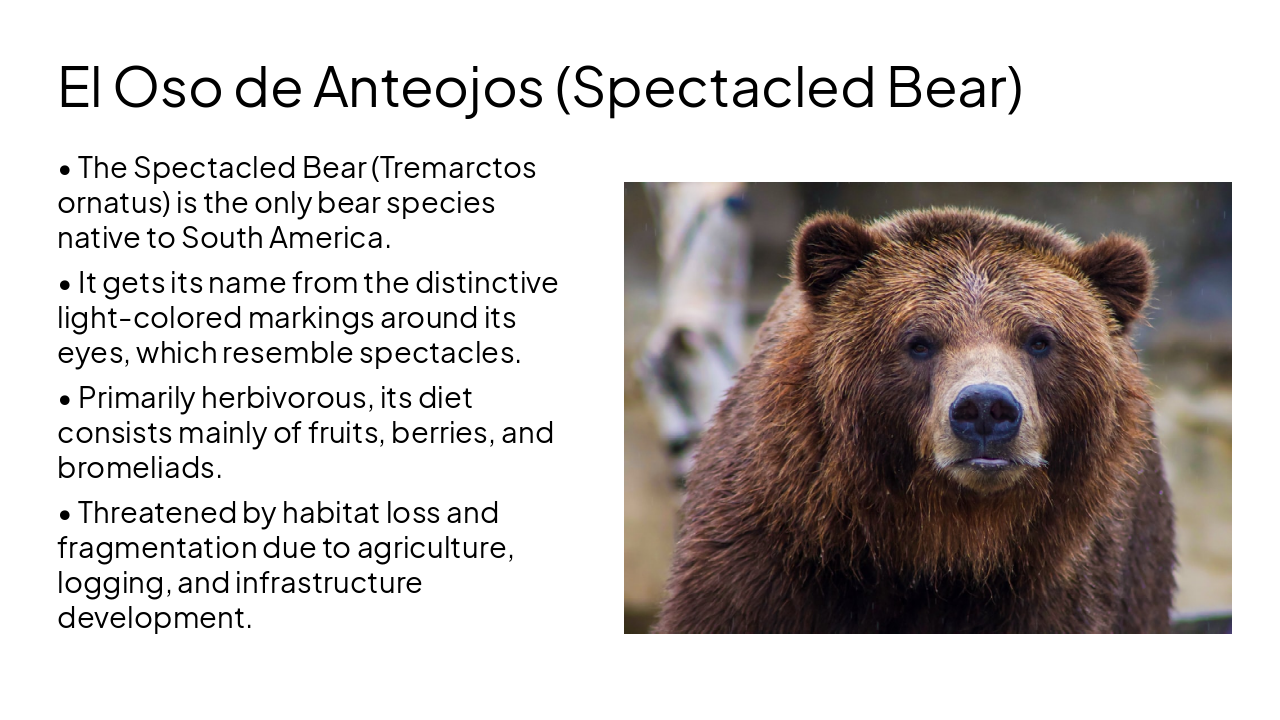
  • The Spectacled Bear (Tremarctos ornatus) is the only bear species native to South America.
  • It gets its name from the distinctive light-colored markings around its eyes, which resemble spectacles.
  • Primarily herbivorous, its diet consists mainly of fruits, berries, and bromeliads.
  • Threatened by habitat loss and fragmentation due to agriculture, logging, and infrastructure development.

---

Photo by Becca on Unsplash

Slide 12 - El Oso de Anteojos (Spectacled Bear)
Slide 13 of 20

Slide 13 - La Tortuga Gigante (Giant Tortoise)

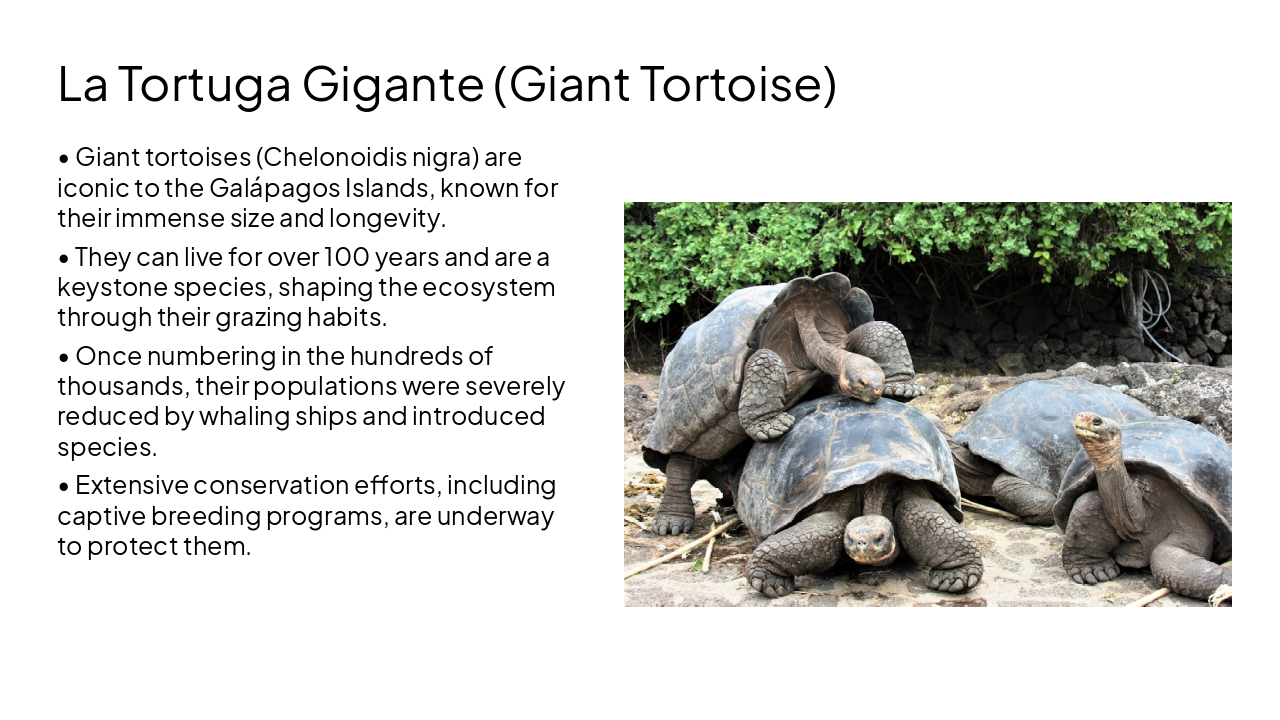
  • Giant tortoises (Chelonoidis nigra) are iconic to the Galápagos Islands, known for their immense size and longevity.
  • They can live for over 100 years and are a keystone species, shaping the ecosystem through their grazing habits.
  • Once numbering in the hundreds of thousands, their populations were severely reduced by whaling ships and introduced species.
  • Extensive conservation efforts, including captive breeding programs, are underway to protect them.

---

Photo by Deb Dowd on Unsplash

Slide 13 - La Tortuga Gigante (Giant Tortoise)
Slide 14 of 20

Slide 14 - Las Islas Galápagos

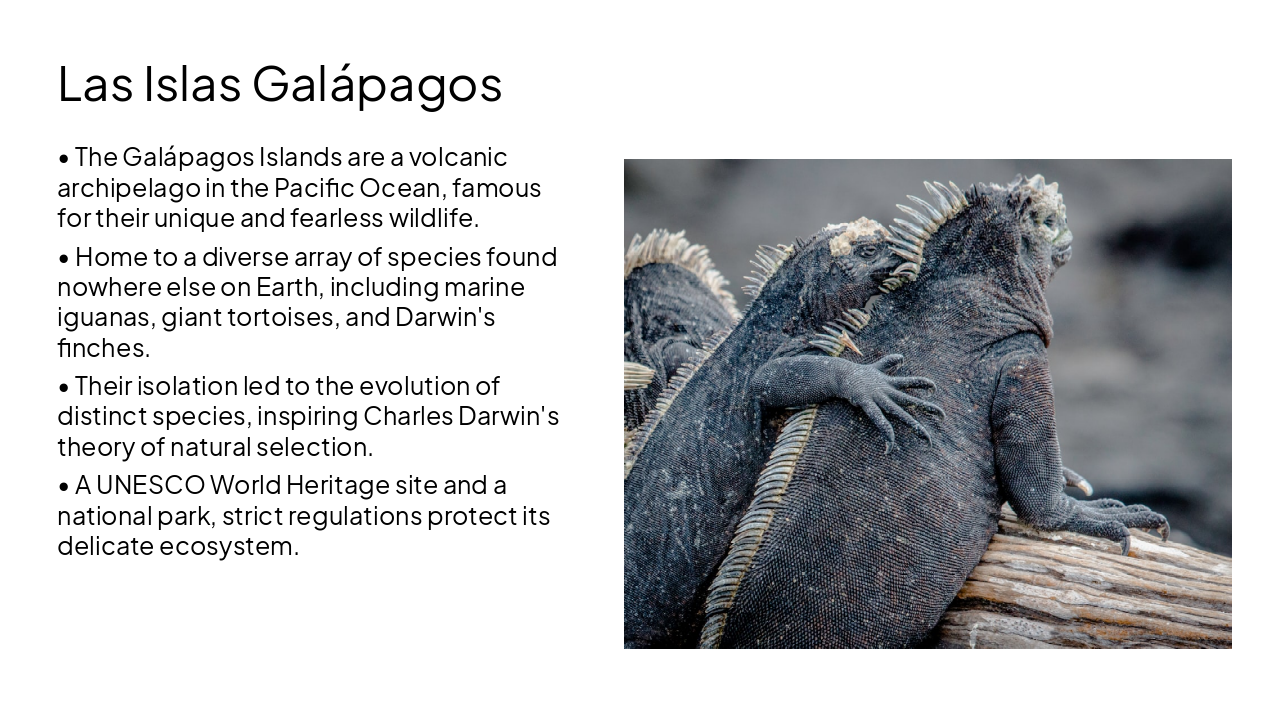
  • The Galápagos Islands are a volcanic archipelago in the Pacific Ocean, famous for their unique and fearless wildlife.
  • Home to a diverse array of species found nowhere else on Earth, including marine iguanas, giant tortoises, and Darwin's finches.
  • Their isolation led to the evolution of distinct species, inspiring Charles Darwin's theory of natural selection.
  • A UNESCO World Heritage site and a national park, strict regulations protect its delicate ecosystem.

---

Photo by Alan Alquist on Unsplash
Slide 14 - Las Islas Galápagos
Slide 15 of 20

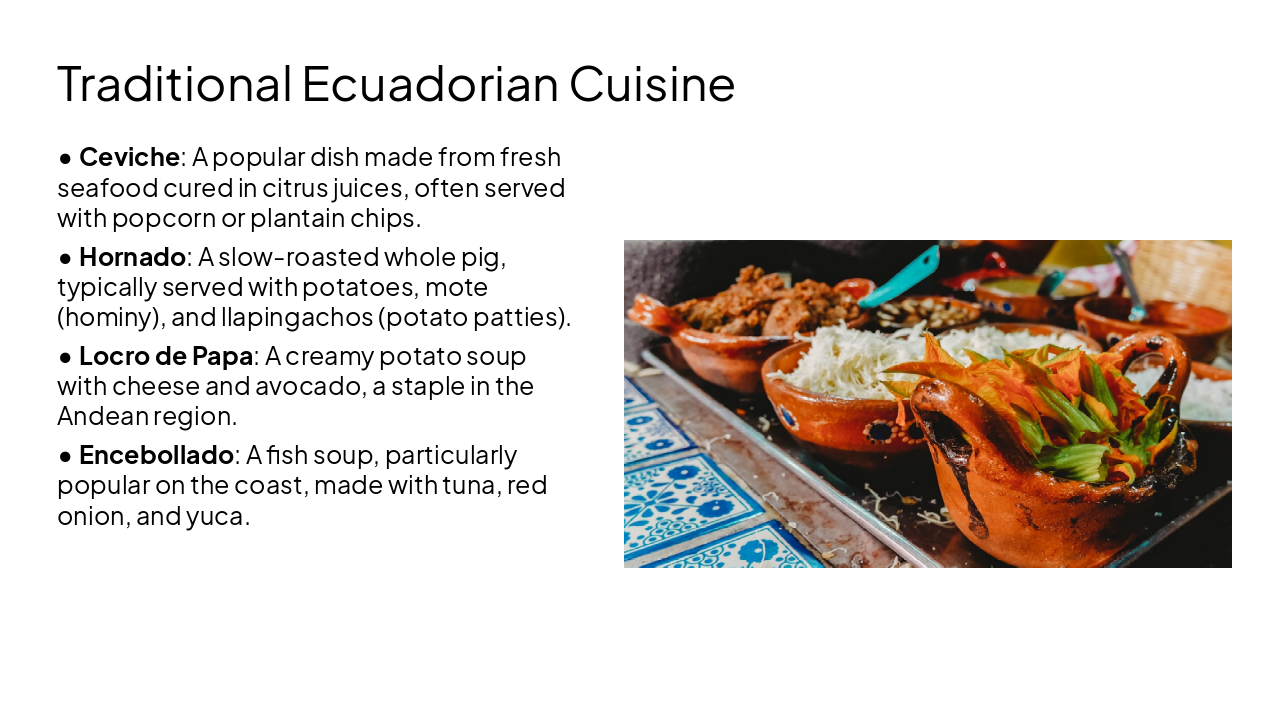
Slide 15 - Traditional Ecuadorian Cuisine

  • Ceviche: A popular dish made from fresh seafood cured in citrus juices, often served with popcorn or plantain chips.
  • Hornado: A slow-roasted whole pig, typically served with potatoes, mote (hominy), and llapingachos (potato patties).
  • Locro de Papa: A creamy potato soup with cheese and avocado, a staple in the Andean region.
  • Encebollado: A fish soup, particularly popular on the coast, made with tuna, red onion, and yuca.

---

Photo by Roberto Carlos Román Don on Unsplash
Slide 15 - Traditional Ecuadorian Cuisine
Slide 16 of 20

Slide 16 - Protecting Nature in Ecuador

  • Establishing Protected Areas: National parks and reserves safeguard critical habitats and endangered species.
  • Sustainable Tourism: Ecotourism initiatives provide economic incentives for conservation and raise awareness.
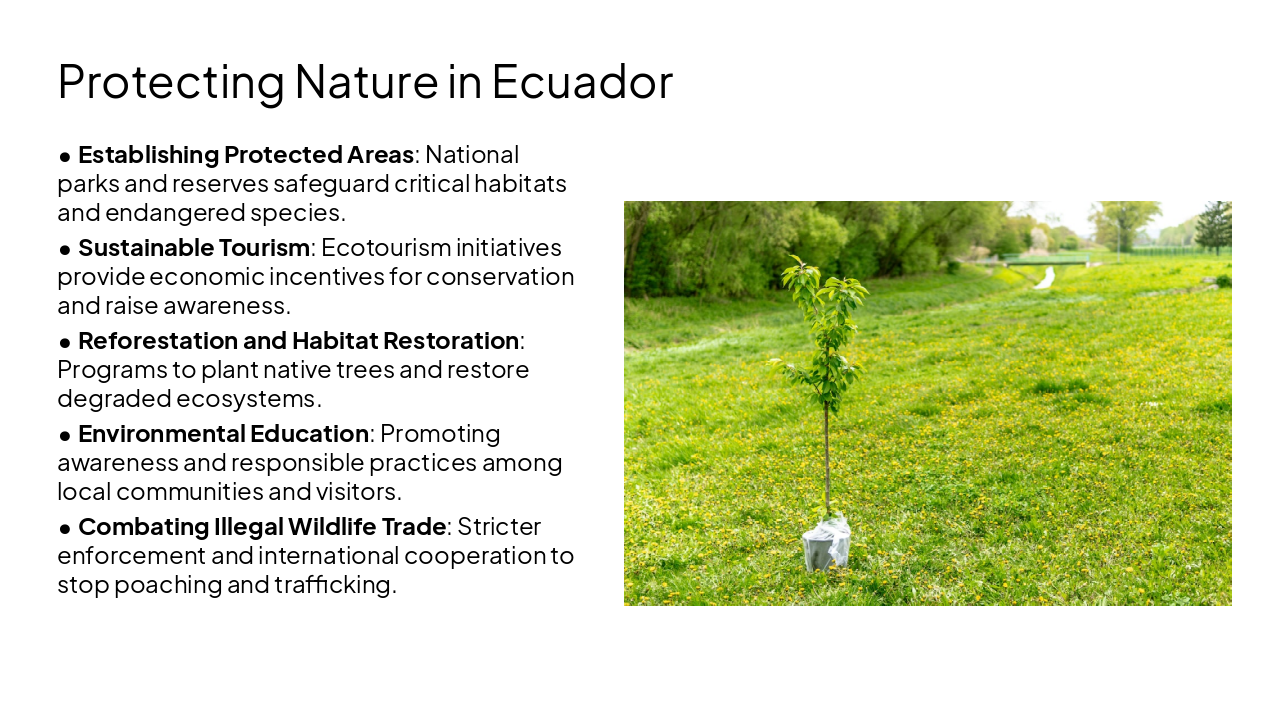
  • Reforestation and Habitat Restoration: Programs to plant native trees and restore degraded ecosystems.
  • Environmental Education: Promoting awareness and responsible practices among local communities and visitors.
  • Combating Illegal Wildlife Trade: Stricter enforcement and international cooperation to stop poaching and trafficking.

---

Photo by George Bakos on Unsplash
Slide 16 - Protecting Nature in Ecuador
Slide 17 of 20

Slide 17 - Why Protect the Amazon Rainforest?

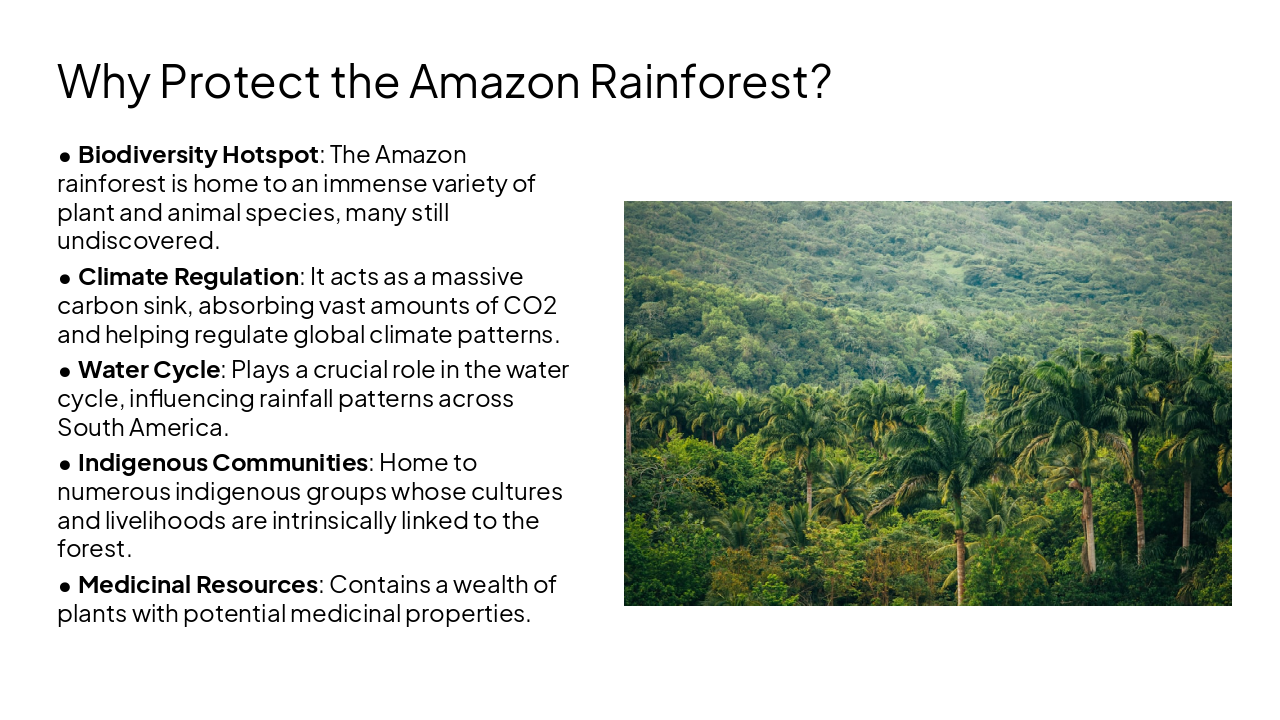
  • Biodiversity Hotspot: The Amazon rainforest is home to an immense variety of plant and animal species, many still undiscovered.
  • Climate Regulation: It acts as a massive carbon sink, absorbing vast amounts of CO2 and helping regulate global climate patterns.
  • Water Cycle: Plays a crucial role in the water cycle, influencing rainfall patterns across South America.
  • Indigenous Communities: Home to numerous indigenous groups whose cultures and livelihoods are intrinsically linked to the forest.
  • Medicinal Resources: Contains a wealth of plants with potential medicinal properties.

---

Photo by Levi Arnold on Unsplash

Slide 17 - Why Protect the Amazon Rainforest?
Slide 18 of 20

Slide 18 - Popular Music Styles in Ecuador

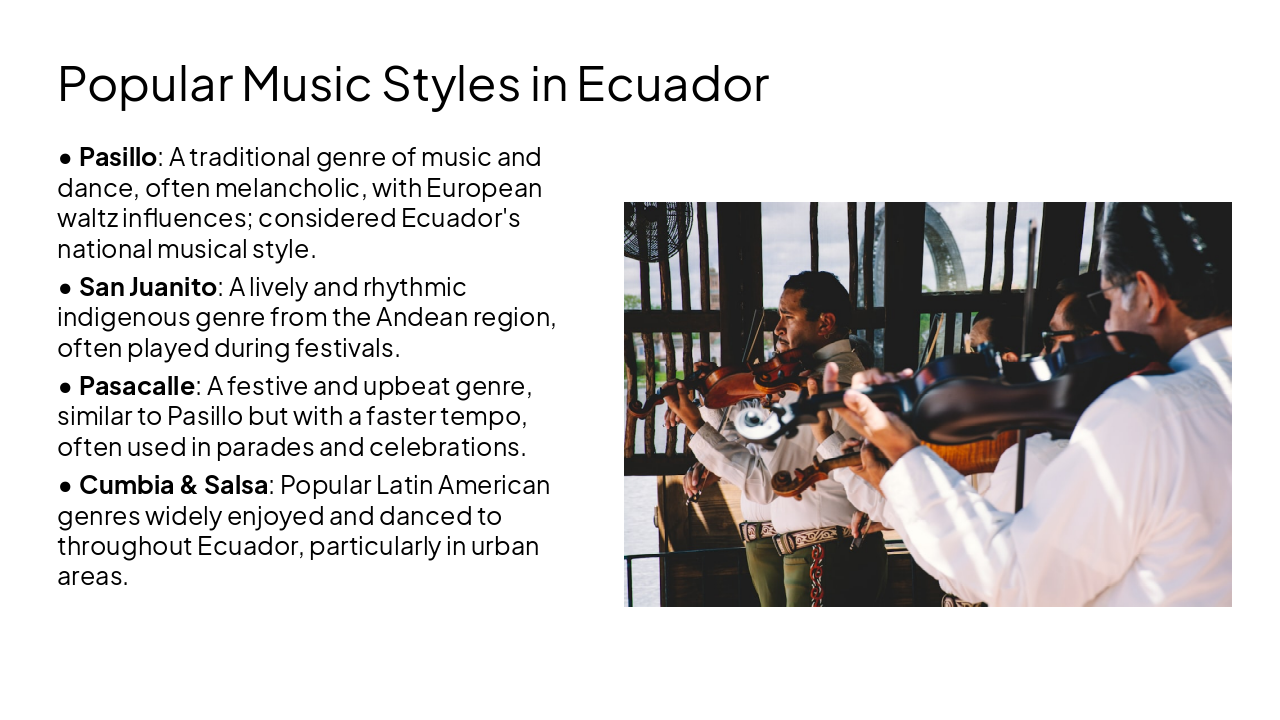
  • Pasillo: A traditional genre of music and dance, often melancholic, with European waltz influences; considered Ecuador's national musical style.
  • San Juanito: A lively and rhythmic indigenous genre from the Andean region, often played during festivals.
  • Pasacalle: A festive and upbeat genre, similar to Pasillo but with a faster tempo, often used in parades and celebrations.
  • Cumbia & Salsa: Popular Latin American genres widely enjoyed and danced to throughout Ecuador, particularly in urban areas.

---

Photo by Samuel Ramos on Unsplash
Slide 18 - Popular Music Styles in Ecuador
Slide 19 of 20

Slide 19 - The Otavalos: Culture & Craftsmanship

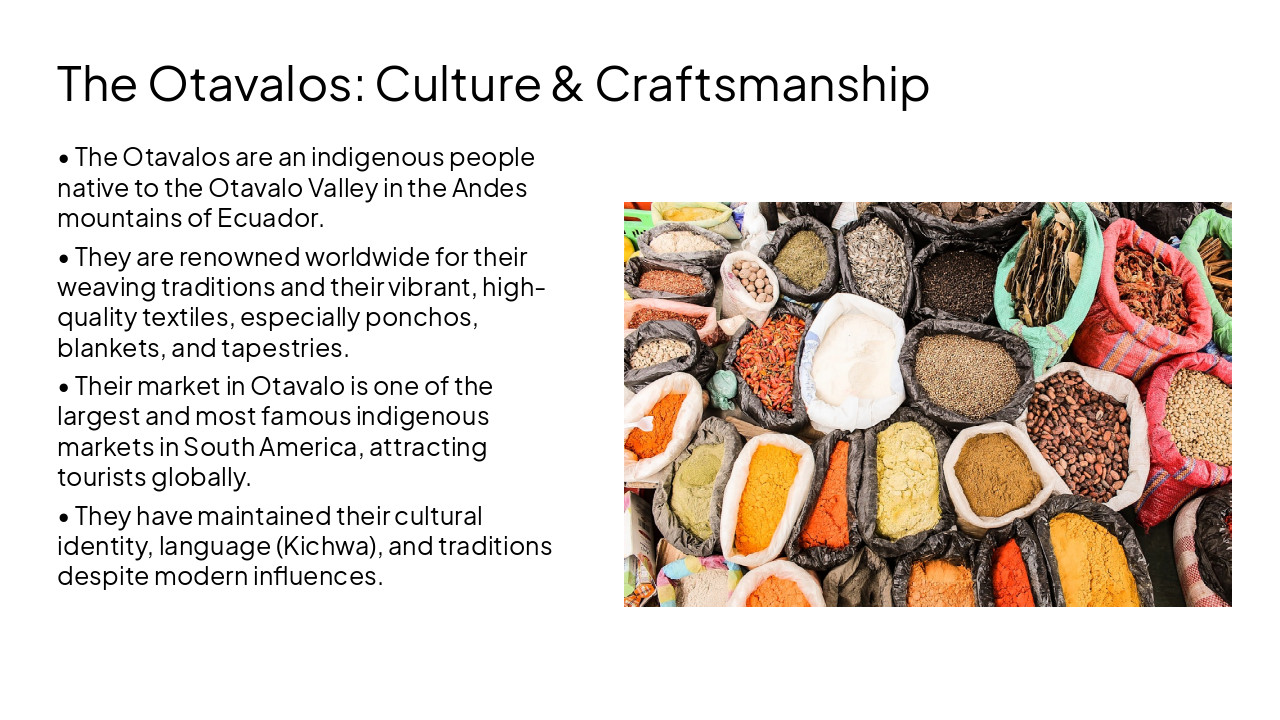
  • The Otavalos are an indigenous people native to the Otavalo Valley in the Andes mountains of Ecuador.
  • They are renowned worldwide for their weaving traditions and their vibrant, high-quality textiles, especially ponchos, blankets, and tapestries.
  • Their market in Otavalo is one of the largest and most famous indigenous markets in South America, attracting tourists globally.
  • They have maintained their cultural identity, language (Kichwa), and traditions despite modern influences.

---

Photo by Andrea Leon on Unsplash

Slide 19 - The Otavalos: Culture & Craftsmanship
Slide 20 of 20

Slide 20 - Cotopaxi: World's Highest Active Volcano

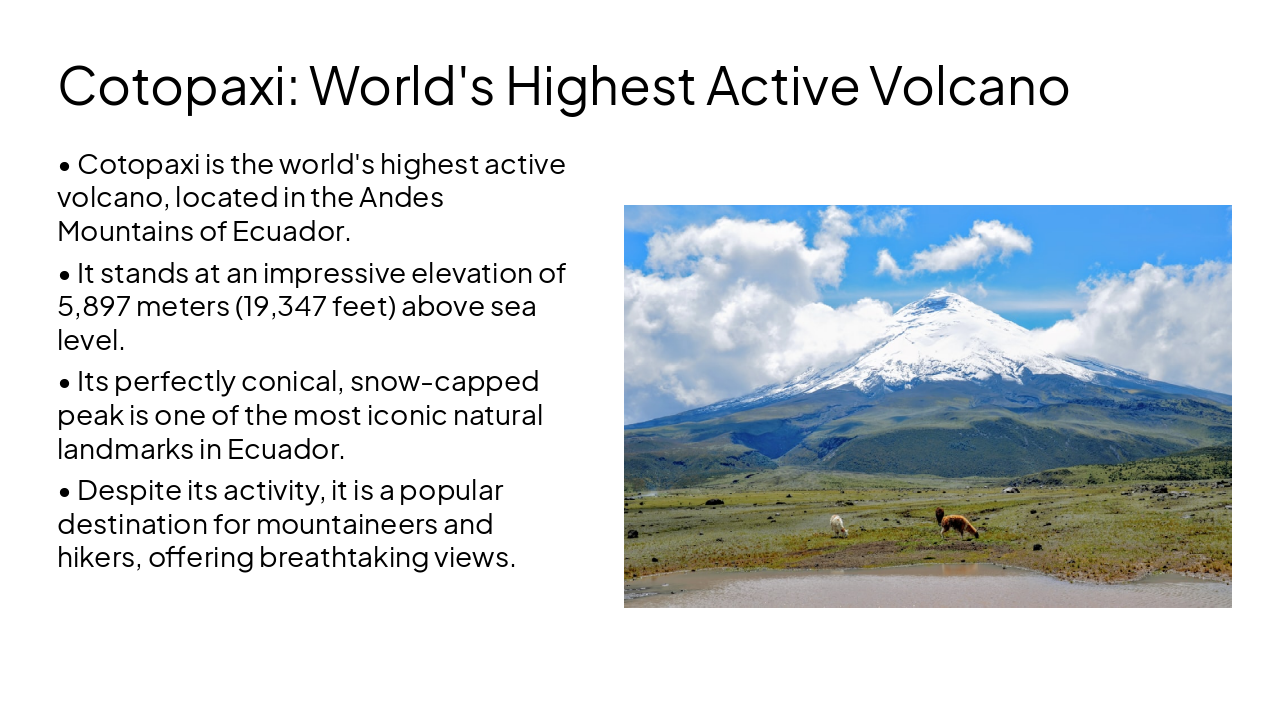
  • Cotopaxi is the world's highest active volcano, located in the Andes Mountains of Ecuador.
  • It stands at an impressive elevation of 5,897 meters (19,347 feet) above sea level.
  • Its perfectly conical, snow-capped peak is one of the most iconic natural landmarks in Ecuador.
  • Despite its activity, it is a popular destination for mountaineers and hikers, offering breathtaking views.

---

Photo by Mauricio Muñoz on Unsplash
Slide 20 - Cotopaxi: World's Highest Active Volcano

Discover More Presentations

Explore thousands of AI-generated presentations for inspiration

Browse Presentations
Powered by AI

Create Your Own Presentation

Generate professional presentations in seconds with Karaf's AI. Customize this presentation or start from scratch.

Create New Presentation

Powered by Karaf.ai — AI-Powered Presentation Generator