Basic First Aid & CPR Training for Maritime Professionals

Generated from prompt:

Create a premium, highly polished, directly downloadable presentation titled 'Basic First Aid & CPR Training for Maritime Industry – Khalid Faraj Shipping'. Use the uploaded company logo prominently on the title slide and subtly in the footer of every slide. Apply a clean, modern maritime theme using the logo colors (red and blue), with professional typography and high-contrast readability. Include 16–18 slides with enhanced, next-level content: 1. Title Slide (with logo and subtitle: Workplace Safety Training) 2. Training Objectives & Outcomes 3. Importance of First Aid at Sea (statistics + impact) 4. Maritime Workplace Hazards (deck, engine room, cargo ops) 5. Emergency Response Plan (DRABC adapted for vessels) 6. Communication Protocols (VHF radio, distress signals) 7. Scene Safety & Risk Assessment onboard 8. Checking Responsiveness & Breathing 9. CPR Overview (with timing & ratios) 10. Adult CPR – Step-by-Step (deck conditions) 11. Child & Infant CPR differences (brief) 12. AED Use onboard ships (placement & safety) 13. Drowning & Rescue Breathing (marine scenarios) 14. Recovery Position (confined spaces adaptation) 15. Severe Bleeding & Trauma Management 16. Burns (thermal, chemical, electrical) 17. Choking Response (Heimlich maneuver onboard) 18. Shock & Hypothermia Management (cold sea exposure) 19. First Aid Kit Requirements for Ships (IMO/STCW aligned) 20. Safety Tips for Rescuers & Crew Responsibility 21. Quick Scenario-Based Drill Slide (interactive style) 22. Summary & Key Takeaways 23. Thank You / Questions Slide with company branding Each slide should include: - Clean bullet points (not overcrowded) - Icon or visual suggestion - Occasional callout boxes (e.g., 'Important', 'Warning') - Consistent footer with company name Ensure the final output is export-ready, high-quality, and optimized for direct download (PPTX + PDF). Logo path: /mnt/data/KFS _ JJJ.jpg

This presentation provides essential first aid and CPR training for maritime industry workers at Khalid Faraj Shipping. It covers STCW/IMO obligations, sea-specific emergencies, hazards, DRABC response protocol, communication, CPR techniques for all,

March 25, 202618 slides
Slide 1 of 18

Slide 1 - Title Slide

Basic First Aid & CPR Training for Maritime Industry – Khalid Faraj Shipping

Workplace Safety Training for Maritime Professionals
Slide 1 - Title Slide
Slide 2 of 18

Slide 2 - Training Objectives & Outcomes

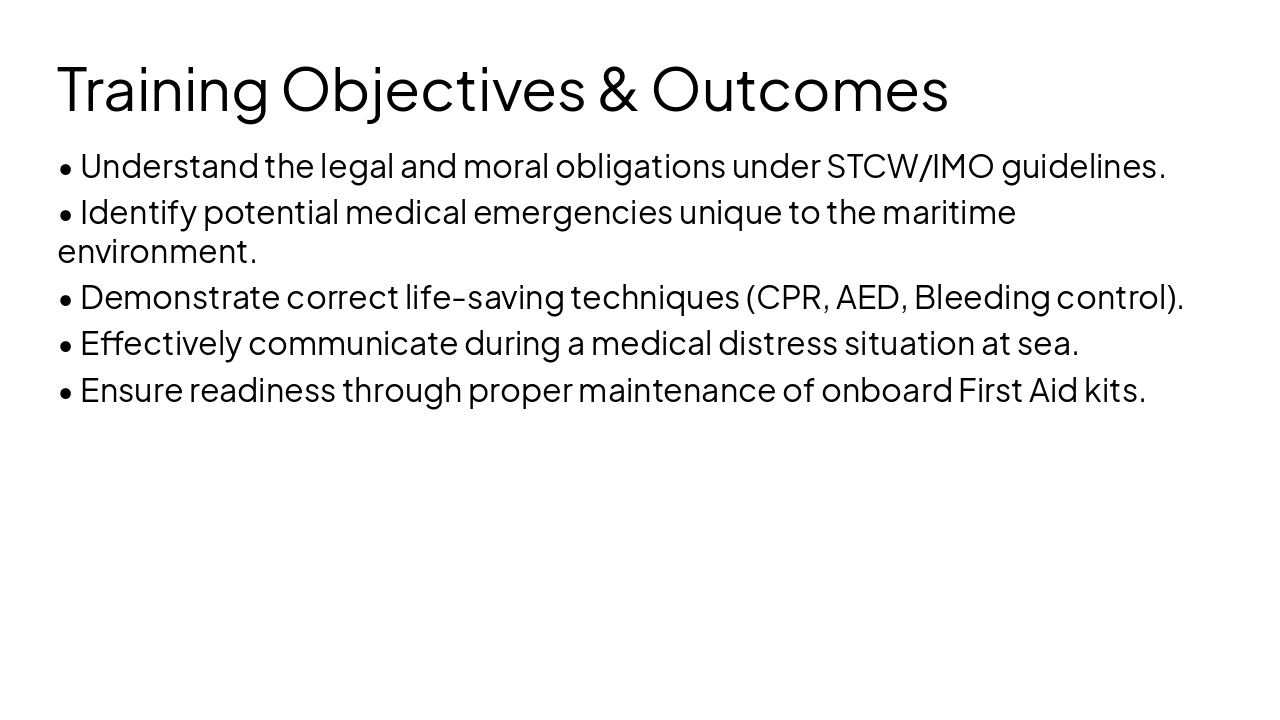
  • Understand the legal and moral obligations under STCW/IMO guidelines.
  • Identify potential medical emergencies unique to the maritime environment.
  • Demonstrate correct life-saving techniques (CPR, AED, Bleeding control).
  • Effectively communicate during a medical distress situation at sea.
  • Ensure readiness through proper maintenance of onboard First Aid kits.
Slide 2 - Training Objectives & Outcomes
Slide 3 of 18

Slide 3 - Importance of First Aid at Sea

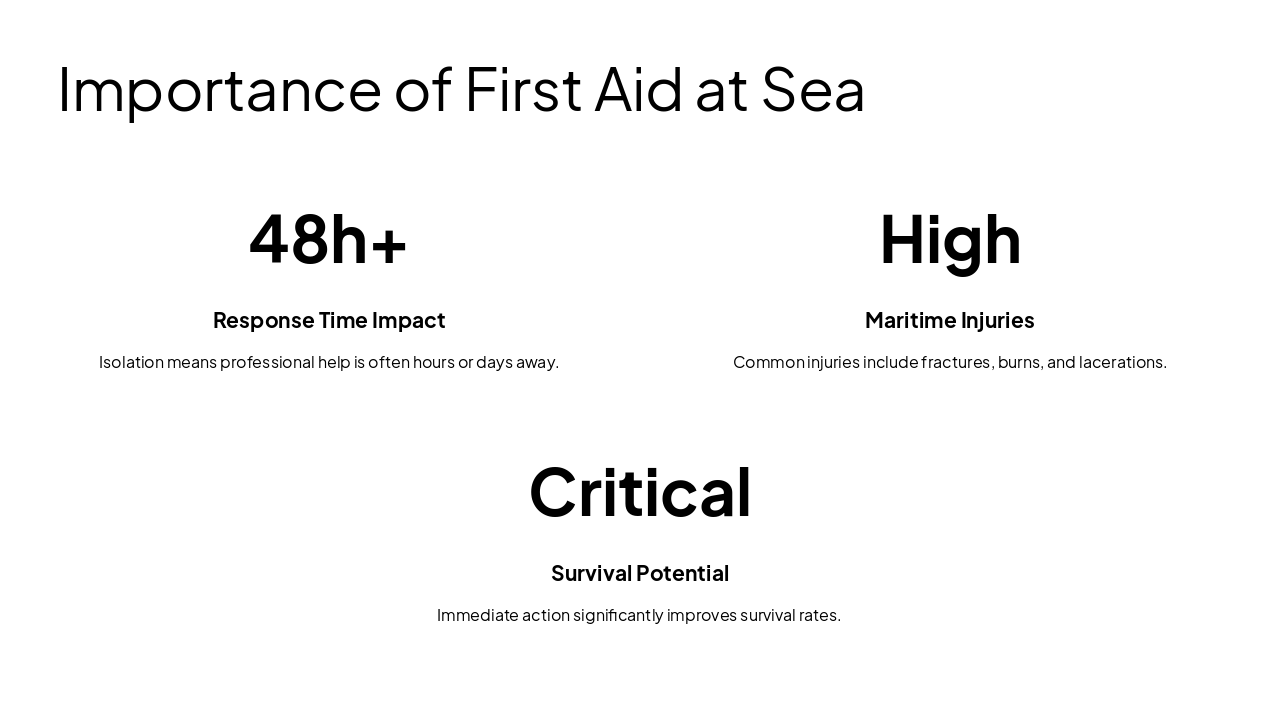
  • 48h+: Response Time Impact
  • High: Maritime Injuries
  • Critical: Survival Potential
Slide 3 - Importance of First Aid at Sea
Slide 4 of 18

Slide 4 - Maritime Workplace Hazards

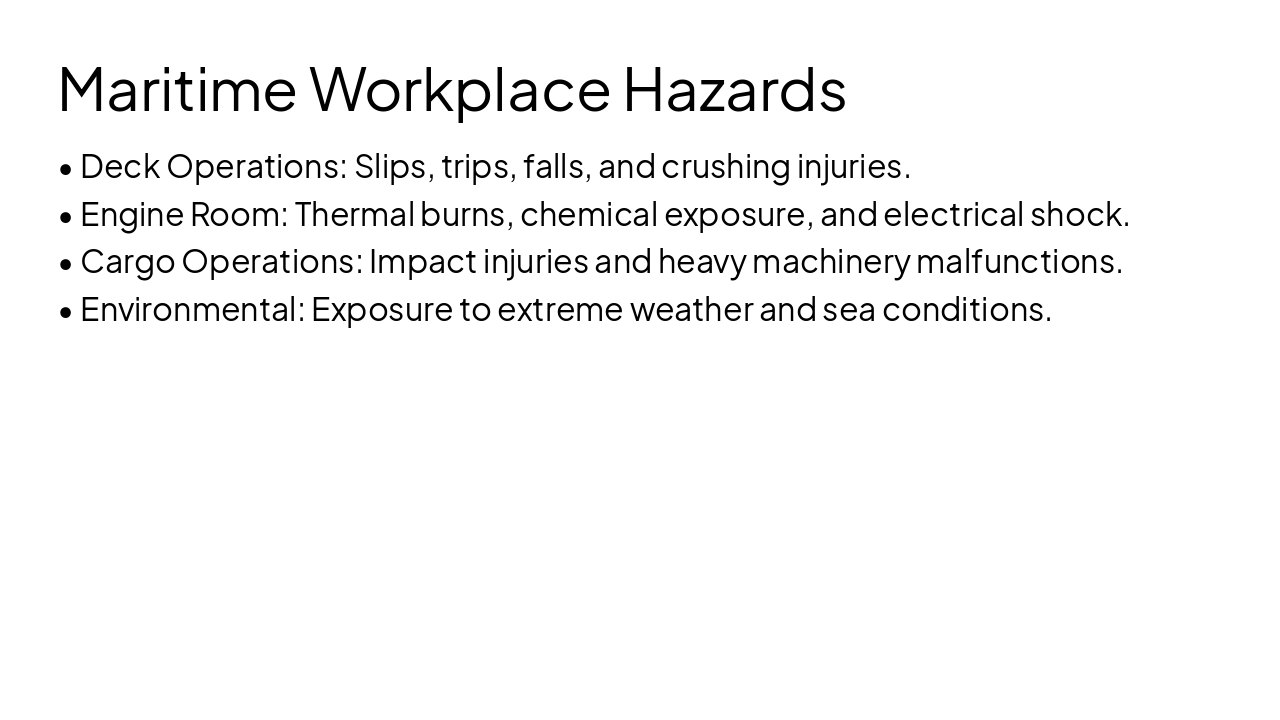
  • Deck Operations: Slips, trips, falls, and crushing injuries.
  • Engine Room: Thermal burns, chemical exposure, and electrical shock.
  • Cargo Operations: Impact injuries and heavy machinery malfunctions.
  • Environmental: Exposure to extreme weather and sea conditions.
Slide 4 - Maritime Workplace Hazards
Slide 5 of 18

Slide 5 - Emergency Response Plan (DRABC)

StepAction
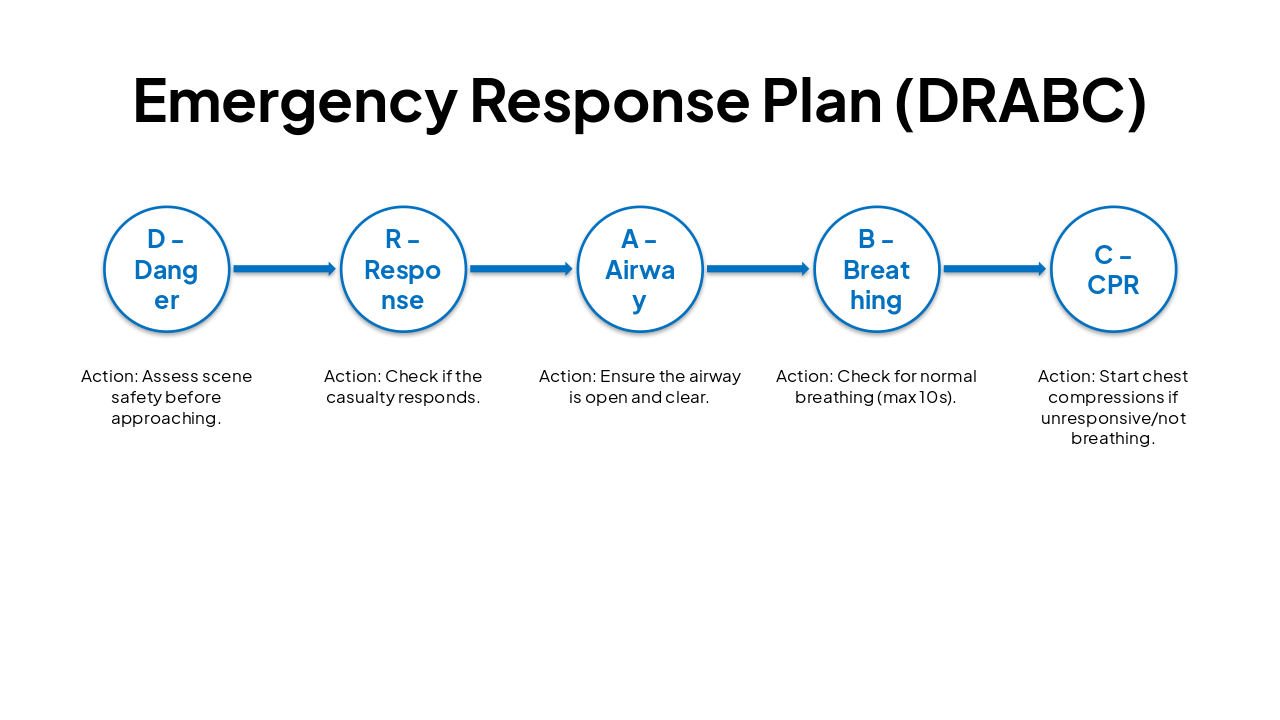
D - DangerAssess scene safety before approaching.
R - ResponseCheck if the casualty responds.
A - AirwayEnsure the airway is open and clear.
B - BreathingCheck for normal breathing (max 10s).
C - CPRStart chest compressions if unresponsive/not breathing.
Slide 5 - Emergency Response Plan (DRABC)
Slide 6 of 18

Slide 6 - Communication Protocols

  • Establish clear communication with the Bridge.
  • Use correct distress terminology: 'MAYDAY', 'PAN-PAN'.
  • Clearly state vessel position, nature of illness/injury, and immediate needs.
  • Monitor VHF Channel 16 for all emergency traffic.
Slide 6 - Communication Protocols
Slide 7 of 18

Slide 7 - Scene Safety & Risk Assessment

  • Stop, Look, and Listen: Assess threats like fire, electricity, or heavy weather.
  • Personal Protective Equipment (PPE): Always wear gloves and appropriate gear before touching a casualty.
  • Request support: Do not work alone in confined or dangerous spaces.
Slide 7 - Scene Safety & Risk Assessment
Slide 8 of 18

Slide 8 - Checking Responsiveness & Breathing

  • Shake the casualty gently by the shoulders.
  • Shout loudly to prompt a response.
  • Check for normal breathing by looking at the chest movement and listening for breath sounds.
  • Warning: Do not spend more than 10 seconds assessing.
Slide 8 - Checking Responsiveness & Breathing
Slide 9 of 18

Slide 9 - CPR Overview

  • Chest Compressions: Push hard and fast in the center of the chest.
  • Depth: At least 5cm, not exceeding 6cm.
  • Rate: 100-120 compressions per minute.
  • Ratio: 30 compressions to 2 rescue breaths.
Slide 9 - CPR Overview
Slide 10 of 18

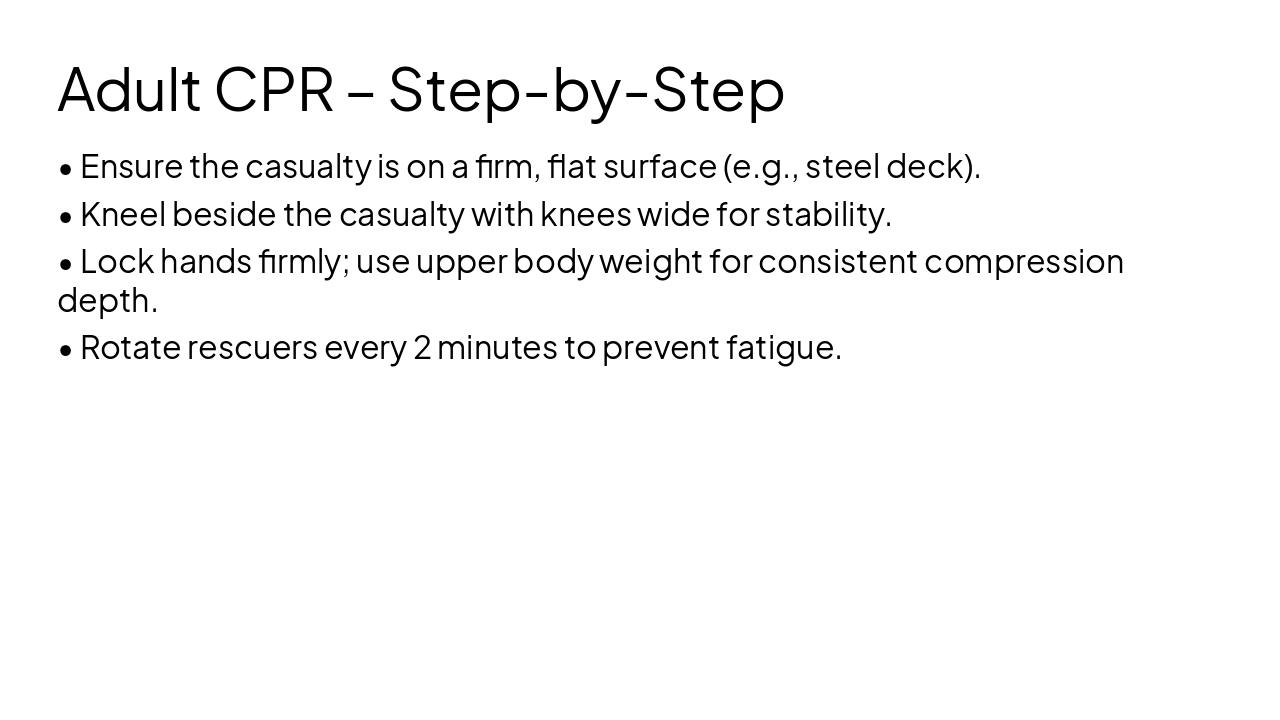
Slide 10 - Adult CPR – Step-by-Step

  • Ensure the casualty is on a firm, flat surface (e.g., steel deck).
  • Kneel beside the casualty with knees wide for stability.
  • Lock hands firmly; use upper body weight for consistent compression depth.
  • Rotate rescuers every 2 minutes to prevent fatigue.
Slide 10 - Adult CPR – Step-by-Step
Slide 11 of 18

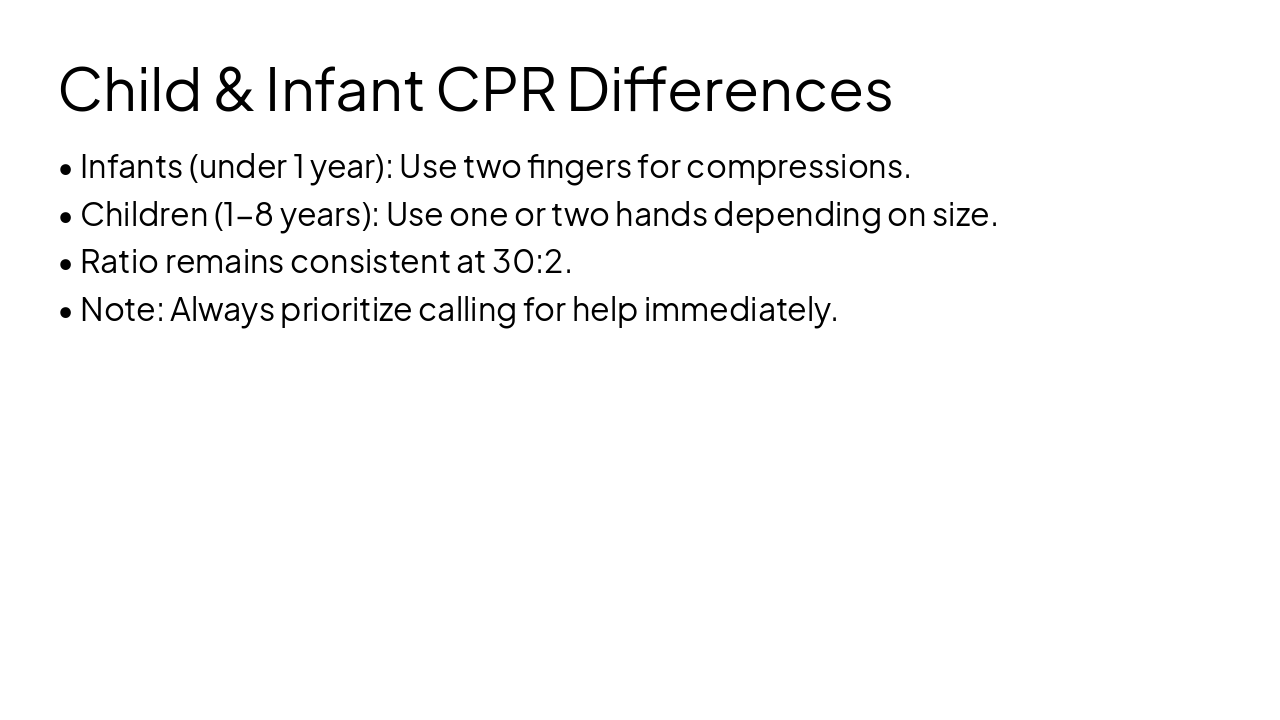
Slide 11 - Child & Infant CPR Differences

  • Infants (under 1 year): Use two fingers for compressions.
  • Children (1-8 years): Use one or two hands depending on size.
  • Ratio remains consistent at 30:2.
  • Note: Always prioritize calling for help immediately.
Slide 11 - Child & Infant CPR Differences
Slide 12 of 18

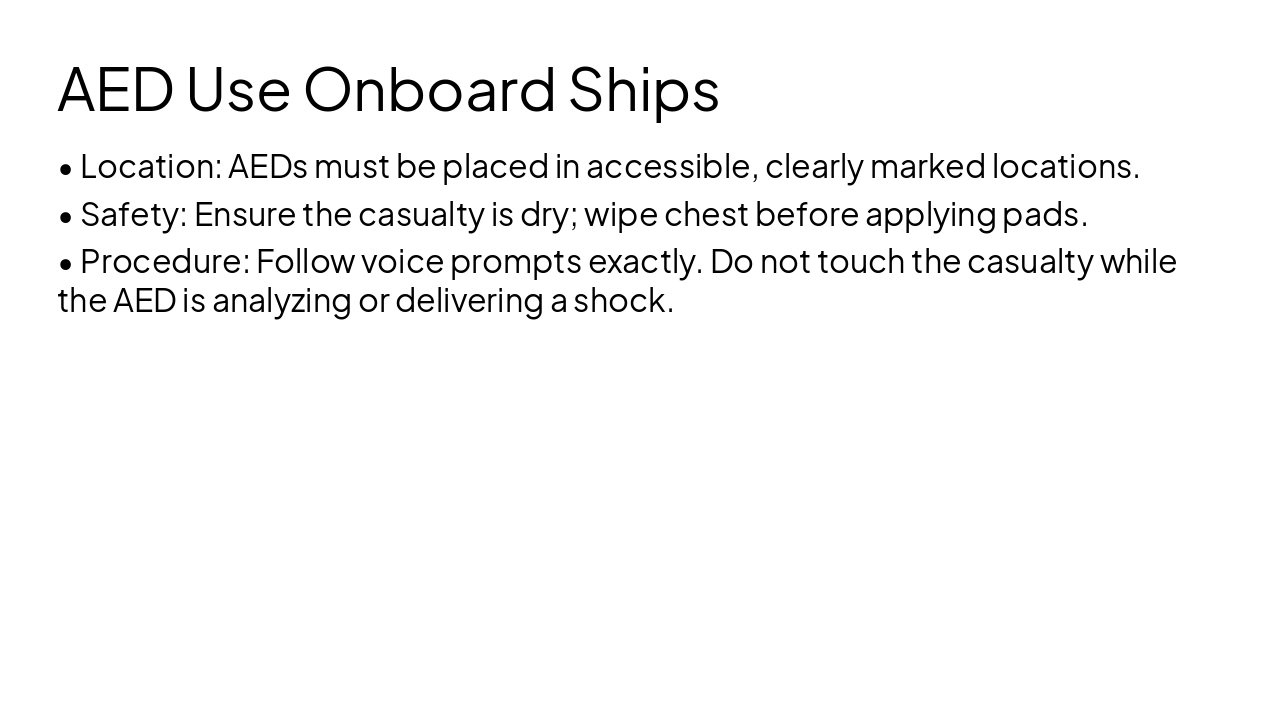
Slide 12 - AED Use Onboard Ships

  • Location: AEDs must be placed in accessible, clearly marked locations.
  • Safety: Ensure the casualty is dry; wipe chest before applying pads.
  • Procedure: Follow voice prompts exactly. Do not touch the casualty while the AED is analyzing or delivering a shock.
Slide 12 - AED Use Onboard Ships
Slide 13 of 18

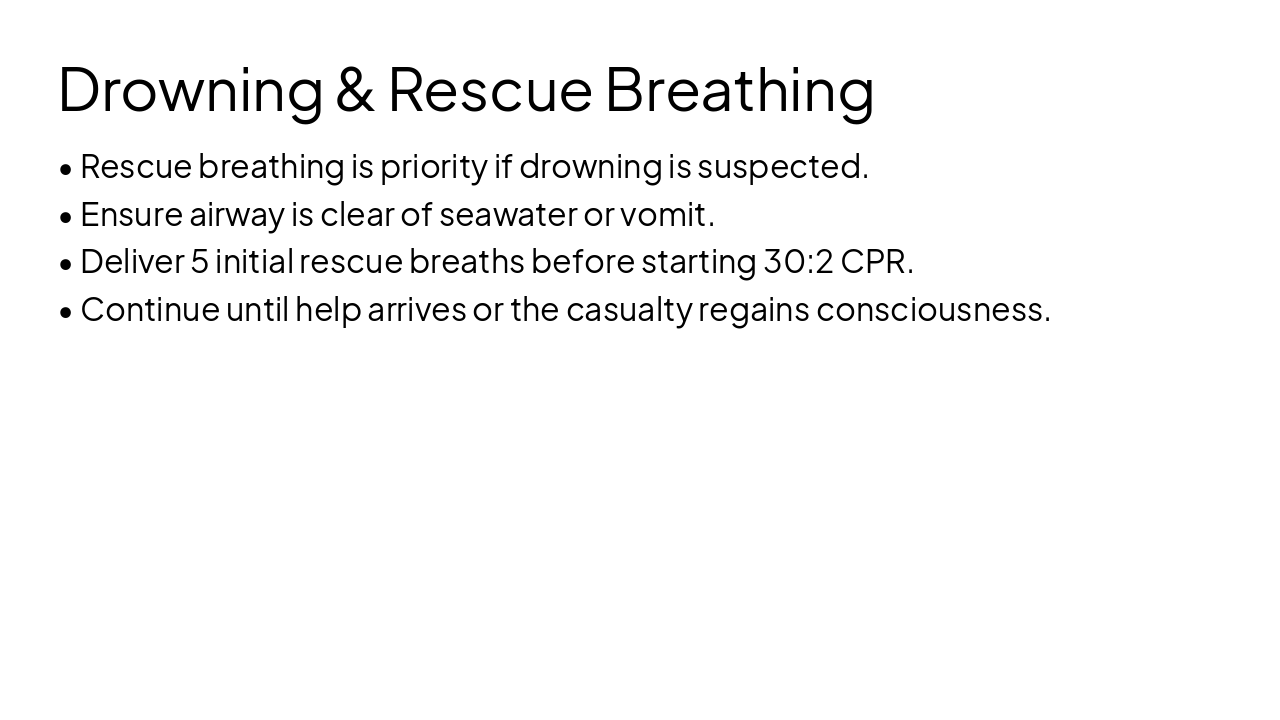
Slide 13 - Drowning & Rescue Breathing

  • Rescue breathing is priority if drowning is suspected.
  • Ensure airway is clear of seawater or vomit.
  • Deliver 5 initial rescue breaths before starting 30:2 CPR.
  • Continue until help arrives or the casualty regains consciousness.
Slide 13 - Drowning & Rescue Breathing
Slide 14 of 18

Slide 14 - Recovery Position

  • If breathing normally but unresponsive, place in the recovery position.
  • Adapt for confined spaces: Use ship furniture or bulkhead if space is limited.
  • Keep the airway clear and monitor breathing continuously.
Slide 14 - Recovery Position
Slide 15 of 18

Slide 15 - Severe Bleeding & Trauma Management

  • Apply direct, firm pressure to the wound with a sterile pad or clean cloth.
  • If bleeding is severe, use a tourniquet only as a last resort.
  • Elevate the injured limb if possible.
  • Monitor for signs of shock.
Slide 15 - Severe Bleeding & Trauma Management
Slide 16 of 18

Slide 16 - Burns (Thermal, Chemical, Electrical)

  • Thermal: Cool the burn with cool running water for at least 20 minutes.
  • Chemical: Flush continuously with water; seek immediate medical advice.
  • Electrical: Ensure power is isolated before touching the casualty.
  • Important: Never apply ice, creams, or ointments to burns.
Slide 16 - Burns (Thermal, Chemical, Electrical)
Slide 17 of 18

Slide 17 - Choking Response

  • Encourage coughing first.
  • If unresponsive, use 5 sharp back blows between the shoulder blades.
  • Follow with 5 abdominal thrusts (Heimlich Maneuver).
  • If they become unconscious, commence CPR.
Slide 17 - Choking Response
Slide 18 of 18

Slide 18 - Summary & Thank You

Thank you for your commitment to safety at Khalid Faraj Shipping.

Stay prepared, stay safe, and act decisively.
Slide 18 - Summary & Thank You

Discover More Presentations

Explore thousands of AI-generated presentations for inspiration

Browse Presentations
Powered by AI

Create Your Own Presentation

Generate professional presentations in seconds with Karaf's AI. Customize this presentation or start from scratch.

Create New Presentation

Powered by Karaf.ai — AI-Powered Presentation Generator