MSc Thesis: Chemical Space Coverage in LC-HRMS

Generated from prompt:

Create a presenation about my thesis

MSc literature thesis presentation investigating chemical space coverage by liquid chromatographic techniques (LC-HRMS) in non-targeted analysis. Analyzes 236 RepoRT methods, revealing RPLC/HILIC selectivity biases, coverage limitations, and need for

April 18, 202628 slides
Slide 1 of 28

Slide 1 - Thesis Presentation

Literature Thesis Presentation

Investigating the chemical space coverage of liquid chromatographic techniques: how selectivity drives measurability

---

Photo by Nastuh Abootalebi on Unsplash
Slide 1 - Thesis Presentation
Slide 2 of 28

Slide 2 - Literature Thesis Presentation

Literature Thesis Presentation

Investigating the chemical space coverage of liquid chromatographic techniques: how selectivity drives measurability

---

Photo by Nastuh Abootalebi on Unsplash
Slide 2 - Literature Thesis Presentation
Slide 3 of 28

Slide 3 - MSc Literature Thesis: Chemical Space Coverage in LC-HRMS

MSc Literature Thesis: Chemical Space Coverage in LC-HRMS

Investigating the chemical space coverage of liquid chromatographic techniques: how selectivity drives measurability
Slide 3 - MSc Literature Thesis: Chemical Space Coverage in LC-HRMS
Slide 4 of 28

Slide 4 - Presentation Agenda

  • Introduction & Problem Statement
  • Methodology: RepoRT Analysis
  • Chemical Space Coverage Results
  • Conclusions & Perspectives

---

Photo by Nastuh Abootalebi on Unsplash

Slide 4 - Presentation Agenda
Slide 5 of 28

Slide 5 - Agenda

  • Introduction: Definition of chemical space and NTA challenges
  • Methodology: Data acquisition and instrumental setups
  • Results and Analysis: RepoRT database and chemical trends analysis
  • Conclusion: Final conclusions and perspectives

---

Photo by Tom Parkes on Unsplash

Slide 5 - Agenda
Slide 6 of 28

Slide 6 - Presentation Outline

  • Overview of Chemical Space and Non-Targeted Analysis: Introduction to exposome and analytical challenges
  • Methodology and Instrumental Setups: Analysis of RepoRT repository and methodology
  • Analysis of Chemical Coverage: Chemical coverage, trends, and limitations
  • Conclusions and Perspectives: Final summary and future directions
Slide 6 - Presentation Outline
Slide 7 of 28

Slide 7 - Introduction

1

Introduction

Chemical space, non-targeted analysis, and the selectivity-measurability bias

---

Photo by Nastuh Abootalebi on Unsplash

Slide 7 - Introduction
Slide 8 of 28

Slide 8 - Introduction: Challenges in NTA

  • The exposome encompasses all chemical and non-chemical exposures.
  • Non-targeted analysis (NTA) with LC-HRMS aims to identify thousands of compounds.
  • Selectivity-measurability bias: analytical methods define which chemicals are detectable.
  • The study aims to investigate how LC experimental conditions capture different regions of the chemical space.
Slide 8 - Introduction: Challenges in NTA
Slide 9 of 28

Slide 9 - The Analytical Challenge

  • Exposome represents the totality of lifelong exposures.
  • Non-targeted analysis (NTA) + LC-HRMS is essential for identifying thousands of unknown compounds.
  • The "Selectivity-Measurability" bias: Analytical choices dictate which compounds are detected.
  • Challenge: Most existing workflows are narrow, potentially missing important chemicals (CECs).
Slide 9 - The Analytical Challenge
Slide 10 of 28

Slide 10 - Research Context

  • The exposome includes all chemical and non-chemical exposures throughout a lifetime.
  • Non-targeted analysis (NTA) with LC-HRMS is essential for identifying thousands of compounds.
  • Selectivity-measurability bias: analytical methods only detect compounds they interact with effectively.
  • The thesis investigates if current LC conditions truly cover the relevant chemical space.
Slide 10 - Research Context
Slide 11 of 28

Slide 11 - Methodology & Data Overview

  • Data source: RepoRT repository (236 curated LC methods).
  • Instrumentation: Primarily RPLC (89%) vs. HILIC (11%).
  • Reported compounds: 75,797 compounds from 17,083 unique structures.
  • Methodological limitations: Lack of extreme polarity/hydrophobicity coverage.
Slide 11 - Methodology & Data Overview
Slide 12 of 28

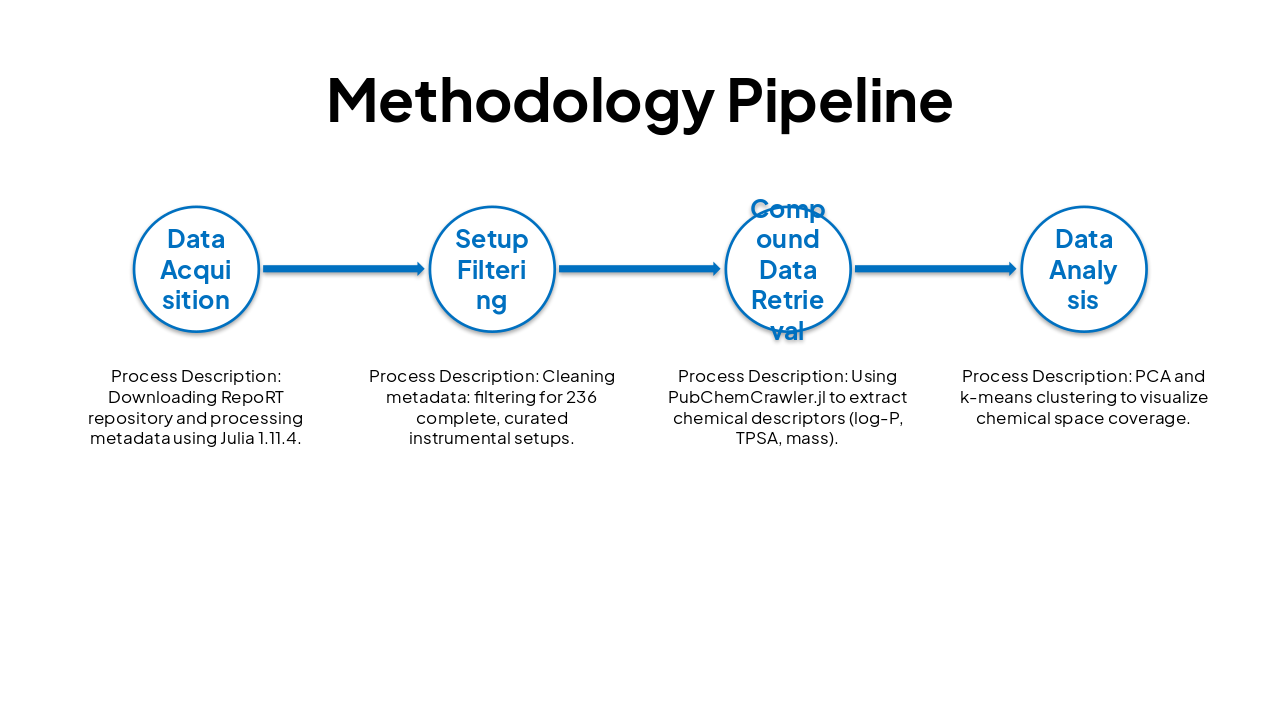
Slide 12 - Methodology Pipeline

PhaseProcess Description
Data AcquisitionDownloading RepoRT repository and processing metadata using Julia 1.11.4.
Setup FilteringCleaning metadata: filtering for 236 complete, curated instrumental setups.
Compound Data RetrievalUsing PubChemCrawler.jl to extract chemical descriptors (log-P, TPSA, mass).
Data AnalysisPCA and k-means clustering to visualize chemical space coverage.
Slide 12 - Methodology Pipeline
Slide 13 of 28

Slide 13 - Methodology

2

Methodology

Leveraging the RepoRT repository for data-driven assessment

---

Photo by Tom Parkes on Unsplash

Slide 13 - Methodology
Slide 14 of 28

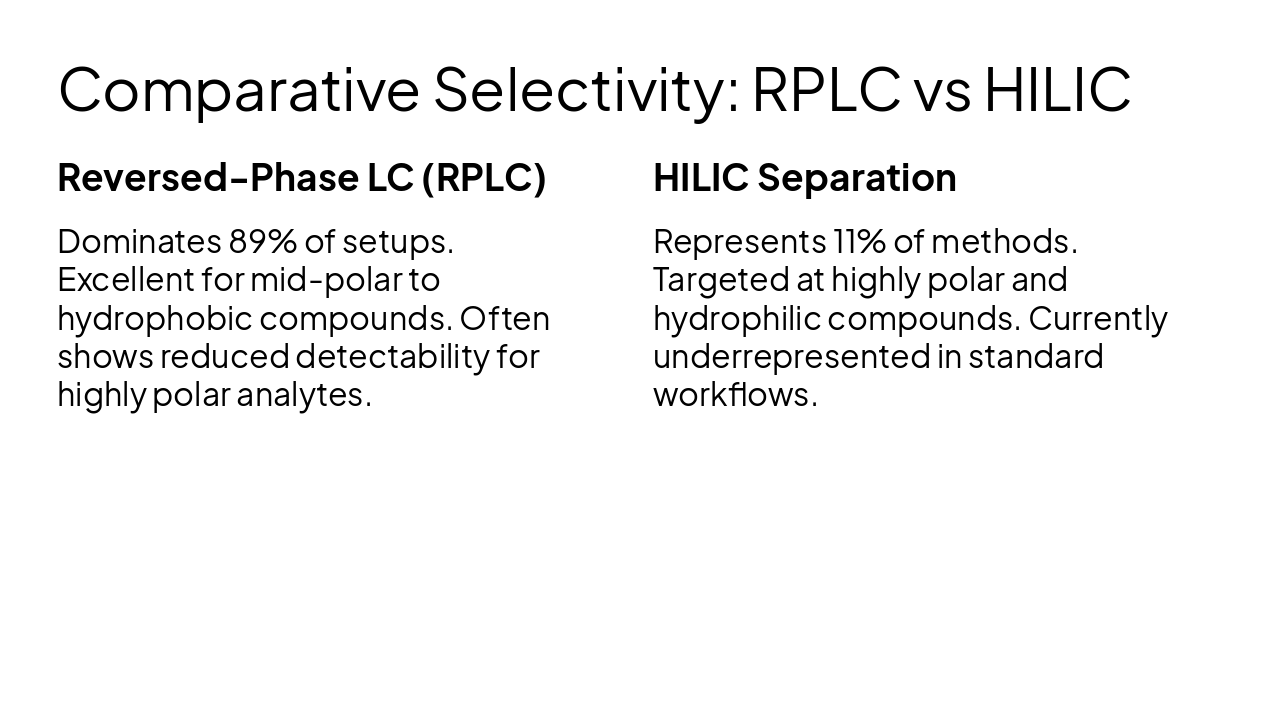
Slide 14 - Comparative Selectivity: RPLC vs HILIC

Reversed-Phase LC (RPLC) Dominates 89% of setups. Excellent for mid-polar to hydrophobic compounds. Often shows reduced detectability for highly polar analytes.

HILIC Separation Represents 11% of methods. Targeted at highly polar and hydrophilic compounds. Currently underrepresented in standard workflows.

Slide 14 - Comparative Selectivity: RPLC vs HILIC
Slide 15 of 28

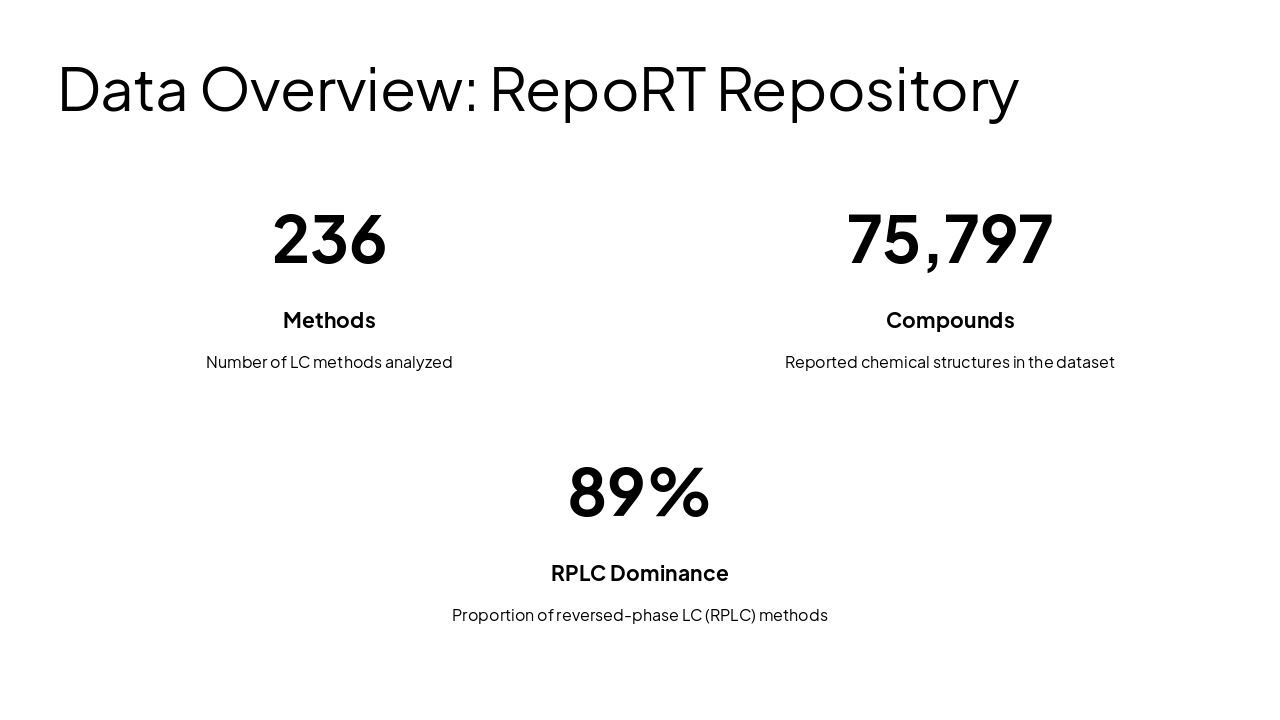
Slide 15 - Data Overview: RepoRT Repository

  • 236: Methods
  • 75,797: Compounds
  • 89%: RPLC Dominance
Slide 15 - Data Overview: RepoRT Repository
Slide 16 of 28

Slide 16 - Data and Methods

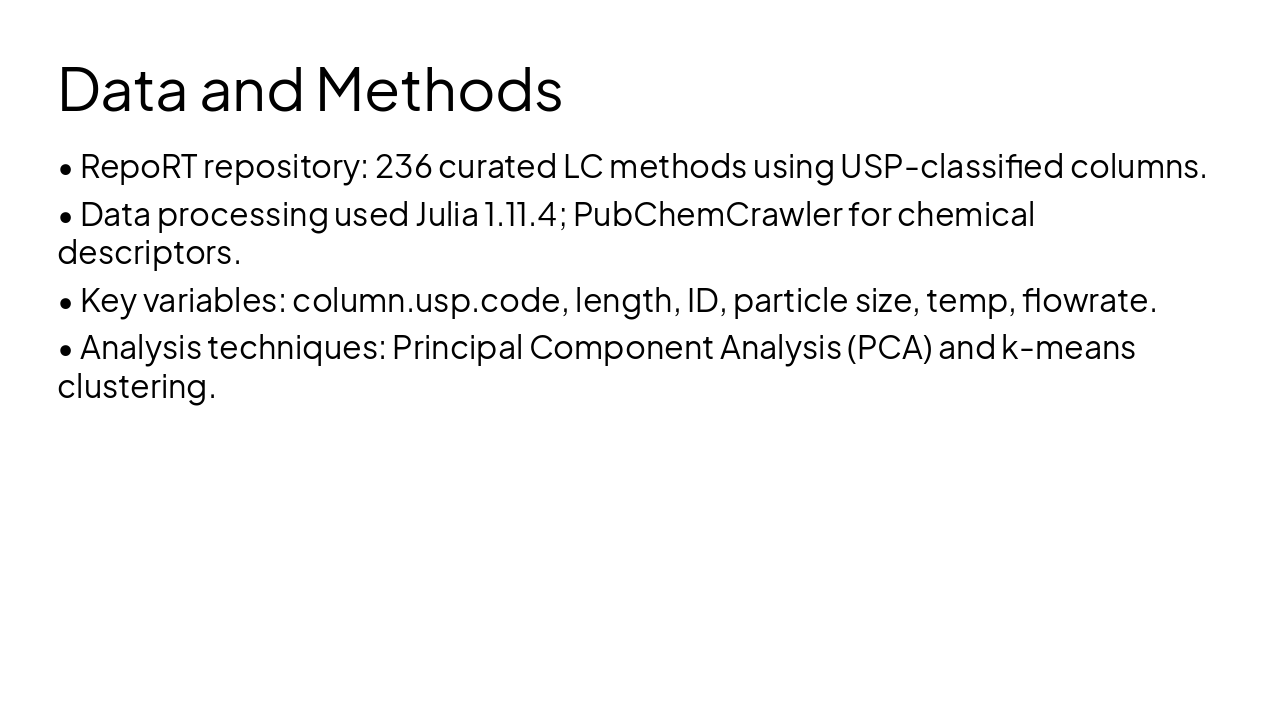
  • RepoRT repository: 236 curated LC methods using USP-classified columns.
  • Data processing used Julia 1.11.4; PubChemCrawler for chemical descriptors.
  • Key variables: column.usp.code, length, ID, particle size, temp, flowrate.
  • Analysis techniques: Principal Component Analysis (PCA) and k-means clustering.
Slide 16 - Data and Methods
Slide 17 of 28

Slide 17 - Key Setup Parameters and Diversity

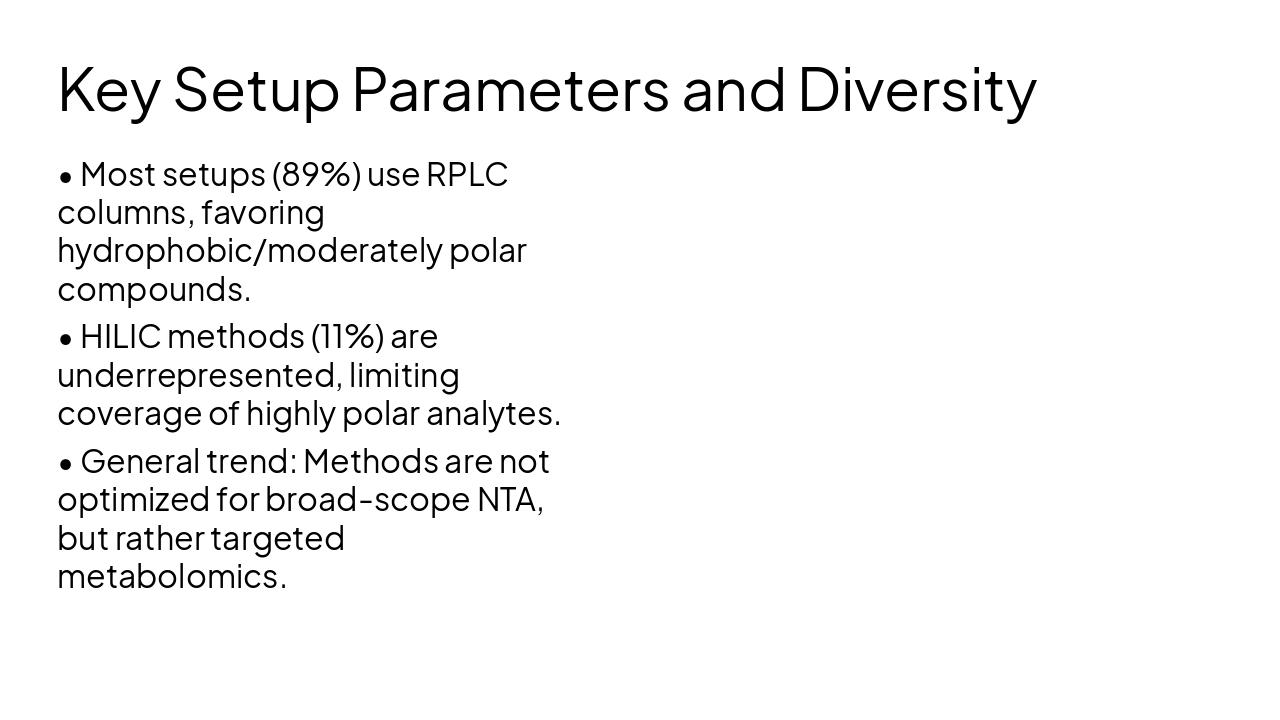
  • Most setups (89%) use RPLC columns, favoring hydrophobic/moderately polar compounds.
  • HILIC methods (11%) are underrepresented, limiting coverage of highly polar analytes.
  • General trend: Methods are not optimized for broad-scope NTA, but rather targeted metabolomics.
Slide 17 - Key Setup Parameters and Diversity
Slide 18 of 28

Slide 18 - Chemical Space Coverage Stats

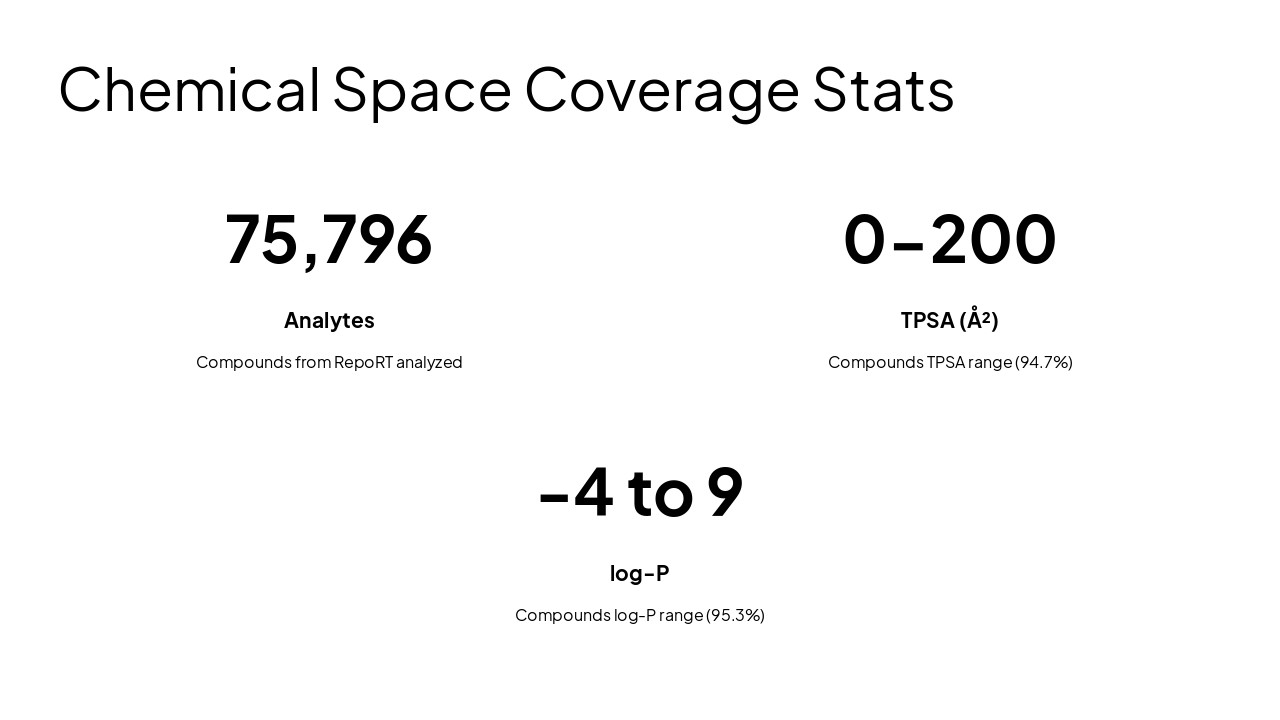
  • 75,796: Analytes
  • 0-200: TPSA (Ų)
  • -4 to 9: log-P
Slide 18 - Chemical Space Coverage Stats
Slide 19 of 28

Slide 19 - Results & Discussion

3

Chemical Coverage Analysis

What does the data reveal about LC performance?

---

Photo by Tom Parkes on Unsplash

Slide 19 - Results & Discussion
Slide 20 of 28

Slide 20 - Key Takeaways

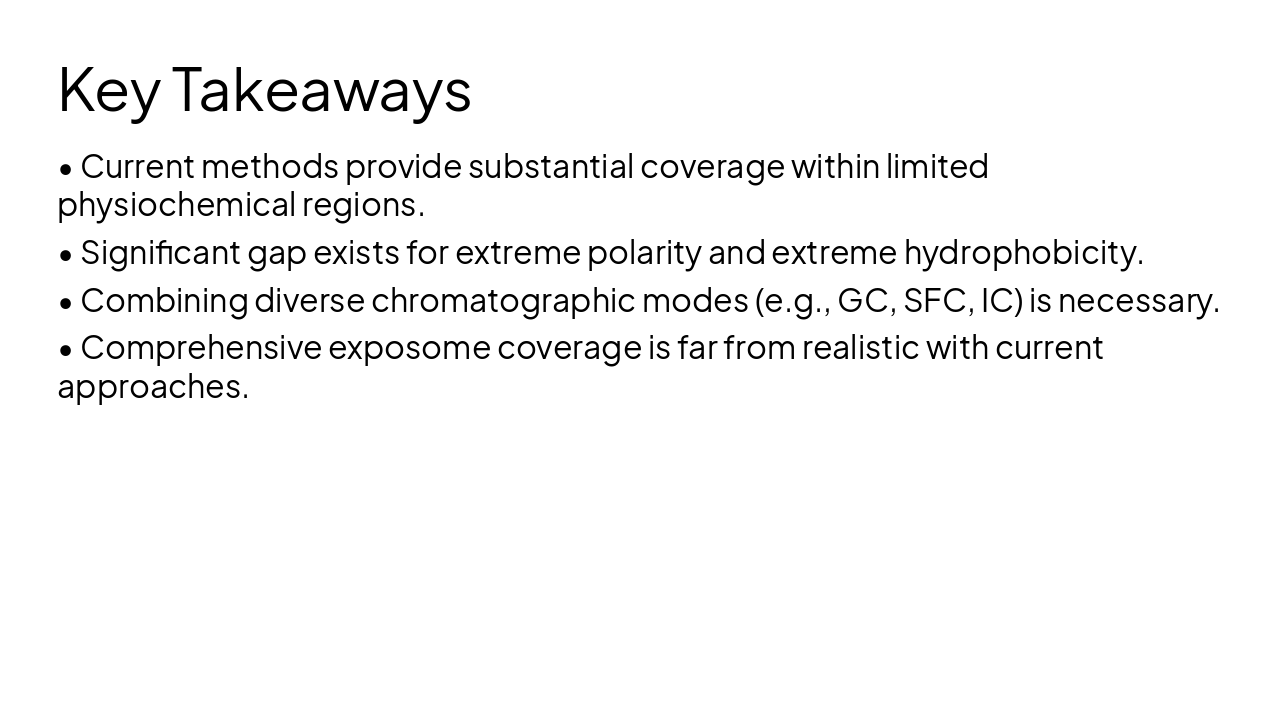
  • Current methods provide substantial coverage within limited physiochemical regions.
  • Significant gap exists for extreme polarity and extreme hydrophobicity.
  • Combining diverse chromatographic modes (e.g., GC, SFC, IC) is necessary.
  • Comprehensive exposome coverage is far from realistic with current approaches.
Slide 20 - Key Takeaways
Slide 21 of 28

Slide 21 - Chemical Space Coverage Findings

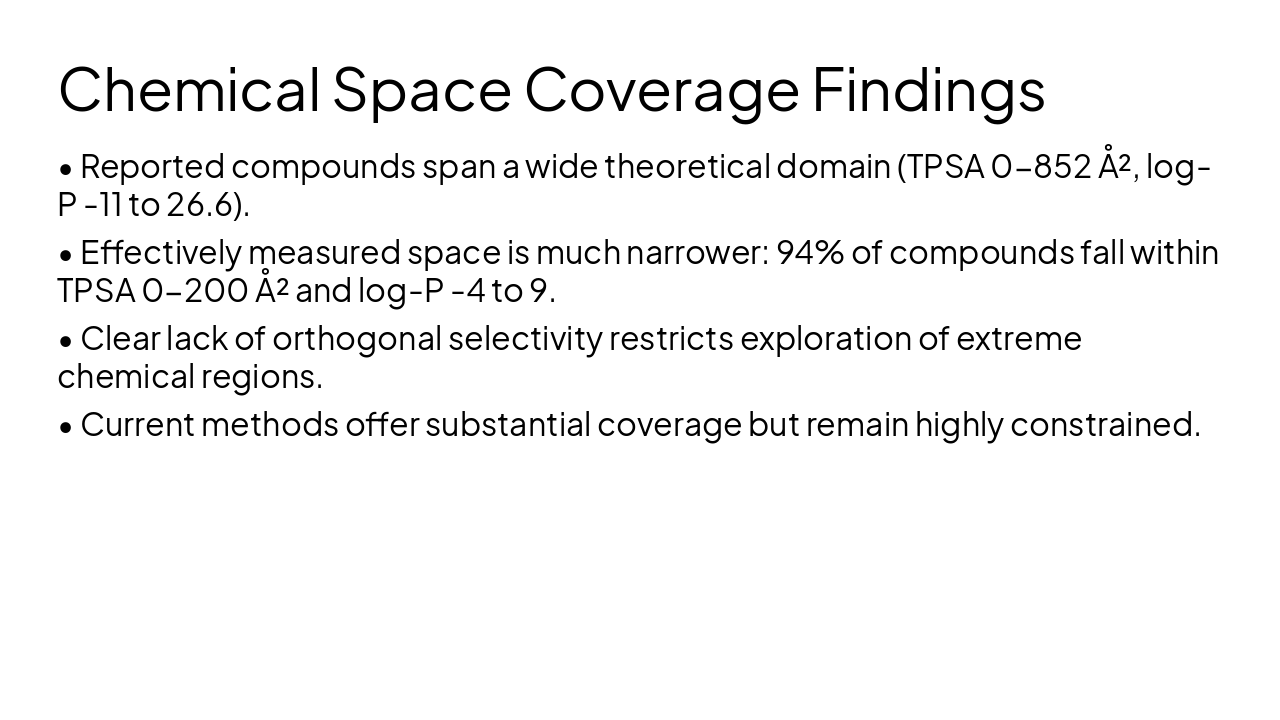
  • Reported compounds span a wide theoretical domain (TPSA 0-852 Ų, log-P -11 to 26.6).
  • Effectively measured space is much narrower: 94% of compounds fall within TPSA 0-200 Ų and log-P -4 to 9.
  • Clear lack of orthogonal selectivity restricts exploration of extreme chemical regions.
  • Current methods offer substantial coverage but remain highly constrained.
Slide 21 - Chemical Space Coverage Findings
Slide 22 of 28

Slide 22 - Conclusion

Thesis Conclusion: Need for wider scope strategies in NTA

Thank you for your attention. Questions?

---

Photo by Nastuh Abootalebi on Unsplash
Slide 22 - Conclusion
Slide 23 of 28

Slide 23 - Key Statistics

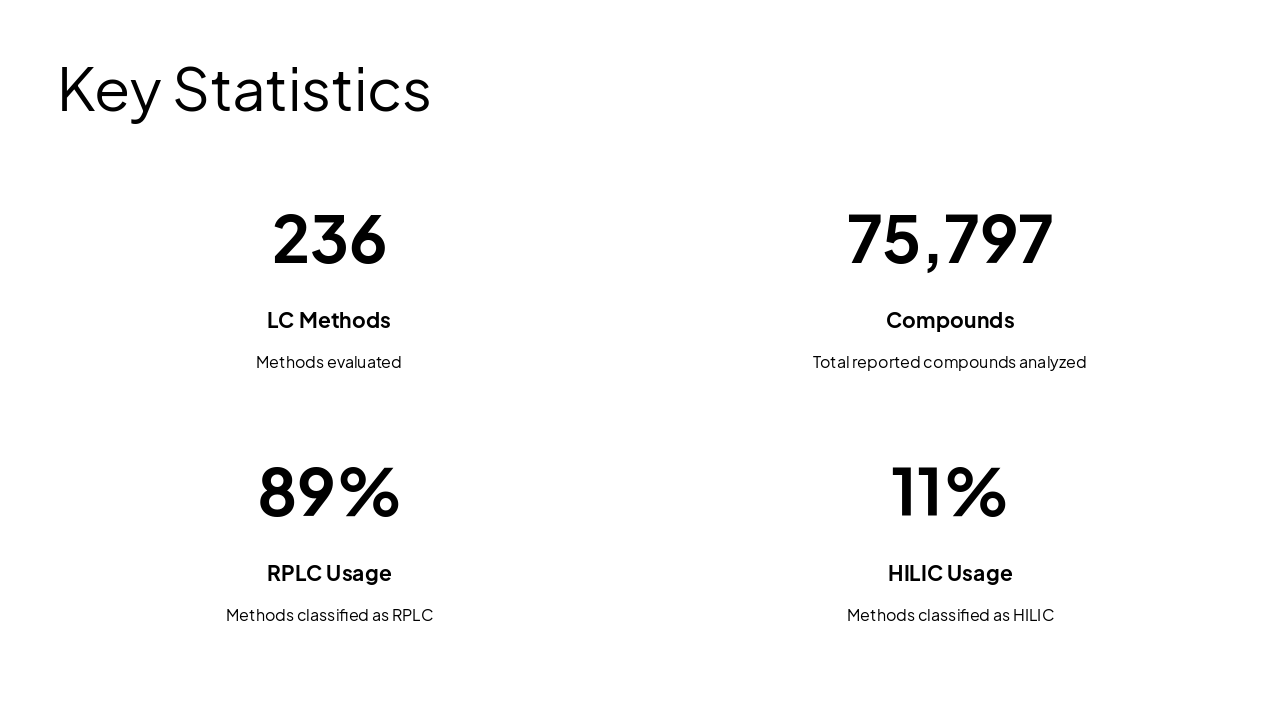
  • 236: LC Methods
  • 75,797: Compounds
  • 89%: RPLC Usage
  • 11%: HILIC Usage
Slide 23 - Key Statistics
Slide 24 of 28

Slide 24 - Thesis Conclusions

Complete chemical space coverage is not currently realistic with existing methods.

Advancing toward comprehensive exposome monitoring requires more than current LC workflows.

Slide 24 - Thesis Conclusions
Slide 25 of 28

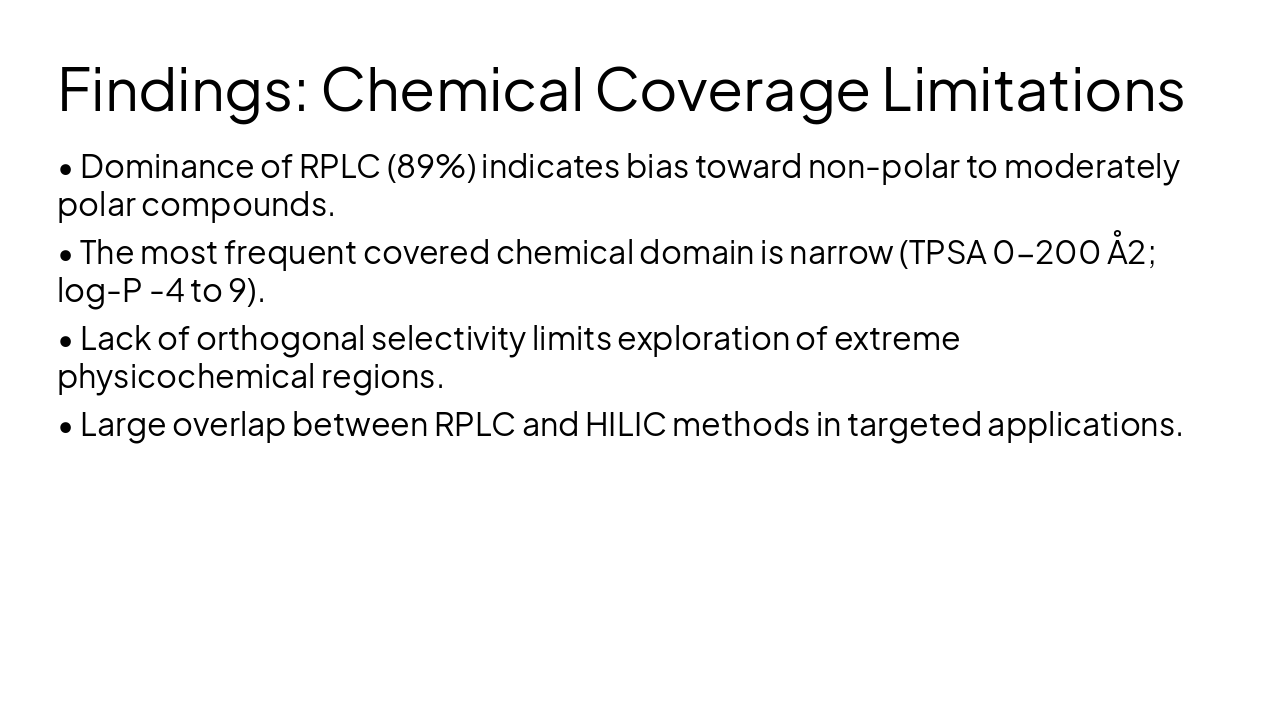
Slide 25 - Findings: Chemical Coverage Limitations

  • Dominance of RPLC (89%) indicates bias toward non-polar to moderately polar compounds.
  • The most frequent covered chemical domain is narrow (TPSA 0-200 Å2; log-P -4 to 9).
  • Lack of orthogonal selectivity limits exploration of extreme physicochemical regions.
  • Large overlap between RPLC and HILIC methods in targeted applications.
Slide 25 - Findings: Chemical Coverage Limitations
Slide 26 of 28

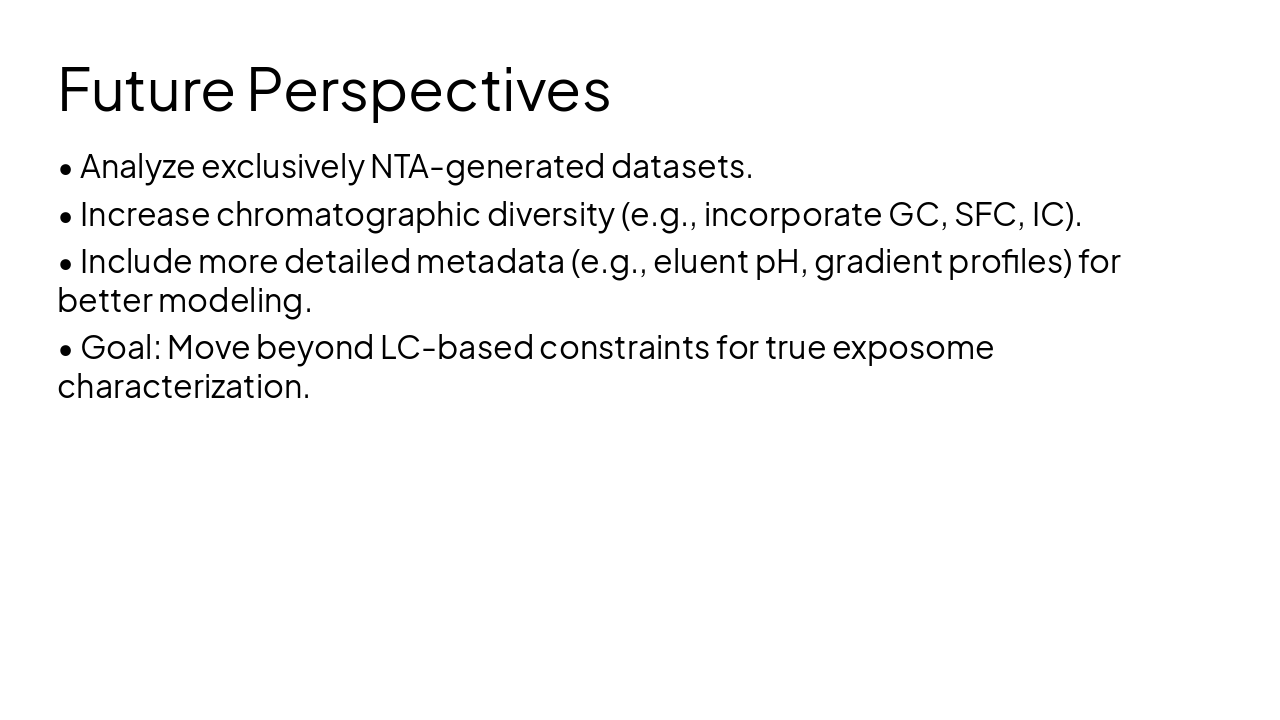
Slide 26 - Future Perspectives

  • Analyze exclusively NTA-generated datasets.
  • Increase chromatographic diversity (e.g., incorporate GC, SFC, IC).
  • Include more detailed metadata (e.g., eluent pH, gradient profiles) for better modeling.
  • Goal: Move beyond LC-based constraints for true exposome characterization.
Slide 26 - Future Perspectives
Slide 27 of 28

Slide 27 - Final Takeaways

Conclusions & Perspectives

The journey toward comprehensive chemical space monitoring continues.

---

Photo by Nastuh Abootalebi on Unsplash
Slide 27 - Final Takeaways
Slide 28 of 28

Slide 28 - Core Conclusions

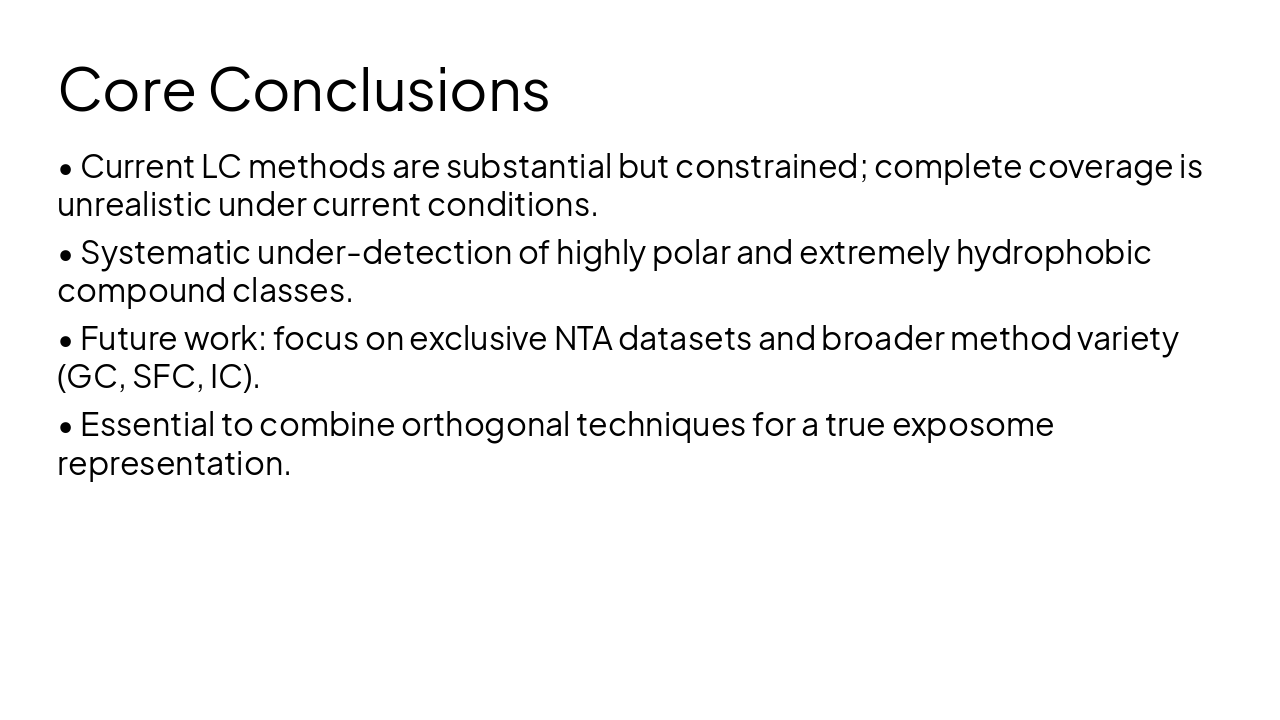
  • Current LC methods are substantial but constrained; complete coverage is unrealistic under current conditions.
  • Systematic under-detection of highly polar and extremely hydrophobic compound classes.
  • Future work: focus on exclusive NTA datasets and broader method variety (GC, SFC, IC).
  • Essential to combine orthogonal techniques for a true exposome representation.
Slide 28 - Core Conclusions

Discover More Presentations

Explore thousands of AI-generated presentations for inspiration

Browse Presentations
Powered by AI

Create Your Own Presentation

Generate professional presentations in seconds with Karaf's AI. Customize this presentation or start from scratch.

Create New Presentation

Powered by Karaf.ai — AI-Powered Presentation Generator