Understanding UV Radiation: Effects and Protection for Your 

Generated from prompt:

to explain my teams how UV affect to skin and what's the machism

This presentation explores UV radiation types, how it damages skin through biological mechanisms, short- and long-term health effects like sunburn, aging, and cancer risks, and practical protection strategies including sunscreen and clothing.

April 12, 20268 slides
Slide 1 of 8

Slide 1 - Understanding UV Radiation and Its Effects on Your Skin

Understanding UV Radiation and Its Effects on Your Skin

An overview of how ultraviolet radiation interacts with human skin and the underlying biological mechanisms.

---

Photo by Fallon Michael on Unsplash
Slide 1 - Understanding UV Radiation and Its Effects on Your Skin
Slide 2 of 8

Slide 2 - Presentation Agenda

  • What is UV Radiation?: Defining UV radiation and its types.
  • The Mechanism of UV Damage: How UV interacts with organic molecules in the skin.
  • Effects on Human Skin: Short-term and long-term health consequences.
  • Protection and Mitigation: Practical tips for daily protection.

---

Photo by ZOBHA (https://unsplash.com/@zobhalife?utmsource=karaf&utmmedium=referral) on Unsplash (https://unsplash.com/?utmsource=karaf&utmmedium=referral)

Slide 2 - Presentation Agenda
Slide 3 of 8

Slide 3 - What is UV Radiation?

  • UV radiation is electromagnetic radiation with wavelengths of 100–400 nm.
  • It is categorized into UVA, UVB, and UVC based on wavelength.
  • About 10% of the Sun's total electromagnetic radiation output is UV.
  • UV photons have higher energy than visible light, enough to induce chemical reactions.
Slide 3 - What is UV Radiation?
Slide 4 of 8

Slide 4 - The Mechanism of Interaction

  • Longer wavelengths (UVA) penetrate deeper into the dermis.
  • Shorter wavelengths (UVB) are mostly absorbed in the epidermis.
  • UV interacts with organic molecules by exciting electrons to higher energy states.
  • This excitation can break chemical bonds, leading to molecular changes in skin cells.
Slide 4 - The Mechanism of Interaction
Slide 5 of 8

Slide 5 - Biological Mechanisms of Damage

  • DNA Damage: UV photons cause direct and indirect damage to DNA sequences.
  • Cellular Stress: Interactions can cause cells to malfunction or trigger apoptosis (cell death).
  • Melanin Response: Skin produces melanin (suntan) as a protective barrier to absorb further UV.
  • Inflammatory Response: Sunburn occurs when cellular damage triggers blood flow and inflammation.
Slide 5 - Biological Mechanisms of Damage
Slide 6 of 8

Slide 6 - Health Consequences of UV Exposure

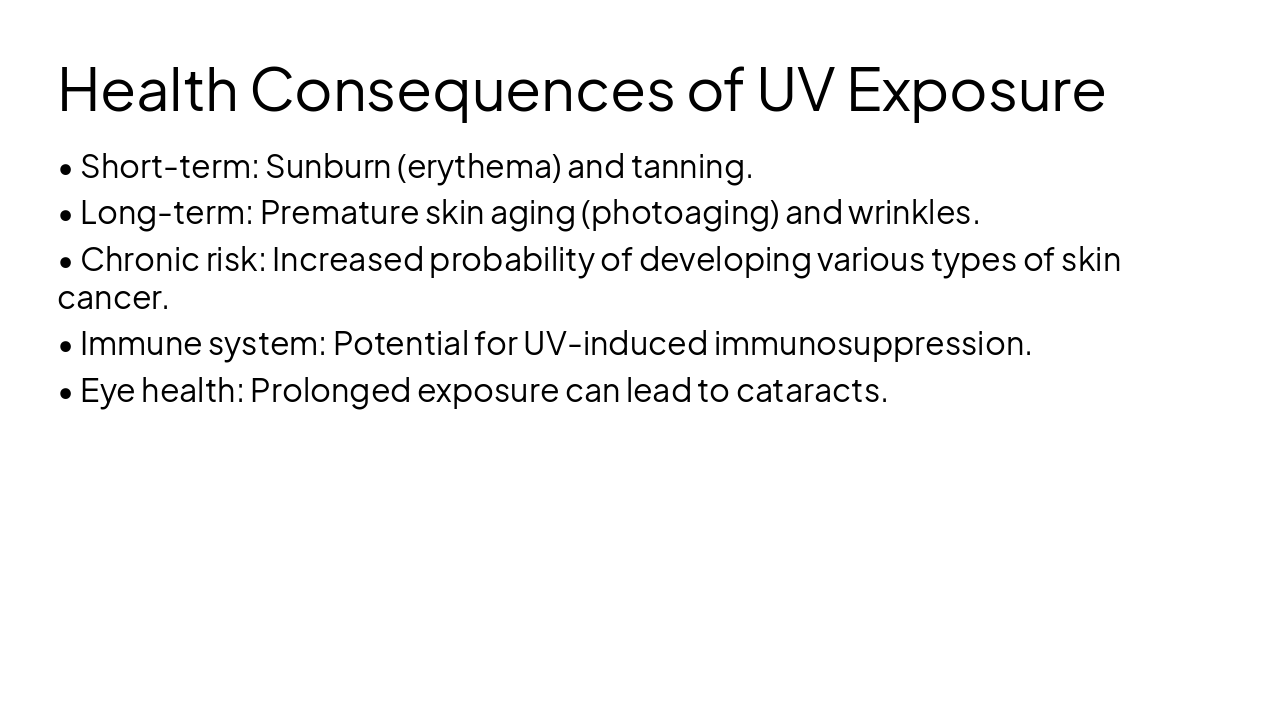
  • Short-term: Sunburn (erythema) and tanning.
  • Long-term: Premature skin aging (photoaging) and wrinkles.
  • Chronic risk: Increased probability of developing various types of skin cancer.
  • Immune system: Potential for UV-induced immunosuppression.
  • Eye health: Prolonged exposure can lead to cataracts.
Slide 6 - Health Consequences of UV Exposure
Slide 7 of 8

Slide 7 - Protecting Your Skin

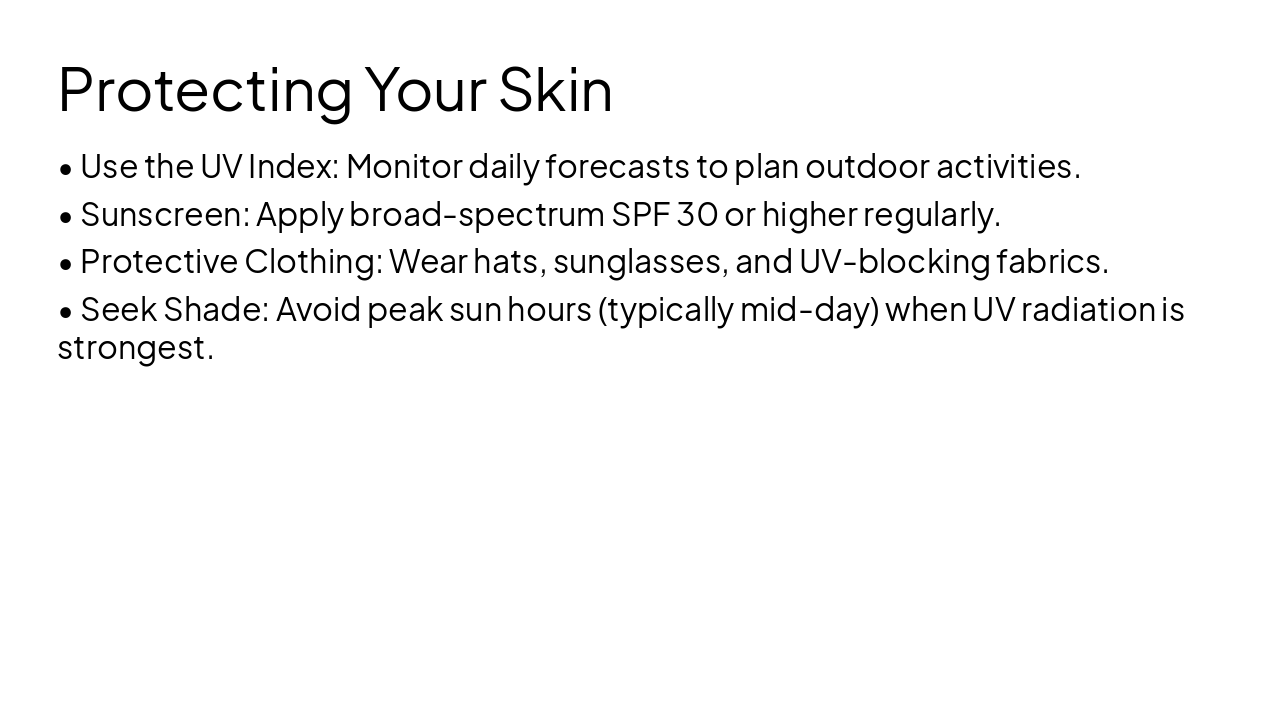
  • Use the UV Index: Monitor daily forecasts to plan outdoor activities.
  • Sunscreen: Apply broad-spectrum SPF 30 or higher regularly.
  • Protective Clothing: Wear hats, sunglasses, and UV-blocking fabrics.
  • Seek Shade: Avoid peak sun hours (typically mid-day) when UV radiation is strongest.
Slide 7 - Protecting Your Skin
Slide 8 of 8

Slide 8 - Conclusion

Stay Safe and Informed under the Sun

Understand the risks, respect the sun, and protect your skin daily.

---

Photo by Evan Berak on Unsplash

Slide 8 - Conclusion

Discover More Presentations

Explore thousands of AI-generated presentations for inspiration

Browse Presentations
Powered by AI

Create Your Own Presentation

Generate professional presentations in seconds with Karaf's AI. Customize this presentation or start from scratch.

Create New Presentation

Powered by Karaf.ai — AI-Powered Presentation Generator