AI History: Winters to Deep Learning Triumphs (40 chars)

Generated from prompt:

make a presentation about the history of artificial intelligence

Traces AI's journey via key milestones timeline, AI winters (1974-80 hype crash, 1987-93 Lisp collapse), revival through expert systems/ML, deep learning revolution, and ubiquitous future outlook. (16

December 10, 20259 slides
Slide 1 of 9

Slide 1 - The History of Artificial Intelligence

This is a title slide titled "The History of Artificial Intelligence." Its subtitle explores AI's evolution from philosophical roots to cutting-edge advancements in machine learning and beyond.

The History of Artificial Intelligence

Exploring the evolution of AI: from philosophical roots to cutting-edge advancements in machine learning and beyond.
Slide 1 - The History of Artificial Intelligence
Slide 2 of 9

Slide 2 - Presentation Agenda

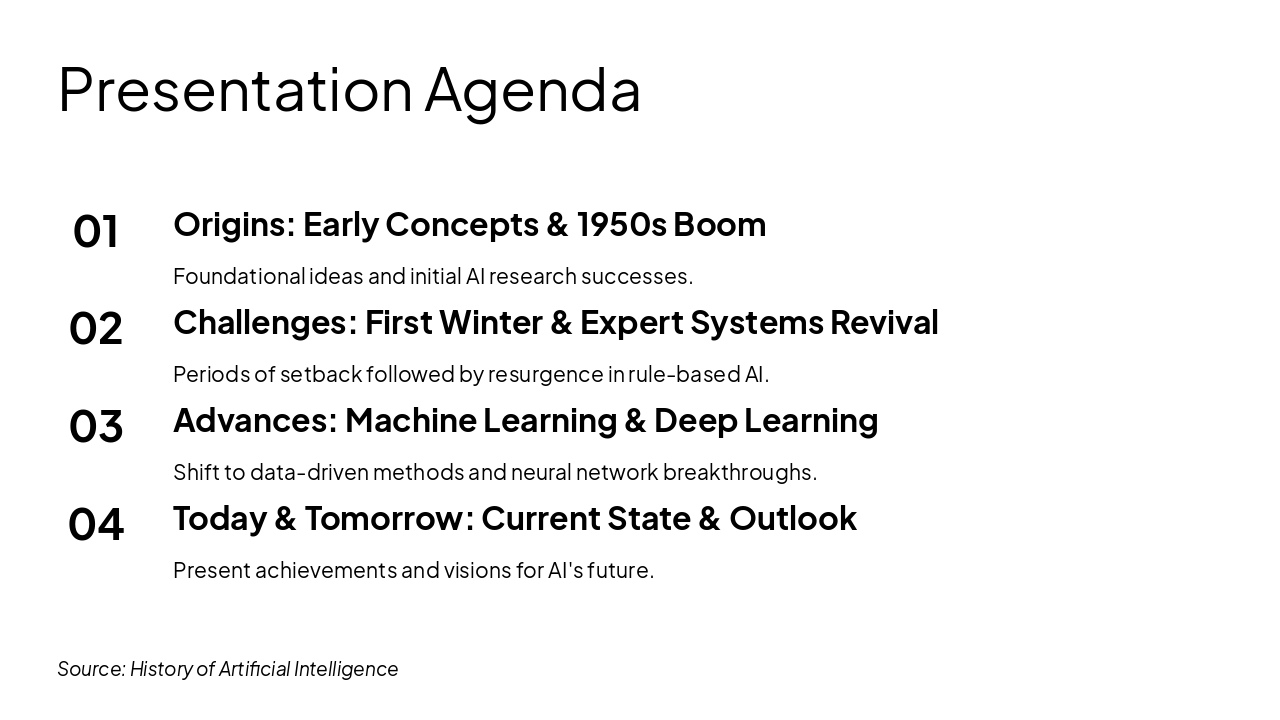
This agenda slide outlines AI's evolution, starting with origins in early concepts and the 1950s boom, followed by challenges like the first winter and expert systems revival. It then covers advances in machine learning and deep learning, ending with the current state and future outlook.

Presentation Agenda

  1. Origins: Early Concepts & 1950s Boom
  2. Foundational ideas and initial AI research successes.

  3. Challenges: First Winter & Expert Systems Revival
  4. Periods of setback followed by resurgence in rule-based AI.

  5. Advances: Machine Learning & Deep Learning
  6. Shift to data-driven methods and neural network breakthroughs.

  7. Today & Tomorrow: Current State & Outlook

Present achievements and visions for AI's future. Source: History of Artificial Intelligence

Slide 2 - Presentation Agenda
Slide 3 of 9

Slide 3 - History of Artificial Intelligence

This section header slide is part of the "History of Artificial Intelligence" presentation, introducing section 02 titled "Early Concepts of AI." Its subtitle outlines the evolution from ancient myths and Greek automata to Alan Turing's 1950 paper.

History of Artificial Intelligence

02

Early Concepts of AI

From ancient myths and Greek automata to Turing's 1950 paper

Speaker Notes
Ancient myths to 20th century foundations: Automata in Greek lore, Turing's 1950 paper 'Computing Machinery and Intelligence'.
Slide 3 - History of Artificial Intelligence
Slide 4 of 9

Slide 4 - Key Milestones Timeline

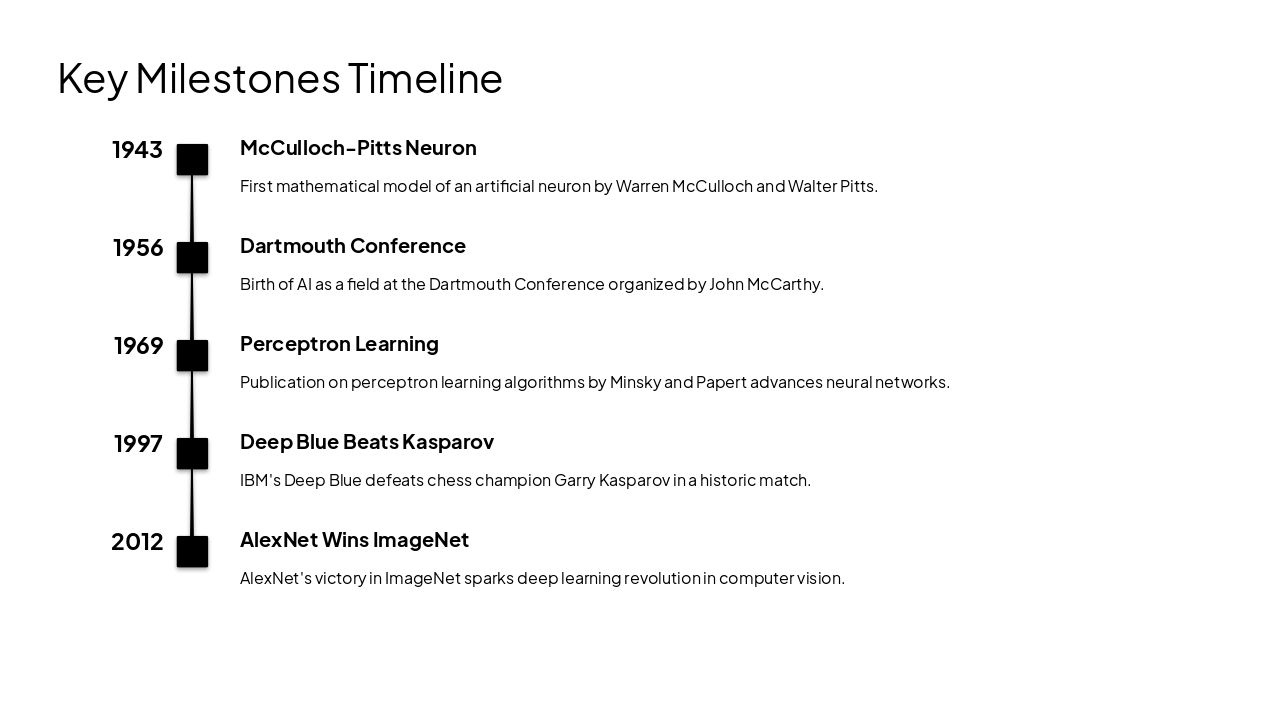
This slide displays a timeline of key AI milestones from 1943 to 2012. It covers the McCulloch-Pitts neuron model, Dartmouth Conference, perceptron learning, Deep Blue's defeat of Kasparov, and AlexNet's ImageNet victory.

Key Milestones Timeline

1943: McCulloch-Pitts Neuron First mathematical model of an artificial neuron by Warren McCulloch and Walter Pitts. 1956: Dartmouth Conference Birth of AI as a field at the Dartmouth Conference organized by John McCarthy. 1969: Perceptron Learning Publication on perceptron learning algorithms by Minsky and Papert advances neural networks. 1997: Deep Blue Beats Kasparov IBM's Deep Blue defeats chess champion Garry Kasparov in a historic match. 2012: AlexNet Wins ImageNet AlexNet's victory in ImageNet sparks deep learning revolution in computer vision.

Slide 4 - Key Milestones Timeline
Slide 5 of 9

Slide 5 - The AI Winters

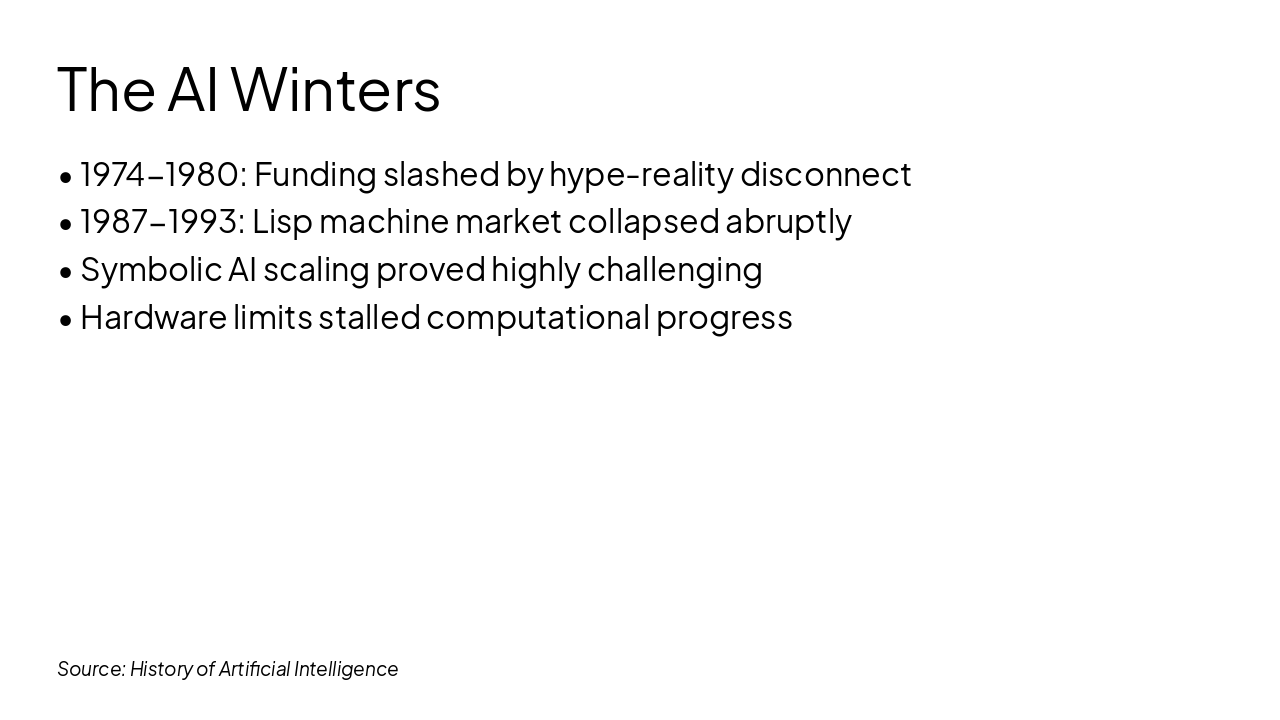
The AI Winters were periods of halted AI progress, including 1974-1980 when funding was slashed due to hype-reality disconnects, and 1987-1993 following the abrupt Lisp machine market collapse. Key challenges included difficulties scaling symbolic AI and hardware limitations stalling computation.

The AI Winters

  • 1974-1980: Funding slashed by hype-reality disconnect
  • 1987-1993: Lisp machine market collapsed abruptly
  • Symbolic AI scaling proved highly challenging
  • Hardware limits stalled computational progress

Source: History of Artificial Intelligence

Speaker Notes
Periods of reduced AI funding: 1974-1980 hype vs. reality; 1987-1993 Lisp crash. Key challenges in scaling symbolic AI amid hardware limits.
Slide 5 - The AI Winters
Slide 6 of 9

Slide 6 - Revival: Expert Systems & ML

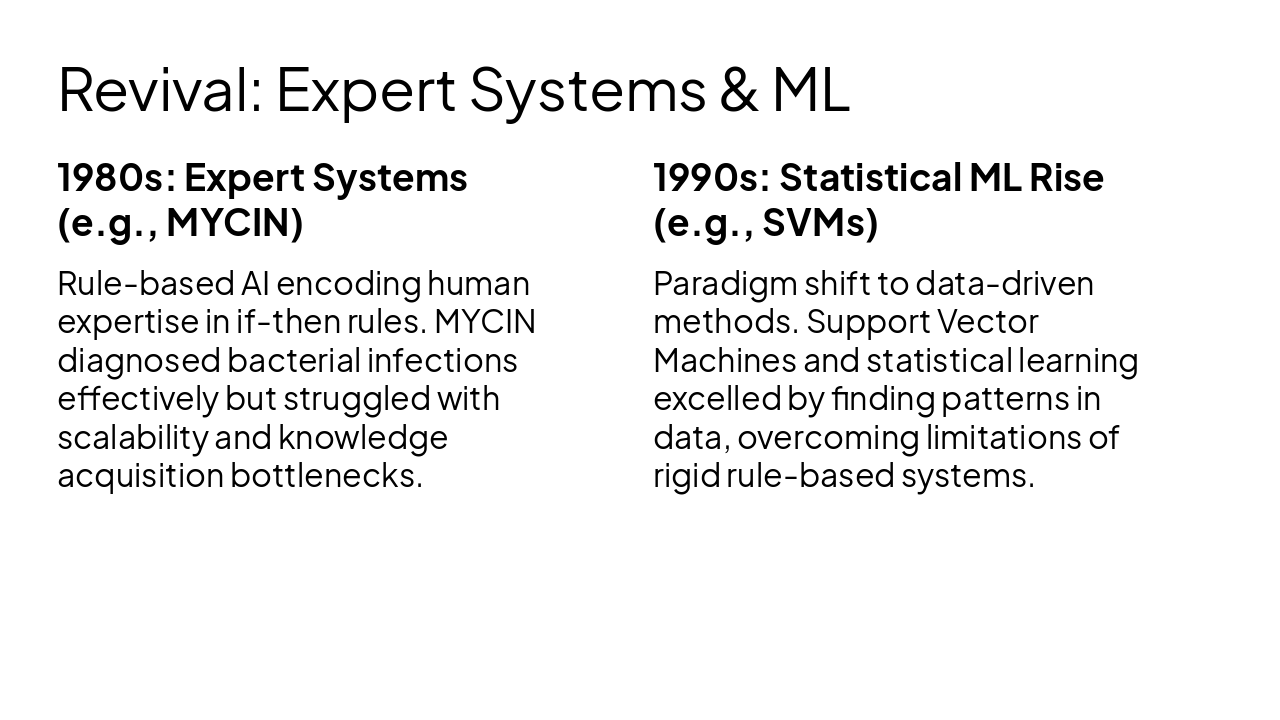
The slide highlights the 1980s revival of expert systems like MYCIN, which used rule-based AI to encode human expertise for tasks like diagnosing infections but faced scalability and knowledge acquisition issues. In the 1990s, statistical ML such as SVMs emerged, shifting to data-driven pattern recognition that overcame the rigidity of rule-based systems.

Revival: Expert Systems & ML

1980s: Expert Systems (e.g., MYCIN)1990s: Statistical ML Rise (e.g., SVMs)
Rule-based AI encoding human expertise in if-then rules. MYCIN diagnosed bacterial infections effectively but struggled with scalability and knowledge acquisition bottlenecks.Paradigm shift to data-driven methods. Support Vector Machines and statistical learning excelled by finding patterns in data, overcoming limitations of rigid rule-based systems.
Slide 6 - Revival: Expert Systems & ML
Slide 7 of 9

Slide 7 - Deep Learning Revolution

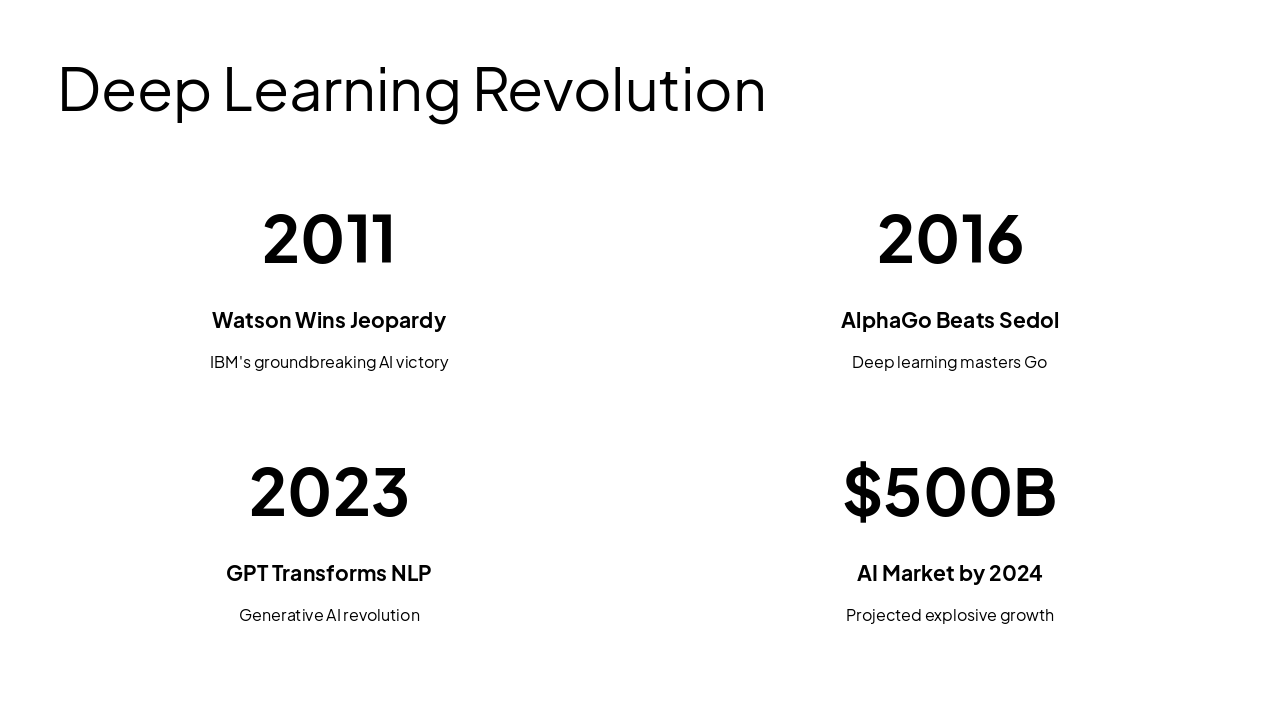
The "Deep Learning Revolution" slide highlights AI milestones: IBM Watson's 2011 Jeopardy win, AlphaGo's 2016 defeat of Sedol, and GPT's 2023 NLP transformation. It projects the AI market to hit $500B by 2024 amid explosive growth.

Deep Learning Revolution

  • 2011: Watson Wins Jeopardy
  • IBM's groundbreaking AI victory

  • 2016: AlphaGo Beats Sedol
  • Deep learning masters Go

  • 2023: GPT Transforms NLP
  • Generative AI revolution

  • $500B: AI Market by 2024
  • Projected explosive growth

Slide 7 - Deep Learning Revolution
Slide 8 of 9

Slide 8 - The Future of AI

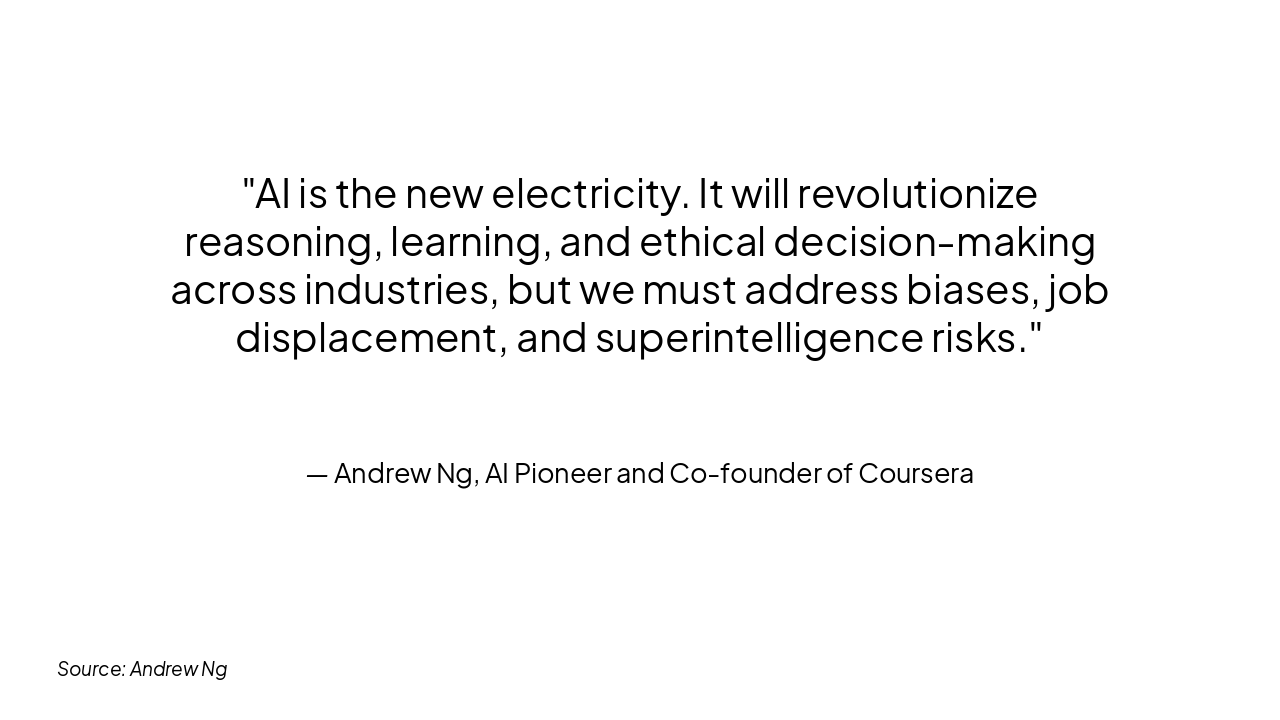
The slide "The Future of AI" features a quote from Andrew Ng, who likens AI to the new electricity for revolutionizing reasoning, learning, and ethical decision-making across industries. Ng emphasizes addressing key challenges like biases, job displacement, and superintelligence risks.

The Future of AI

> AI is the new electricity. It will revolutionize reasoning, learning, and ethical decision-making across industries, but we must address biases, job displacement, and superintelligence risks.

— Andrew Ng, AI Pioneer and Co-founder of Coursera

Source: Andrew Ng

Speaker Notes
Goals: Reasoning, learning, ethical AI. Challenges: Bias, jobs, superintelligence. Context: History of AI presentation.
Slide 8 - The Future of AI
Slide 9 of 9

Slide 9 - Conclusion

The conclusion slide recaps AI's evolution from hype and winters to triumphs, envisioning a future of ubiquitous intelligence that maximizes human potential. It closes with "Thank you! Q&A?"

Conclusion

AI's journey: Hype, winters, triumphs. Future: Ubiquitous intelligence maximizing human potential.

Thank you! Q&A?

Slide 9 - Conclusion
Powered by AI

Create Your Own Presentation

Generate professional presentations in seconds with Karaf's AI. Customize this presentation or start from scratch.

Create New Presentation

Powered by Karaf.ai — AI-Powered Presentation Generator