From Mathematicians' Tablets to LLM Magic

Generated from prompt:

عنوان سخنرانی: از لوحِ ریاضیدانان تا جادوی کلام؛ مدل‌های زبانی بزرگ (LLMs) شامل ۱۷ اسلاید از مقدمه تا جمع‌بندی و تشکر، با تمرکز بر تاریخچه هوش مصنوعی، ریاضیات، یادگیری ماشین، و مدل‌های زبانی بزرگ (LLMs). هر اسلاید دارای عنوان، نکات کلیدی و تصویر پیشنهادی است. طراحی حرفه‌ای، علمی و جذاب با تمی مدرن و مینیمال (سیاه، آبی تیره و سفید).

This presentation traces AI's evolution from ancient math and Turing's 1950s foundations to modern large language models (LLMs). It covers key mathematical concepts, machine learning types, neural net

November 25, 202517 slides
Slide 1 of 17

Slide 1 - از لوحِ ریاضیدانان تا جادوی کلام؛ مدل‌های زبانی بزرگ (LLMs)

The title slide, titled "From the Tablets of Mathematicians to the Magic of Words: Large Language Models (LLMs)," introduces a presentation on the evolution of language models. Its subtitle describes the journey from ancient mathematics to modern artificial intelligence.

از لوحِ ریاضیدانان تا جادوی کلام؛ مدل‌های زبانی بزرگ (LLMs)

سفری از ریاضیات باستان تا هوش مصنوعی مدرن
Slide 1 - از لوحِ ریاضیدانان تا جادوی کلام؛ مدل‌های زبانی بزرگ (LLMs)
Slide 2 of 17

Slide 2 - فهرست مطالب

The agenda slide, titled "فهرست مطالب" (Table of Contents), outlines a presentation on artificial intelligence in four main sections. It begins with an introduction and history of AI, followed by the mathematical foundations and basics of machine learning, then explores large language models and their architecture, and concludes with practical applications, future outlook, and a summary.

فهرست مطالب

  1. مقدمه و تاریخچه AI
  2. معرفی موضوع و سیر تحول هوش مصنوعی از ابتدا.

  3. مبانی ریاضی و یادگیری ماشین
  4. اصول ریاضیاتی و مفاهیم پایه یادگیری ماشین.

  5. مدل‌های زبانی بزرگ
  6. بررسی معماری و عملکرد مدل‌های LLMs.

  7. کاربردها، آینده و جمع‌بندی

کاربردهای عملی، چشم‌انداز آینده و نتیجه‌گیری. Source: عنوان سخنرانی: از لوحِ ریاضیدانان تا جادوی کلام؛ مدل‌های زبانی بزرگ (LLMs)

Speaker Notes
تصویر: نقشه راه گرافیکی با نقاط کلیدی. طراحی حرفه‌ای، علمی و جذاب با تمی مدرن و مینیمال (سیاه، آبی تیره و سفید).
Slide 2 - فهرست مطالب
Slide 3 of 17

Slide 3 - از لوحِ ریاضیدانان تا جادوی کلام؛ مدل‌های زبانی بزرگ (LLMs)

This section header slide, titled "From the Tablet of Mathematicians to the Magic of Words; Large Language Models (LLMs)," introduces the topic with a welcoming overview. It highlights the importance of LLMs in transforming the world, as noted in the subtitle under section 01.

از لوحِ ریاضیدانان تا جادوی کلام؛ مدل‌های زبانی بزرگ (LLMs)

01

مقدمه

خوش‌آمدگویی و بررسی اهمیت مدل‌های زبانی بزرگ در تغییر جهان

Speaker Notes
خوش‌آمدگویی و اهمیت موضوع. LLMs چگونه جهان را تغییر می‌دهند؟ تصویر: جهان دیجیتال متصل.
Slide 3 - از لوحِ ریاضیدانان تا جادوی کلام؛ مدل‌های زبانی بزرگ (LLMs)
Slide 4 of 17

Slide 4 - تاریخچه هوش مصنوعی

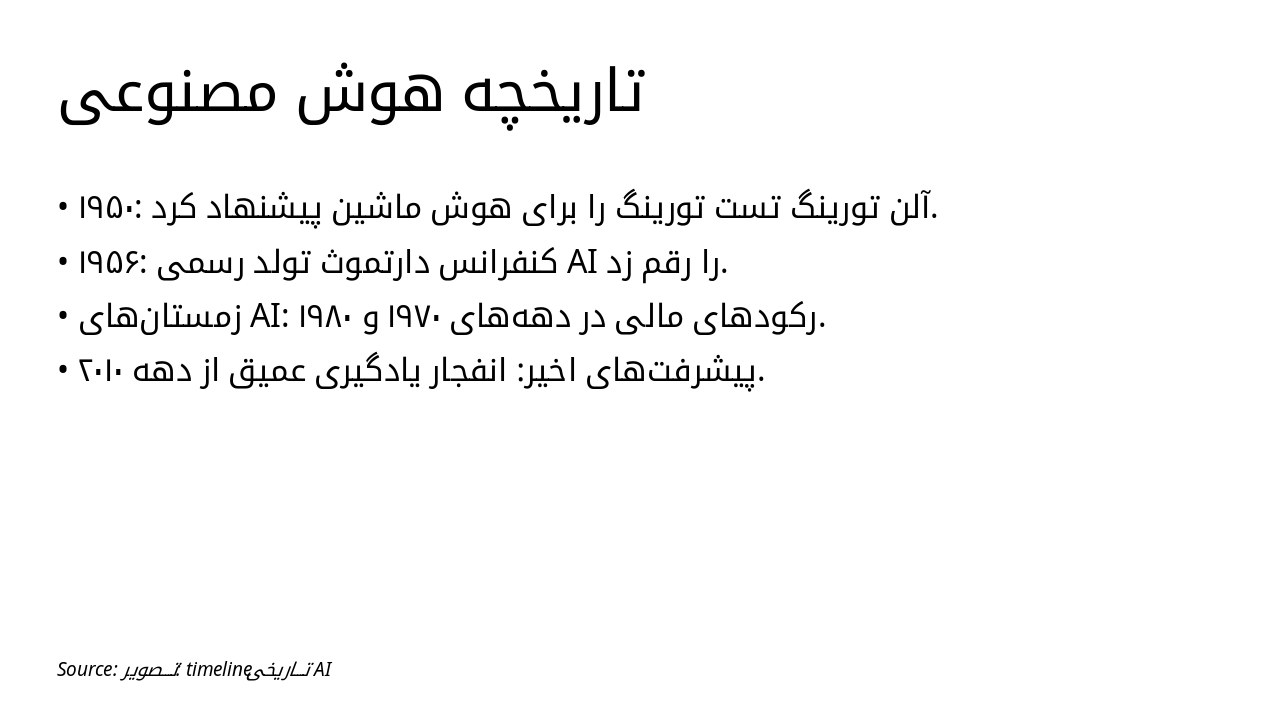
The history of artificial intelligence began in 1950 when Alan Turing proposed the Turing Test for machine intelligence, followed by the official birth of AI at the 1956 Dartmouth Conference. The field experienced financial setbacks during the AI winters of the 1970s and 1980s, but saw explosive growth in deep learning advancements starting from the 2010s.

تاریخچه هوش مصنوعی

  • ۱۹۵۰: آلن تورینگ تست تورینگ را برای هوش ماشین پیشنهاد کرد.
  • ۱۹۵۶: کنفرانس دارتموث تولد رسمی AI را رقم زد.
  • زمستان‌های AI: رکودهای مالی در دهه‌های ۱۹۷۰ و ۱۹۸۰.
  • پیشرفت‌های اخیر: انفجار یادگیری عمیق از دهه ۲۰۱۰.

Source: تصویر: timeline تاریخی AI

Speaker Notes
تمرکز بر نقاط کلیدی تاریخچه AI برای مقدمه سخنرانی.
Slide 4 - تاریخچه هوش مصنوعی
Slide 5 of 17

Slide 5 - جدول زمانی AI

The timeline slide "جدول زمانی AI" outlines key milestones in artificial intelligence history, starting with the 1943 McCulloch-Pitts Neuron Model, which introduced the first mathematical foundation for neural networks. It progresses through the 1969 backpropagation algorithm for efficient neural network training, the 2012 AlexNet breakthrough that ignited the deep learning era in computer vision, and culminates in the 2020 launch of OpenAI's GPT-3, a massive model advancing natural language processing.

جدول زمانی AI

1943: McCulloch-Pitts Neuron Model First mathematical model of artificial neurons, laying the foundation for neural networks in AI. 1969: Backpropagation Algorithm Development Key algorithm for training neural networks by propagating errors backward, enabling efficient learning. 2012: AlexNet and Deep Learning Rise AlexNet wins ImageNet competition, sparking the deep learning revolution in computer vision. 2020: GPT-3 Model Launch OpenAI releases GPT-3, a 175-billion parameter model advancing natural language processing capabilities.

Slide 5 - جدول زمانی AI
Slide 6 of 17

Slide 6 - ریاضیدانان باستان

The slide, titled "Ancient Mathematicians" in Persian, features an image highlighting key contributions from historical figures to modern fields like AI and data analysis. It points out Euclid's foundational geometry for AI algorithms, Pythagoras' theorem in data analysis, and Babylonian tablets as early methods of numerical computation.

ریاضیدانان باستان

!Image

  • Euclid's geometry foundations for AI algorithms
  • Pythagoras theorem applications in data analysis
  • Babylonian tablets: Early numerical computation methods

Source: Wikipedia

Speaker Notes
نقش ریاضیات در پایه AI: اقلیدس، فیثاغورس. لوح‌های بابلی. تصویر: لوح گلی ریاضی باستانی.
Slide 6 - ریاضیدانان باستان
Slide 7 of 17

Slide 7 - مبانی ریاضی

This slide serves as a section header titled "مبانی ریاضی," introducing the foundational mathematics essential for artificial intelligence. It highlights a focus on linear algebra, probability, and calculus as the core building blocks.

مبانی ریاضی

مبانی ریاضی

ریاضیات زیربنای هوش مصنوعی با تمرکز بر جبر خطی، احتمالات و حسابان

Speaker Notes
ریاضیات زیربنای AI. تمرکز بر جبر خطی، احتمالات و حسابان.
Slide 7 - مبانی ریاضی
Slide 8 of 17

Slide 8 - مفاهیم کلیدی ریاضی

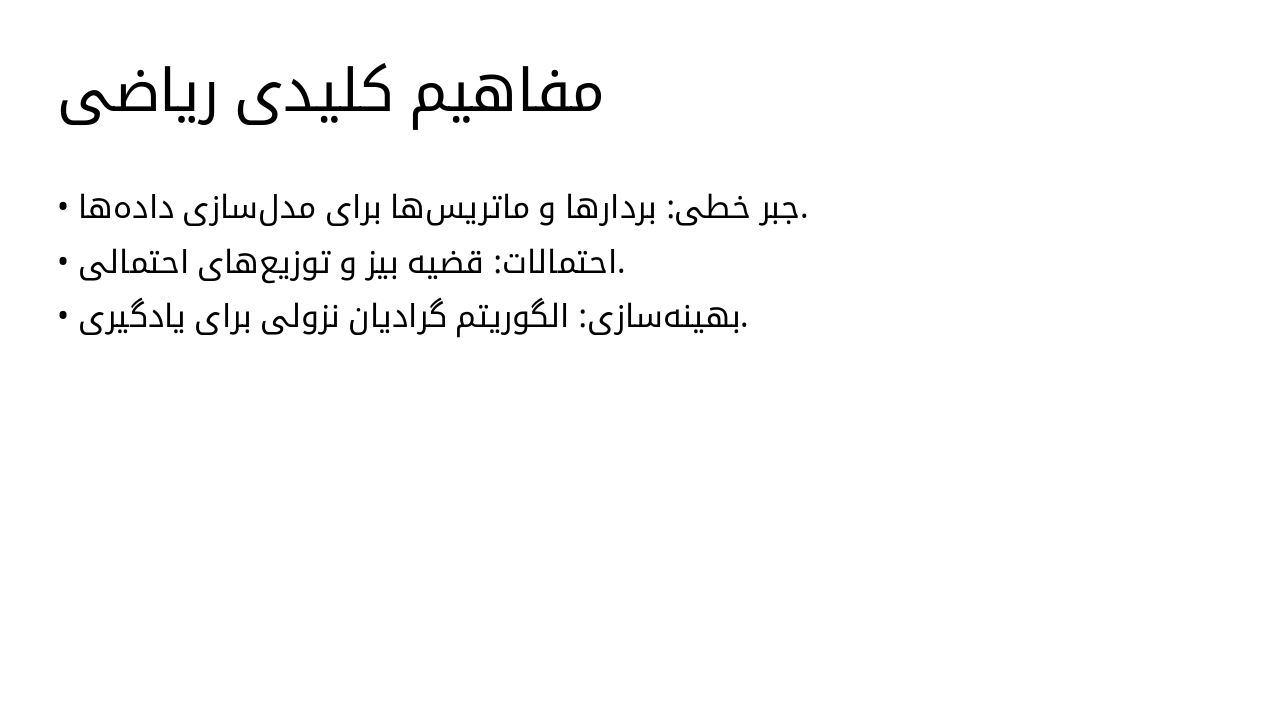
The slide titled "Key Mathematical Concepts" outlines essential topics in mathematics for data modeling and learning. It covers linear algebra through vectors and matrices, probability including Bayes' theorem and probability distributions, and optimization via the gradient descent algorithm.

مفاهیم کلیدی ریاضی

  • جبر خطی: بردارها و ماتریس‌ها برای مدل‌سازی داده‌ها.
  • احتمالات: قضیه بیز و توزیع‌های احتمالی.
  • بهینه‌سازی: الگوریتم گرادیان نزولی برای یادگیری.
Slide 8 - مفاهیم کلیدی ریاضی
Slide 9 of 17

Slide 9 - آمار ریاضی در AI

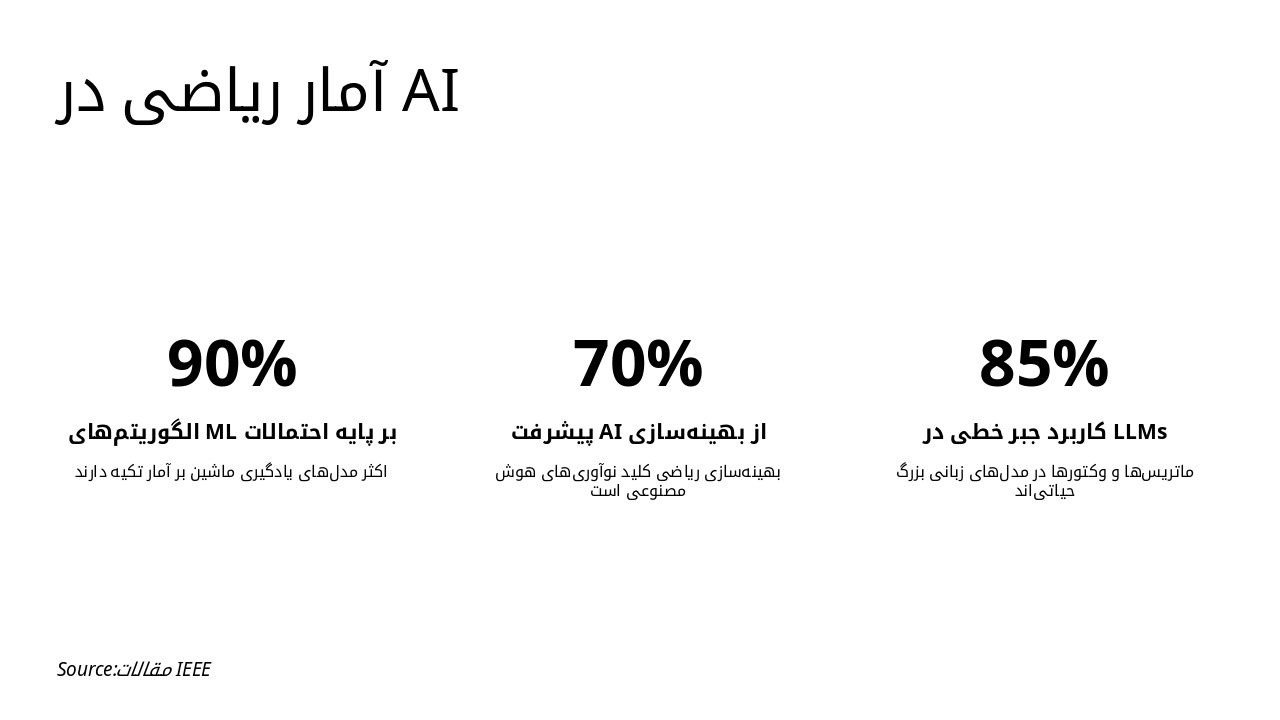
The slide "Math Statistics in AI" highlights key stats showing that 90% of machine learning algorithms rely on probabilities, with most models depending on statistical foundations. It also notes that 70% of AI advancements stem from mathematical optimization, while 85% emphasize the critical role of linear algebra, such as matrices and vectors, in large language models.

آمار ریاضی در AI

  • 90%: الگوریتم‌های ML بر پایه احتمالات
  • اکثر مدل‌های یادگیری ماشین بر آمار تکیه دارند

  • 70%: پیشرفت AI از بهینه‌سازی
  • بهینه‌سازی ریاضی کلید نوآوری‌های هوش مصنوعی است

  • 85%: کاربرد جبر خطی در LLMs

ماتریس‌ها و وکتورها در مدل‌های زبانی بزرگ حیاتی‌اند Source: مقالات IEEE

Speaker Notes
تصویر: نمودارهای آماری.
Slide 9 - آمار ریاضی در AI
Slide 10 of 17

Slide 10 - احتمالات و آمار

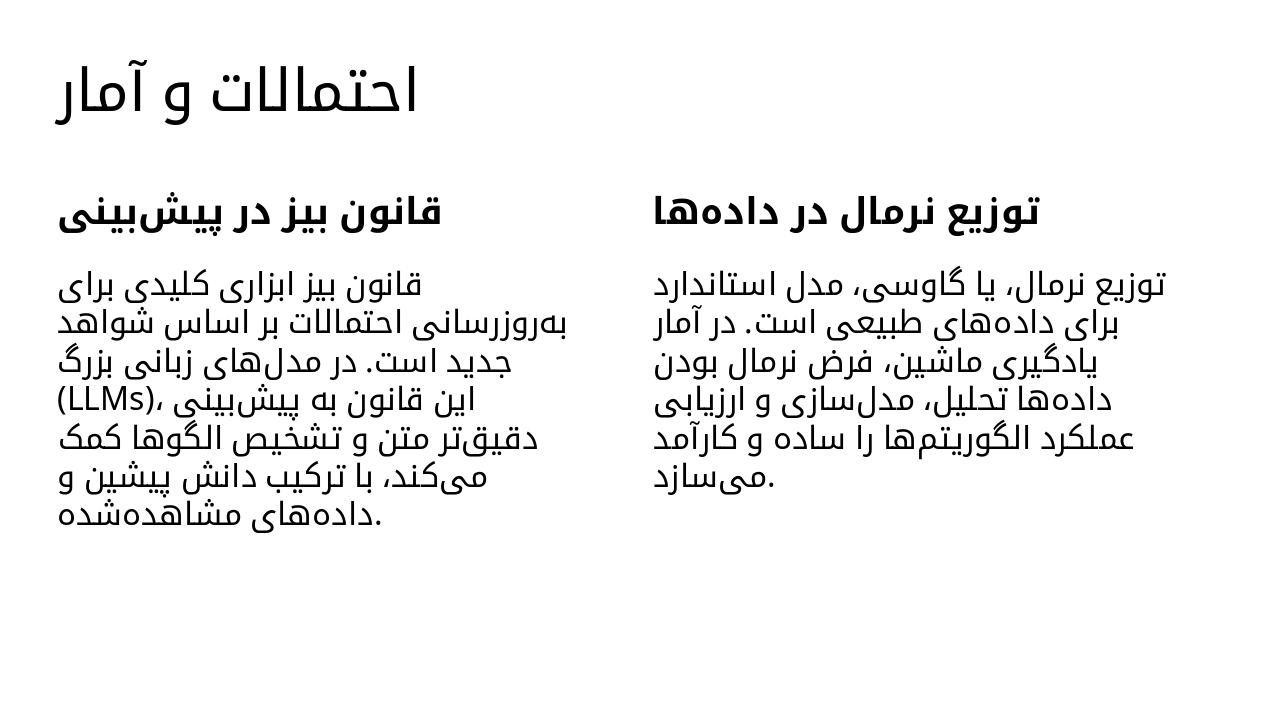
Bayes' theorem serves as a key tool for updating probabilities based on new evidence, enhancing text prediction and pattern recognition in large language models by integrating prior knowledge with observed data. The normal distribution, also known as Gaussian, acts as the standard model for natural data, simplifying analysis, modeling, and algorithm performance evaluation in machine learning statistics.

احتمالات و آمار

قانون بیز در پیش‌بینیتوزیع نرمال در داده‌ها
قانون بیز ابزاری کلیدی برای به‌روزرسانی احتمالات بر اساس شواهد جدید است. در مدل‌های زبانی بزرگ (LLMs)، این قانون به پیش‌بینی دقیق‌تر متن و تشخیص الگوها کمک می‌کند، با ترکیب دانش پیشین و داده‌های مشاهده‌شده.توزیع نرمال، یا گاوسی، مدل استاندارد برای داده‌های طبیعی است. در آمار یادگیری ماشین، فرض نرمال بودن داده‌ها تحلیل، مدل‌سازی و ارزیابی عملکرد الگوریتم‌ها را ساده و کارآمد می‌سازد.
Speaker Notes
تصویر: نمودارهای احتمالی. این اسلاید بخشی از ارائه ۱۷ اسلایدی با تمرکز بر تاریخچه هوش مصنوعی، ریاضیات، یادگیری ماشین و مدل‌های زبانی بزرگ (LLMs). طراحی: حرفه‌ای، علمی، جذاب با تم مدرن مینیمال (سیاه، آبی تیره، سفید).
Slide 10 - احتمالات و آمار
Slide 11 of 17

Slide 11 - یادگیری ماشین

This section header slide is titled "Machine Learning" and marked as Section 03. It features a subtitle that spans from supervised learning to unsupervised learning, serving as a bridge to Large Language Models (LLMs).

یادگیری ماشین

03

یادگیری ماشین

از نظارت‌شده تا بدون نظارت. پلی به LLMs.

Slide 11 - یادگیری ماشین
Slide 12 of 17

Slide 12 - انواع یادگیری ماشین

Machine learning is categorized into supervised learning, which involves regression and classification of data; unsupervised learning, focused on clustering and pattern discovery; and reinforcement learning, commonly applied in games and robotics. This slide outlines these fundamental types to highlight their key methods and uses.

انواع یادگیری ماشین

  • یادگیری نظارت‌شده: رگرسیون و طبقه‌بندی داده‌ها.
  • یادگیری بدون نظارت: خوشه‌بندی و کشف الگوها.
  • یادگیری تقویتی: کاربرد در بازی‌ها و ربات‌ها.
Speaker Notes
تصویر پیشنهادی: درخت تصمیم. توضیح: - نظارت‌شده: رگرسیون، طبقه‌بندی. - بدون نظارت: خوشه‌بندی. - تقویتی: بازی‌ها و ربات‌ها.
Slide 12 - انواع یادگیری ماشین
Slide 13 of 17

Slide 13 - شبکه‌های عصبی

This slide on neural networks explains that hidden layers process information, neurons mimic biological nerve cells, and activation functions determine neuron outputs. It also describes how networks operate layer by layer from input to output.

شبکه‌های عصبی

!Image

  • لایه‌های پنهان اطلاعات را پردازش می‌کنند.
  • نورون‌ها شبیه سلول‌های عصبی زیستی هستند.
  • توابع فعال‌سازی خروجی نورون را تعیین می‌کنند.
  • شبکه‌ها از ورودی به خروجی لایه‌به‌لایه عمل می‌کنند.

Source: Image from Wikipedia article "Neural network (machine learning)"

Slide 13 - شبکه‌های عصبی
Slide 14 of 17

Slide 14 - نقل قول از اندرو انگ

This slide features a quote from Andrew Ng, founder of Coursera and a pioneer in artificial intelligence. The quote defines deep learning as machine learning using deep neural networks.

نقل قول از اندرو انگ

> یادگیری عمیق، یادگیری ماشینی با شبکه‌های عمیق است.

— اندرو انگ، بنیان‌گذار Coursera و پیشگام هوش مصنوعی

Source: از سخنرانی: از لوحِ ریاضیدانان تا جادوی کلام؛ مدل‌های زبانی بزرگ (LLMs)

Speaker Notes
تصویر: پرتره اندرو انگ. این نقل قول بر اهمیت یادگیری عمیق در تاریخچه هوش مصنوعی تأکید دارد.
Slide 14 - نقل قول از اندرو انگ
Slide 15 of 17

Slide 15 - مدل‌های زبانی بزرگ (LLMs)

This slide serves as a section header introducing Large Language Models (LLMs). It features the subtitle "Transformers and GPT: The Magic of Language in Artificial Intelligence," highlighting key technologies in AI.

مدل‌های زبانی بزرگ (LLMs)

ترانسفورمرها و GPT: جادوی کلام در هوش مصنوعی

Slide 15 - مدل‌های زبانی بزرگ (LLMs)
Slide 16 of 17

Slide 16 - چگونگی کار LLMs

Large Language Models (LLMs) operate using transformer architectures that incorporate attention mechanisms and positional encoding to process input data. They are trained on massive datasets by predicting the next token in sequences, enabling the generation of coherent and natural-sounding text outputs.

چگونگی کار LLMs

  • ترانسفورمرها از مکانیسم توجه و کدگذاری موقعیتی استفاده می‌کنند.
  • آموزش بر داده‌های عظیم با پیش‌بینی توکن بعدی.
  • تولید خروجی متن طبیعی و منسجم.
Speaker Notes
تصویر: معماری ترانسفورمر.
Slide 16 - چگونگی کار LLMs
Slide 17 of 17

Slide 17 - کاربردها و آینده

Large Language Models (LLMs) offer extensive applications in automated language translation and summarizing lengthy texts, enhancing efficiency and information accessibility, particularly in educational and media industries. Key challenges include algorithmic biases and ethical concerns like privacy preservation, while the future of LLMs points toward fairer, more cost-effective models that address social issues and integrate with emerging technologies.

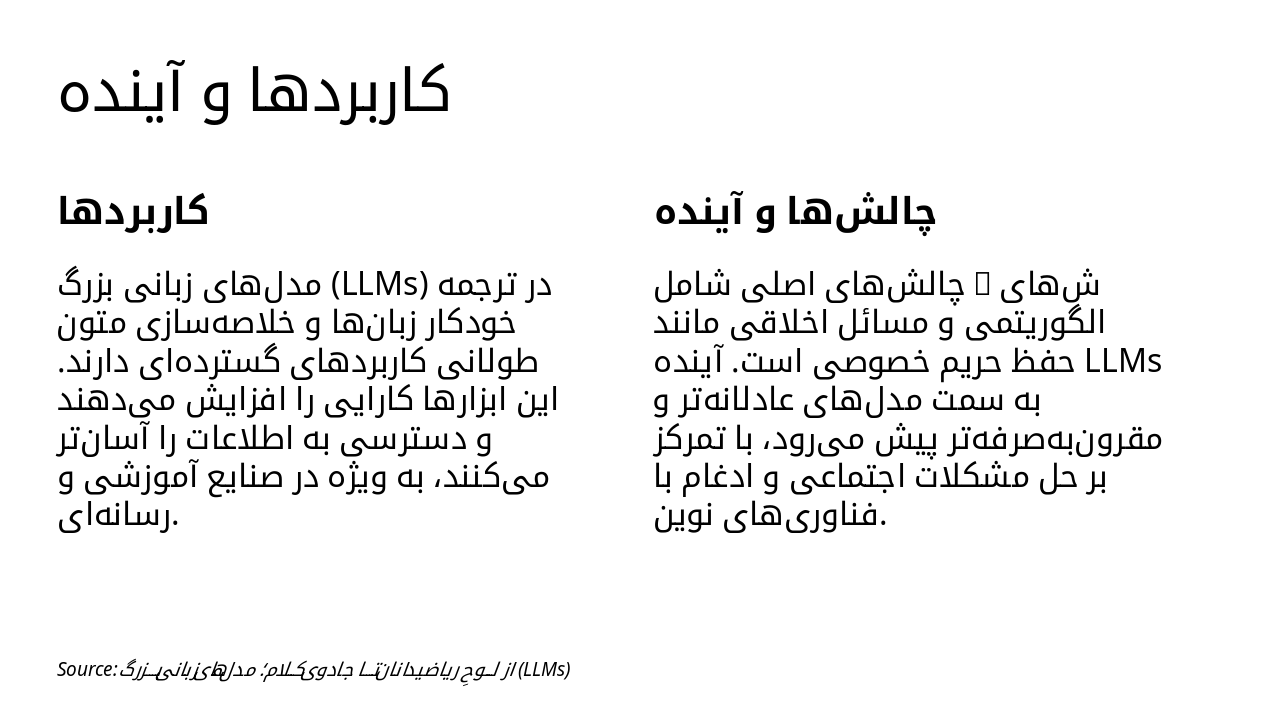
کاربردها و آینده

کاربردهاچالش‌ها و آینده
مدل‌های زبانی بزرگ (LLMs) در ترجمه خودکار زبان‌ها و خلاصه‌سازی متون طولانی کاربردهای گسترده‌ای دارند. این ابزارها کارایی را افزایش می‌دهند و دسترسی به اطلاعات را آسان‌تر می‌کنند، به ویژه در صنایع آموزشی و رسانه‌ای.چالش‌های اصلی شامل偏ش‌های الگوریتمی و مسائل اخلاقی مانند حفظ حریم خصوصی است. آینده LLMs به سمت مدل‌های عادلانه‌تر و مقرون‌به‌صرفه‌تر پیش می‌رود، با تمرکز بر حل مشکلات اجتماعی و ادغام با فناوری‌های نوین.

Source: از لوحِ ریاضیدانان تا جادوی کلام؛ مدل‌های زبانی بزرگ (LLMs)

Speaker Notes
توضیح کاربردهای عملی LLMs مانند ترجمه و خلاصه‌سازی در ستون چپ، و چالش‌های اخلاقی مانند偏ش در ستون راست. پیشنهاد تصویر: آیکون‌های کاربردی مانند globe برای ترجمه و warning برای چالش‌ها.
Slide 17 - کاربردها و آینده

Discover More Presentations

Explore thousands of AI-generated presentations for inspiration

Browse Presentations
Powered by AI

Create Your Own Presentation

Generate professional presentations in seconds with Karaf's AI. Customize this presentation or start from scratch.

Create New Presentation

Powered by Karaf.ai — AI-Powered Presentation Generator