John Dalton: Father of Modern Atomic Theory

Generated from prompt:

John Dalton

Explore the life and scientific legacy of John Dalton (1766–1844), covering his early education, meteorological observations, revolutionary atomic theory, research on color blindness, and lasting impact on chemistry and physics.

April 29, 20267 slides
Slide 1 of 7

Slide 1 - John Dalton Biography

John Dalton (1766–1844)

The Life and Scientific Contributions of the Father of Modern Atomic Theory
Slide 1 - John Dalton Biography
Slide 2 of 7

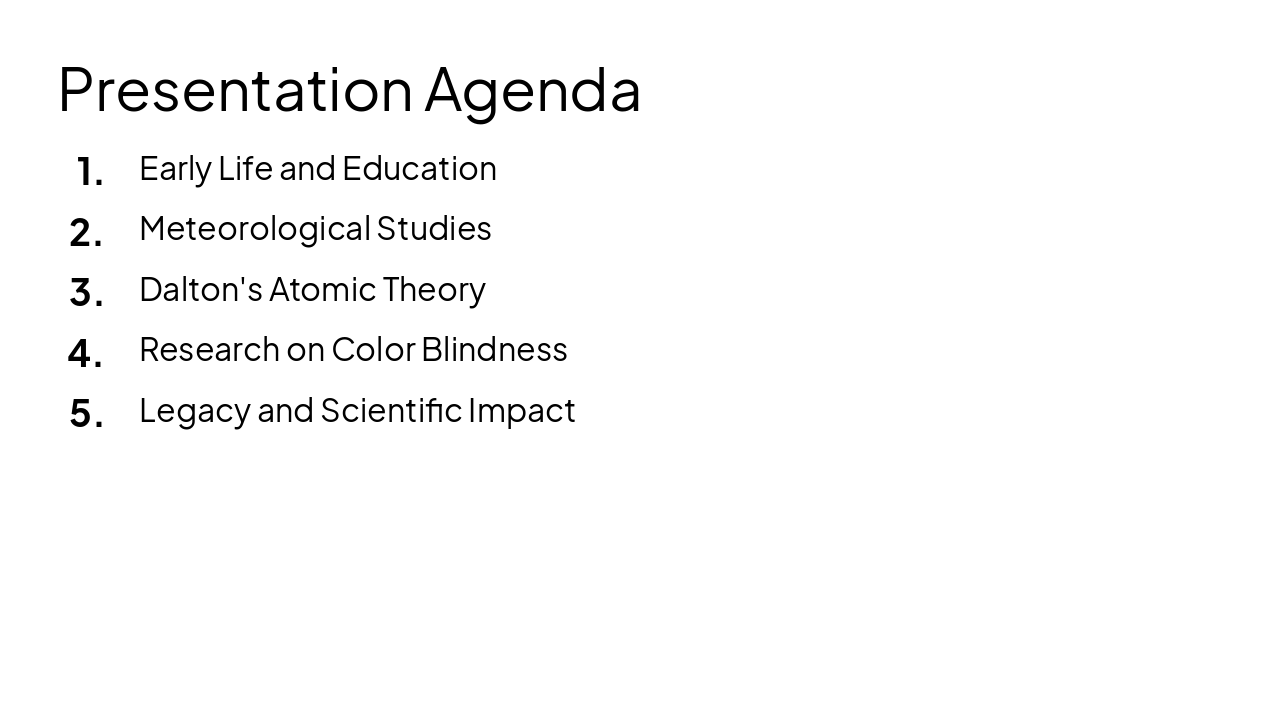
Slide 2 - Presentation Agenda

  • Early Life and Education
  • Meteorological Studies
  • Dalton's Atomic Theory
  • Research on Color Blindness
  • Legacy and Scientific Impact
Slide 2 - Presentation Agenda
Slide 3 of 7

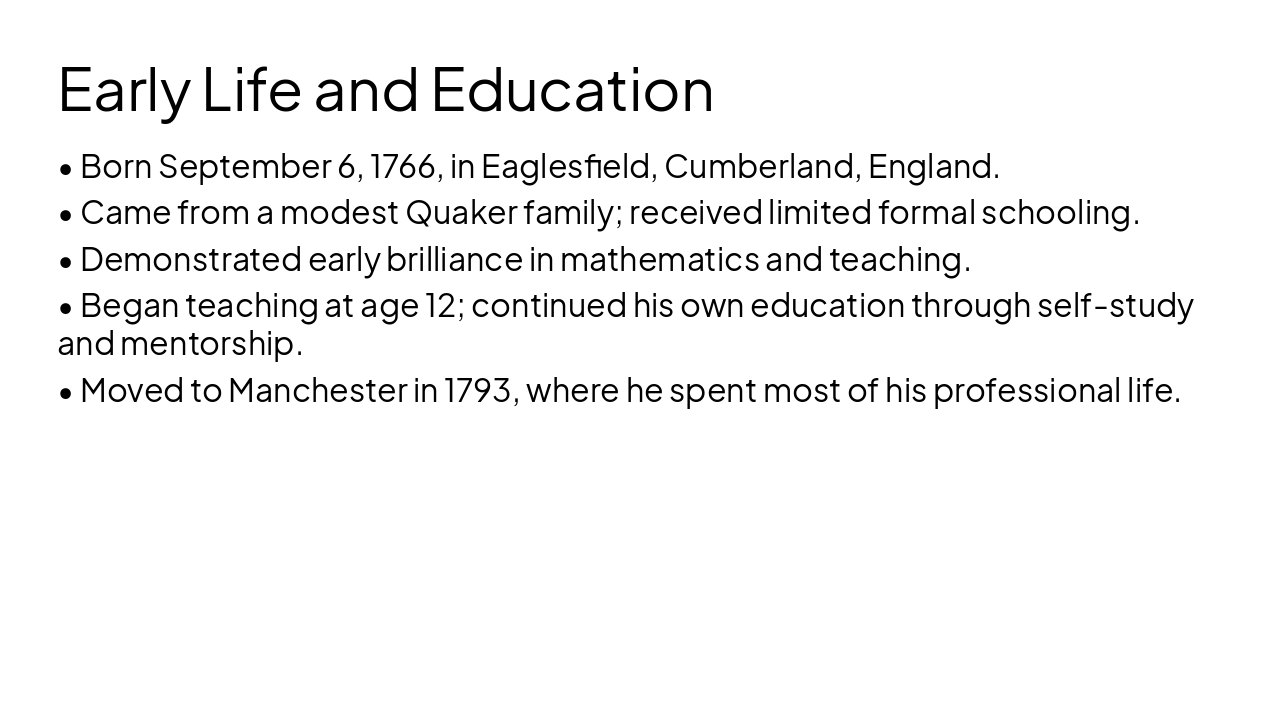
Slide 3 - Early Life and Education

  • Born September 6, 1766, in Eaglesfield, Cumberland, England.
  • Came from a modest Quaker family; received limited formal schooling.
  • Demonstrated early brilliance in mathematics and teaching.
  • Began teaching at age 12; continued his own education through self-study and mentorship.
  • Moved to Manchester in 1793, where he spent most of his professional life.
Slide 3 - Early Life and Education
Slide 4 of 7

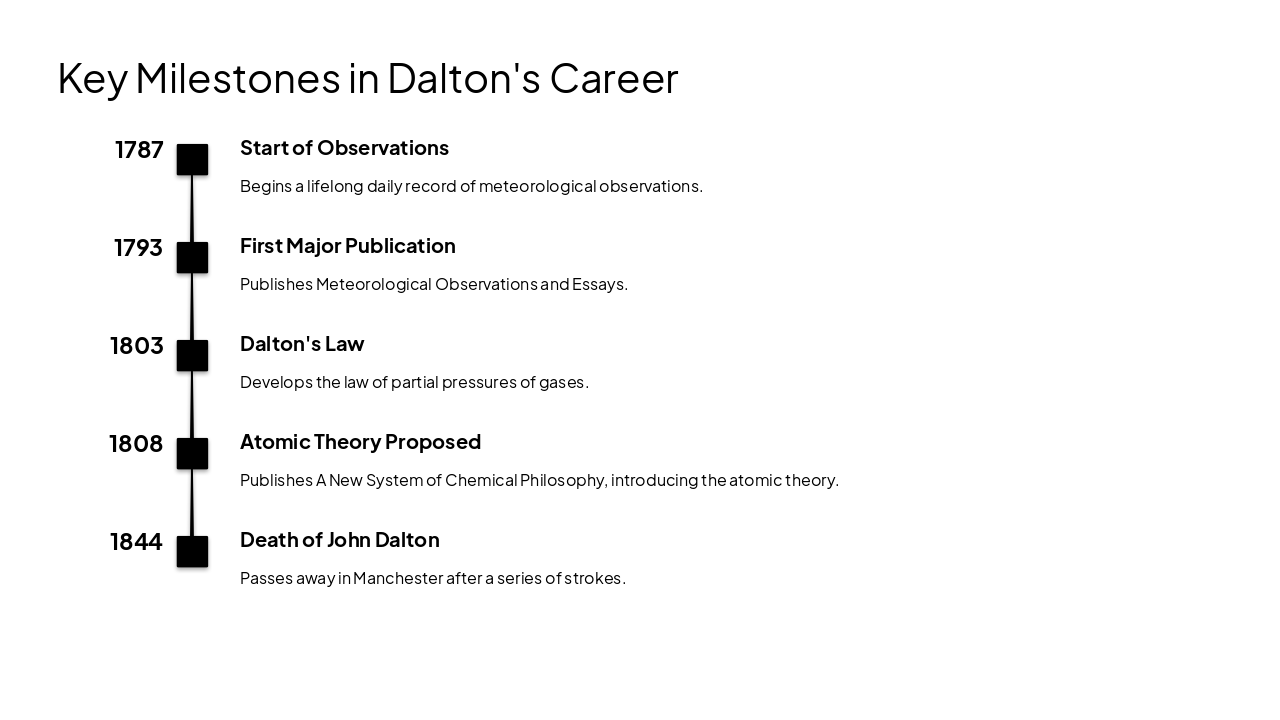
Slide 4 - Key Milestones in Dalton's Career

1787: Start of Observations Begins a lifelong daily record of meteorological observations. 1793: First Major Publication Publishes Meteorological Observations and Essays. 1803: Dalton's Law Develops the law of partial pressures of gases. 1808: Atomic Theory Proposed Publishes A New System of Chemical Philosophy, introducing the atomic theory. 1844: Death of John Dalton Passes away in Manchester after a series of strokes.
Slide 4 - Key Milestones in Dalton's Career
Slide 5 of 7

Slide 5 - Dalton's Atomic Theory

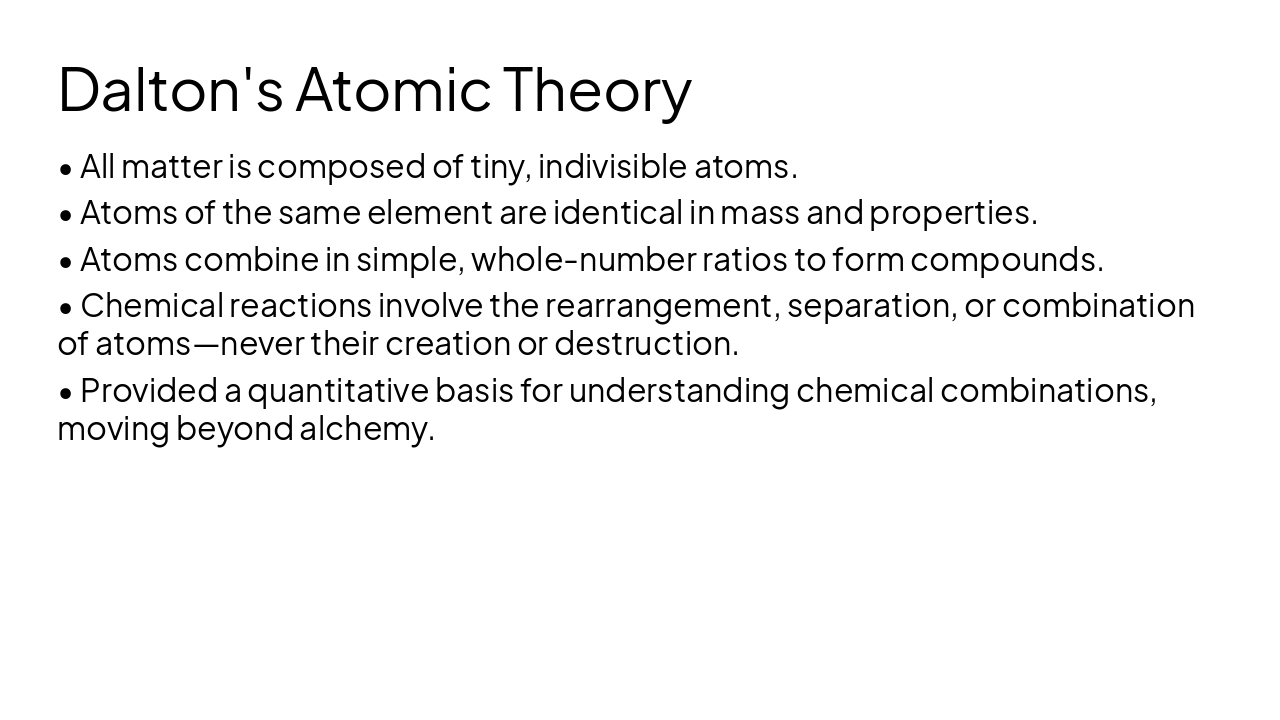
  • All matter is composed of tiny, indivisible atoms.
  • Atoms of the same element are identical in mass and properties.
  • Atoms combine in simple, whole-number ratios to form compounds.
  • Chemical reactions involve the rearrangement, separation, or combination of atoms—never their creation or destruction.
  • Provided a quantitative basis for understanding chemical combinations, moving beyond alchemy.
Slide 5 - Dalton's Atomic Theory
Slide 6 of 7

Slide 6 - Reflections on Matter

> Every form of matter is composed of small particles, the ultimate particles of all homogeneous bodies are perfectly alike in weight, figure, etc.

— John Dalton
Slide 6 - Reflections on Matter
Slide 7 of 7

Slide 7 - Legacy and Impact

John Dalton's work remains the bedrock of modern chemical science.

Paving the way for 19th and 20th-century physics and chemistry.
Slide 7 - Legacy and Impact

Discover More Presentations

Explore thousands of AI-generated presentations for inspiration

Browse Presentations
Powered by AI

Create Your Own Presentation

Generate professional presentations in seconds with Karaf's AI. Customize this presentation or start from scratch.

Create New Presentation

Powered by Karaf.ai — AI-Powered Presentation Generator