Unlocking QuickCheck for Haskell Testing

Generated from prompt:

Quick test presentation

This presentation introduces QuickCheck, a Haskell tool that automates test case generation and focuses on property-based testing. It covers core concepts, development history, impact stats, and pract

November 9, 20259 slides
Slide 1 of 9

Slide 1 - Introduction to QuickCheck

This title slide introduces QuickCheck, a tool for efficient test case generation in Haskell. The subtitle highlights the focus on exploring this functionality.

Introduction to QuickCheck

Exploring Efficient Test Case Generation in Haskell

Source: Quick test presentation

Speaker Notes
A software library for property-based testing in Haskell. Explore its role in generating test cases efficiently.
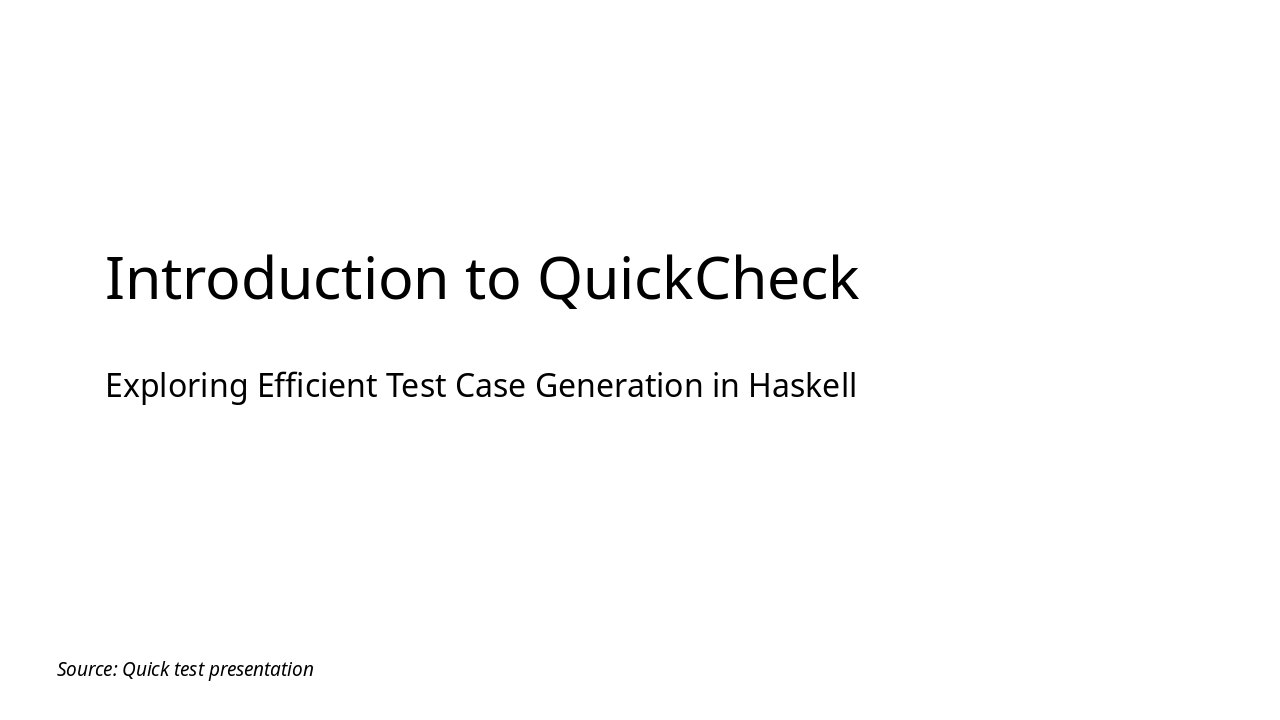
Slide 1 - Introduction to QuickCheck
Slide 2 of 9

Slide 2 - Presentation Agenda

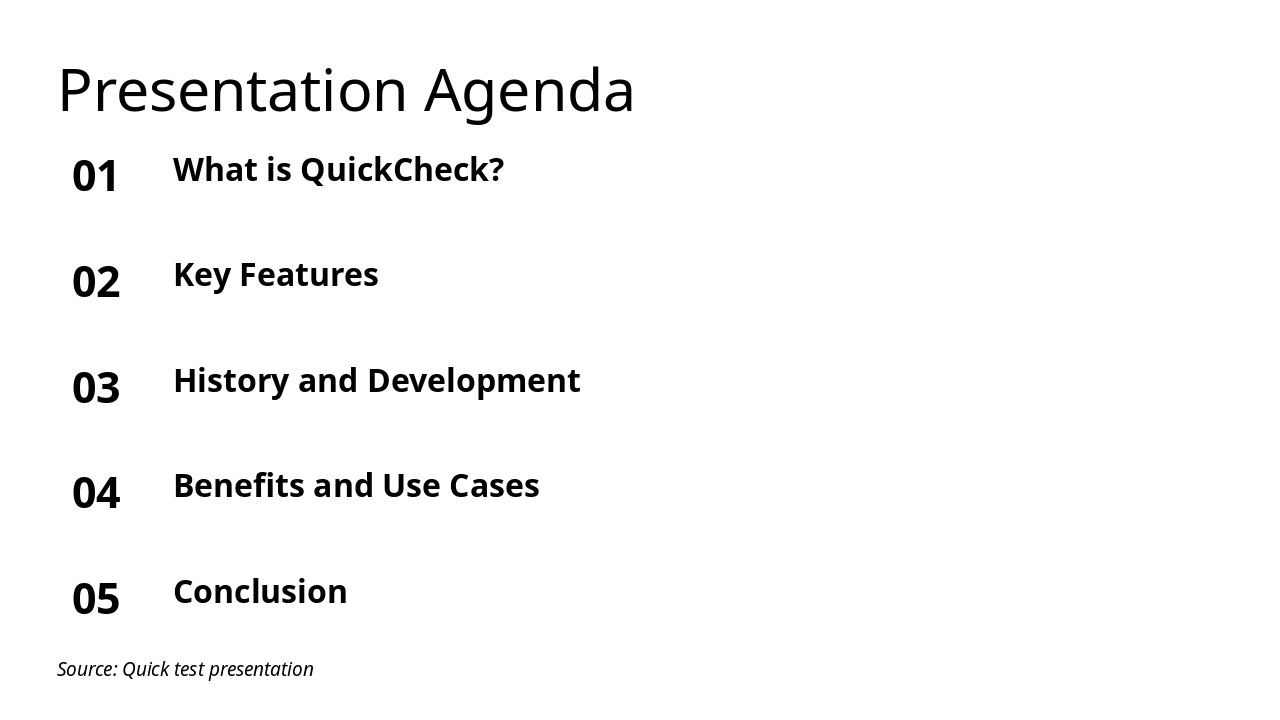
The slide outlines the agenda for a presentation on QuickCheck, listing key sections to cover. These include an introduction to what QuickCheck is, its key features, history and development, benefits and use cases, and a conclusion.

Presentation Agenda

  1. What is QuickCheck?
  2. Key Features
  3. History and Development
  4. Benefits and Use Cases
  5. Conclusion

Source: Quick test presentation

Slide 2 - Presentation Agenda
Slide 3 of 9

Slide 3 - What is QuickCheck?

This slide serves as a section header titled "What is QuickCheck?" and is numbered as section 02. It introduces QuickCheck as a combinator library in Haskell designed for property-based software testing.

What is QuickCheck?

02

What is QuickCheck?

A combinator library in Haskell for property-based software testing.

Source: Quick test presentation

Slide 3 - What is QuickCheck?
Slide 4 of 9

Slide 4 - Core Concepts

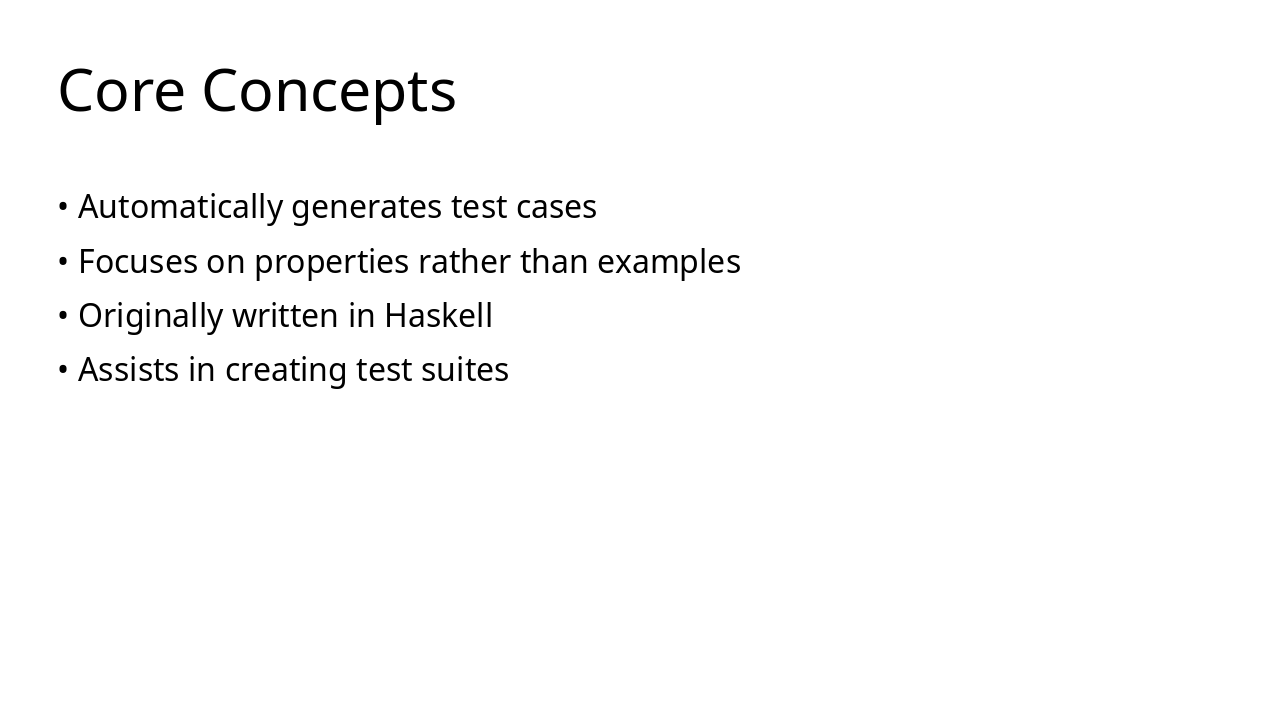
The slide titled "Core Concepts" outlines key features of a tool that automatically generates test cases by focusing on properties instead of specific examples, originally implemented in Haskell. It emphasizes how this approach assists in building effective test suites for software development.

Core Concepts

  • Automatically generates test cases
  • Focuses on properties rather than examples
  • Originally written in Haskell
  • Assists in creating test suites
Slide 4 - Core Concepts
Slide 5 of 9

Slide 5 - Developer Insight

This slide, titled "Developer Insight," features a quote from QuickCheck creators Koen Claessen and John Hughes. They describe how QuickCheck transforms abstract properties into concrete, executable tests, making software testing enjoyable and highly efficient.

Developer Insight

> QuickCheck revolutionizes software testing by transforming abstract properties into concrete, executable tests, making the process both enjoyable and remarkably efficient.

— Koen Claessen and John Hughes, Creators of QuickCheck

Source: QuickCheck Original Creators

Slide 5 - Developer Insight
Slide 6 of 9

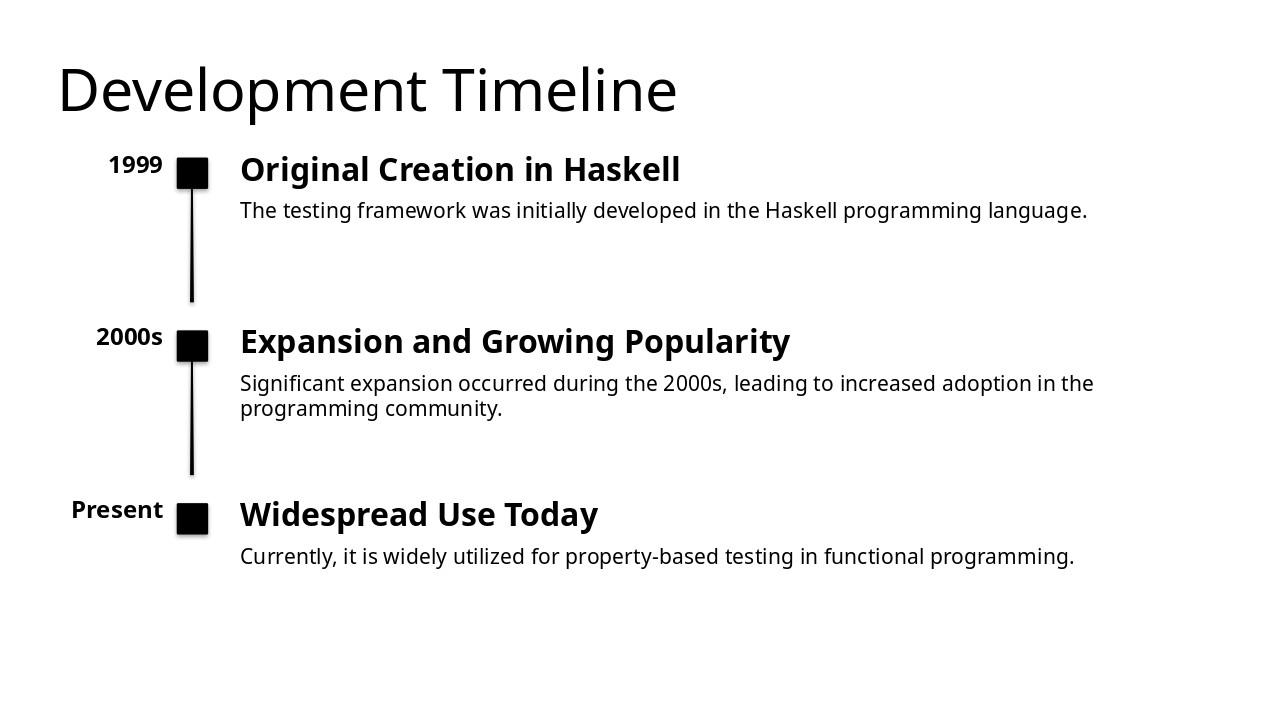
Slide 6 - Development Timeline

The testing framework originated in 1999 with its creation in the Haskell programming language. It expanded significantly during the 2000s, gaining popularity in the programming community and achieving widespread use today for property-based testing in functional programming.

Development Timeline

1999: Original Creation in Haskell The testing framework was initially developed in the Haskell programming language. 2000s: Expansion and Growing Popularity Significant expansion occurred during the 2000s, leading to increased adoption in the programming community. Present: Widespread Use Today Currently, it is widely utilized for property-based testing in functional programming.

Slide 6 - Development Timeline
Slide 7 of 9

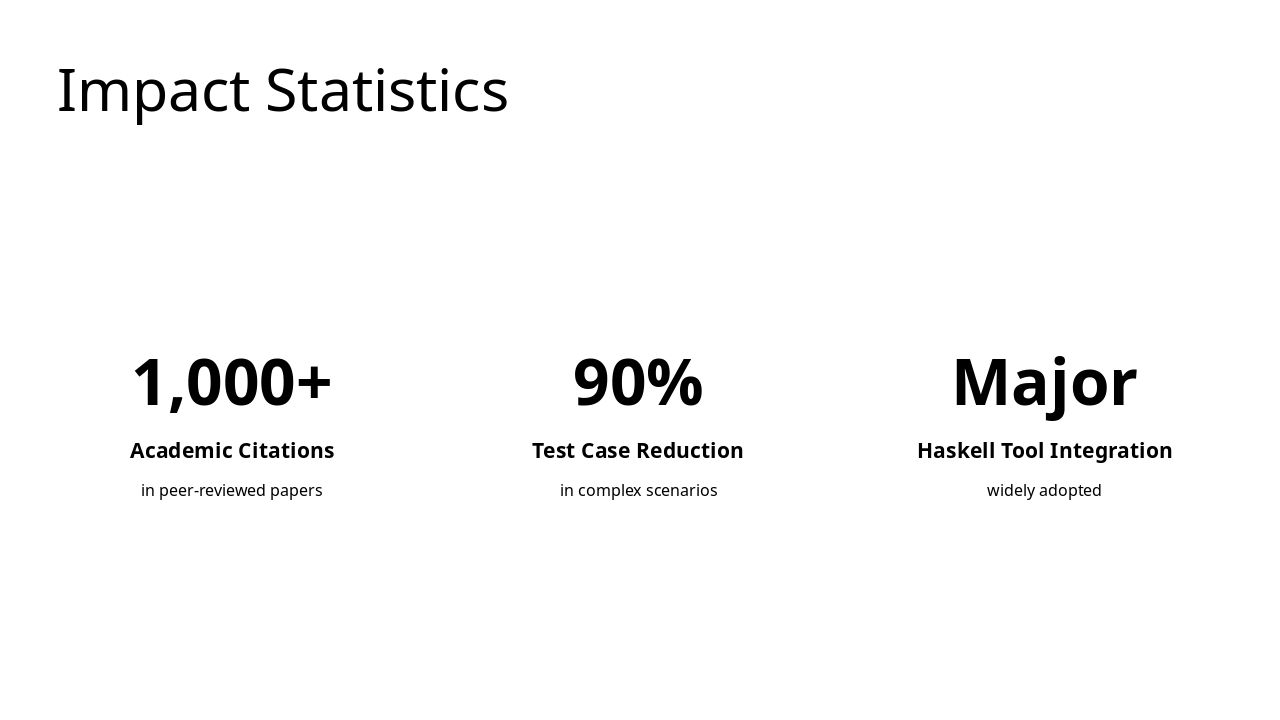
Slide 7 - Impact Statistics

The Impact Statistics slide highlights key achievements, including over 1,000 academic citations in peer-reviewed papers. It also showcases a 90% reduction in test cases for complex scenarios and major, widely adopted integration with Haskell tools.

Impact Statistics

  • 1,000+: Academic Citations
  • in peer-reviewed papers

  • 90%: Test Case Reduction
  • in complex scenarios

  • Major: Haskell Tool Integration
  • widely adopted

Slide 7 - Impact Statistics
Slide 8 of 9

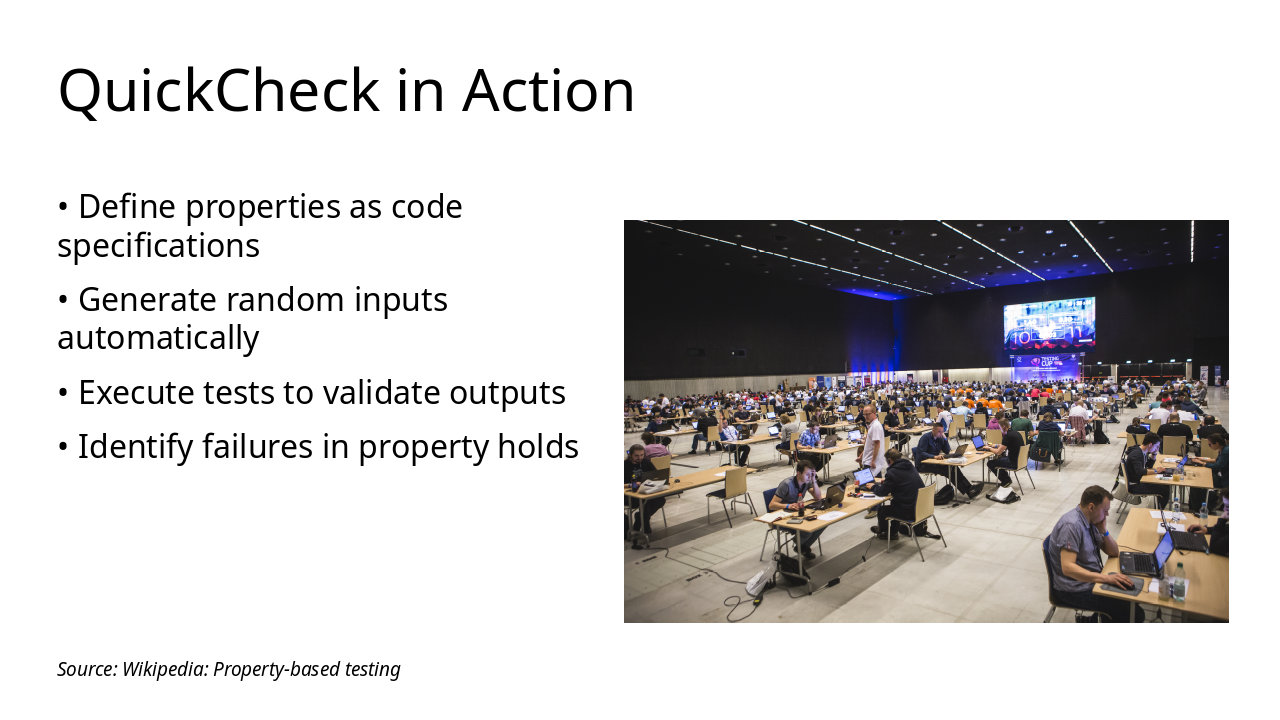
Slide 8 - QuickCheck in Action

The slide "QuickCheck in Action" illustrates the process of property-based testing through an image and key points. It outlines defining properties as code specifications, automatically generating random inputs, executing tests to validate outputs, and identifying failures where properties do not hold.

QuickCheck in Action

!Image

  • Define properties as code specifications
  • Generate random inputs automatically
  • Execute tests to validate outputs
  • Identify failures in property holds

Source: Wikipedia: Property-based testing

Speaker Notes
Diagram of property generation process, showing input properties to random test outputs. Context: Quick test presentation
Slide 8 - QuickCheck in Action
Slide 9 of 9

Slide 9 - Wrapping Up

The conclusion slide, titled "Wrapping Up," encourages embracing QuickCheck to enhance robust testing in Haskell. It urges immediate integration of property-based testing while suggesting exploration of Wikipedia and official documentation for more details.

Wrapping Up

Embrace QuickCheck for Robust Haskell Testing

Integrate property-based testing today—explore Wikipedia and official docs.

Source: QuickCheck Presentation

Speaker Notes
QuickCheck revolutionizes testing in Haskell. Adopt property-based testing for robust software. Resources: Wikipedia and official docs.
Slide 9 - Wrapping Up

Discover More Presentations

Explore thousands of AI-generated presentations for inspiration

Browse Presentations
Powered by AI

Create Your Own Presentation

Generate professional presentations in seconds with Karaf's AI. Customize this presentation or start from scratch.

Create New Presentation

Powered by Karaf.ai — AI-Powered Presentation Generator